Sharing a Forest Trail With Horses
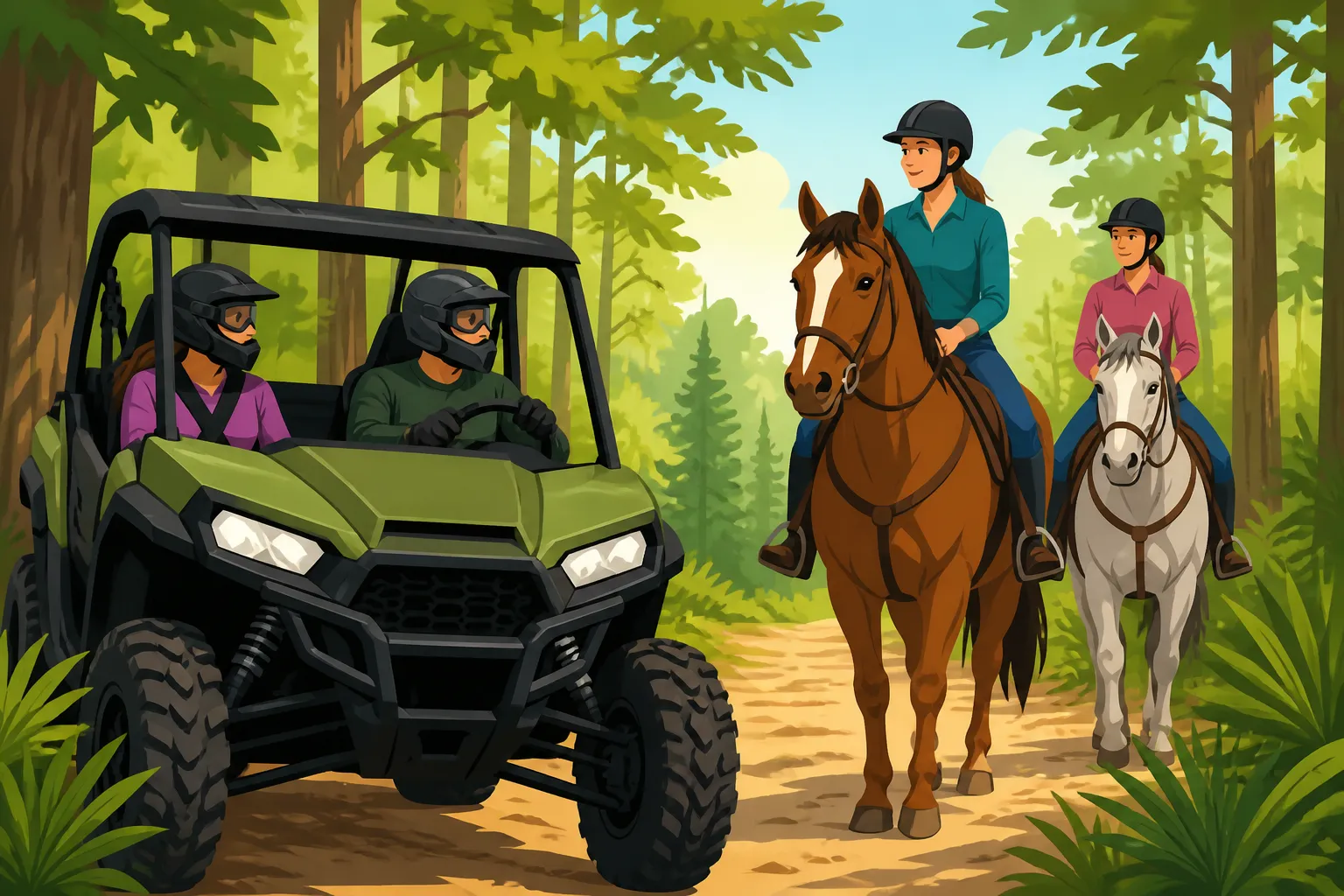
A quiet forest ride can turn tense in seconds when an ATV rounds a bend and meets a horse. Horses may spook at engine noise, sudden movement, or a machine they cannot place, while riders may have little room to turn around. This guide explains how to approach, pass, and plan around horses on Louisiana forest trails.
Before You Ride a Louisiana Forest Trail
Confirm the trail is open to your machine and other users
“Forest trail” does not automatically mean every trail is open to every kind of recreation. Before unloading near Kisatchie National Forest, Sandstone, or another riding area, check the specific trail’s current designation, permitted uses, closures, and access requirements. A trail that allows motorized riding may have restrictions on vehicle type, season, or route. Equestrian access can also vary by location, so don’t assume horses are allowed everywhere—or that a trail is motorized simply because you see tire tracks.
Start with the managing agency’s official information and posted signs at the trailhead. If the map, sign, or trail-status page is unclear, choose a different route or contact the land manager before riding. A phone map can help you understand where you are, but it does not override a closure or authorize access. For general trail preparation, see Checking a Trail Status Page First and [Louisiana Forest Trail Use Passes].
A little planning also prevents the uncomfortable moment when riders meet at a junction and neither knows whether the other belongs there. Check what uses are allowed before you go, and make sure everyone in your group understands the route. If you use onX Offroad to plan, treat it as a navigation aid rather than the final word on access; compare what you see in the app with current official trail information and signs on the ground.
Prepare for narrow routes, blind corners, and weak cell service
Forest trails can be enclosed by brush, trees, and uneven ground. On a winding trail, a horse and ATV may not see each other until they are close. Dust, vegetation, and engine noise can make it harder to judge where another trail user is coming from. Slow down before bends, keep to a speed that lets you stop within the visible trail, and be ready for someone approaching from the other direction.
Route planning matters most when a trail is unfamiliar. Look at the route before setting out, note intersections and possible turnarounds, and avoid choosing a narrow spur just because it looks like a shortcut. onX Offroad can help you review a route before you ride; if you rely on a phone for navigation, prepare for areas where reception is unreliable by saving the information you’ll need ahead of time. A paper map is a useful backup in the woods, especially if your phone battery is low or the screen is difficult to read in bright light. See Carrying a Paper Map in the Forest.
Tell your group where you plan to ride and when you expect to return. Bring water, basic first aid supplies, and a charged phone, but don’t count on being able to call for help from every trail. If conditions have changed after rain or a storm, reassess the route rather than pushing ahead because it was on yesterday’s plan. Louisiana Trail Conditions After Rain offers more on deciding when a route may no longer be suitable.
Set a group pace that leaves room to react
A group ride can get noisy quickly when several machines accelerate, stop, and bunch together. When horses may be on the route, ride in a controlled line and leave space between machines. That gives each rider a better chance to stop smoothly if the person ahead slows down or encounters an animal.
Agree on simple signals before leaving the staging area. Riders should know how the lead person will indicate a stop, a hazard, or an approaching trail user. Avoid revving engines to catch up or crowding the machine ahead. If one rider needs extra time to pass a horse, everyone behind should wait rather than creating pressure to hurry.
Choose a pace that suits the least experienced rider in your group, not the person who knows the trail best. For additional preparation, Louisiana Trail Difficulty Ratings can help you think about whether a route matches your group’s ability. Good planning is not just about avoiding a breakdown; it gives you options when the trail becomes crowded, muddy, or unexpectedly shared.
How to Approach a Horse Safely
Slow down early and give the horse time to notice you
When you see a horse ahead, reduce speed well before you reach it. Avoid a sudden stop close behind the animal, and don’t accelerate toward it to get past quickly. A horse may interpret an unfamiliar engine as a threat, and an abrupt burst of noise or movement can startle it. The horse may shy sideways, turn around, or move unpredictably—creating danger for the rider and anyone nearby.
If you can stop at a safe distance, do so. Keep your ATV or UTV steady, avoid unnecessary throttle, and wait for the horse rider to acknowledge you. Do not assume the horse has noticed your machine just because the rider has looked back. Give the rider time to assess the situation and tell you how they would like to proceed.
If the horse seems tense, restless, or difficult to control, stay put and let the rider manage the encounter. A calm pause is usually safer than trying to squeeze through. You are not wasting the group’s day by waiting a few minutes; you are preventing a close pass from turning into an injury or a loose horse on a trail.
Communicate clearly without adding noise
Once you have stopped, communicate in a calm, ordinary voice. A brief greeting or “Would you like me to wait here?” gives the rider a chance to respond without startling the horse with shouting. Avoid honking, revving the engine, playing loud music, or making sudden gestures. Don’t assume that a rider’s silence means “go ahead”; they may be focusing on keeping the horse settled.
Follow the rider’s directions when they can safely guide the pass. Some riders may prefer that you remain still while they lead the horse past. Others may want you to move slowly to a wider spot. The horse and rider are best placed to judge how the animal is responding, so ask rather than guessing.
If you are riding in a group, communicate the plan to everyone before moving. A lead rider should make sure the rest of the group understands whether to wait, move, or shut off engines if it is safe to do so. Keep chatter, gestures, and movement controlled. The aim is to make the ATV’s behavior predictable, not to attract the horse’s attention with a lot of activity.
Pass only when there is room and the rider is ready
Never try to squeeze a machine between a horse and the edge of a narrow trail. If the route is too tight, wait for a wider section or follow the rider’s request. Don’t ride off the trail into vegetation or soft ground without checking whether it is safe and permitted; a machine can damage the trail, get stuck, or create a new hazard.
When the rider says the horse is settled and a pass is appropriate, move slowly and steadily. Keep as much distance as the trail allows, avoid sudden steering, and don’t stop beside the horse unless the rider asks you to. Pass one machine at a time if the group is large, leaving a gap so the horse is not suddenly surrounded by several vehicles.
After passing, continue at a restrained speed until you are well clear. Do not gun the engine as soon as you get ahead. If the trail is narrow and you cannot pass safely, back up carefully to a suitable turnout if that can be done without putting anyone at risk. For practical guidance on meeting another trail user in a tight spot, read Yielding on a Narrow Forest Trail.
| Situation | Safer response | Avoid |
|---|---|---|
| You spot a horse ahead | Slow down early and stop at a comfortable distance | Riding close behind or accelerating to catch up |
| The horse appears unsettled | Stay still, keep noise low, and let the rider decide | Honking, revving, or making abrupt movements |
| The trail is too narrow to pass | Wait or move to a wider, safe location as directed | Squeezing between the horse and trail edge |
| The rider signals that passing is safe | Pass slowly, steadily, and with as much room as possible | Passing several machines as a tight cluster |
| You meet a horse around a blind bend | Stop, create space, and communicate calmly | Reversing quickly or turning around without checking |
Trail Etiquette While Sharing Space
Make your movements predictable
Trail etiquette is not only about yielding. It is also about being easy to read. Sudden speed changes, sharp turns, and loud bursts of throttle can surprise horses and other trail users. Stay alert for hoofprints, voices, parked trailers, or movement through the trees, and slow down when you approach places where people may be out of sight.
Keep the machine under control and stay on the route. Cutting a corner can make you appear suddenly in front of a horse. Riding through puddles or muddy patches at speed can throw water and debris toward people or animals. If visibility is poor because of dust, wait for it to settle rather than continuing into an area you cannot see clearly.
Be especially careful near trailheads, shared staging areas, and intersections, where horses may be mounting or dismounting. A rider handling a horse on the ground may need extra room. Don’t park in a way that blocks a gate, access route, or space needed to manage the animal. Local expectations and signs matter; Louisiana Trail Etiquette Locals Expect is a helpful companion for thinking through respectful trail behavior.
Keep dogs, passengers, and other distractions under control
A dog running loose beside an ATV can be startling to a horse and difficult for its owner to control. Keep pets secured and follow the riding area’s rules. Passengers should stay seated and avoid sudden movements, shouting, or reaching toward an animal. If a child is riding along, explain beforehand that the group may need to stop quietly and wait.
Avoid trying to feed, touch, or photograph a horse without permission. Even a well-meaning approach can put the rider in a difficult position or make the animal uneasy. Give the horse and rider a clear path, and do not treat the encounter as an opportunity to get closer for a better look.
If you see a horse rider ahead and your group has a noisy or modified machine, make the encounter more controlled rather than assuming the horse will tolerate it. Stop well back, reduce unnecessary noise, and let the rider set the pace of the interaction. A considerate pause is usually less disruptive than a rushed pass followed by a startled animal.
Be willing to change your route
Sometimes the safest option is to wait, turn around, or take another trail. That can be frustrating when you have driven a long way to ride or are trying to keep a group on schedule. Still, a trail is shared space, and a horse may need more room than the route provides. If the rider cannot safely move aside and there is no wide passing area, don’t pressure them to make the encounter work for your convenience.
A flexible plan helps. Before your trip, identify alternate routes and a few places where your group can safely stop. Use onX Offroad or another mapping tool to think through route options, but confirm permitted use and closures with official information. Keep a paper map as a backup in case a phone loses power or reception.
If trail conditions or congestion make the route feel unsafe, call it early. Turning around before a difficult encounter is better than trying to improvise on a steep, muddy, or narrow section. For broader planning advice, Louisiana Trail Difficulty Ratings and Checking a Trail Status Page First can help you choose a route that fits the day rather than forcing a plan that no longer makes sense.
What to Do After a Close Call
Give the horse and rider space to recover
If a horse spooks, stop moving and let the rider regain control. Do not follow the animal if it moves away, and do not crowd the rider while they are managing it. Keep other machines back and ask whether help is wanted. The rider may need a moment to settle the horse before deciding whether to continue.
If anyone is injured, prioritize immediate safety and contact emergency services when possible. Be clear about your location, the trail name or nearest access point, and the nature of the incident. Forest roads and trail networks can be difficult to describe, so noting intersections and landmarks during your ride can help.
After a frightening encounter, give the rider room even if there was no collision. A horse may remain unsettled, and a second pass too soon can restart the problem. Wait for the rider to indicate that it is safe to move on, or choose another route.
Learn from the encounter without blaming the other user
Once everyone is safe, think about what could be changed next time. Perhaps the group was moving too quickly around blind bends, the route was busier than expected, or the lead rider did not communicate a stop. The useful question is not who had the right of way in an informal encounter; it is how the group can make its behavior safer and more predictable.
If signage was missing, confusing, or inconsistent with the posted trail information, report the issue to the land manager. Stick to specific details, such as the trail name, location, date, and what was unclear. Don’t post private information about another trail user or turn a close call into an online argument.
You can also look for local trail work or stewardship opportunities. Louisiana Trail Volunteer Days is a useful topic to explore if you want to support well-maintained, clearly marked trails. Better signs and shared expectations can make future encounters easier for riders, horse users, and everyone else using the forest.
Disclaimer
This article is for general informational purposes only and does not constitute professional advice. Laws, prices and regulations vary by location and change over time. Consult a qualified professional for guidance on your specific situation.