Louisiana Trail Conditions After Rain
A Louisiana ride can change quickly after a downpour: a firm pine-forest trail turns slick, a shallow-looking rut hides standing water, or an access road becomes too soft to tow across safely. This guide explains how to assess trail conditions after rain, where to check for closures, and how to decide whether to ride, wait, or choose a different area.
Why Rain Changes Louisiana Trail Conditions
Clay, sand, and standing water behave differently
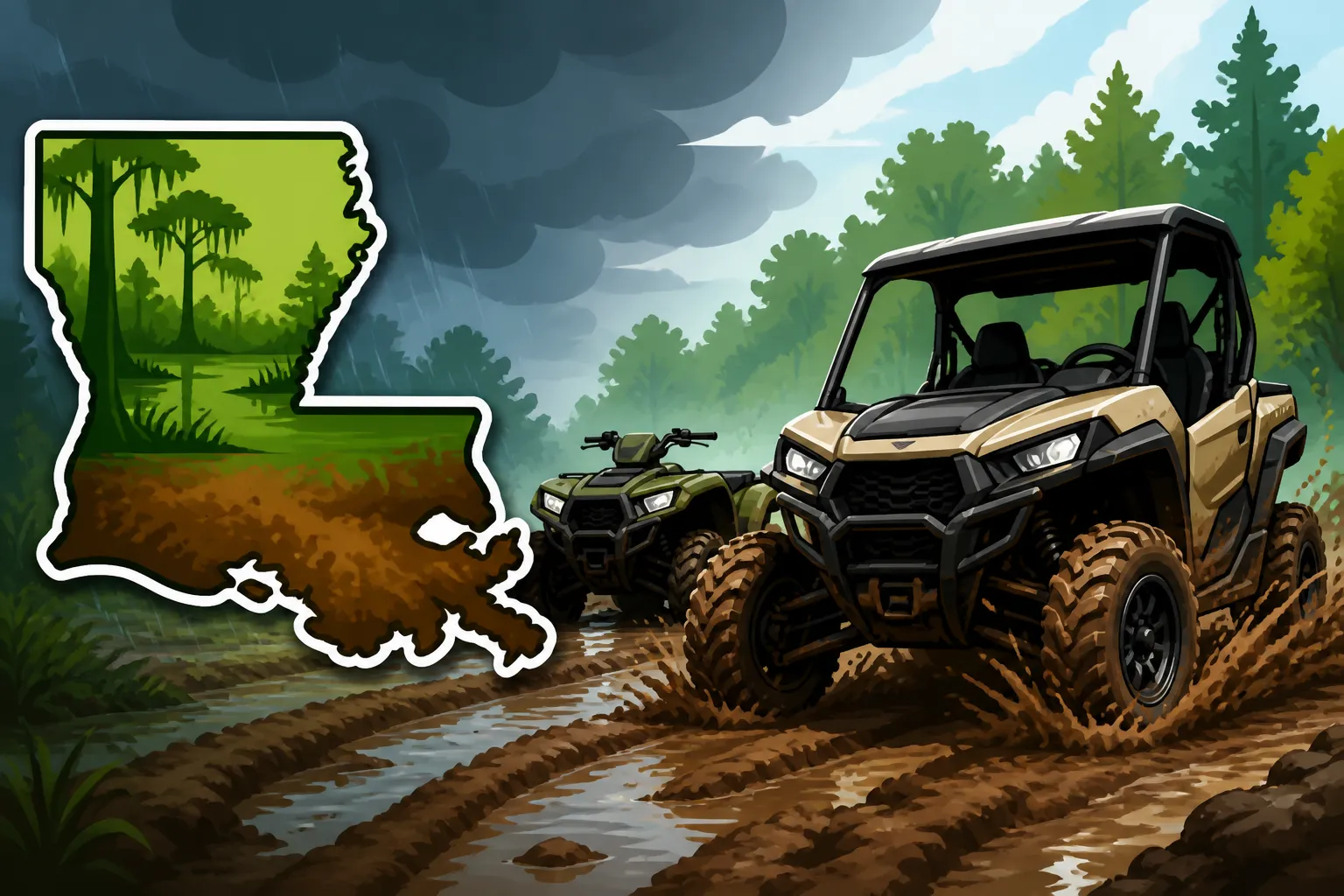
Louisiana trails don’t all respond to rain in the same way. Sandy stretches may drain relatively quickly, while clay-heavy soil can stay slick long after the rain has stopped. That contrast can catch riders off guard: the trailhead may feel manageable, but a shaded low spot farther in can still be greasy and deeply rutted.
In the piney woods, water can collect where the ground dips or where a trail crosses a drainage. A rut that looks like a simple puddle may hide a firm bottom, loose sand, or a hole deep enough to stop a machine. On flat ground, standing water can linger because it has nowhere to run. These conditions are especially hard to judge when you’re following someone else’s tire tracks.
Rain also changes the approach roads and parking areas, not just the trails. A truck and trailer may be able to reach a trailhead on a dry day but struggle on a saturated access road. If your tow vehicle starts spinning, avoid making repeated attempts that dig deeper holes or damage the road. Check access conditions as well as riding conditions before loading up.
The trail can be worse than the weather forecast suggests
A forecast describes weather over an area; it doesn’t tell you how much rain fell on a specific trail or how quickly that site drains. A passing shower near your home may have missed the riding area entirely, while overnight rain several parishes away may have left the trail network soaked. Local reports and official trail-status information are more useful than a broad forecast alone.
Timing matters, too. Rain that falls on already-wet ground can have a bigger effect than the same amount after a long dry spell. The sun, shade, wind, soil, slope, and drainage all affect how quickly a route firms up. Even neighboring sections of the same trail can vary, so don’t assume a single dry-looking entrance means the entire network is ready.
If conditions are uncertain, treat the first mile as a cautious assessment rather than a commitment to a full-day ride. Notice whether tires are cutting deep grooves, whether water is draining across the trail, and whether your machine can turn around without chewing up the surface. For broader planning, see Louisiana ATV Trails: Where to Ride and Louisiana Trail Closures and Seasons.
How to Check Conditions Before You Tow
Start with the land manager or park operator
Before leaving home, look for a current notice from the agency or private park responsible for the riding area. A route may be closed because of rain, maintenance, seasonal restrictions, or damage even when the entrance looks open. For public land, check the official land-manager information for the specific trail system rather than relying on a general map or an old social post.
For Kisatchie National Forest, confirm the current status of the particular OHV area or trail you intend to visit. Conditions at one forest location don’t automatically describe another. The same goes for Sandstone and Vernon Enduro: their trail surfaces, access roads, operating rules, and closures can differ. Start with Kisatchie National Forest OHV Trails in Louisiana when planning a forest ride, then verify the latest instructions directly with the relevant land manager.
Private riding parks may share updates through their own websites or social channels, but check that a post applies to the date you plan to arrive. A photo from last weekend isn’t a reliable report for today, especially after more rain. If the information is unclear, contact the operator before towing. For more on what to verify, see [Checking a Trail Status Page First] and [Louisiana Trail Closures After a Storm].
Use maps for orientation, not as proof that a trail is open
A mapping app can help you understand where trails, roads, and access points are, but a route displayed on a map isn’t proof that it is open, passable, or appropriate for your machine. Check that your planned route is within an authorized riding area and that no current closure or seasonal restriction applies. A track recorded by another rider may be old, unofficial, or unsuitable after rain.
onX Offroad can be useful for reviewing mapped routes and preparing navigation before you lose reliable cell service. Download or save what you need in advance if the app supports offline use for your setup, and make sure you know how to find your position without depending on a strong signal. Still, treat the official land manager or park operator as the authority on closures and access.
A practical routine is to compare three things before you leave: the official status notice, the weather around the riding area, and your planned route on a map. onX Offroad may help with the route-planning piece, but it can’t tell you whether a recently soaked trail has become unsafe or whether a gate has closed. If you use it, keep a second navigation option, such as a saved paper map or another device, in case your phone battery or reception becomes a problem.
| What to check | Why it matters after rain | What to do if the answer is unclear |
|---|---|---|
| Official trail or park status | A closure may be in effect even if the weather has cleared | Contact the land manager or park operator |
| Rain near the riding area | Conditions may differ from your home forecast | Check local observations and recent reports |
| Access road and parking conditions | A muddy approach can trap a tow vehicle | Ask about road and staging-area access |
| Route and boundary information | Mapped lines don’t establish permission to ride | Confirm the route is authorized and open |
| Machine and tire suitability | Wet terrain can expose traction or clearance limits | Choose an easier route or postpone |
Ask questions that lead to useful answers
If you call or message a park, ask about the specific things that affect your trip: whether the area is open, whether the access road is passable, which routes are usable, and whether certain machine types should stay off the trails. “Is it muddy?” is understandable, but it may not tell you enough. A staff member might say a park is open while still advising riders to avoid a particular section or low-lying route.
For public trails, ask about the exact unit or trail name rather than asking whether “Kisatchie” is open in general. A large forest can contain different riding areas, roads, and management conditions. If you’re going to Sandstone or Vernon Enduro, check that the information is specific to that riding area and your intended arrival time.
Recent rider reports can add context, especially if they mention when the ride happened and which sections were used. Treat them as observations, not permission or an official status notice. When reports conflict, follow the current official direction and choose the more conservative interpretation. A long tow is frustrating to cancel, but it is worse to arrive at a closed gate or spend the day trying to recover a stuck truck and trailer.
Deciding Whether to Ride, Reroute, or Wait
Read the ground before committing to a route
When you arrive, take a moment to assess the entrance and nearby trail surface. Look for water flowing across the route, fresh tire cuts, deep ruts, soft shoulders, and pooled water that seems to have no clear bottom. If the first section already requires aggressive throttle or repeated wheelspin, conditions may worsen deeper in the network.
Avoid testing an uncertain trail by charging through it. A cautious approach at walking speed gives you a better chance to judge depth and traction, but even a slow test isn’t worth it if the route is marked closed or the ground is visibly deteriorating. Don’t use another rider’s tracks as a guarantee that the surface is safe; their machine, tires, weight, and line may be different from yours.
Set a turnaround point before you start. For example, agree as a group to turn back if the route becomes deeply rutted, if standing water hides the trail edge, or if the recovery gear would be inadequate for the next section. That agreement helps when some riders want to push on simply because they’ve already made the trip.
Match the route to the group and the machine
A short-wheelbase ATV with suitable tires may handle a slick section differently from a loaded side-by-side carrying passengers and gear. Ground clearance, tire condition, drivetrain, vehicle weight, and rider experience all affect how a machine behaves on wet ground. Don’t assume that an easier ride last month means the same trail is manageable after rain.
Group ability matters just as much. If a newer rider is nervous on slippery slopes or around water, choose a route with room to stop and turn around rather than a narrow, muddy track with no easy exit. Experienced riders should resist setting a pace that leaves less confident riders rushing to keep up. A wet-day ride should be more deliberate, not a test of who can go fastest.
Use a conservative rule: if the machine needs repeated momentum to clear ordinary wet patches, the route may be beyond what’s sensible for the day. Winches and recovery straps can help in an emergency, but they don’t make a closed or damaged trail acceptable to ride. Planning for recovery is good preparation; relying on repeated recoveries as the plan is a sign to choose another route.
Know when postponing is the responsible choice
There are days when the right decision is to unload only after conditions improve. If an official closure is in place, follow it. If the access road is too soft, water is crossing the trail, or your group lacks the gear and experience for the conditions, postpone or choose a more suitable riding area. The fact that a machine can push through a section doesn’t mean the trail can take the damage.
This can be especially disappointing when friends have arranged a weekend or you’ve already packed the trailer. It helps to have a backup plan before you leave: another confirmed-open area, a shorter route on firm ground, or a later date. Use the time to inspect the machine, check permits and paperwork, and prepare for your next trip. [Louisiana Trail Etiquette Locals Expect] is also worth reviewing before riding in a group or sharing a busy trail.
A useful distinction is whether the challenge comes from the trail being naturally wet or from the route becoming damaged by traffic. If tires are carving deep channels, widening the trail around puddles, or breaking down the edges, stop and turn back. Those actions can make the route worse for everyone and may contribute to further restrictions. For a broader look at how wet weather affects planning, see [Louisiana Trail Closures After a Storm].
Riding Responsibly on Wet Trails
Protect the trail instead of digging through it
A spinning tire can quickly turn a damp patch into a trench. Use smooth throttle, keep a steady pace, and avoid sudden steering changes where traction is limited. If you lose forward progress, stop and reassess rather than repeatedly accelerating. Backing out carefully or using an appropriate recovery method can cause less harm than digging deeper.
Stay on the established route. Riders sometimes try to go around a puddle through brush, along a soft shoulder, or onto an unmarked path. That can widen the trail, damage plants, and create new tracks that look like unofficial routes. A puddle is not an invitation to create a bypass. If the only way through would damage the trail or put the group at risk, turn around.
Give other riders space and avoid rushing behind someone who is working through a slippery section. Mud can obscure holes, branches, and other hazards, and a machine may slide sideways without warning. If you need to stop, pull over only where the ground is firm and the trail remains clear. On narrow routes, communicate before passing or attempting a recovery so no one is surprised by a moving machine.
Carry equipment for a wet-weather ride
A post-rain ride calls for preparation beyond bringing a winch. Pack a first-aid kit, drinking water, basic tools, a charged phone, and a way to communicate if the group gets separated. A tow strap or recovery equipment should be suitable for your machine and used according to its instructions. Keep hands, feet, and bystanders clear of tensioned recovery gear.
Wear clothing and footwear that can handle water without leaving you cold or uncomfortable for the rest of the day. Bring dry layers for the ride home, especially if the temperature may fall or you expect to be outside for hours. Gloves with a secure grip, eye protection, and a helmet help you stay composed when mud and water start flying. Pack gear so it remains usable if the machine gets wet.
Navigation preparation matters in wooded areas where phone reception may be limited. onX Offroad can help you review a planned route and keep your group oriented, but don’t rely on a single phone as your only safety tool. Tell someone where you’re riding and when you expect to return. In a group, agree on a stopping point if riders become separated, and make sure everyone knows how to signal a problem.
Clean and inspect the machine afterward
Mud and standing water can leave debris in places that are easy to overlook. After the ride, rinse the machine carefully and inspect around the radiator, brakes, wheel wells, underbody, and suspension for packed material. Follow the manufacturer’s maintenance guidance for cleaning and servicing; a quick rinse isn’t a replacement for checking components that may have been exposed to water or grit.
Pay attention to unusual noises, steering changes, warning lights, or a machine that feels different on the trailer than it did before the ride. If you submerged part of the vehicle or suspect water reached a component that should remain dry, consult the owner’s manual or a qualified mechanic before using it again. Cleaning soon after the ride is often easier than letting wet clay harden into a stubborn layer.
Check your trailer and tow vehicle as well. Mud on ramps, tires, and hitch areas can create slippery footing or hide damage. Clear the trailer safely before loading or unloading next time, and secure the machine for the road home. A little post-ride maintenance can prevent a wet afternoon from turning into an avoidable repair problem.
Planning a Louisiana Ride Around Rain
Choose a location with a realistic backup plan
A good rain-day plan starts with flexibility. If your first choice is in a low-lying area or has a long unpaved access road, have a backup that you can confirm is open and suitable for your group. Don’t assume a different trail system is dry just because it is farther away; check local conditions for each option.
When comparing areas, think about both the ride and the logistics. Is there a place to turn around if the access road is soft? Can your truck and trailer park without blocking the entrance? Are the trails appropriate for the machines you’re bringing? A route that is manageable for one ATV may not be comfortable for a wide side-by-side, especially where wet ground has narrowed the usable surface.
The Louisiana ATV Trails: Where to Ride guide can help you consider different types of riding areas. Once you have a possible destination, confirm details specific to that location rather than treating a general list as a condition report. If your plan includes a seasonal trail, review its specific operating information; Sandstone's Winter Closure in Louisiana is a reminder that access can depend on more than rain alone.
Build a decision routine you can repeat
Use the same sequence for every ride: check the official status, review recent local weather, confirm access, map your route, and agree on conditions that will make the group turn back. Writing these steps down can be useful if several people are organizing the trip or if riders are meeting at the trailhead from different towns.
On the day of the ride, repeat the check before unloading. Conditions can change between the time you leave home and the time you arrive, and a gate notice or operator update may affect your plan. If you’re using onX Offroad for route planning, compare the mapped route with current official access information and keep a practical backup navigation method available.
After the trip, share a precise, responsible report if the park or land manager accepts condition updates. Say when you rode, what area you used, and what you observed, without suggesting that every section has the same conditions. Don’t encourage people to ride a closed or damaged route. Accurate reports help the next rider make a better decision—and help protect the places people want to keep riding.
Disclaimer
This article is for general informational purposes only and does not constitute professional advice. Laws, prices and regulations vary by location and change over time. Consult a qualified professional for guidance on your specific situation.