Louisiana’s Sandstone Multiple-Use Trail
Sandstone Multiple-Use Trail can be a memorable way to ride Louisiana’s piney woods, but a good day depends on more than loading the ATV and heading north. Seasonal closures, trail access rules, changing conditions, and the right machine all matter. This guide covers how to plan a Sandstone ride, what to check before you leave, and how to make the day safer and less stressful.
Getting to Know Sandstone Multiple-Use Trail
Where the trail fits into Louisiana riding
Sandstone Multiple-Use Trail is in the Kisatchie National Forest in central Louisiana, in the general Forest Hill area. The setting feels different from a private mud park: expect forest roads, pine woods, natural terrain, and a ride shaped by weather and trail conditions rather than a groomed event layout. For many riders, that quieter, more outdoors-focused experience is the appeal.
Sandstone is a forest riding destination, not a neighborhood trail where you can assume every road or path is open to machines. Access is managed, and the routes open to motorized use are identified through official forest maps and signs. Treat the marked route as the boundary of your ride. A track visible on a phone map, a worn path, or a gap in a gate does not automatically mean motorized travel is permitted there.
It also helps to think of Sandstone as a destination you plan around, rather than a place to visit on impulse. Riders coming from Alexandria, Natchitoches, or elsewhere in Louisiana should check the route, access points, seasonal status, and any applicable pass requirements before towing out. The forest setting can make it harder to improvise once you arrive, especially if you have poor cell reception or discover that a trail section is closed.
What “multiple-use” means for your ride
The name can sound as though every kind of recreation happens on every part of the trail. In practice, multiple-use means you should expect to share an outdoor area and follow the rules for the specific route and activity. Other trail users may include hikers, cyclists, equestrians, or other motorized riders, depending on the route and current designations. Ride with the assumption that you may encounter someone around a bend or over a rise.
That shared setting changes how you ride. Slow down when visibility is limited, stay on the designated route, and leave room for people approaching from the other direction. Dust, engine noise, and blind corners can make a fast approach alarming even when you believe you have the right of way. On a narrow stretch, easing off the throttle early is usually more useful than trying to squeeze past at speed.
Before unloading, confirm which sections are open to your type of machine. Trail designations and restrictions can vary by route, and a machine that fits one area may not be allowed on another. The forest’s official motor-vehicle information should be your final reference for access, while a navigation app such as onX Offroad can help you orient yourself and understand the surrounding terrain. Use digital maps as a planning aid, not as a substitute for current signs and official rules.
What makes Sandstone different from a mud park
Sandstone is better approached as a forest trail ride than as a deep-mud challenge. The experience is about following a designated route through a natural landscape, staying aware of changing surfaces, and enjoying the time outdoors. Riders hoping for a park-style day with marked obstacles, facilities, event staff, or a predictable loop should check what is available before they go rather than assume those features will be present.
That distinction affects what you bring. A forest ride calls for water, basic tools, a first-aid kit, a charged phone, and a plan for getting back to your vehicle. A spare belt or recovery gear may make sense for some machines and riding styles, but carrying equipment does not make it safe to attempt a route that exceeds your ability. Choose a conservative pace and avoid turning an ordinary trail day into a recovery operation.
If your group mainly wants deep mud, wash stations, or an event atmosphere, a private park may suit the day better. If you want a forest setting and are comfortable checking maps and access rules, Sandstone may be a better fit. For a sense of the route’s length and character, start with [Sandstone's 36 Miles in Louisiana], then plan the ride around your group’s pace rather than assuming everyone will cover the same distance in the same time.
Plan Around the Season and Trail Status
Understand the seasonal closure
Sandstone’s motorized riding season is seasonal. The trail is commonly described as closed to motorized use from January through April, with OHV use opening on May 1. Seasonal timing is important, but it should not be the only thing you check. Weather, maintenance, fire conditions, or other management decisions can affect access, so a calendar date alone is not a guarantee that the trail is open and ready for riding.
A closure is not just a suggestion to avoid a muddy section. Riding during a closure can damage the route, create problems for other visitors, and put future access at risk. If you arrive and see a closure sign or barrier, do not go around it because the ground looks firm or because other tire tracks are visible. Turn back and check for a permitted alternative.
Build your trip around the official access information, including [Sandstone's Winter Closure in Louisiana] and [Sandstone Trail Opens to OHVs on May 1]. Those topics help explain the seasonal pattern, but confirm the specific status of the trail before you load. If you’re traveling with friends, share the status check with the whole group so nobody is relying on an old post, last season’s message, or a map saved months earlier.
Check current conditions before towing
Rain can make a forest ride feel entirely different from the same trail on a dry day. A route that was manageable last weekend may now have slick clay, standing water, washouts, or soft edges. Even when a trail is officially open, wet conditions may make it a poor choice for your machine, tires, or experience level. Call or check the relevant forest information before committing to a long tow.
Use more than one source when planning. Look for current forest notices and trail-status information, review posted signs when you arrive, and check your map for the designated route. [Checking a Trail Status Page First] is a useful habit before any Louisiana forest ride, not just Sandstone. If the status information is unclear, pause your plan and seek clarification rather than interpreting silence as permission.
Weather also affects how long the outing takes. A slow, cautious ride through damp conditions can take considerably longer than a dry ride, and recovery or rerouting can add time. Plan to return well before dark, especially if your group is unfamiliar with the trail. Keep enough daylight for loading, securing the machines, and dealing with a minor issue without rushing.
Plan for the closure window and shoulder seasons
The months around a seasonal closure are easy to misread. Riders may hear that the trail usually opens in May or expect it to remain open into a certain part of the year, then travel based on that assumption. Conditions and management notices can change the practical plan. Check the published dates and the latest access status close to the trip, especially if you have booked a cabin, arranged a group ride, or taken time off work.
If Sandstone is closed, do not treat nearby forest roads or informal tracks as a substitute unless official information says they are open to your machine. A closure may apply to a specific route, but that does not mean you can simply relocate to an unmarked road. Use the official map to identify legal alternatives and confirm any separate permit or pass requirements. The same careful approach applies to nearby public lands and wildlife management areas, which can have different rules.
For a broader comparison of riding windows and seasonal access, see [Sandstone Trail Closes to Motors January Through April]. If your preferred dates fall inside the closure period, reschedule or choose a different legal riding destination. That can be frustrating when the group has already coordinated schedules, but it is far better than towing to a closed trailhead or risking a citation and trail damage.
Choose the Right Machine and Prepare It
Confirm your ATV or UTV is allowed
Do not assume every ATV or side-by-side is permitted on every Sandstone route. Width, vehicle type, route designation, and current forest rules can affect access. Check the official map and posted signs for machine restrictions before you go. If your UTV is wide or your ATV has been modified, verify the applicable limits rather than relying on a friend’s experience with a different machine.
A practical example: a rider with a compact ATV may be comfortable following a narrow route, while a wider side-by-side could have trouble navigating the same section or may not be allowed there. A machine that physically fits is not necessarily a machine authorized to use the route. Likewise, a route that appears on a recreational app may not be designated for the vehicle you plan to bring.
If you are unsure, contact the appropriate forest office before traveling and describe the machine clearly, including whether it is an ATV or UTV and any unusual dimensions or modifications. Keep a copy of the applicable map or access information with your trip materials. Digital apps such as onX Offroad can help you keep your route context visible, but cross-check the route against official forest information and follow signs at the trailhead.
Check the machine before you leave home
A simple pre-ride inspection can prevent a small mechanical issue from ending the day. Check tire condition and pressure, brakes, throttle return, steering, lights, fuel, battery connections, and fluid levels. Look for loose fasteners, cracked hoses, leaking seals, or damage from the last ride. If a machine has been sitting in a humid shed or trailer, do not assume it is ready just because it started once.
For a UTV, inspect seat belts, doors or nets, the parking brake, and any cargo or recovery equipment. Make sure each rider has a secure seat and that loose gear cannot slide into the footwell or obstruct controls. For an ATV, check that the rider can reach the controls comfortably and that any rack load is firmly secured. A heavy or shifting load can make a machine harder to steer on uneven ground.
Bring tools and spares that match your machine and your group’s skills. A tire plug kit, basic hand tools, a portable air source, and a tow strap can be useful, but only if someone knows how to use them safely. Keep the kit accessible rather than buried under camping gear. Before leaving, tell someone who is not riding where you plan to go and when you expect to be back.
Match tires and riding style to the terrain
Sandstone is not a reason to install the most aggressive tire you can find. The right setup depends on the route, conditions, vehicle, and riding style. Very aggressive tires can be hard on some surfaces and may reduce comfort or control on terrain where steady traction is more useful than spinning through mud. Choose equipment for the actual ride you plan to take, not for an imagined worst-case obstacle.
Ride within the limits of your tires and machine. If a section looks slick or rutted, slow down and assess it before committing. Avoid charging into standing water when you cannot judge its depth or what lies underneath. A route can hide branches, holes, soft shoulders, or other hazards beneath murky water. When in doubt, use a safe alternative or turn around.
A group ride also needs a shared standard of caution. Agree beforehand that nobody will pressure another rider into tackling an obstacle or leaving the designated route. If a rider is uncomfortable, let them stop and assess the situation without ridicule. That small courtesy often prevents the kind of rushed decision that leads to a stuck machine, damaged equipment, or an injury.
Maps, Passes, and Access Rules
Use official maps as your source of access rules
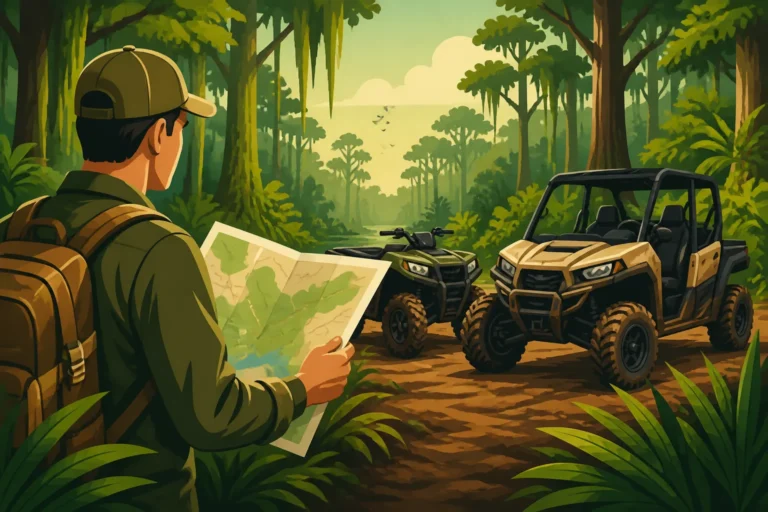
A map is not just a way to avoid getting lost. On public forest land, it can help distinguish roads and trails open to motorized vehicles from routes that are closed or limited to other uses. Review the official motor-vehicle map before the ride, identify the legal route, and note any restrictions relevant to your vehicle. Keep a copy available even if you use a phone app.
Digital mapping tools can be useful for orientation, particularly when you want to see where a trail sits in relation to roads, trailheads, and nearby communities. onX Offroad may help you plan and follow a route, but do not treat an app’s line as proof that riding is permitted. Map data, signs, and management decisions can differ, and an app may not reflect a temporary closure or a newly posted restriction.
A reliable routine is to compare the official forest information with your chosen navigation app before leaving, then confirm access again at the trailhead. If the map and a sign appear to disagree, follow the posted restriction and contact the forest office for clarification. Keep your route conservative: use only the trail you have verified rather than exploring every spur that appears on a screen.
Find out whether a pass is required
Public-land riding can involve passes, permits, or fees, and the requirements depend on the site and activity. Do not assume a pass that applies at one Kisatchie location automatically covers every trail or recreation area. Check the current requirements for Sandstone specifically, including whether a day-use or annual forest pass applies and how it must be displayed or carried.
The details can be easy to overlook when you are focused on getting the trailer ready. Add the pass check to your pre-trip list, alongside trail status and machine restrictions. [Louisiana Forest Trail Use Passes] provides broader context on forest access passes, while [How to Buy a Louisiana Forest Pass] can help you plan the purchase process. Verify the current requirements through the official forest channels before relying on general guidance.
If your group is riding multiple vehicles, check whether the requirement applies per person, per vehicle, or in another way. Do not assume that one rider’s pass covers everyone. Keep proof readily accessible so you are not searching through a phone or glove box during a check at the trailhead. A little preparation here can save a needless delay after a long drive.
Keep your paperwork and route plan practical
Before setting off, save the information you may need when reception is poor: a map, trailhead directions, emergency contacts, and the forest office details. Downloading or saving map information in advance is especially useful in wooded areas where mobile coverage can be inconsistent. If you use onX Offroad for navigation, prepare the map before you arrive rather than trying to load it from the trail.
Give another person your basic itinerary, not just the name “Sandstone.” Include who is riding, which vehicles you are taking, your planned return time, and what they should do if you do not check in. For a group, choose a lead rider and a sweep rider so nobody is left behind without the rest of the group noticing. Agree on a simple regrouping point if riders become separated.
Carry a paper map or written directions as a backup when practical. Batteries can run low, phones can overheat, and a device can be damaged in a fall. A backup does not need to replace your digital navigation; it just gives you another way to orient yourself if technology fails. Store it somewhere protected from rain, mud, and spilled drinks.
Make the Ride Safer and More Enjoyable
Set a pace for a shared forest trail
A forest trail is not a place to ride as though every corner is empty. Keep your speed low enough to stop within the distance you can see, especially on narrow or winding sections. Reduce speed around blind turns, trail crossings, parked vehicles, and areas where another user could appear without warning. Dust can make visibility worse, so leave space between machines rather than riding close behind the vehicle ahead.
Use clear group signals and agree on what they mean before starting. A lead rider can warn the group about a hazard, an approaching trail user, or a required stop. The last rider should know how to communicate that someone is delayed. If the group is spread out, stop at agreed junctions and wait until everyone has arrived before continuing.
Respecting other visitors is part of keeping access welcoming. Slow down well before passing, give people room, and avoid revving needlessly near trailheads or camps. [Louisiana Trail Etiquette Locals Expect] offers useful reminders for sharing riding areas responsibly. Good etiquette is not merely about avoiding complaints; it reduces the chance of a close call when machines, people, and limited sightlines meet.
Dress for heat, bugs, and changing weather
Louisiana’s warm, humid conditions can make a ride tiring even when the trail is not especially difficult. Wear a properly fitting helmet and protective gear appropriate for your machine and the riding area. Long sleeves, gloves, sturdy boots, and eye protection can help shield you from branches, debris, and brush. Choose clothing that offers protection without making you dangerously overheated.
Bring more water than you think you will need, and make drinking part of the ride rather than waiting until you feel thirsty. Plan breaks in shaded areas when possible and pay attention to headache, dizziness, nausea, unusual fatigue, or confusion. If someone appears overheated, stop the ride, move them to a cooler spot, and seek medical help when needed. Do not let group momentum pressure an unwell rider to continue.
Insects and sudden rain deserve a place in the plan as well. Pack insect repellent, a lightweight rain layer, and a dry change of clothing for the ride home. Protect electronic devices and important papers from moisture. A weather check before departure helps, but the conditions can still change while you are out, so make sure your group can shorten or end the ride without argument.
Know when to turn around
Turning around is a sensible riding decision, not a failure. If a section is outside your ability, appears damaged, is blocked, or has an unexpected hazard, stop and reassess. Do not follow another vehicle into an uncertain area simply because it has gone ahead. A machine can get stuck, damaged, or stranded quickly when the rider commits without understanding the surface or route.
Agree on a turnaround rule before the group begins. For example, the least experienced rider should not be pushed to tackle an obstacle, and no one should be expected to cross water of unknown depth. If the group cannot safely pass, turn back together and choose a route that everyone can manage. A conservative ride may feel less dramatic, but it is far more likely to end with the whole group back at the trailhead.
Be especially cautious if someone suggests leaving the marked route to find a shortcut or avoid a difficult section. Unauthorized travel can damage the forest and create consequences for the entire riding community. Use your map to return along a known, permitted route. If you are lost or dealing with a serious mechanical issue, prioritize safety and contact emergency services when appropriate rather than attempting a risky recovery.
Logistics for a Smooth Sandstone Trip
Prepare the tow vehicle and trailer
A successful ride begins before you reach the trailhead. Check that the tow vehicle is suitable for the loaded trailer, confirm the trailer tires and lights work, and secure each machine using appropriate tie-down points. Recheck straps after the first stretch of driving and whenever you stop. Mud, vibration, and a long rural route can loosen equipment that seemed secure in the driveway.
Pack so the items you may need first are easy to reach. Water, first aid, tools, maps, and recovery gear should not be trapped underneath coolers or overnight bags. Keep keys, documents, and phones in a dry, secure place. If you are carrying fuel or other supplies, transport them safely and in line with the equipment and container instructions.
Plan your arrival and departure around daylight. Rural roads and forest entrances may be unfamiliar, and unloading takes longer when several machines are involved. Leave time to review the signs, check the route, and get everyone ready before riding. When the group is tired at the end of the day, allow time to load carefully instead of rushing to beat darkness.
Bring a realistic day-ride kit
A useful day-ride kit is built around the problems your group might actually face. Include water, snacks, first aid, basic tools, a tire repair option, a tow strap, a flashlight, and protective gear. Carry a fully charged phone and, where appropriate, a backup battery. Keep critical items secured to the vehicle or in a pack that will not interfere with safe riding.
Food and comfort supplies matter too. A snack can help a tired rider maintain focus, while sunscreen, insect repellent, and extra socks can make the difference between a pleasant ride and an uncomfortable one. Pack a trash bag so wrappers and empty containers leave with you. If a trailhead has limited amenities, arrive prepared rather than counting on finding supplies nearby.
Your kit should match the route and the group. A short outing with experienced riders may need less equipment than a long day with children or first-time riders, but no group should head out without water, basic safety supplies, and a plan for communication. onX Offroad can support navigation planning, but keep the practical items that help if your phone stops working or the route needs to change.
Make a backup plan for closures and delays
A backup plan keeps one problem from turning into a wasted weekend. Identify another legal riding option before you leave, but confirm its rules, access, and operating status independently. A nearby forest road may not be open to OHVs, and a private park may require advance planning or have event-specific access. Never assume that a second location follows Sandstone’s rules.
If you are traveling with a group, agree on how you will decide whether to continue when conditions are poor. Set a time by which someone will check the official trail status and a clear point when the group will switch plans. This avoids a parking-lot debate after everyone has already driven for hours. Keep the fallback choice realistic for the vehicles, riders, and remaining daylight.
Build extra time into the day for a flat tire, slow travel, or a machine that needs attention. Let someone at home know if your return time changes. If you finish early, resist the urge to explore an unmarked route just to fill the day. A flexible plan is useful; an unauthorized detour is not.
Respect the Forest and Protect Future Access
Stay on designated routes
The simplest way to reduce your impact is to ride only where motorized use is allowed. Do not widen a trail by riding around a puddle, cut across a switchback, or create a new path to bypass a blockage. Those choices can damage vegetation and soil, and repeated shortcuts can turn one wet spot into a much larger erosion problem.
If a trail is muddy, do not assume that spinning through it is harmless. The right decision depends on the route’s condition and current rules. If the surface is deteriorating or your machine is leaving deep ruts, turn around or stop and reassess. Protecting the trail matters more than finishing a loop on a particular schedule.
Pack out everything you bring in, including food scraps, broken parts, and small pieces of plastic or tie-down material. Keep noise reasonable near other visitors and respect gates, signs, and barriers. These habits help maintain a positive relationship between riders and land managers, which is important for continued access to public riding areas.
Leave wildlife and other visitors undisturbed
A forest ride is an opportunity to see more than the trail in front of your tires. Wildlife may be near the route, and other visitors may be enjoying the area on foot or by bicycle. Slow down when you see people or animals, avoid chasing wildlife, and give them a clear way to move away. Do not assume an animal will run in the direction you expect.
Keep dogs under control and follow the applicable rules for pets and the specific recreation area. A dog riding unsecured on an ATV or UTV can be injured or distract the driver. If you bring a pet, plan for water, shade, safe transport, and a way to keep the animal from wandering into the trail.
Share the trail with patience. A quiet greeting, a slow pass, and a little space can prevent tension between different recreation groups. If another visitor asks about the route, be courteous but avoid giving an uncertain answer about what is open. Point them toward the official map or posted information instead of presenting a guess as a rule.
Help protect Sandstone’s long-term access
Public riding opportunities depend on riders following the rules even when no one is watching. A single machine leaving the designated route may seem insignificant, but repeated misuse can cause visible damage and complaints. Staying within the approved area, respecting seasonal closures, and following restrictions all help demonstrate that motorized recreation can coexist with forest management and other public uses.
If you notice a damaged sign, a blocked route, or a safety issue, report it through the appropriate forest contact rather than trying to repair, remove, or bypass it yourself. Do not post directions that encourage others to use a closed or unofficial path. When sharing photos or ride notes online, make sure they do not imply that a restricted area is open to motorized use.
Sandstone is most rewarding when riders arrive prepared, ride with care, and leave the area in good shape. Check the season and status, verify your vehicle and pass requirements, carry a backup navigation plan, and choose a pace that suits the group. A little preparation makes it easier to focus on the ride instead of solving avoidable problems at the trailhead.
Disclaimer
This article is for general informational purposes only and does not constitute professional advice. Laws, prices and regulations vary by location and change over time. Consult a qualified professional for guidance on your specific situation.