Louisiana Safety Course Options
Louisiana riders often hear conflicting advice about whether an ATV safety course is required, where to take one, and whether a class from another state counts. For most recreational riding, a statewide course is not mandatory, but training can help prevent avoidable crashes. Here’s how to find Louisiana options, choose a course that fits the rider, and understand what training does—and does not—authorize.
Does Louisiana require an ATV safety course?
Louisiana does not generally require recreational ATV riders to complete a safety course before riding. A course can still be worthwhile, especially for a new rider, a young person, or anyone moving from a small quad to a more powerful machine. Training helps riders practice controls, braking, turning, hills, and hazard awareness in a structured setting rather than learning every lesson on a trail.
The lack of a general course mandate does not mean there are no rules. Riders still need to follow the requirements that apply to their machine and the place they plan to ride. A course does not replace an off-road decal, a public-land permit, landowner permission, or compliance with trail restrictions. For an overview of the paperwork side, see Louisiana ORV Decals and Titles Explained and Louisiana Proof of Ownership on the Trail.
| What you want to do | Is a safety course the same as permission? | What to check |
|---|---|---|
| Ride recreationally on private land | No | Get permission and follow the landowner’s rules |
| Use a Louisiana public riding area | No | Check the area’s current permit, access, and machine rules |
| Ride a marked WMA trail | No | Confirm permit requirements, designated trails, and machine limits |
| Ride a public road where permitted | No | Check the specific road-use law and local rules |
| Ride in another state | No | Check that state’s rules and the riding area’s requirements |
Course availability, age guidelines, and class formats may vary. Before making plans, contact the provider and ask what is currently offered, whether a parent or guardian must attend, and whether the class is hands-on or classroom-based.
Course completion does not grant riding privileges
A course certificate is evidence of training, not a general riding permit. It does not make an ATV street legal, allow access to a closed trail, or override a land manager’s rules. Louisiana’s public-land requirements are separate from training. For example, riders should check Louisiana WMA Permit Requirements before visiting a wildlife management area, and check the current access rules for a national forest trail before unloading.
The same distinction applies to road use. Louisiana has specific restrictions on where ATVs and UTVs may travel, and the rules are not interchangeable. A rider should not assume that a safety card, an out-of-state certificate, or an off-road decal authorizes public-road use. Start with Can You Ride an ATV on the Road in Louisiana? if road riding is part of the plan.
Louisiana safety course options
The main places to ask about ATV safety education in Louisiana are LSU AgCenter Extension offices and 4-H. Programs and scheduling can vary by parish and season, so treat these as starting points for finding an available class rather than a promise that a course is running near you on a particular date.
LSU AgCenter and parish Extension offices
Louisiana has a voluntary safety education program associated with LSU AgCenter Extension. A parish Extension office is a sensible first call for current information about classes, youth programs, or other local training opportunities. Ask whether the office offers a course directly, coordinates one with another organization, or can refer you to a nearby provider.
When you call, be specific about the rider and machine. A class intended for younger beginners may not suit an adult learning to operate a utility ATV, and a classroom presentation may not include practical riding instruction. Useful questions include:
- Is a class currently scheduled, and where will it be held?
- What ages can participate?
- Does the course include supervised practice on a machine?
- Must participants bring their own ATV, or is equipment provided?
- Is there a parent or guardian requirement for a minor?
- What should participants wear or bring?
- Is a completion card or certificate provided?
- Does the program have separate sessions for ATVs and UTVs?
The answers help you understand what the class actually teaches. A short awareness session can be useful, but it is not the same as supervised practice with starting, stopping, braking, and maneuvering.
4-H youth safety education
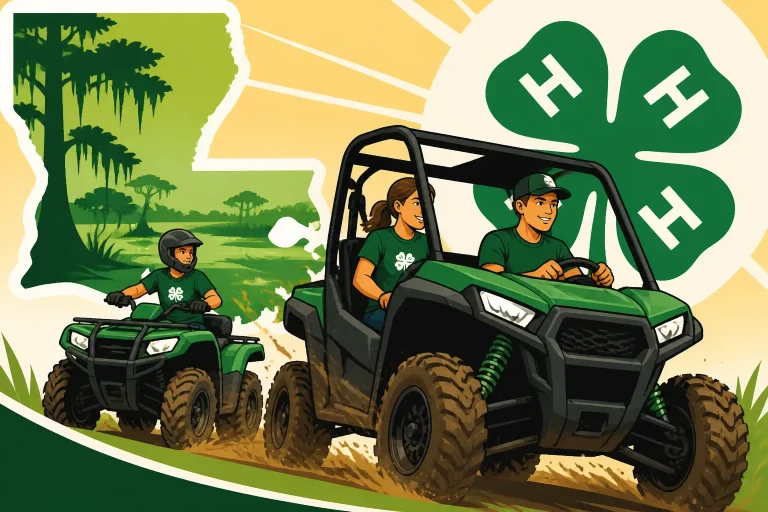
The 4-H ATV safety program is another option to ask about for young riders. Contact the local 4-H or parish Extension office to confirm whether a program is available and what its age range and participation requirements are. The course may be a better fit for a child or teen than an adult-focused class, but ask about the specific format rather than relying on the program name alone.
A parent should look for instruction that addresses more than simply operating the throttle. For a young rider, important topics include choosing a machine that fits, recognizing when not to ride, wearing protective equipment, and understanding that adult supervision does not make an unsuitable machine safe.
Louisiana has no general mandatory ATV safety course for recreational riding, but a youth program can help families set a shared baseline. It also gives a young rider a chance to ask questions and practice safer habits before riding in a busy group or unfamiliar setting. For related age-specific considerations, see Louisiana ATV Age Requirements and [Louisiana Rules for a Ten-Year-Old Rider].
Private instructors and organized riding programs
A dealer, riding club, private park, or event organizer may know of local instruction, but do not assume every demonstration or orientation is a formal safety course. Some programs are designed to explain a venue’s rules rather than teach comprehensive riding skills. Ask what the instruction covers and whether it includes a controlled practice session.
A private riding area may also set its own age, helmet, passenger, or machine requirements. Those are venue rules, not statewide training requirements. Check the park’s current policies before you travel, especially if a child will ride or if you plan to bring a UTV. Louisiana Private Park Age Minimums explains why a park’s rules should be checked separately from state law.
For an out-of-state rider visiting Louisiana, a course taken at home may still be useful preparation, but it does not automatically satisfy a Louisiana permit or site-access requirement. Verify the riding area’s rules directly. The same is true in reverse: a Louisiana course certificate should not be assumed to meet another state’s requirements.
How to choose a useful course
The best course is the one that matches the rider, machine, and type of terrain—and includes enough practical instruction to make the skills usable. A general classroom session can introduce hazards, but riders also need to understand how their own machine responds to braking, turns, uneven ground, and changes in traction.
Match the class to the rider and machine
Before enrolling, explain whether the rider is new or experienced, whether they will use an ATV or UTV, and what kind of riding they expect to do. A person who mostly rides flat farm lanes may need different practice from someone planning to ride wooded trails, sand, or deep mud. The course should make clear which machines it covers; ATV and UTV handling are not identical.
For a youth rider, ask whether the program teaches machine fit and age-appropriate riding, not just basic controls. A child who can reach the handlebars is not automatically ready for a powerful or heavy machine. For an adult beginner, look for instruction that allows time to practice slowly and ask questions without pressure to keep up with more experienced riders.
Look for practical, safety-focused instruction
A helpful class should cover the basics in plain language and give riders room to practice where possible. Topics worth asking about include:
- Pre-ride checks, including tires, controls, brakes, and visible damage
- Protective gear and correct helmet fit
- Starting, stopping, and controlled braking
- Turning and managing speed on uneven ground
- Recognizing slopes, water, mud, and other hazards
- Carrying a passenger only when the machine is designed for one
- Safe spacing and communication when riding with others
- What to do after a breakdown, injury, or separation from a group
Training should also make clear that riders need to adapt to conditions. A skill practiced in a dry, open area may not translate directly to a slippery trail or a mud hole. For example, reading an obstacle before entering it is safer than assuming a machine can power through. A course is a starting point for sound judgment, not a guarantee that every situation can be handled safely.
Check the instructor and course details
Ask who provides the instruction, how much time is spent on practical skills, and whether the provider issues a completion record. If you need documentation for a particular program or event, confirm in advance what it accepts. Do not assume that a certificate from one provider will meet another organization’s requirement.
Be cautious of vague claims such as “certified” or “approved” without an explanation of what that means. Ask which organization recognizes the course, what the certificate represents, and whether the instruction is intended for general safety education or a specific riding site. If the class is mainly a venue orientation, it can still be useful, but it should not be mistaken for full rider training.
Preparing for training and riding safely afterward
A course works best when riders arrive ready to participate and then continue practicing what they learned. Call the provider before the class for its equipment and clothing requirements. Wear sturdy clothing and closed-toe footwear, and bring protective gear if the provider asks participants to supply it. A helmet should fit correctly and be appropriate for the activity; do not assume a borrowed or poorly fitting helmet offers adequate protection.
Amazon can be convenient for non-fit-critical items such as a waterproof pouch for emergency contact information, but protective equipment should be chosen for fit and suitability rather than convenience alone. If a provider requires a particular type of gear, confirm the details before buying anything.
Make the course part of a larger safety plan
Training is only one part of a safe ride. Before heading out, check the machine, terrain, weather, access rules, and the abilities of everyone in the group. Riders should know where they are going, how they will communicate, and what to do if someone becomes separated.
A simple pre-ride routine can help:
- Confirm that the riding area is open and that your machine is allowed there.
- Review the applicable decal, pass, permit, and access requirements.
- Inspect the ATV or UTV and confirm that protective gear fits.
- Agree on a route, pace, regrouping points, and a plan for an emergency.
- Ride within the least experienced rider’s ability and stop when conditions change.
Public-land rules deserve particular attention. On a WMA, trail access may be limited to marked routes and may depend on season or machine specifications. For forest riding, check the current trail status and access requirements before towing to the trailhead. Louisiana Trail Closures and Seasons and Checking a Trail Status Page First are useful starting points.
If a rider plans to use an off-road machine on a public road, take time to understand the specific legal limits before riding. A course instructor may discuss traffic hazards, but only the applicable law determines where road use is allowed. Similarly, decals and titles serve different purposes: Why an Off-Road Decal Is Not Street-Legal Registration explains an important distinction.
Keep proof, but do not rely on it as a permit
If a course provides a certificate or card, keep it somewhere accessible and make a digital copy. The record can help document training for a family, club, or organization. Still, carry any separate documents required by the riding area, and check whether the site has its own proof-of-training rules.
For visiting riders, this is especially important. A home-state course certificate may show that the rider has received instruction, but it does not substitute for Louisiana land-access requirements or local rules. Check the requirements for the specific trail, park, or public land before setting out.
The practical takeaway is straightforward: Louisiana riders can pursue voluntary safety education through LSU AgCenter Extension and 4-H, but a class is not a statewide recreational riding prerequisite and does not provide access rights. Choose instruction suited to the rider and machine, verify the course details with the provider, and check permits and riding rules separately before every trip.
Disclaimer
This article is for general informational purposes only and does not constitute professional advice. Laws, prices and regulations vary by location and change over time. Consult a qualified professional for guidance on your specific situation.