Can You Ride an ATV on the Road in Louisiana?
It's a question that nearly every ATV or UTV owner in Louisiana has wrestled with: can I just hop on my machine and run down the road to my buddy's camp, or even just to the corner store for a cold drink? The dream of ditching the truck and trailer for a quick jaunt on your quad is appealing, but the reality of Louisiana road laws for off-road vehicles is often complex and, frankly, frustratingly restrictive. This guide will meticulously break down the rules, exceptions, and practical considerations for riding your ATV or UTV on public roads here in the Pelican State, helping you navigate the confusing legal landscape so you can ride smart and stay out of trouble.
The General Rule: Why Your ATV or UTV Isn't Street Legal in Louisiana
Let's get straight to the point: for the most part, your ATV or UTV is not considered street legal in Louisiana. This isn't just a suggestion; it's a fundamental legal distinction that can carry significant consequences if ignored. Many riders assume that because they have a title and a decal, they're good to go anywhere, but that's a common misconception that can lead to headaches and heavy fines.
Understanding Louisiana's Core Stance on Off-Road Vehicles
The state of Louisiana draws a very clear line between vehicles designed and intended for off-road recreation or utility, and those built to operate safely on public highways and streets. An ATV, or All-Terrain Vehicle, is specifically engineered for unpaved surfaces, with features like low-pressure tires, a straddle seat, and handlebars. UTVs, or Utility Task Vehicles (often called side-by-sides), share similar off-road design principles, though they typically have a steering wheel, foot pedals, and side-by-side seating. Neither is built to meet the same stringent safety and emissions standards as a passenger car or truck, which is why they generally don't belong on public roads.
This fundamental distinction is crucial. When you get a title for your ATV or UTV through the Louisiana Office of Motor Vehicles (OMV), you're proving ownership, much like with a car. However, that title, combined with your [Louisiana ORV Decals and Titles Explained] and the yearly off-road decal, simply allows you to legally operate your machine off-road. It doesn't magically transform it into a street-legal vehicle. Think of it this way: your fishing boat has a title and registration, but you can't drive it down I-10. The same principle applies here. [Why an ATV Needs Both a Title and a Decal] explains this distinction in more detail.
Mixing off-road vehicles with traditional street traffic introduces a host of dangers, not just for the ATV/UTV rider but for other motorists as well. Off-road tires aren't designed for highway speeds or hard pavement, affecting handling and braking. These machines lack many of the safety features found in cars, such as enclosed cabins, airbags, and robust crumple zones. The state's stance is rooted in public safety, aiming to prevent accidents and ensure that all vehicles on public roads adhere to a common set of standards.
What Louisiana Law Says About ATVs on Public Roads
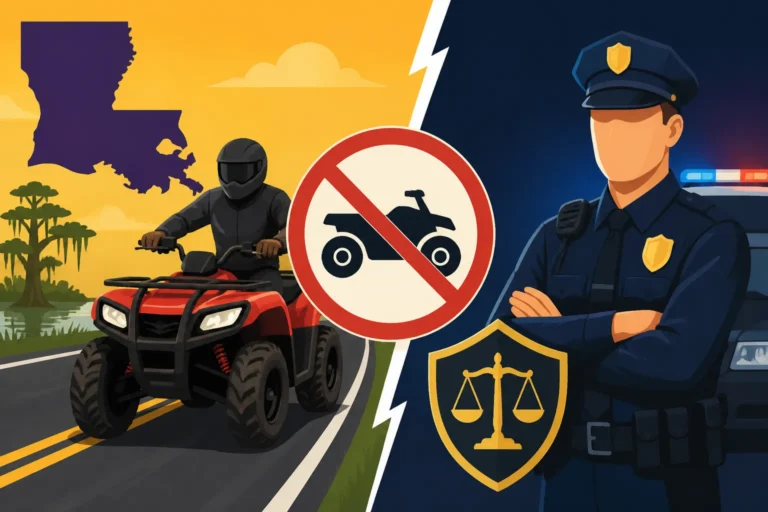
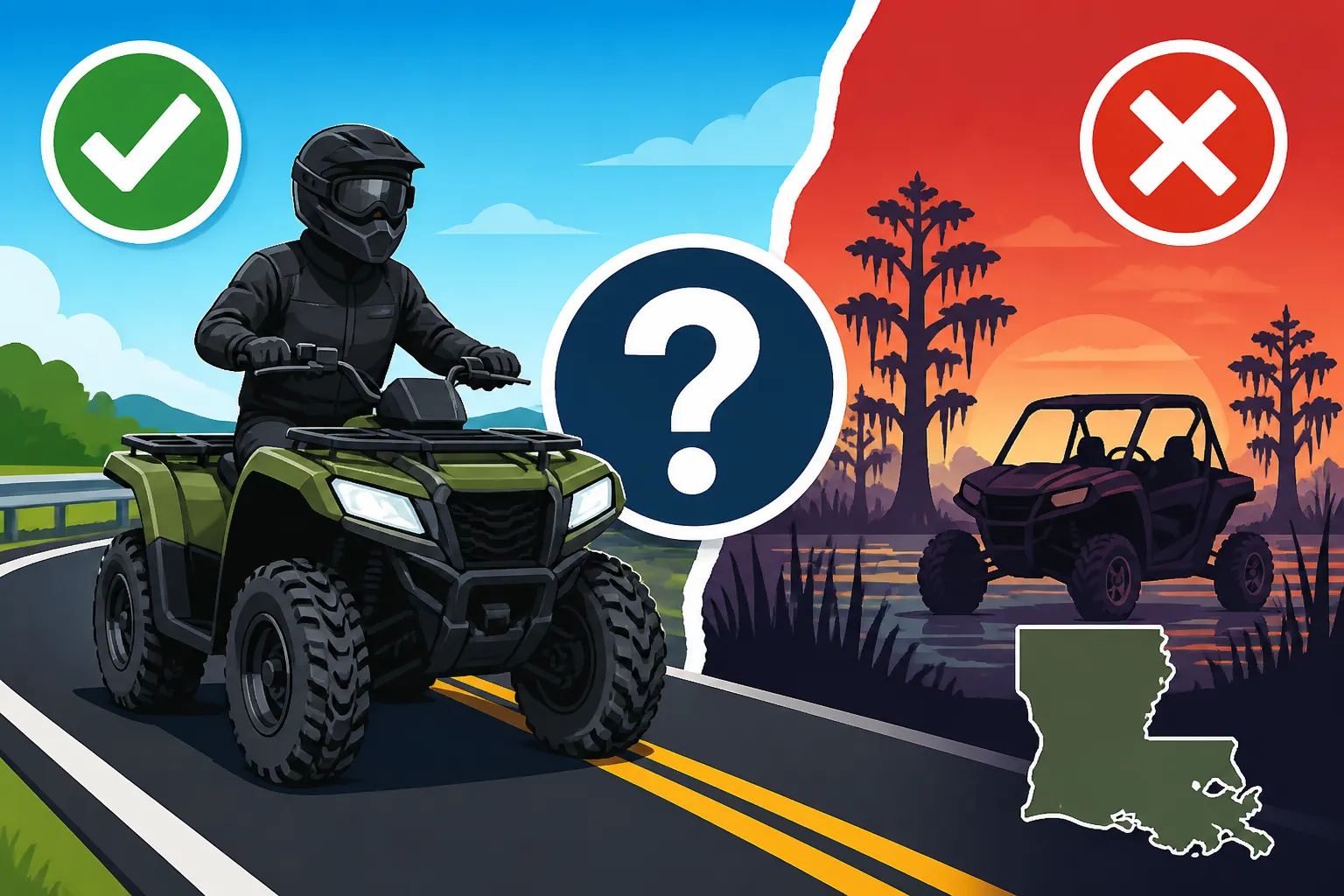
Louisiana Revised Statute 32:299 explicitly addresses the operation of ATVs on public roadways. The law, in no uncertain terms, states that no person shall operate an all-terrain vehicle upon any public street or highway of this state. This is the bedrock principle you must understand. While there are a few very specific, narrow exceptions we'll get into, the default answer to "Can I ride my ATV on the road?" is a resounding "No."
This prohibition extends to all types of public roads, from busy interstates to quiet parish backroads. It's not just about speed limits or traffic volume; it's about the very classification of the vehicle. Ignorance of the law is, unfortunately, no excuse. A state trooper or local sheriff's deputy doesn't need to catch you doing anything reckless; merely operating your ATV on a public road is enough for a citation. The penalties can be steep, ranging from significant fines and court costs to the potential impoundment of your machine. We're talking about more than just a slap on the wrist. [Louisiana Penalties for Illegal Road Riding] are serious, and law enforcement officers in rural parishes, especially, are well-versed in these regulations.
When pulled over, officers will check for proper documentation, including proof of ownership and the required off-road decal. They'll also be looking for any signs of impairment, as [Louisiana DUI Law and Off-Road Machines] applies even if you're riding off-road. It's important to understand [What a Louisiana State Trooper Can Ask to See] during such a stop. The risks simply aren't worth the convenience of a short ride on a public road.
The Exceptions: When You Can Ride on Louisiana Roads (Sometimes)
While the general rule is "no," Louisiana law does provide a couple of very specific, highly conditional exceptions that allow ATVs and UTVs onto public roads. These exceptions are often misunderstood, leading many riders to mistakenly believe they have broader rights than they actually do. It's critical to pay close attention to the details here, as even a small deviation can void the exception and land you in trouble.
The Agricultural Use Exemption
This is perhaps the most common, yet most frequently abused, exception for ATVs in Louisiana. Under [Louisiana's Shoulder-Only Farm Exception], an ATV can be operated on the shoulder of a public road, or can cross a public road, if the operation is directly related to agricultural purposes. This isn't a carte blanche to ride down the shoulder to your favorite fishing spot; it's strictly for legitimate farming activities.
Here's the catch: the law specifies that this agricultural use must occur within a [Louisiana's 5-Mile Farm Radius] from the farmer's property or land being farmed. This means if you're a farmer needing to move your quad from one field to another, and those fields are within five miles of your home base, you may be able to use the shoulder of the road. However, this ride must be "incidental to the operation of the farm." What does "incidental" mean? It means it's a necessary part of getting farm work done, not just a joyride. [Every Legal Road Trip Has to Be Farm Related], reinforcing that recreational use is explicitly excluded from this exception.
To qualify, you'll need to carry specific paperwork, typically a [Louisiana Farm Affidavits for Road Use]. This is a sworn statement, often notarized, that attests to the machine's primary use for agriculture. Without this, even if you're legitimately moving between fields, you could still be cited. The intent of this exemption is to allow farmers to efficiently manage their operations, not to open up public roads to general ATV traffic. It's a very narrow lane to travel, both literally and legally. And remember, this exception only allows for shoulder riding; you are expressly prohibited from entering the travel lanes of the road.
Designated UTV Roads and Municipal Ordinances
UTVs, or side-by-sides, have a slightly different pathway to limited road use in Louisiana, primarily through local designation. [Louisiana UTV Road Rules Under 32:299.3], passed in 2015 and amended in 2022, provides a framework for parishes and municipalities to designate certain roads or streets for UTV operation. This is a game-changer for UTV owners in areas that choose to adopt such ordinances, but it's not universal.
The key here is that [Louisiana Parishes Must Designate and Sign Roads] specifically for UTV use. This isn't something that just happens automatically; a local governing body, like a parish council or city council, has to vote on an ordinance, identify specific roads, and then put up proper signage indicating that UTVs are permitted. If there are no signs, assume it's illegal. You need to do your homework and check [Louisiana Parish Ordinance Lookups] or municipal records to see if your local area has adopted such rules. Orleans Parish, for example, is explicitly exempt from the state's UTV statute.
Even on designated roads, there are strict rules for UTV operation:
- Driver Age: The driver must be at least [Louisiana's 21 Age Minimum for UTV Drivers]. This is a major difference from ATV age requirements off-road.
- License: Drivers must hold a valid [Louisiana Requires a Class E License] or equivalent.
- Insurance: Proof of liability insurance is mandatory. [Louisiana UTV Insurance Minimums] usually apply, and you'll need to provide [Louisiana Insurance Proof on Demand] if stopped.
- Equipment: The UTV must be equipped with essential safety features, including headlamps, taillamps, brake lights, a horn, a rearview mirror, and potentially turn signals and a windshield. This is where companies like SuperATV come in handy, offering street-legal kits that provide many of these components. However, installing a kit from SuperATV or any other brand does not automatically make your UTV street legal; it just provides the necessary equipment if your parish has designated the roads and you meet all other requirements.
- Time of Day: Operation is typically limited to daylight hours, generally between thirty minutes after sunrise and thirty minutes before sunset.
- Road Types: UTVs are typically restricted to roads with speed limits of 35 mph or less, and they are almost universally banned from interstates and controlled-access highways.
It's a patchwork of regulations, and what's legal in one parish might be strictly prohibited in the next. Always verify the specific ordinances for the area you plan to ride in, and remember that even with a designated road, these are for UTVs, not ATVs.
The Realities of Road Riding: What You Need to Know
Even with the specific exceptions for agricultural use or designated UTV roads, taking your off-road machine onto public asphalt comes with a set of practical realities and risks that every rider needs to understand. It's not just about avoiding a ticket; it's about safety, legal liability, and how your actions impact the broader perception of our riding community.
Essential Equipment and Legal Requirements
Let's assume, for a moment, that you're operating under one of the narrow legal exceptions – say, you're a farmer moving your ATV within the 5-mile radius, or you're on a UTV on a properly designated street. Even then, you need to ensure your machine is appropriately equipped and you're carrying the right documentation.
For UTVs on designated roads, the equipment list is often quite similar to what you'd expect on a golf cart or low-speed vehicle. This usually includes:
- Headlights and Taillights: Functioning, clearly visible lights are essential, especially since most designated road use is restricted to daylight hours, but you might be starting or ending your ride near dusk or dawn.
- Brake Lights: Signaling your stops is critical for other drivers.
- Turn Signals: While not always explicitly required by state statute for designated UTV roads, many local ordinances will require them for clarity in traffic. This is another area where a comprehensive kit from SuperATV can prove invaluable, ensuring you have all the necessary signaling.
- Rearview Mirror: Essential for seeing traffic behind you.
- Horn: To alert pedestrians or other drivers.
- Windshield: Often required for UTVs that will see any road use.
Beyond the machine itself, you, the operator, have requirements. As mentioned, for designated UTV roads, a valid [Louisiana Requires a Class E License] is a must. You cannot operate these machines on public roads with just a learner's permit or a restricted license. And while Louisiana does not have a statewide helmet law for ATVs or UTVs being operated off-road, some local ordinances or specific circumstances (like carrying a youth passenger) might introduce helmet requirements. Always check local rules.
Finally, and this is crucial, you must carry proof of insurance if you're operating a UTV on a designated public road. [Louisiana UTV Insurance Minimums] are similar to those for cars, and law enforcement can demand [Louisiana Insurance Proof on Demand]. For ATVs used under the agricultural exemption, while insurance isn't always explicitly mandated for shoulder use, it is always a wise idea to have liability coverage in case of an accident. Imagine the financial implications if your ATV inadvertently caused damage to another vehicle or property while on a public shoulder – adequate insurance could save you from significant personal liability.
Risks, Penalties, and Public Perception
Riding an ATV or UTV on roads that aren't specifically designated or under a valid agricultural exception carries substantial risks. First and foremost are the safety risks. These machines are nimble off-road but can be unstable and difficult to control at higher speeds on pavement, especially with their suspension and tire setups. Collisions with full-sized vehicles can be catastrophic for ATV/UTV riders, who lack the protection of a car. Sadly, many serious accidents occur when off-road machines venture onto inappropriate roadways.
Then there are the legal penalties. If you're caught riding illegally, you're looking at more than just a minor traffic ticket. [Louisiana Penalties for Illegal Road Riding] can include fines that quickly add up, court costs, and potentially points on your driver's license. Even worse, your machine could be impounded. The process to get an impounded quad released can be costly, time-consuming, and require you to pay towing and storage fees on top of any fines. [How to Get an Impounded Quad Released] is a process you absolutely want to avoid, as it can involve significant financial and logistical headaches.
Beyond the immediate legal and safety concerns, there's the issue of public perception. When ATVs and UTVs are ridden illegally on public roads, it often leads to complaints from residents about noise, dust, and safety concerns. This negative perception can harm the entire off-road community, leading to calls for stricter regulations, fewer riding opportunities, and more aggressive enforcement. Being a responsible rider means understanding where your machine is legally allowed to operate and respecting those boundaries, both for your own safety and for the future of off-road recreation in Louisiana. It’s far better to haul your machine to a designated trail or private property for a ride than to risk penalties and public ire for a short trip on a prohibited road.
Disclaimer
This article is for general informational purposes only and does not constitute professional advice. Laws, prices and regulations vary by location and change over time. Consult a qualified professional for guidance on your specific situation.