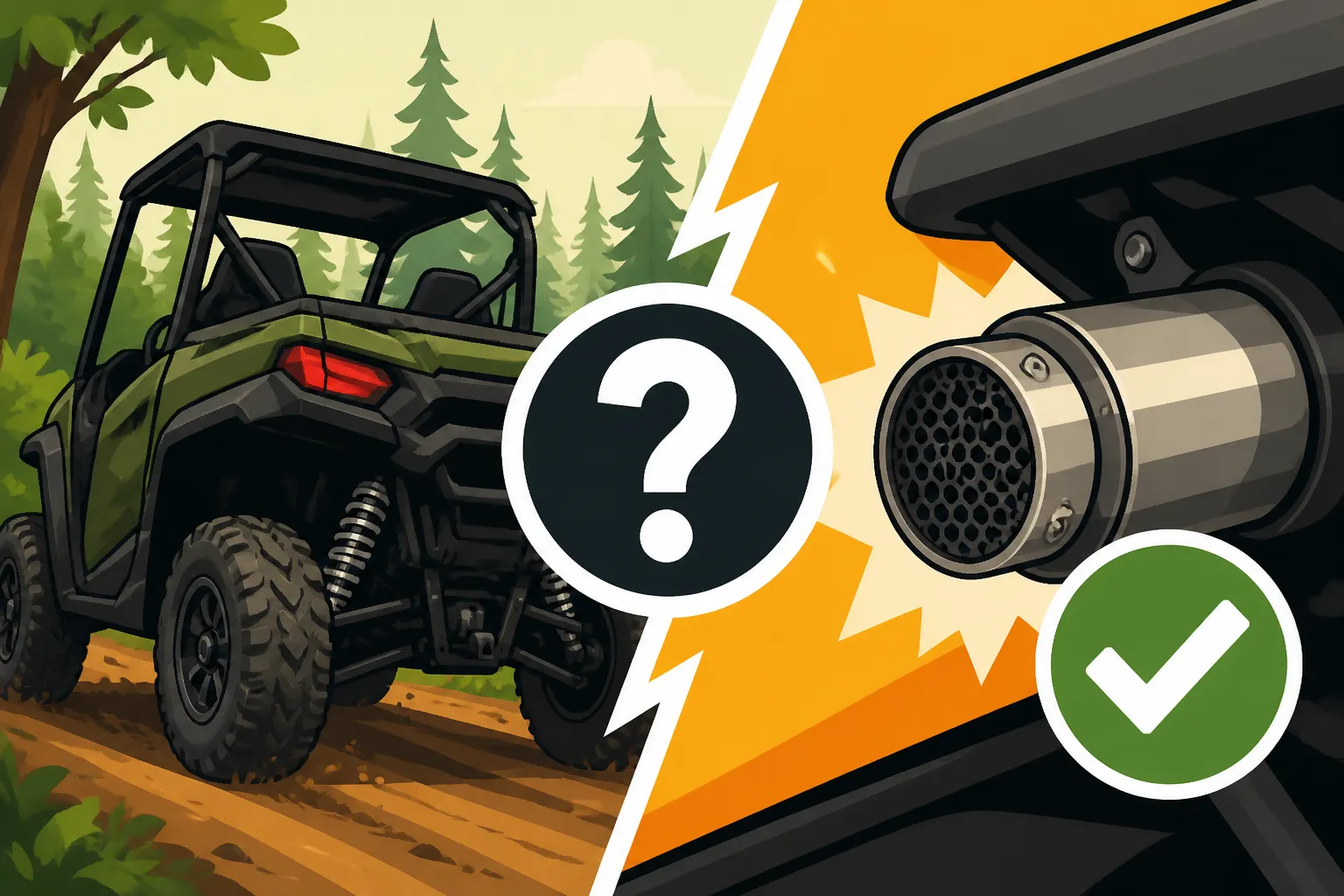
Do Louisiana Forest Trails Require a Spark Arrester?
Louisiana forest-trail riders often focus on permits, trail conditions and machine access, then discover a spark arrester is another part of the equipment check. The answer depends on who manages the land: National Forest System trails have different rules from private parks and other public areas. Here’s how to tell what applies and what to inspect before unloading.
The short answer: it depends on who manages the trail
If you’re riding an OHV route on National Forest System land, plan to use a properly installed and maintained spark arrester. Forest rules generally prohibit operating an internal-combustion engine without one on those lands. In Louisiana, that can matter on routes in Kisatchie National Forest, including its designated OHV trail systems.
That does not mean every trail in Louisiana has the same requirement. A private riding park, a state-managed area or a wildlife management area may set its own rules. Even within a large recreation area, the managing agency’s current rules and any posted restrictions should guide your decision. Don’t assume that “forest trail” means the same thing as “National Forest System trail.”
| Where you plan to ride | How to approach the spark-arrester question |
|---|---|
| A designated route on National Forest System land | Bring a properly installed, serviceable spark arrester and check current forest rules before riding. |
| A private OHV park | Check the park’s current equipment and admission rules; its requirements may differ from federal forest rules. |
| A wildlife management area or other public land | Confirm the rules for that specific area. A forest pass or riding permit does not automatically settle equipment requirements. |
| A trail with unclear management or boundary signs | Identify the land manager before riding, and use the stricter applicable rule until you confirm. |
A spark arrester is a safety device in the exhaust system that helps prevent hot particles from escaping and starting a fire. It is not the same thing as a muffler, and a quiet exhaust is not proof that a machine has a spark arrester. The device must be present, fitted correctly and in working condition; a missing, damaged or altered component may not meet the requirement.
Before leaving home, confirm that your route is open to your type of machine and review the relevant access rules. The overview of Kisatchie National Forest OHV Trails in Louisiana can help you identify the forest trail system you’re considering. For broader access information, see Louisiana Forest Trail Use Passes and Louisiana Trail Closures and Seasons. A permit or pass concerns access; it does not replace required machine equipment.
What counts as a spark arrester, and what does not
A spark arrester is designed to keep combustible particles from leaving the exhaust. Depending on the machine and exhaust design, it may be integrated into a muffler or installed as a separate component. The important point is not where it sits, but whether the machine has a suitable device installed and it remains in serviceable condition.
A muffler primarily reduces noise. Some exhaust systems combine noise control and spark-arresting functions, but the terms are not interchangeable. A machine can have a muffler and still lack a spark arrester. It can also sound quiet while its spark-arresting element has been removed, damaged or replaced with an unsuitable part.
Check the machine, not just the paperwork
Start with the owner’s manual and the manufacturer’s equipment information for the exact make, model and year. Look for the specified exhaust assembly or spark-arresting component. If the machine has an aftermarket exhaust, ask the manufacturer or a qualified shop whether that configuration includes a spark arrester suitable for use on National Forest System land.
Do not rely on appearance alone. A perforated insert, screen or baffle may look like a spark arrester without meeting the relevant requirements. Likewise, a part advertised as a “spark arrestor” is not automatically approved or compatible with your machine. Confirm that the component is intended for the exhaust system and meets the standard required by the land manager.
If a replacement is needed, match it to the machine and exhaust. A parts counter, the machine manufacturer or an experienced repair shop can help identify the correct part. Amazon may list model-specific exhaust parts, but verify the fitment and the manufacturer’s stated compliance before buying; a generic screen is not a reliable substitute for a suitable spark arrester.
Inspect it before the ride
A quick pre-ride check can catch obvious problems, but it cannot establish compliance if you do not know what component the machine requires. Use the manual or a knowledgeable mechanic to identify the correct device. Then check that it is installed in the intended position, secured properly and not visibly broken or missing.
Pay particular attention if the exhaust has been modified, repaired or replaced. A previous owner may have removed an insert to change sound or performance, or a repair may have left out a required component. Mud, rust, vibration and heat can also damage exhaust parts. If there’s doubt about whether the arrester is present or functional, get the system checked before heading onto a national forest route.
Do not modify the exhaust at the trailhead or improvise a substitute. A makeshift screen can restrict exhaust flow, come loose or fail to provide the protection expected. If the machine is not ready, the safer choice is to repair it or ride somewhere whose rules you have confirmed, rather than hoping an inspection will not happen.
How to confirm the rule for your specific Louisiana ride
The most useful first step is to identify the land manager—not just the nearest town, forest name or trail listing. Louisiana has public and private riding areas with different access systems. A forest pass, WMA permit, park ticket or event waiver may cover one requirement while leaving equipment rules to the agency or property owner.
Use this process before you load the machine:
- Identify the trail and the managing agency. Check the trail’s official information and signs at the entrance. If the route is in Kisatchie National Forest, treat it as a National Forest System ride unless current official information says otherwise.
- Check whether the route is open to your machine. A route’s access rules can vary by vehicle type, season and location. Review Louisiana Trail Conditions After Rain and Louisiana Forest Trail Use Passes when planning, but confirm current conditions and requirements with the land manager.
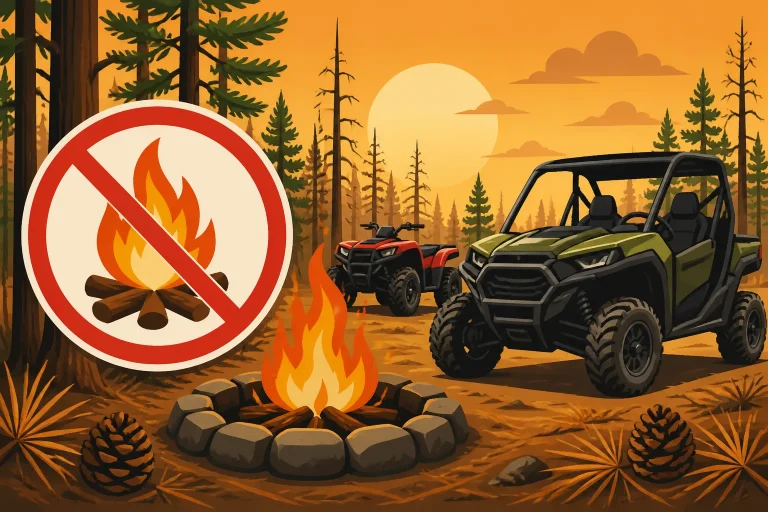
- Look for equipment rules, fire restrictions and posted notices. Spark-arrester requirements may be listed with vehicle-use rules or displayed at an entrance. Fire restrictions can change, so check current notices rather than relying on an old post or a past visit.
- Verify the exhaust configuration. Compare the machine’s setup with its manual or manufacturer information. If it has an aftermarket exhaust or a missing part, get a qualified person to confirm what is installed.
- Ask the land manager if anything remains unclear. Provide the exact trail name and machine type. A question about “Louisiana trails” is broad; a question about a named route and its managing agency is easier to answer accurately.
For a national forest ride, don’t treat an online discussion, a friend’s machine or last season’s experience as the final word. Trail access and temporary restrictions can change, and riders may use the word “forest” loosely for a private property or a route outside federal management. The Louisiana Forest Trail Use Passes overview can help with access planning, while Louisiana Sound Limits on Forest Land covers a separate equipment concern that riders sometimes confuse with spark-arrester rules.
If you are choosing a private park instead, contact the park directly and ask whether it requires a spark arrester, whether it checks exhaust equipment at the gate, and whether there are other restrictions on modified exhausts. A park might focus on sound limits, fire precautions or its own admission rules. Do not assume that meeting a private park’s sound rule means the machine also meets a federal forest requirement.
Common mistakes and a practical pre-ride checklist
The most frequent mistake is assuming the muffler itself satisfies the rule. It may, if the exhaust assembly includes a suitable spark arrester, but the muffler’s presence alone does not confirm that. Another common error is treating a replacement part’s product description as proof of approval. Fitment and compliance both matter.
Riders can also confuse an access pass with equipment approval. A pass may allow a vehicle to use a particular area, but it does not certify that the machine meets every safety, exhaust or fire-related requirement. Likewise, a sticker or permit on the machine does not prove that the spark arrester is intact.
A final trap is assuming a machine that was accepted at one location will be accepted everywhere. Private parks set their own policies; public land managers apply the rules for their property. Even when the same vehicle is used at both, its equipment still has to meet the rules at each destination.
Use this checklist before a forest ride:
- Confirm the exact trail and the agency or owner that manages it.
- Check that the route is open and allows your ATV or UTV.
- Review current access, fire and equipment notices.
- Confirm that the exhaust has the correct spark arrester for the machine.
- Check that the component is installed and not damaged, missing or altered.
- Recheck the setup after exhaust work or a change of ownership.
- Ask the land manager or a qualified repair shop if you cannot verify the part.
- Carry any required pass or permit, while remembering it does not replace equipment compliance.
If the spark arrester is missing, damaged or uncertain, postpone the national forest ride until the issue is resolved. That is simpler than arriving at a trailhead unable to ride or risking a violation. For additional background on what to expect at an entrance, see Spark Arrestors at a Forest Gate. Treat that as a planning aid, then confirm the current rule with the manager of the particular trail.
The practical takeaway is straightforward: for Louisiana routes on National Forest System land, arrive with a correctly equipped machine and a serviceable spark arrester. For other trails, identify the manager and check its current rules. That distinction prevents a common equipment misunderstanding and helps you choose the right repair or riding location before the trailer is hooked up.
Disclaimer
This article is for general informational purposes only and does not constitute professional advice. Laws, prices and regulations vary by location and change over time. Consult a qualified professional for guidance on your specific situation.