Why an Off-Road Decal Is Not Street-Legal Registration
Many folks around Louisiana see that little decal on their ATV or UTV and mistakenly think it grants them permission to cruise down public roads. It's an easy assumption to make, especially when you're just trying to get from your camp to a fishing spot or move a machine down a short stretch of parish road. But that off-road decal is absolutely not street-legal registration, and misunderstanding its purpose can lead to some real headaches, not to mention costly tickets. This guide will clear up the confusion, explain the actual role of the decal, and outline what you really need to do if you ever hope to ride legally on a public road in Louisiana.
Understanding the Purpose of Louisiana's Off-Road Decal
It’s completely understandable why so many riders might confuse an off-road decal with some form of street-legal permission. After all, it’s a physical sticker you put on your machine, just like a license plate or inspection sticker on your truck. You acquire it through the OMV, so it feels official, right? The truth is, while it’s definitely official, its purpose is fundamentally different from a road registration.
What the Decal Actually Signifies
At its core, Louisiana’s off-road decal serves as proof that your off-road vehicle (ORV) has been titled and that you've paid a small, recurring fee to the state. This fee, which you pay through the OMV, goes directly into the Off-Road Vehicle Conservation Fund. This fund is absolutely vital for the off-road community, as it helps to maintain and develop trails, supports safety education programs, and assists with enforcement efforts related to off-road riding. It's an investment in the future of riding in our state, ensuring that there are places to ride and resources to keep riders safe.
Think of your off-road decal more like a park entrance fee or a user permit for a specific activity. It identifies your machine as belonging to a responsible owner who has completed the basic steps of [Louisiana ORV Decals and Titles Explained] and paid their dues to support the sport. It doesn’t, however, certify that your machine meets any particular safety standards for operation on public highways. It’s an administrative identifier and a revenue generator for off-road purposes, not a green light for road travel.
This is why, even though you get it from the same state agency that handles vehicle registration, the off-road decal exists in its own separate category. It’s about recognizing your ownership of an off-road machine and contributing to the resources that make off-road riding possible in Louisiana, rather than declaring it road-ready. You can learn more about this system by checking out information on [Louisiana's Yearly Off-Road Decal].
The Limited Scope of the Decal's Authority
The authority granted by your Louisiana off-road decal is, by design, very specific and quite limited. It permits you to operate your ATV or UTV on private land with the owner's permission, and crucially, on designated public off-road trails and areas where such use is explicitly allowed. This includes places like the trails within Kisatchie National Forest or specific Wildlife Management Areas (WMAs), provided you adhere to their individual rules and regulations, which often include additional permits or specific operating hours.
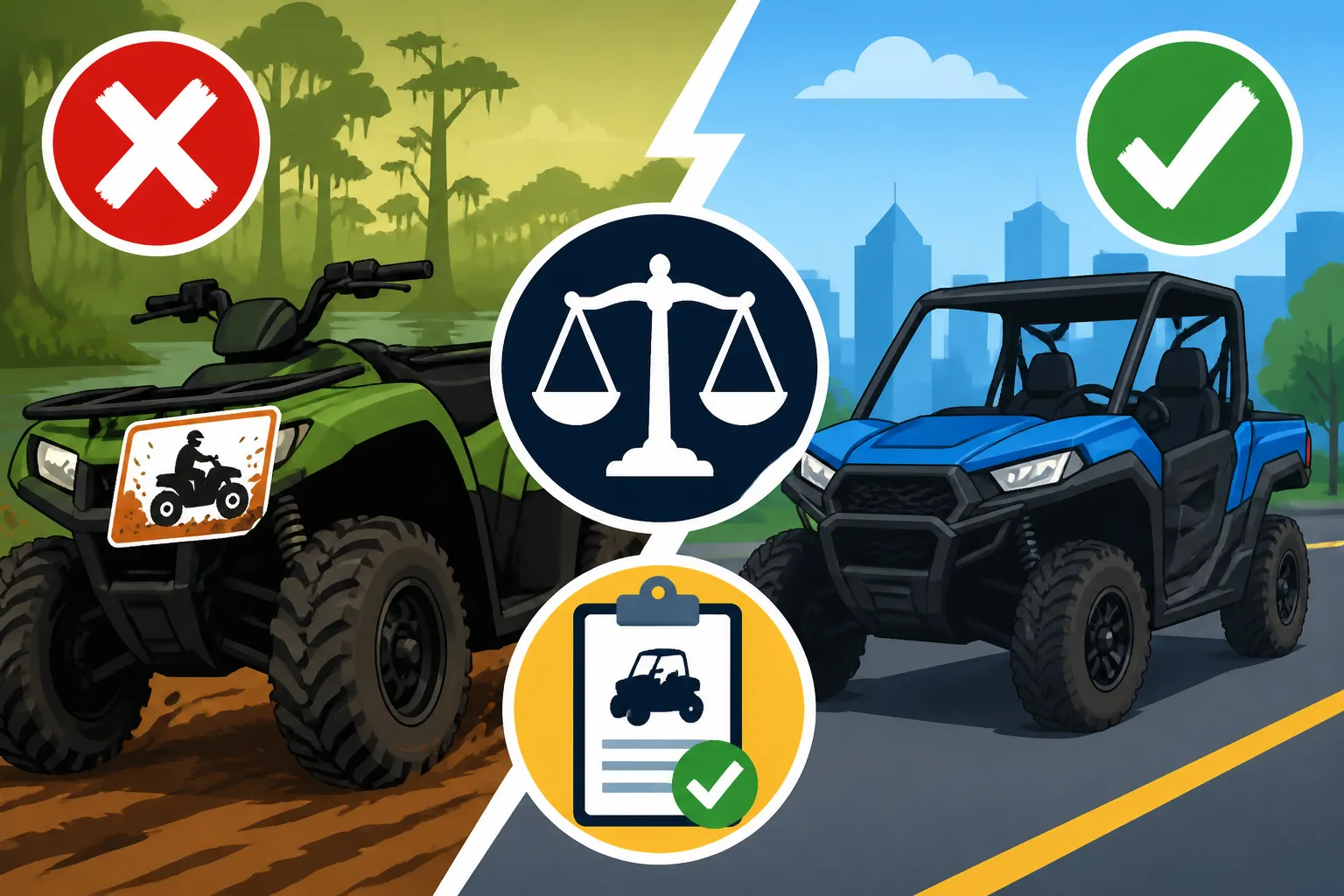
The critical distinction here is that the decal absolutely, unequivocally does not grant you permission to operate your machine on public roads, streets, or highways. The moment your tires roll onto the asphalt or gravel of a public thoroughfare, the authority of that off-road decal vanishes. It's valid within the confines of private property, dedicated off-road parks like Muddy Bottoms, or sanctioned public trails, but it simply has no bearing on public roadways.
Imagine you're driving your truck to your favorite hunting spot. Your truck's license plate and registration are valid for the road, but they don't give you permission to drive it across someone's private field. Similarly, your off-road decal is permission for specific off-road environments, but it doesn't extend to the public road system. Understanding this limited scope is the first step in avoiding serious legal trouble.
Why Decals Fall Short of Street-Legal Requirements
The core of the confusion often lies in misunderstanding the fundamental difference between a vehicle designed and intended for off-road use and one that is legally permitted to share public roads with cars and trucks. The laws governing these two types of vehicles are distinct for a reason, primarily safety.
The Legal Framework for Road Use vs. Off-Road Use
Louisiana, like many states, maintains a clear legal distinction between Off-Road Vehicles (ORVs) and vehicles that are designed and registered for on-road use. ATVs, by their very nature and construction, are almost universally classified as off-highway vehicles, meaning they are not built to meet the rigorous safety standards required for public roads. While some UTVs can be modified and registered for limited street-legal use in certain areas, this process is entirely separate from obtaining an off-road decal.
The off-road decal system, as we discussed, is primarily about identifying ownership and funding off-road recreational programs. It's a system that acknowledges your machine exists and is owned by you, but it doesn't touch on the complex regulations surrounding roadworthiness, driver licensing, or liability that are central to street-legal registration. This is why you need both a title and a decal for your off-road machine, but neither of those documents alone makes it street-legal. The OMV has a specific process for vehicle registration that results in a license plate and a street-legal designation, which is entirely different from the process for ORV decals. This fundamental split is crucial to grasp, as detailed in resources like [Why an ATV Needs Both a Title and a Decal]. For a deeper dive into road rules specific to ATVs, you might consult [Louisiana ATV Road Rules Under 32:299].
Essentially, the laws are structured to ensure that any vehicle operating on public roads is equipped to do so safely, protecting not only the operator but also other drivers, passengers, and pedestrians. Off-road vehicles simply do not meet these intrinsic safety standards without significant, and often impractical, modifications, especially in the case of ATVs.
Essential Elements Missing from Decal-Only Machines
When your machine only has an off-road decal, it means it hasn't been equipped or inspected to meet the exhaustive list of safety and operational requirements mandated for street-legal vehicles. This isn't just a minor technicality; these are critical components that ensure visibility, control, and accident prevention in a traffic environment.
Consider the basics: a street-legal vehicle must have DOT-approved headlights that provide both high and low beams, functioning tail lights, bright brake lights, and visible turn signals at both the front and rear. It needs an audible horn, at least one rearview mirror (and often two), and sometimes a speedometer and odometer. Many off-road machines lack some, or all, of these features. Furthermore, the tires on your off-road machine, while perfect for mud and trails, are often not DOT-approved for street use and may not provide adequate traction or handling on pavement, especially at higher speeds.
Perhaps most critically, a vehicle that only has an off-road decal almost certainly lacks the mandatory liability insurance required for any vehicle operating on public roads. Without this insurance, you are completely exposed to financial ruin in the event of an accident, a topic we'll delve into further. The off-road decal simply doesn't verify any of these road-specific necessities, nor does it imply that your machine has passed any inspection for roadworthiness. It's a distinct system for a distinct purpose.
To help illustrate these differences, here's a quick comparison:
| Feature | Louisiana Off-Road Decal | Louisiana Street-Legal UTV (where permitted) |
|---|---|---|
| Purpose | Ownership ID, trail access fee | Road operation, public safety, traffic law |
| Governed by | OMV (Off-Road Section) | OMV (Vehicle Registration Section) |
| Required Equipment | Minimal (spark arrestor for public land) | DOT-approved lights, mirrors, horn, turn signals, etc. |
| Insurance | Not required for decal | Mandatory liability insurance |
| Driver's License | Not always required for off-road operation | Class E (or higher) required for road use |
| Road Access | Generally Prohibited | Permitted on designated roads/parishes only |
| Legal Authority | Identifies machine | Authorizes road use, identifies vehicle |
As you can see, the list of requirements for street-legal operation is extensive and goes far beyond what an off-road decal signifies. You can learn more about the specific requirements for UTVs, for example, by looking into [Louisiana UTV Insurance Minimums].
The Consequences of Misinterpreting the Decal
Riding your ATV or UTV on public roads with only an off-road decal is a gamble with potentially very high stakes. Many riders assume the worst that can happen is being told to go home, but the reality can be much more severe and costly. The legal system doesn't differentiate between genuine misunderstanding and intentional disregard when it comes to traffic laws.
Penalties for Illegal Road Use
Getting caught operating an off-road machine on a public road in Louisiana without proper street-legal registration can lead to a host of significant penalties. This isn't just a minor infraction; you could be facing substantial fines, the cost of which can quickly add up and vary by jurisdiction. Beyond monetary penalties, the possibility of your machine being impounded is very real. Imagine the frustration and expense of having your ATV or UTV towed away, then having to pay impound fees, daily storage fees, and potentially other administrative costs just to get it back, if you even can.
A state trooper, parish deputy, or local law enforcement officer isn't going to be swayed by the argument that you "thought the decal was enough." Their job is to enforce the law, and an off-road decal does not grant permission for road travel. The inconvenience alone can be immense, turning a simple trip into a nightmare involving court appearances, legal fees, and a significant dent in your wallet. It's a stark reminder that the state's off-road decal exists for one purpose, and public road use isn't it. For a comprehensive overview of potential fines and actions, it's wise to review [Louisiana Penalties for Illegal Road Riding] and even [Louisiana Impoundment for No Decal].
Insurance Implications and Liability Concerns
Perhaps the most terrifying consequence of riding a decal-only machine on public roads is the complete lack of insurance coverage in the event of an accident. Standard off-road insurance policies are meticulously crafted to cover incidents that occur on private land, designated trails, or within sanctioned off-road parks. They are simply not designed, nor do they provide coverage, for collisions or incidents that happen on public streets and highways.
If you are involved in an accident – whether it’s a minor fender bender with a car or a more serious incident resulting in injury – and your off-road machine is not legally registered and insured for road use, your personal liability could be catastrophic. This means you could be held personally responsible for all property damage to your machine, other vehicles, or public property, as well as the medical bills for anyone injured, including yourself. The financial implications can quickly spiral into hundreds of thousands of dollars, putting your assets, savings, and future at severe risk. Even if you hold some form of off-road insurance, it almost certainly won't apply to a road-use incident.
This is a risk that far too many riders overlook. A simple decal offers absolutely no protection in the face of a liability claim on a public road. While services like LawDepot can help you generate critical documents like a robust bill of sale to prove ownership for your machine or aid in drafting affidavits, they cannot retroactively grant you insurance coverage that didn't exist in the first place. Prevention is always better than trying to mitigate the damage after the fact. It’s crucial to understand whether [Does Louisiana Require Insurance on an Off-Road Machine?] for specific situations, especially if you plan any sort of road crossing or limited road travel.
Achieving Street-Legal Status for Your UTV (Not ATV) in Louisiana
For the vast majority of ATVs, achieving true "street-legal" status in Louisiana is simply not possible due to their fundamental design and state statutes. However, for UTVs, there are very specific, limited pathways to operate on public roads, but these require much more than just an off-road decal.
The Specific Steps for UTV Road Registration
Louisiana has specific statutes (primarily 32:299.3) that allow parishes and municipalities to pass ordinances designating certain roads for UTV use. This is a critical point: it's not a blanket statewide permission. If your local parish has taken the initiative to designate roads, you will then need to go through a rigorous process to make your UTV street-legal for those specific roads. This involves ensuring your UTV meets a list of stringent equipment requirements, securing proof of liability insurance that covers road operation, and holding a valid driver's license.
After outfitting your UTV with all the necessary safety components (which we’ll detail next), you’ll then need to visit the OMV to complete a standard vehicle registration, much like you would for a car or truck. This means submitting your title, proof of sales tax payment, proof of insurance, and all other required documentation. This entirely separate process results in your UTV receiving a legitimate license plate, not just an off-road decal, signifying its lawful, albeit limited, street-legal status. It’s a multi-step journey that requires careful attention to detail and adherence to local and state laws. Delve deeper into these regulations by exploring [Louisiana UTV Road Rules Under 32:299.3] and understand how [Louisiana Parishes Must Designate and Sign Roads].
For example, if you live in a parish that has designated specific roads for UTV use, you can't just slap a decal on and go. You must first ensure your UTV is properly equipped, then secure adequate insurance, and finally, register it with the OMV to get an actual license plate. This is the only way to avoid the penalties and liability issues we discussed earlier.
Equipment and Driver Requirements for Street Use
Beyond the official registration, your UTV must be thoroughly equipped to safely operate on public roads, and the driver must meet specific qualifications. The list of required equipment is extensive, reflecting the safety standards necessary when sharing roads with traditional motor vehicles. This typically includes:
- Headlamps: DOT-approved, capable of high and low beams.
- Tail lamps and Brake lamps: Clearly visible from the rear.
- Turn Signals: Operational front and rear signals.
- Horn: An audible warning device.
- Mirrors: At least one rearview mirror, typically two side mirrors.
- Tires: DOT-approved for street use.
- Windshield: Often required.
In addition to the vehicle requirements, the driver must also meet specific criteria. In Louisiana, if a UTV is to be operated on designated public roads, the driver must be at least 21 years old. Furthermore, the operator must possess a valid Class E driver’s license or higher. These age and licensing requirements are in place to ensure that individuals operating these vehicles on public roads have demonstrated a fundamental understanding of traffic laws and possess the maturity and experience deemed necessary for safe operation. You can find more information on these specific requirements, such as [Louisiana Requires UTV Drivers to Be 21] and [Louisiana Requires a Class E License].
Meeting these equipment and driver requirements is not optional. They are integral to the legal operation of a UTV on public roads in Louisiana. Without them, even if your parish designates roads, you are still operating illegally and expose yourself to all the associated penalties and risks. It's a significant investment in both time and money, but it's the only way to ensure legal and safe road travel for your UTV.
Disclaimer
This article is for general informational purposes only and does not constitute professional advice. Laws, prices and regulations vary by location and change over time. Consult a qualified professional for guidance on your specific situation.