Louisiana Rules for Riding After Dark
Ah, Louisiana nights are something special, aren't they? The air cools down, the crickets start their chorus, and there’s a certain magic to the quiet. For many of us with ATVs and UTVs, the thought of cruising under a star-lit sky is incredibly appealing. But here in the Pelican State, simply firing up your machine and heading out after dark can land you in a heap of trouble. It's a common frustration for riders who just want to enjoy their property or a quick jaunt, only to find out the rules are far more restrictive than they imagined. This guide is here to untangle the complexities of Louisiana's laws regarding riding ATVs and UTVs once the sun goes down, helping you understand where you can and can't ride, and what equipment you absolutely need if you’re one of the few exceptions.
General Restrictions on After-Dark Riding in Louisiana
Let's be blunt: for most recreational riders, the general rule of thumb in Louisiana is that ATVs and UTVs are not permitted on public roads or rights-of-way after dark. This isn't just a suggestion; it's a state law designed primarily for safety, given the limited visibility of these machines in low-light conditions compared to street-legal vehicles. It can feel unfair when you see other vehicles out, but ATVs and UTVs are specifically treated differently under the law.
The "Thirty Minutes After Sunset" Rule
The Louisiana Revised Statute 32:299 (for ATVs) and 32:299.3 (for UTVs) are pretty clear on this. For all practical purposes, if you're thinking about riding your ATV or UTV on any public road, highway, or right-of-way, you need to be off that surface by the time the sun dips below the horizon. Specifically, the law prohibits operation during the period from [Thirty Minutes After Sunset] to [Thirty Minutes Before Sunrise]. This isn't some arbitrary time limit; it's a critical safety measure. The moments immediately following sunset and preceding sunrise are often the most dangerous for driving due to rapidly changing light conditions and glare. For a smaller, less visible vehicle like an ATV or UTV, this risk is amplified significantly.
Imagine you're on a rural parish road, perhaps gravel or dirt, and the last sliver of sun has just vanished. You might still feel like there's enough ambient light to see, but drivers in oncoming cars or those approaching from behind will have a much harder time spotting you. This is precisely the scenario the law aims to prevent, as ATVs and UTVs lack many of the standard safety features (like robust lighting, turn signals, and enclosed cabs) that make traditional vehicles safer after dark. The law doesn't care if you're just trying to get home from a fishing trip or heading to a friend's camp down the road; once that official sunset time passes, you're expected to be off public thoroughfares.
"Thirty Minutes Before Sunrise" and Its Implications
The other side of the coin is the morning rule: you're generally not allowed to operate your ATV or UTV on public roads until [Thirty Minutes Before Sunrise]. This means those early morning deer camp runs, or even just heading out to check traps or work livestock, need to be carefully timed if any portion of your route involves a public road or right-of-way. Just like with sunset, the period before full daylight can be deceptively risky. Fog, dew, and lingering darkness can make visibility poor, and other vehicles might not be expecting an off-road machine on the shoulder.
This restriction highlights a fundamental aspect of Louisiana's approach to ATVs and UTVs on public lands and roads: they are primarily seen as recreational or utility machines for private property, with very limited exceptions for public road use. If you're planning an early morning outing that involves even a short stretch of public road, you need to know the official sunrise time for your location. Relying on "when it feels light enough" is a surefire way to invite a citation from a sheriff's deputy or State Trooper. It's about ensuring that everyone on the road can see each other clearly, and ATVs and UTVs, by their nature, present a greater challenge in low-light conditions.
Exceptions to After-Dark Riding Rules
While the general rule is "no riding after dark," Louisiana law does carve out specific exceptions. These aren't blanket permissions; rather, they are narrow allowances for particular circumstances or individuals where the operation of an ATV or UTV after hours is deemed necessary for public service or agricultural purposes. It's crucial to understand that these exceptions come with their own set of requirements and are not an invitation for recreational night rides.
Law Enforcement and Emergency Exceptions
First responders and law enforcement personnel are often granted exceptions to traffic laws when performing their official duties, and this extends to the operation of ATVs and UTVs. When a deputy needs to access a remote area for a search and rescue operation, or a paramedic needs to reach an accident scene across a difficult terrain, the time of day won't stop them. The statute explicitly allows for [Law Enforcement Riding a Quad on Duty] and [When a Paramedic Can Ride a Quad on Duty] after dark, provided they are in the line of duty.
This exception is rooted in public safety. Imagine a situation where an ATV is the only way to quickly navigate flooded roads during a hurricane or to search dense woods for a missing person at night. These are the critical scenarios where the utility of these machines, even after dark, outweighs the general prohibitions. However, it's vital to remember that this applies only to individuals officially designated for such tasks, operating clearly marked machines, often with emergency lights engaged. This is not a loophole for private citizens to justify a late-night ride by claiming an "emergency." The distinction is clear: official duties for public good, not personal convenience.
Farm Operations and Agricultural Exemptions
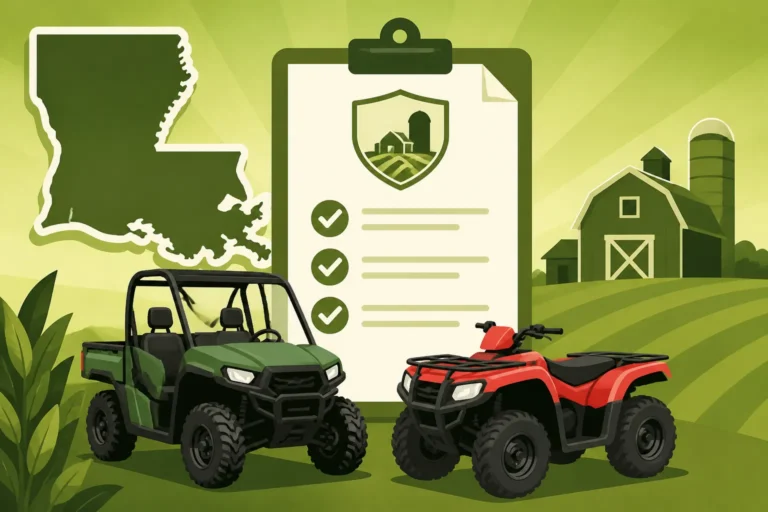
Agriculture is a cornerstone of Louisiana's economy, and the state's laws reflect the practical needs of farmers. One significant exception to the after-dark rule applies to bona fide farming operations. If you're actively engaged in agricultural pursuits, such as hauling feed, checking fences, or moving equipment between fields, you might be allowed to operate your ATV or UTV on certain public roads or shoulders after dark. This is usually within a specific radius of the farm operation, typically five miles, and solely for agricultural purposes. It's important to carry a [Louisiana Farm Affidavit Requirements] sworn before a notary public to prove your eligibility for this exemption.
This is not an excuse for joyriding. The machine must be used for legitimate farm work, and it absolutely must be equipped with proper lighting and reflective materials to ensure it's visible to other motorists. You’re not just relying on the glow of the moon. This exemption recognizes that farming often requires work outside of conventional daylight hours, but it places a high burden on the operator to ensure safety. So, while you might see a farmer checking irrigation after sunset, they are almost certainly doing so as part of their livelihood and with their machine fully lit up, not simply cruising.
Designated Roadways and Parish Ordinances (UTVs only)
Louisiana has a unique provision that allows individual parishes and municipalities to designate certain roads or streets for UTV use. This is detailed in Louisiana Revised Statute 32:299.3. If a local government has officially passed an ordinance designating a specific road for UTVs, and that ordinance specifies or implies that UTVs can operate on it after dark, then you might be able to ride legally.
This is a big "if," and it requires you to do your homework. You cannot assume a road is designated, and you definitely cannot assume night riding is allowed. Most such ordinances will still stipulate strict lighting and safety equipment requirements, often mirroring those of street-legal vehicles. For instance, you'd likely need functioning headlights, taillights, brake lights, and possibly even turn signals and reflective signage. [Louisiana UTV Signage Requirements] often mandate an orange triangular flag or other high-visibility markings. Always check with your local parish or municipal clerk's office for the exact wording of any ordinances and confirm the specific hours of operation permitted.
If your parish does allow it, ensuring your UTV is properly equipped for night visibility is paramount. Companies like SuperATV specialize in aftermarket accessories that can bring your UTV up to snuff, offering everything from LED light bars to full signal kits. While these accessories can greatly enhance visibility, remember that adding them doesn't automatically make your UTV street-legal after dark; it only allows you to meet the requirements if the local ordinance permits. Without that specific local designation and adherence to all lighting rules, you're still bound by the state's general prohibition.
Essential Equipment for Legal Night Riding (When Permitted)
Even if you fall under one of the narrow exceptions for riding an ATV or UTV after dark in Louisiana, simply having permission isn't enough. Your machine must be properly equipped to ensure maximum visibility and safety. This isn't just about avoiding a ticket; it's about making sure you and others on the road stay safe.
Lighting Requirements for Visibility
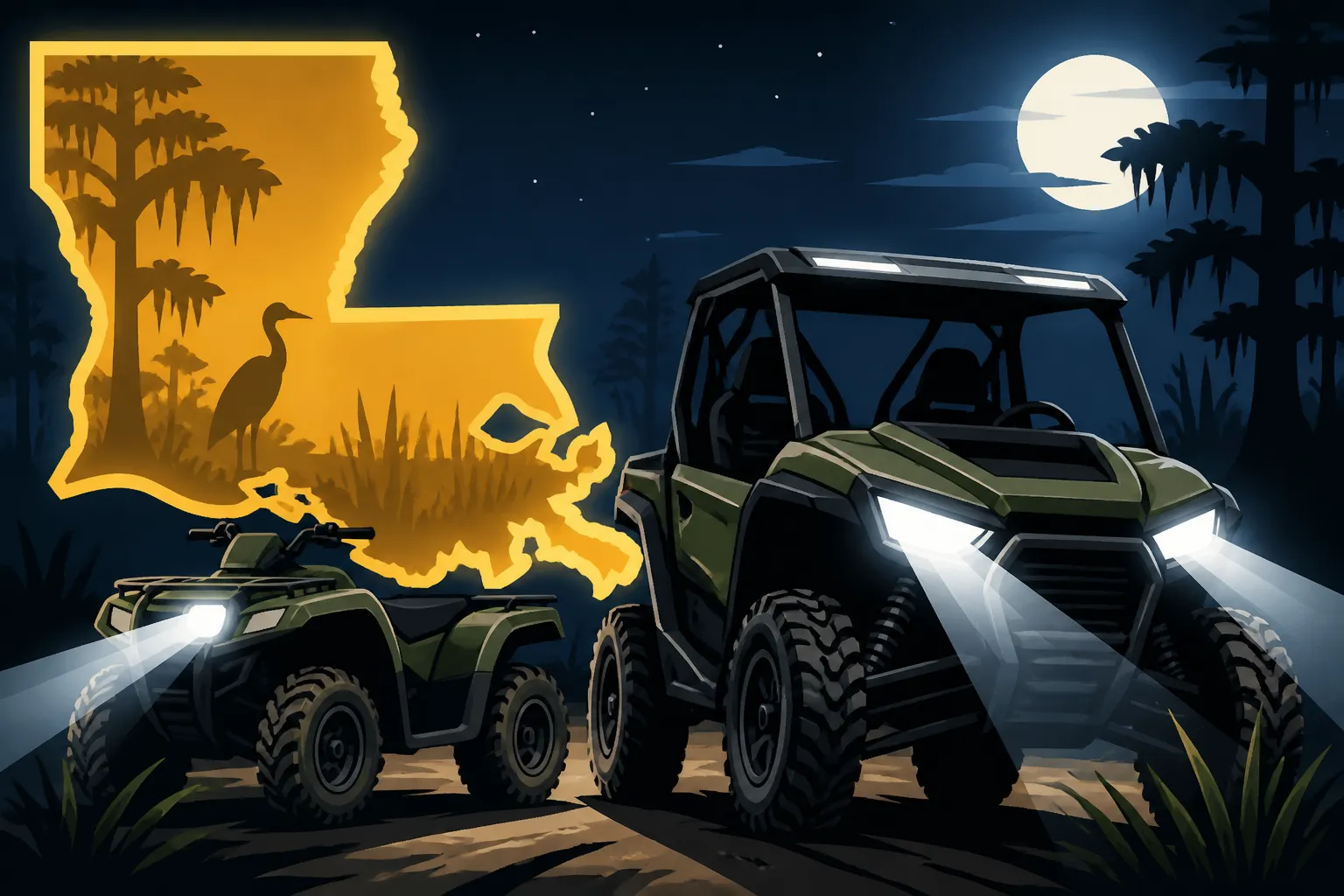
When it comes to after-dark operation, lighting is absolutely non-negotiable. Whether you're a farmer checking fields or riding a UTV on a specially designated parish road, your machine needs to be seen. Louisiana law generally requires ATVs and UTVs (when allowed on public roads) to have at least one working headlight and at least one working taillight. However, to be truly safe and compliant with any local ordinances, you'll need more than the bare minimum.
- Headlights: Your headlights must emit a white light visible from at least 500 feet to the front. Many stock ATV/UTV headlights are sufficient for off-road use but might not be bright enough for public road visibility, especially if you're sharing the road with cars. Consider upgrading to brighter LED headlights or adding auxiliary light bars. Brands like SuperATV offer robust lighting solutions that can significantly improve your forward visibility and make you more noticeable to oncoming traffic.
- Taillights and Brake Lights: A red taillight visible from at least 500 feet to the rear is required. Additionally, brake lights that illuminate when the brakes are applied are crucial. These warn drivers behind you of your intentions. Many UTVs come with these standard, but older ATVs might require an aftermarket kit.
- Reflective Material: Beyond active lighting, your machine should have red reflectors on the rear, visible from 600 feet, and amber reflectors on each side, visible from 200 feet. This passive reflectivity helps other drivers spot you even if your active lights temporarily fail or if they approach from an angle where your lights aren't directly visible.
- Turn Signals: While not always explicitly required by state statute for ATVs on public roads, UTVs operating on designated roads often need to comply with standard vehicle laws, which includes turn signals. Adding a turn signal kit is a wise safety upgrade, even if not strictly mandated in every scenario.
Investing in proper [Louisiana Lighting Rules on a Machine] is not just about avoiding a fine; it's about protecting yourself and others. A poorly lit machine after dark is a severe hazard, inviting accidents that could have devastating consequences.
Reflective Gear and Markings
Beyond equipping your machine, you, as the rider, also play a crucial role in visibility. Wearing reflective gear can make a significant difference in how quickly other drivers identify you. This is especially true if you get off your machine for any reason, like to check a gate or retrieve something from the bed of your UTV.
Consider wearing a reflective vest or jacket, particularly if your ride takes you onto a designated parish road. Helmets with reflective strips are also a smart choice. These items catch and reflect light from other vehicles, making you stand out much more effectively than dark clothing. Even reflective tape on your backpack or boots can contribute to your overall visibility profile. Think of it as creating a "human beacon" in addition to your machine's lights. This added layer of safety is cheap insurance against an unforeseen accident.
Other Safety Considerations for Night Operations
Even with perfect lighting, night riding presents unique challenges that demand extra caution.
- Reduced Speed: Your reaction time is naturally slower in the dark. Reduce your speed significantly, especially on unfamiliar terrain or roads. What looks like a small puddle in daylight could be a deep rut after dark.
- Wildlife: Nocturnal animals are much more active at night. Deer, hogs, and other critters can dart out unexpectedly, causing serious accidents. Keep your eyes peeled and be prepared to react.
- Terrain Awareness: Ruts, rocks, and other obstacles are much harder to spot. If possible, avoid riding completely new or highly technical trails after dark unless you are intimately familiar with them.
- Communication and Emergency Gear: Always carry a fully charged cell phone. Even better, ride with a buddy if you can. A first-aid kit, a bright flashlight (independent of your machine's power), and basic tools are also smart additions to your night riding kit. You never know when you might need to make a quick repair or navigate on foot. SuperATV, for instance, offers various storage solutions and accessories that can help you organize and carry essential emergency gear efficiently.
Remember, the goal is not just to be legal, but to be safe. Night riding is inherently riskier, and taking every possible precaution is just common sense.
Penalties and Consequences of Illegal Night Riding
Ignoring Louisiana's rules about riding ATVs and UTVs after dark can lead to far more than just a stern warning. Law enforcement takes these regulations seriously because they are directly tied to public safety. The consequences can range from financial penalties to the loss of your machine, and even more severe legal and personal repercussions in the event of an accident.
Citations, Fines, and Court Costs
The most immediate consequence of illegal after-dark riding is a traffic citation. A State Trooper or parish deputy can issue you a ticket for violating the specific statutes that govern ATV and UTV operation on public roads. This isn't a simple parking ticket; these are moving violations that carry real financial weight.
You'll likely face [Louisiana Ticket Costs for Road Riding], which can vary but are rarely insignificant. On top of the fine itself, you'll also be responsible for [Louisiana Court Costs for a Citation], which can sometimes equal or even exceed the fine amount, depending on the parish and specific charges. These costs add up quickly. A single instance of illegal night riding could easily set you back several hundred dollars. Furthermore, repeated violations could lead to higher fines, potentially impacting your driving record, and increasing scrutiny from law enforcement in the future. It’s a costly lesson to learn, and one that's easily avoided by knowing and following the rules.
Vehicle Impoundment and Recovery
Beyond the financial hit of fines and court costs, there's another, often more severe, consequence: the impoundment of your ATV or UTV. If you're caught operating your machine illegally after dark on a public roadway, especially if you don't have the necessary permits or documentation (like a farm affidavit), law enforcement has the authority to seize your vehicle.
Imagine having your pride and joy loaded onto a tow truck right there on the side of the road. It's a frustrating and embarrassing situation. Getting your machine back isn't a quick or cheap process. You'll typically be responsible for towing fees, daily storage fees at the impound lot, and possibly administrative fees from the law enforcement agency. These costs accrue every single day your machine sits there. You'll also likely need to appear in court, pay any fines, and prove ownership before the impound lot will release your ATV or UTV. Trying to figure out [How to Get an Impounded Quad Released] can be a bureaucratic nightmare, costing you not just money but also significant time and hassle. It’s a very real and often overlooked penalty for violating the rules.
Safety Risks and Liability
Perhaps the most critical, yet often underestimated, consequence of illegal after-dark riding relates to safety and legal liability. Operating an ATV or UTV in low-light conditions, especially where it's not permitted, dramatically increases the risk of an accident. Your visibility is compromised, and the visibility of others seeing you is also greatly reduced. This isn't just a hypothetical risk; it's a statistical reality.
If you are involved in an accident while riding illegally after dark, the repercussions can be severe.
- Personal Injury: You or your passenger could suffer serious injuries. Without proper lighting, you might not see an obstacle, a pothole, or even another vehicle until it's too late.
- Liability: If your illegal operation contributes to an accident involving another vehicle or person, you could face significant civil liability. Your insurance policy might even deny coverage if you were operating your ATV or UTV in violation of state law or local ordinances at the time of the crash. This means you could be personally responsible for property damage, medical bills, and other expenses, which can quickly run into the tens or even hundreds of thousands of dollars.
- Criminal Charges: In serious accidents, particularly if there are injuries or fatalities, you could face criminal charges in addition to civil suits.
Understanding [Louisiana Accident Reporting for an ATV Crash] is crucial, but prevention is always the best medicine. Even if you carry [Louisiana Insurance Proof on Demand] for road use (which is required if you meet one of the road-use exceptions), being found in violation of the "after dark" rule can complicate or even nullify your coverage. The costs of an accident, both human and financial, far outweigh the fleeting thrill of an illegal night ride. Always prioritize safety and legal compliance over convenience or perceived fun.
Disclaimer
This article is for general informational purposes only and does not constitute professional advice. Laws, prices and regulations vary by location and change over time. Consult a qualified professional for guidance on your specific situation.