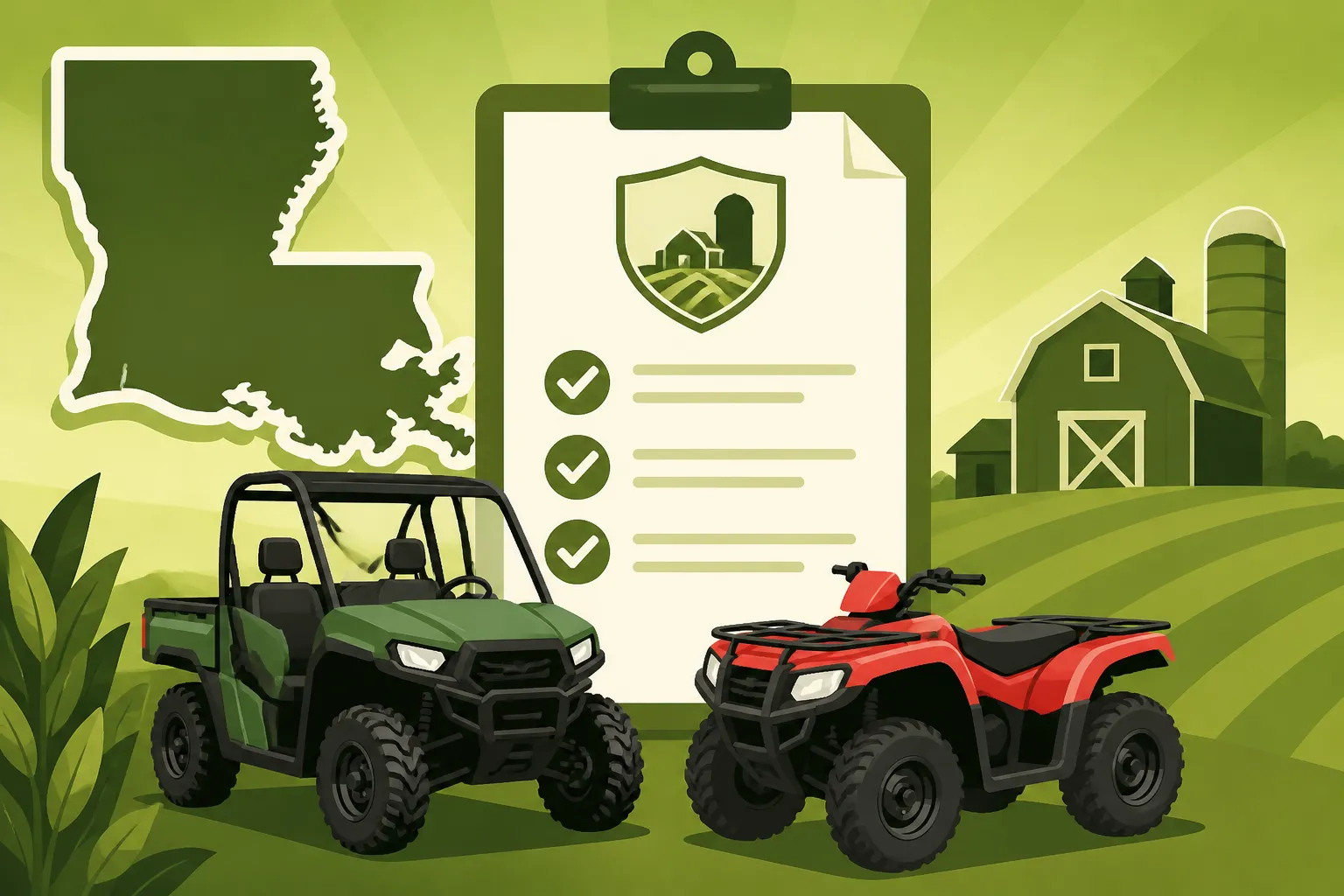
Louisiana Farm Affidavit Requirements
It can be incredibly frustrating to navigate the labyrinth of Louisiana’s ATV and UTV laws, especially when you’re just trying to get honest work done on your farm. Many folks find themselves scratching their heads, wondering if their trusty quad, essential for everything from checking fences to hauling feed, is suddenly a legal liability just for crossing a parish road. This guide is here to untangle the specific requirements for Louisiana Farm Affidavits, helping you understand when and how this crucial piece of paperwork allows you to use your off-road machine for agricultural purposes on public access ways.
Understanding the Louisiana Farm Affidavit for ATVs and UTVs
For many of us who rely on ATVs and UTVs for daily farm tasks, the idea of having to jump through bureaucratic hoops just to move a machine from one field to another can feel like a real nuisance. But the Louisiana Farm Affidavit isn't just another piece of paper; it's a specific legal document designed to acknowledge the unique needs of agricultural operations. It’s a declaration, sworn under oath, that your off-road vehicle is primarily used for farming or ranching activities, and it’s the key to unlocking certain road-use exemptions that wouldn't otherwise apply to recreational machines. Without it, even a quick hop across the road could land you in hot water.
What Exactly is a Farm Affidavit?
Think of a farm affidavit as your official statement to the state that your ATV or UTV is a bona fide farm implement, not just a toy. This document essentially certifies that your machine’s primary purpose is agricultural. It’s what allows you to bypass some of the stricter road-use prohibitions that apply to standard off-road vehicles. This isn't a blanket permit to cruise down the highway, mind you. Instead, it’s a targeted exemption for specific, farm-related movements, like traveling between two non-contiguous parcels of land or accessing machinery across a public right-of-way. The state recognizes that a farmer sometimes needs to cross a road to get from one part of their operation to another, and this affidavit is the mechanism that allows it, within very strict parameters. It’s a vital distinction that prevents everyday farming from becoming a legal headache.
Who Needs to File a Farm Affidavit?
If your ATV or UTV is integral to your farming, ranching, or timber operation in Louisiana, and you foresee any instance where you'll need to operate it on a public road or shoulder, then you absolutely need a farm affidavit. This applies to individual farmers, agricultural businesses, and anyone else who uses these machines predominantly for tasks like crop management, livestock care, fence repair, or forestry work. It’s not for the weekend warrior who occasionally helps a friend with a garden; it’s for those whose livelihood depends on the machine's utility on agricultural land. The state provides a specific affidavit form for this purpose, and it’s critical that you, as the machine owner or operator, complete it accurately. This document explicitly states your machine's dedicated farm use, making it distinguishable from machines used purely for recreation or casual transport. Without this affidavit, even crossing a short stretch of public road for a legitimate farm reason could be seen as illegal operation.
Where Do You Get a Farm Affidavit and Who Witnesses It?
The Louisiana Farm Affidavit form itself is typically available through the Louisiana Office of Motor Vehicles (OMV) or sometimes even directly from agricultural extension offices. It's a fairly straightforward document that asks for details about you, your farm, and your specific ATV or UTV. However, merely filling it out isn't enough to make it valid. One of the most critical steps is getting it properly witnessed and notarized. This isn't just a suggestion; it's a requirement to ensure the document's legal standing. You’ll need to sign it in front of a public notary, who will then affix their seal, validating your sworn statement. This notarization step is similar to how other important documents, like a [Why Your Bill of Sale Needs a Notary], require this official seal to be legally recognized. Once completed and notarized, you typically don’t submit this affidavit to the OMV unless specifically requested. Instead, you need to keep a copy with you whenever you operate the machine on a public road, making it available for inspection by law enforcement. Think of it as your proof of eligibility for these limited road-use exemptions.
Specific Road Use Exemptions Under the Farm Affidavit
So, you’ve got your notarized farm affidavit, but what exactly does it empower you to do? This is where many riders get confused, often assuming it grants broader access than it actually does. The key thing to remember is that the affidavit doesn't magically make your ATV or UTV street-legal in the conventional sense. Instead, it carves out very specific, limited exceptions for farm-related travel on public roads, always with the understanding that the machine's primary function is agricultural. It's all about facilitating essential farm work without turning every brief road crossing into a major legal risk.
Riding on Shoulders and Crossing Public Roads
The primary road-use privilege granted by a farm affidavit relates to using road shoulders and making direct crossings. Louisiana law, specifically under statute 32:299 (and 32:299.3 for UTVs), is very clear on this: if you have a valid farm affidavit, you are permitted to operate your ATV or UTV on the shoulder of a public road. Notice I said "shoulder," not the travel lane itself. [The Statute Allows the Shoulder and Nothing More] for farm machinery. This is crucial. You cannot simply drive in the traffic lane alongside other vehicles, even if you’re just going a short distance.
When it comes to crossing public roads, the rules are equally strict. Crossings must be direct and incidental to your farm operation. This means you should take the shortest possible route across the road to get from one field to another, or to access equipment stored on the other side. You cannot leisurely travel down one side of a road, then cross, then travel back down the other. The intent is to minimize the machine’s time on any public right-of-way. It's about necessity, not convenience. These crossings are generally allowed within a specific radius of your farm, which brings us to the next point.
The 5-Mile Farm Radius: What It Means for Riders
A critical component of the farm affidavit road-use exemption is the "5-mile farm radius." This often-misunderstood rule states that your farm-use-permitted road travel, whether on the shoulder or crossing, must occur within a five-mile radius of your farm property. [The 5-Mile Farm Radius on a Shoulder] is designed to ensure that these exemptions are truly for local, operational needs, not for extended journeys.
Practically speaking, this means if you have multiple parcels of land that are part of your farming operation, or if you need to access a distant pump station or a particular piece of equipment, you can do so on the shoulder of public roads, as long as that travel stays within five miles of your primary farm property. This radius is measured from the nearest point of your farm, giving you a reasonable operational zone. For example, if you have a field a few miles down the road that requires a specific implement, your farm affidavit, combined with the 5-mile rule, allows you to transport that implement via your ATV or UTV on the shoulder, provided it’s within that radius. However, if your second farm property is, say, ten miles away, the farm affidavit alone would not cover that entire journey on public roads; you'd need alternative transport methods for the public road portions outside the radius.
What the Farm Affidavit Does Not Cover
It’s just as important to understand what the farm affidavit doesn't cover as what it does. This document is not a magic wand that transforms your off-road machine into a street-legal vehicle for any purpose. First and foremost, it does not grant you permission to ride in the travel lanes of any public road. Louisiana law unequivocally [Louisiana Bans ATVs From Travel Lanes], regardless of farm affidavit status. This means sticking to the shoulder or making direct crossings only.
Furthermore, the farm affidavit does not supersede local ordinances in parishes or municipalities that have stricter regulations, especially for UTVs. While some parishes may designate specific roads for UTV use, this is a separate process and requires a local ordinance, not just your farm affidavit. It also offers no exemption for riding on interstate highways, within incorporated city limits (unless specifically allowed by local ordinance), or on levees, which are generally off-limits for recreational or even utility riding due to safety and maintenance concerns. The affidavit is strictly for farm-related operations on public roads shoulders within the specified radius, and for direct crossings. Using it for casual errands, joyrides, or any non-farm-related activity on public roads is a misuse and can lead to penalties.
Completing and Maintaining Your Farm Affidavit
Getting your farm affidavit properly filled out and keeping it current might seem like a small detail in the grand scheme of running a farm, but overlooking it can lead to significant headaches down the road. This document is your shield against potential legal issues when your work takes your off-road machine onto public access ways, so making sure it's accurate and accessible is paramount.
Step-by-Step Guide to Filling Out the Affidavit
Filling out the Louisiana Farm Affidavit form is generally straightforward, but precision is key. You'll need to provide your full legal name, contact information, and details about your farm or agricultural operation, including its physical address. Then, you'll specify the ATV or UTV that the affidavit covers. This includes the make, model, year, and crucially, the Vehicle Identification Number (VIN). Always double-check the VIN for accuracy, as a single digit off can invalidate the entire document. The OMV is quite particular about [Serial Numbers the OMV Will Accept on a Title], and the same meticulousness applies here. You'll also be asked to briefly describe the agricultural purpose for which the machine is used, such as "transporting feed," "fence maintenance," or "crop inspection." Be honest and concise in your description. The goal is to clearly establish the machine's role as a tool for your farm, not just a recreational vehicle. Don't leave any blanks; if a section doesn't apply, mark it as such.
Notarization and Record Keeping
Once you've meticulously filled out every field, the next critical step is notarization. As mentioned, you must sign the affidavit in the presence of a public notary. The notary will verify your identity, witness your signature, and then affix their official seal and signature. This step transforms your personal declaration into a legally recognized, sworn statement. It's exactly why [Carrying an Affidavit Sworn Before a Notary] is so important—it gives the document legal weight.
After notarization, make several copies of the completed and signed affidavit. One copy should be kept with your essential farm records. Another, and this is crucial, should always be carried on the specific ATV or UTV it covers whenever you operate it on or cross a public road. You can laminate a copy or keep it in a waterproof bag to protect it from the elements. This way, if a state trooper or local deputy stops you and asks for documentation, you can immediately provide proof of your eligibility for the farm-use exemption. [Louisiana Equipment Checks by Troopers] are a reality in rural areas, and being prepared means a smoother interaction. Failing to produce the affidavit on demand could lead to questioning, delays, or even a citation, despite your legitimate farm use.
Consequences of Misuse or Lapsed Affidavit
The farm affidavit is a privilege, not an inherent right, and using it improperly or letting it lapse can lead to serious consequences. If you’re caught operating your ATV or UTV on a public road for non-agricultural purposes, or outside the 5-mile radius, or in a travel lane, your affidavit offers no protection. This could result in a citation for [Louisiana Penalties for Illegal Road Riding], which can include significant fines and court costs. Even worse, your machine could be impounded, leading to additional fees for towing and storage, not to mention the hassle of getting it back. Imagine being in the middle of a crucial planting or harvest season, and your essential farm machine is sitting in an impound lot because of a misunderstanding or negligence regarding your paperwork.
Furthermore, if your farming operation ceases, or if you sell the machine, the affidavit's relevance diminishes. It’s essential that the information on your affidavit remains current and accurate. While these affidavits don't typically have an expiration date like a decal, any substantial change in your operation or machine ownership could render it obsolete. Always ensure your documentation is up-to-date to avoid any unnecessary legal entanglements.
Beyond the Affidavit: Other Farm-Related Machine Considerations
While the farm affidavit is a cornerstone for legal road access for farm machines, it's just one piece of a larger puzzle. Louisiana law has several other nuances that farmers need to be aware of, spanning everything from decals to insurance. Understanding these additional requirements ensures you're fully compliant and your valuable farm assets are protected.
Does a Farm-Only Quad Need a Decal?
This is a point of frequent confusion. While your farm affidavit grants you specific road-use exemptions, it doesn't necessarily exempt your off-road machine from all decal requirements. In Louisiana, even if your quad is used exclusively for farm work and never sees a recreational trail, it may still require an agricultural exemption decal. This is different from the standard [Louisiana's Yearly Off-Road Decal] that recreational riders purchase. The agricultural exemption decal essentially flags your machine as farm-use only, affirming its non-recreational status. [The Decal a Farm-Exempt Quad Still Has to Carry] is important for identification and helps law enforcement understand the machine’s purpose. While the standard ORV decal is often tied to trail access and general off-road registration, the agricultural decal is specifically designed for machines that fall under the agricultural exemption. It’s a subtle but important distinction that ensures compliance without burdening farmers with fees meant for recreational users. Essentially, [Why an ATV Needs Both a Title and a Decal] clarifies that even farm machines need some form of identification, even if it's an exemption-specific one.
Titling and Sales Tax for Farm Machines
Even if your ATV or UTV is dedicated solely to farm work, it generally still needs a title in Louisiana. The OMV, not the Wildlife and Fisheries Department, is the authority for titling all off-road vehicles in the state, including those used for agriculture. [Louisiana Titles ATVs Through the OMV], and this applies whether your machine is for recreation or farm utility. The titling process confirms ownership and is crucial for resale or proving legitimate possession.
Regarding sales tax, this is another area where farmers often have questions. When you purchase an ATV or UTV for farm use, you are still typically required to pay state and parish sales tax at the point of sale, unless you qualify for a specific agricultural sales tax exemption on the purchase itself. However, regardless of purchase exemptions, the OMV generally [Louisiana Requires Proof of Sales Tax First] before they will issue a title for any vehicle, including off-road machines. This means you’ll need to provide a receipt showing sales tax was paid or pay use tax directly to the OMV. There is a specific [Louisiana's Agricultural Registration Exemption] that applies to the registration portion, but it doesn't automatically negate the sales tax obligation during the initial purchase. It's always best to clarify these specifics with your dealer or the OMV directly when acquiring a new farm machine.
Insurance for Farm ATVs and UTVs
While Louisiana doesn't mandate insurance for off-road vehicles used exclusively on private land, if your farm machine ever touches a public road—even the shoulder, as permitted by your affidavit—then liability insurance becomes an extremely important consideration. While the law technically states [Does Louisiana Require Insurance on an Off-Road Machine?], and the answer for private land is generally no, the moment you use that machine on a public right-of-way, the risks change dramatically.
If you're involved in an accident on a public road, even if it's just a minor fender-bender with another vehicle on the shoulder, you could be held liable for damages. Without liability insurance, you'd be personally responsible for covering those costs, which could be substantial. Many farmers invest in high-quality machines, often accessorized with robust equipment, perhaps from brands like SuperATV, to enhance their utility. Protecting that investment, and your personal assets, with adequate liability coverage for any road-adjacent use is simply smart practice. It’s worth speaking with your farm insurance agent to see if your ATV or UTV can be added to an existing farm policy, or if a separate off-road vehicle policy is more appropriate, especially if you regularly utilize the farm affidavit for road travel. Don't let a small oversight in insurance coverage put your entire operation at risk.
Comparison of Road Use Authorizations for ATVs/UTVs in Louisiana
| Feature/Authorization Type | Farm Affidavit | Standard ORV Decal | Road-Designated UTV (Parish Ordinance) |
|---|---|---|---|
| Primary Use Case | Agricultural/Farm Work | Recreational Off-Road | Limited Road Travel (Utility/Recreation) |
| Required Document | Notarized Farm Affidavit | ORV Decal (yearly) | Title, Registration, Insurance, Class E License |
| Permitted Road Use | Shoulder, direct crossings (within 5-mile farm radius) | None (prohibited on public roads) | Designated roads/streets only (posted signs) |
| Travel Lanes Allowed? | No | No | Only on designated roads/streets |
| Interstate/Highway Use | No | No | No |
| Required License | No, but Class E for UTVs if designated | No | Yes, Class E for UTVs |
| Age Requirement | Varies by machine/use | Varies by machine/use | 21+ for UTVs on designated roads |
| Notarization Needed? | Yes, for the affidavit | No | No, for the registration |
| Required Insurance | Recommended (if on roads) | No (if private land only) | Yes, statutory minimums |
| Agricultural Exemption | Yes, if applicable | No | No |
| Example Scenario | Crossing Hwy 1 to check cattle | Riding trails at Muddy Bottoms | Driving UTV on designated town street for errands |
Understanding the specific requirements for a Louisiana Farm Affidavit can feel like navigating a maze, but it's an essential step for any farmer relying on ATVs or UTVs for their operations. By meticulously completing your affidavit, having it notarized, and keeping it accessible, you ensure that your vital farm work isn't hampered by legal ambiguities. Remember, this document is a tool for legitimate agricultural travel, not a pass for general road use. Always prioritize safety, adhere to the strict limitations, and consider additional protections like insurance for your valuable machines—whether they're stock or equipped with robust accessories from providers like SuperATV—to keep your farm running smoothly and legally.
Disclaimer
This article is for general informational purposes only and does not constitute professional advice. Laws, prices and regulations vary by location and change over time. Consult a qualified professional for guidance on your specific situation.