Louisiana Rules for a Sixteen-Year-Old Rider
A 16-year-old may be ready to ride, but age alone does not answer whether they can use a particular ATV or UTV in Louisiana. The rules depend on where they ride, what they drive, and the requirements set by the landowner or riding area. Here’s how to sort out the main restrictions before a teen gets on the machine.
Start with the machine and where it will be ridden
An ATV and a UTV are not interchangeable under Louisiana rules. An ATV is generally a straddle-seat machine operated with handlebars. A UTV is typically a side-by-side with a steering wheel and seats. That difference matters especially when a ride involves public roads.
There is no single age-based permission that should be treated as approval to ride every machine everywhere. A 16-year-old’s eligibility can depend on the machine’s design, the owner’s instructions, the riding area’s rules, and whether the route includes a public road. A facility or landowner may set stricter limits than a rider expects.
| Riding setting | What a 16-year-old should check |
|---|---|
| Private property | Permission to ride, the machine’s age and size suitability, and the landowner’s rules |
| Private riding park | Minimum age, supervision, helmet, passenger, and trail requirements |
| Wildlife Management Area | Current access rules, permitted trails, vehicle limits, permits, and any age-specific conditions |
| Public road or shoulder | Whether the specific statutory exception applies, plus age, license, equipment, and route restrictions |
| Public forest trail | Whether motorized riding is allowed on that trail and whether the rider and machine meet current site rules |
The most practical first step is to identify the exact riding location and machine. “My teenager is 16” is not enough information for a park attendant, land manager, or law enforcement officer to determine whether the ride is allowed.
For a broader overview, see Louisiana ATV Age Requirements and Louisiana Rules for a Teen Rider. Rules for a younger rider can differ, so a 16-year-old should not assume that guidance for a child under 16 applies in the same way—or that turning 16 removes every restriction.
On private land
A teen may be allowed to ride on private land if the owner or person in charge gives permission and sets appropriate conditions. That permission does not make an unsuitable machine safe. A large, heavy ATV or UTV can be difficult for an inexperienced teen to control, particularly on slopes, in deep mud, or when carrying a passenger.
The person supervising should match the machine to the rider’s size, strength, judgment, and experience. Follow the manufacturer’s age guidance for the specific model. A machine designed for an adult may be too powerful or physically demanding even when the rider can reach the controls.
At parks and managed riding areas
A private park can impose its own minimum age, supervision, helmet, passenger, and operating rules. Those rules may vary between facilities and can also differ by event. Check the park’s current requirements before traveling, rather than relying on a friend’s experience from a previous visit.
Public riding areas have their own access rules. For example, a Wildlife Management Area is not open to unrestricted off-road riding just because a rider has permission to enter the property. The permitted routes, vehicle limits, permits, and seasonal restrictions still matter. Review Louisiana WMA Riding Rules for Quads or Louisiana WMA Riding Rules for UTVs for the applicable machine type, and confirm the current rules for the specific area.
Public-road riding is a separate question
A common mistake is to assume that a teen who may ride off-road can also drive the machine on a road. Louisiana’s limited public-road rules are separate from ordinary off-road use. They do not turn an ATV or UTV into a street-legal vehicle for general transportation.
For UTVs, Louisiana’s special public-road provisions include a minimum driver age of 21. A 16-year-old therefore should not drive a UTV on a public road under that provision. Read Louisiana UTV Road Rules Under 32:299.3 for the conditions that apply to qualifying UTV road use.
ATV road use is also restricted. Louisiana’s limited exception is not a general permission to ride along public roads, and it includes requirements such as a valid Class E driver’s license. A 16-year-old should not assume that holding a learner’s permit or an intermediate license satisfies that requirement. Confirm the rider’s exact license status and the current legal conditions before considering any public-road use.
The distinction between a public road and private property can be easy to miss. A route across a field may be private, while a nearby shoulder or parish road is public. A rider should not enter a road or shoulder simply because it is close to a legal trail or because other people routinely ride there.
For more detail on the narrow rules, see Louisiana Rules for Riding a Parish Road and Can You Ride an ATV on the Road in Louisiana?. Those rules are not a substitute for checking whether a particular road is designated for the relevant use and whether the rider and machine meet every condition.
Crossing a road is not the same as riding along it
A limited crossing may be treated differently from traveling along a road, but riders should not interpret that distinction broadly. A short, necessary crossing does not create permission to use the roadway as a route. Follow any applicable signs and restrictions, cross only where permitted, and yield to traffic.
If the ride plan requires a teen to travel along a public road, use another route or transport the machine. Do not rely on an informal understanding that a road is quiet, rural, or used by other off-road vehicles.
Supervision, training, and protective gear
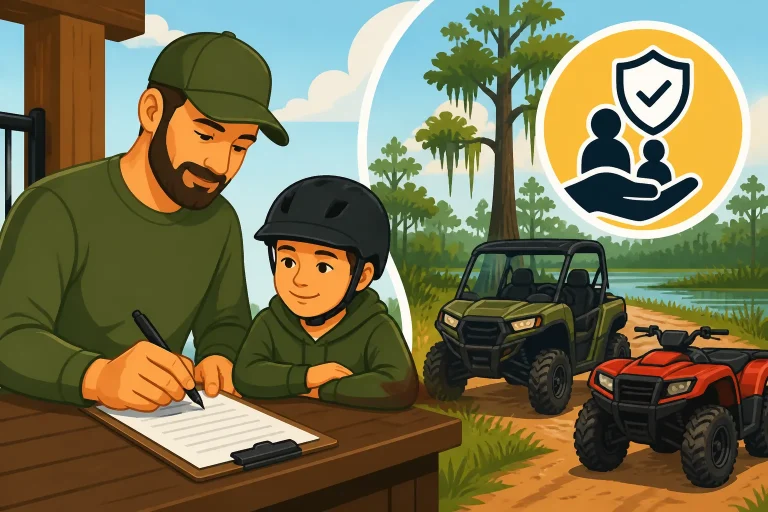
Even where a 16-year-old is allowed to ride, safe operation takes more than reaching the minimum age. A teen may have limited experience judging terrain, spotting hidden obstacles, handling a rollover risk, or recognizing when a water crossing is too deep. Supervision should be close enough to prevent risky decisions, not merely an adult’s presence somewhere on the property.
Choose a machine the rider can control confidently. Check that the teen can reach and operate the brakes, throttle, steering, and shutoff controls, and can mount and dismount without help. Review the owner’s manual and use its age and passenger guidance. Never carry a passenger on a machine that is designed for one rider.
A safety course can be useful even when it is not mandatory. Louisiana does not have a general mandatory ATV safety course requirement, but that is not a reason to skip instruction. A course or hands-on orientation can cover starting and stopping, turning, braking, riding on slopes, safe spacing, and what to do if the machine becomes stuck. See Louisiana Has No Mandatory Safety Course for the difference between a legal requirement and a sensible precaution.
At minimum, use a properly fitted helmet designed for motorized riding, eye protection, gloves, long sleeves, long pants, and sturdy over-the-ankle boots. A helmet that shifts or exposes the forehead is not a good fit. If shopping online, including through Amazon, check the helmet’s fit guidance and applicable safety certification rather than choosing by appearance alone. Have the rider try it on and make sure it stays secure.
Set clear ride boundaries before starting. Agree on where the teen may go, how far ahead they may ride, where they must stop, and what signal to use if there is trouble. Keep a working way to contact the supervising adult when practical, but do not treat a phone as a replacement for supervision, especially in areas with poor reception.
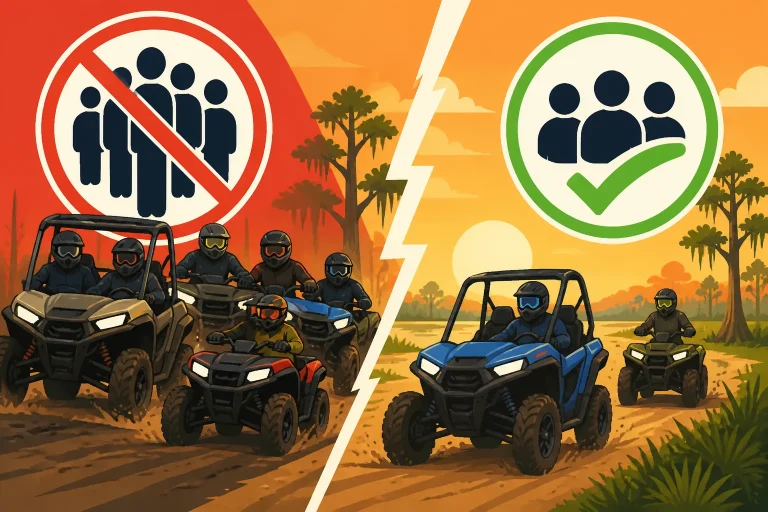
Night riding, passengers, and alcohol create additional risks. Check the location’s specific rules before riding after dark; private parks and public areas may have different restrictions. A teen should not carry a passenger unless the machine is designed for one and the applicable rules allow it. See Louisiana Rules for Riding After Dark for more on the conditions that can apply.
A practical check before the ride
A short pre-ride check can prevent a long drive to a closed trailhead or a disagreement at a park entrance. Confirm the location’s rules directly, especially if the ride is on public land or part of a scheduled event. Access policies and seasonal restrictions can change.
Use this checklist:
- Identify the machine. Confirm whether it is an ATV or UTV, and check the model’s intended rider age, passenger capacity, and operating instructions.
- Confirm permission. Get permission from the property owner or confirm that the riding area is open to the public and allows the machine.
- Check the age and supervision rules. Ask the park or land manager whether a 16-year-old may operate that model and whether an adult must accompany them.
- Review the route. Determine whether the ride stays on private land or approved trails. Do not assume a public road, shoulder, levee, or utility route is open to off-road machines.
- Check permits and equipment limits. Public land may require a permit and restrict where a machine can go or which machines it allows. A permit does not override trail closures or vehicle requirements.
- Prepare the rider and machine. Fit the helmet and protective gear, review controls, and check tires, brakes, lights, fuel, and other safety items.
- Set a supervision plan. Establish boundaries, a meeting point, and a way to stop the ride if conditions change.
For rides on a Wildlife Management Area, use the current map and official access information rather than choosing a trail based on appearance. A visible track may not be an authorized motorized route. The same caution applies after rain, during seasonal closures, or when signs at the entrance differ from older information.
If a rider is visiting Louisiana from another state, do not assume that an out-of-state registration, decal, or riding permission settles every age and access question. The rules for a visiting machine and the rules for a teen operator are separate issues. Louisiana Rules for an Out-of-State Machine can help with the machine side of that check.
When the answer is unclear, pause and ask the park, land manager, or relevant agency before unloading. For a public-road question, verify the specific road-use conditions and the teen’s license eligibility with an authoritative source. A conservative answer may mean changing the route, but it is safer than relying on a broad claim that “ATVs are allowed” or “16 is old enough.”
Disclaimer
This article is for general informational purposes only and does not constitute professional advice. Laws, prices and regulations vary by location and change over time. Consult a qualified professional for guidance on your specific situation.