Louisiana WMA Riding Rules for Quads
Planning a quad ride on a Louisiana wildlife management area can be confusing: public land does not mean every trail is open to machines. You generally need to use marked routes, follow permit and equipment rules, and check for seasonal closures. Here’s how to prepare, what limits to check, and where a WMA ride differs from riding in a private park or forest.
Where You Can Ride and What Permit You Need
A wildlife management area, or WMA, is not an unrestricted off-road riding area. Quad access is limited to the routes and conditions allowed for that particular WMA. The safest starting point is its current map and regulations, not a trail you can see on the ground or a route someone has described.
On WMAs that allow quad riding, stay on designated trails. A path that looks established may be closed to motor vehicles, and a route shown on an old map may no longer be open. Do not cut across woods, fields, or wet ground to reach another trail. Riding off the designated route can damage habitat and may result in a violation even if the machine and rider otherwise meet the rules.
Before unloading, identify the WMA you are visiting and check its current access information. Look for:
- Whether quad riding is allowed at that location
- Which marked trails are open to machines
- Seasonal closures and any exceptions
- Permit requirements and how to complete them
- Machine, tire, and operating-hour restrictions
- Parking and overnight-storage rules
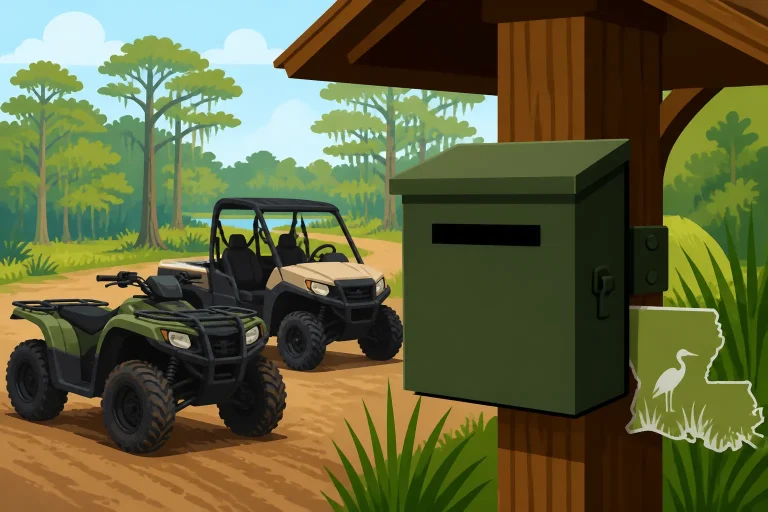
Some WMA access requires a self-clearing permit. Where one is required, complete it as directed at the trailhead or access point before riding, and keep the portion you are told to retain. Do not assume that a permit for one activity automatically covers every use, or that a permit from a different property applies. The steps are explained in Louisiana Self-Clearing Permit Steps, and Why Louisiana WMAs Need a Self-Clearing Permit covers the purpose of the system.
A self-clearing permit is not permission to ride anywhere on the WMA. It works alongside the property’s access rules: you still need to stay on allowed trails, follow closure dates, and use a machine that meets the applicable limits. If there is no clear permit box or sign at the entrance, check the official property information rather than guessing.
A WMA is also different from a national forest trail system. Kisatchie National Forest has its own access requirements, trail status, and use passes. A WMA permit does not replace a forest pass, and a forest pass does not authorize riding on a WMA. For the separate forest system, see Louisiana Forest Trail Use Passes.
Check the map at the trailhead
Use a current map to confirm where a marked route begins and ends. Trail signs can be hard to spot in brush or after weather, so it helps to know the route before setting out. If a trail marker is missing or the map and signs appear to conflict, stop and check with the managing agency or the posted contact before proceeding.
Download or save the relevant map before leaving home if service may be unreliable. Keep a copy that is usable offline, and bring a paper version if you are unfamiliar with the area. A phone map can be useful, but it is not a substitute for official trail designations. Do not treat a general navigation app’s dirt-road line as proof that a route is open to quads.
Quad Size, Tire, and Condition Limits
WMA riding can come with equipment restrictions that are stricter than the rules at a private riding park. These limits protect trails and natural surfaces from damage. A quad that is legal on private land or at a mud park may not meet a WMA’s requirements.
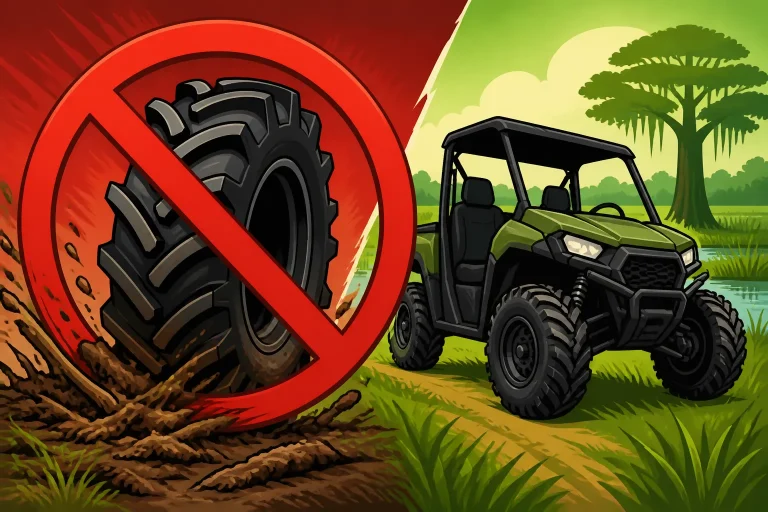
Rules listed for Louisiana WMA machine access include limits on vehicle weight, tire dimensions, lug height, and tire pressure. The commonly cited limits include a quad weighing under 750 pounds, tires no wider than 26 by 12, lugs no taller than 1 inch, and tire pressure no higher than 12 PSI. Check the current rules for the WMA you plan to visit before relying on those figures: property rules and current access notices control.
| Equipment check | Limit to verify before riding | Why it matters |
|---|---|---|
| Quad weight | Under 750 pounds where that limit applies | Heavy machines can damage trails and may be excluded |
| Tire dimensions | No larger than 26 by 12 where that limit applies | Oversize tires can increase ground disturbance |
| Lug height | No more than 1 inch where that limit applies | Tall lugs can tear up trail surfaces |
| Tire pressure | No higher than 12 PSI where that limit applies | Excess pressure may conflict with access rules |
| Tire type | Farm-tread restrictions may apply | Aggressive tread can damage designated routes |
The exact measurement method can matter. If the rule refers to tire size or lug height, do not rely on a seller’s informal description or a visual estimate. Check the tire markings and current agency instructions. If you are changing tires, verify that the replacement set complies before transporting the machine to the WMA.
Pressure is easy to overlook because riders often adjust it for terrain. If the applicable limit is 12 PSI, set and check pressure before entering the trail system. A compact gauge can help you avoid guessing; one is available from many auto and outdoor retailers, including Amazon. Carrying a gauge is useful only if you follow the rules posted for that WMA.
Farm-tread tires are another possible issue. A tire’s suitability for a field or private property does not mean it is allowed on a WMA trail. Confirm the rule before loading the quad. Likewise, do not assume a machine is exempt because it is used for hunting, fishing, or work elsewhere on the property.
For more detail on the specific equipment restrictions, see Louisiana WMA Tire Rules Explained and Louisiana WMA Weight Limits Explained. If your quad is close to a listed limit, confirm its actual specifications and the applicable measurement method before making the trip. A disagreement at the trailhead is a poor time to discover that a machine is too heavy or its tires are outside the permitted range.
Seasonal Closures, Hours, and Limited Exceptions
A trail that is open during one part of the year may be closed to quad traffic during another. Louisiana WMA riding rules include a broad seasonal ban from March through August, with limited exceptions that depend on the activity and property rules. Do not treat the exception as a general riding season extension.
A seasonal exception may permit access for a specific purpose, such as an authorized spring squirrel season. That does not mean every trail is open, that all riding activities qualify, or that a rider may ignore other restrictions. Confirm the WMA’s current dates and terms before heading out. Louisiana WMA Season Closures explains the seasonal restrictions, and The Spring Squirrel Exception to the WMA Ban addresses the narrow exception.
Operating hours are also restricted. WMA rules commonly limit riding to a defined daytime window, with a stated start time of 4 a.m. and a cutoff two hours after sunset in the relevant rules. Exceptions may apply to particular permitted activities, such as certain hunting or retrieval situations. Confirm the current rule for the property and activity rather than assuming that ordinary trail riding is allowed after dark.
The sunset cutoff is not an invitation to begin a ride late in the day and continue until the final minute. Allow time to return to the trailhead, find the correct exit, and load safely. Louisiana’s woods can be difficult to navigate in low light, and a machine problem or blocked route can leave you on the trail after the permitted period.
Closures can change during the season
A trail may close because of weather, habitat conditions, management work, or another property-specific reason. Recent rain can also make a route vulnerable to rutting. If a trail is closed, do not ride around a gate or find an alternate path through the woods. Check the property’s current notice and respect signs at the entrance and along the route.
Before departure, check both the general WMA regulations and the specific property’s latest notices. A printed map can remain useful for orientation, but it may not reflect a temporary closure. If the information is unclear, contact the managing agency or the site contact before unloading.
Riding Safely and Avoiding Common Violations
Preparation is the simplest way to keep a WMA ride from turning into a citation or a long walk back to the truck. Confirm the rules before you leave, then check the machine and paperwork at the access point.
Use this checklist:
- Confirm the property and route. Make sure quad riding is allowed on the WMA you plan to visit and identify its marked trails.
- Check current notices. Look for seasonal restrictions, temporary closures, operating-hour rules, and any property-specific conditions.
- Complete the required permit. Follow the posted process and retain the correct portion if instructed.
- Measure the machine against the limits. Check weight, tire size, lug height, pressure, and tire type against the current rules.
- Carry the information you may need. Keep your permit and a usable map accessible, and know where the trailhead and exit are.
- Stay on marked routes. Do not cut corners, ride around barriers, or follow an unmarked path because it appears to connect to the trail.
- Leave before the operating cutoff. Build in enough time to return and load the quad within the allowed hours.
One frequent mistake is confusing WMA access with game retrieval. A limited retrieval rule, where applicable, is not a general trail-riding exception. It may be restricted by the purpose of the trip, the number of machines, the route, or other conditions. Check [Louisiana Game Retrieval by Quad] and Louisiana Retrieval Party Limits before relying on retrieval access. Never use a retrieval exception as a reason to explore closed trails.
Another mistake is assuming that an out-of-state decal or registration resolves Louisiana WMA access requirements. A decal, title, or proof of ownership does not automatically satisfy a WMA permit requirement or establish that the machine meets trail limits. Visiting riders should check Riding Louisiana Public Land on an Out-of-State Machine as well as the WMA’s current property rules.
Do not rely on what other riders are doing. A machine on a trail may be there under a different permit, an exception, or a rule that does not apply to your trip. If you see an open gate or tire tracks beyond a sign, that is not proof that the route is legally open to you.
Finally, distinguish WMA regulations from general Louisiana road rules. A WMA trail is not a public road, and a quad’s title or off-road decal does not grant permission to ride on a closed public route. Conversely, a rule that applies to road riding does not necessarily describe what is allowed on a WMA. For the separate state-road requirements, see Louisiana ATV Road Rules Under 32:299.
When in doubt, pause at the trailhead and verify. A short call or check of an official notice is easier than returning home after discovering that the property is closed, the trail is not designated for quads, or the machine does not meet the access limits.
Disclaimer
This article is for general informational purposes only and does not constitute professional advice. Laws, prices and regulations vary by location and change over time. Consult a qualified professional for guidance on your specific situation.