Riding Louisiana Public Land on an Out-of-State Machine
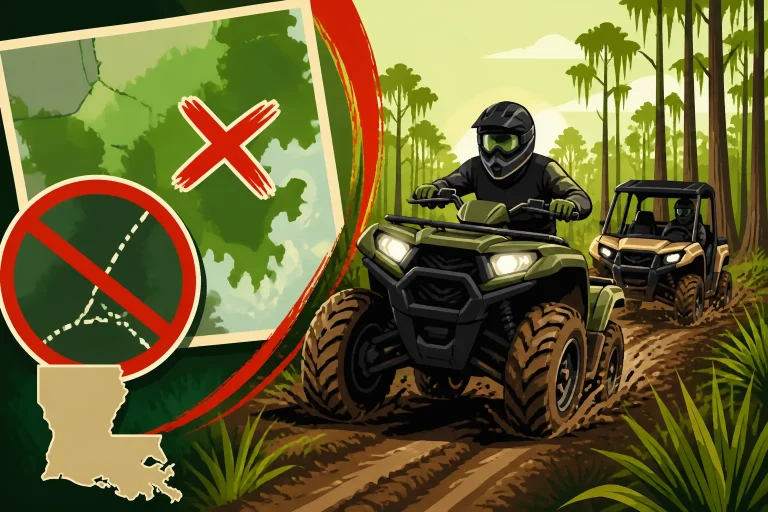
An out-of-state ATV or UTV does not automatically have permission to ride Louisiana public land just because it is registered, titled, or allowed on trails at home. The key is to identify who manages the land, what that area requires, and whether your machine qualifies. This guide helps visiting riders sort out permits, home-state documents, machine rules, and the checks worth making before towing.
Start With the Land Manager, Not Your Home-State Decal
“Public land” is not one single riding system. In Louisiana, the requirements depend on the particular forest, wildlife management area, trail, or other property you plan to visit. A permit that works at one location may not cover another, and a valid out-of-state registration or decal is not a substitute for a local land-use permit.
Before you pack, identify the exact riding area and its land manager. A trailhead may sit within a larger public property but have its own designated routes, seasonal schedule, vehicle limits, or access procedure. The name of the nearest town or forest is not always enough to pin down the rules. Find the specific trail or unit on an official map, then check the managing agency’s current information for that location.
A useful distinction is:
- State wildlife management areas: These can have self-clearing permits, designated-route restrictions, seasonal closures, and machine or tire specifications. Riding may be allowed only on marked routes and during allowed periods.
- Kisatchie National Forest trail sites: Some designated motorized trail areas have a forest-use pass or fee requirement. A pass does not mean every forest road or trail is open to motorized riding.
- Private parks and event grounds: These are not public land. They set their own admission, waiver, safety, age, and machine rules, even if they are located near public land.
- Roads and rights-of-way: A road that crosses public property is not necessarily an authorized ATV route. Road-use laws and land-manager rules may both apply.
If you are choosing between a forest trail and a WMA, do not assume one permit covers both. Check the details for the exact riding area, including what counts as an authorized route and whether the access requirement applies to each rider, each machine, or the vehicle used to transport them.
The agency page, posted notice, or official map should be your final reference—not a forum post, an old trail report, or a friend’s memory of last season. General guides to [Louisiana Forest Trail Use Passes] and [Louisiana WMA Permit Requirements] can help you understand the two systems, but confirm the current instructions for the place you intend to ride.
Does an Out-of-State Registration or Decal Transfer?
Sometimes visitors expect their home-state registration, OHV sticker, or trail decal to function as a universal pass. It may be relevant to proving that the machine is properly documented, but it does not automatically satisfy every Louisiana requirement.
Treat these as separate questions:
- Is the machine documented or identified as required? Your home state may issue a title, registration, or off-road decal. Keep the paperwork that applies to your machine and ownership.
- Does Louisiana require a state decal from a visiting rider? The answer can depend on current Louisiana rules and the visitor’s circumstances. Do not assume that an out-of-state sticker is accepted—or that every visitor must buy a Louisiana decal—without checking the current rule.
- Does the land manager require a separate pass or permit? A state decal generally does not replace a forest-use pass or WMA self-clearing permit.
- Is the machine allowed on that specific route? A valid decal does not make a route open to ATVs or UTVs.
This is why reciprocity needs to be checked rather than guessed. Louisiana may treat a visiting machine differently from a locally owned one, and a visitor’s home-state document may not be equivalent to a Louisiana decal. The relevant question is not just, “Do I have a sticker?” It is, “Does this document meet the Louisiana requirement for this machine and this kind of use?”
Review the current guidance on Louisiana Rules for an Out-of-State Machine and [Louisiana Rules for an Out-of-State Decal]. If the wording does not clearly answer your situation, ask the land manager or appropriate state office directly. Explain that you are a nonresident, where the machine is titled or registered, what decal or document it carries, and where you plan to ride. A clear answer to those details is more useful than asking generally whether Louisiana “takes” your home-state sticker.
| Document or requirement | What it may help establish | What it does not automatically provide |
|---|---|---|
| Home-state title or ownership document | Who owns the machine and how it is identified | Permission to ride a Louisiana public trail |
| Home-state registration or off-road decal | Compliance with some home-state rules; possibly relevant to Louisiana reciprocity | A forest pass, WMA permit, or permission for every route |
| Louisiana ORV decal, if required for your situation | Compliance with a Louisiana state requirement | Access to a closed or undesignated trail |
| Forest-use pass, where required | Access under the applicable forest fee or pass system | Permission to ride throughout the entire forest |
| WMA self-clearing permit, where required | Completion of the WMA’s access procedure | Permission to leave designated routes or ignore equipment limits |
| Trail map and current status information | Which routes are open and where they go | A substitute for required permits or machine eligibility |
For a closer explanation of why the two state-level documents are not interchangeable, read Why an Off-Road Decal Is Not Street-Legal Registration. The same principle applies to public-land access: a decal may help with one legal obligation while doing nothing to satisfy another.
Public-Land Permits Are Separate From Reciprocity
A visiting rider can meet Louisiana’s state-level documentation rules and still arrive without the permit required by the land manager. This is one of the most common planning mistakes because riders often use “registration,” “permit,” and “pass” as if they all mean the same thing.
Wildlife management areas
A WMA may use a self-clearing permit system. In practice, that means you may need to complete a permit at a designated location or through the method the agency specifies before using the area. Follow the posted process, carry or retain the required portion if instructed, and complete any check-out step the system requires.
Do not assume that buying a hunting or fishing license replaces a WMA access permit. They serve different purposes. Likewise, a self-clearing permit does not necessarily authorize riding every road or track on the property. The route must be open to motorized use, and the machine must meet the rules for that unit.
Read [Louisiana Self-Clearing Permit Steps] before you leave home. If the site relies on a permit box or a paper form, bring a pen and allow time to complete the procedure. If instructions have changed to an online or other process, use the current official directions rather than relying on an older visitor’s routine.
Kisatchie National Forest trail areas
Some designated motorized trail locations in Kisatchie National Forest have their own pass or fee requirements. Check the precise trail area, what the pass covers, how it is obtained, and whether the pass must be displayed or carried. A forest pass is not a general license to ride anywhere in the forest. Roads, trails, and off-road areas can have different designations, and some routes may be closed to motorized use.
A common planning error is to look up a forest pass but not check whether the trail is open. Weather, maintenance, seasonal restrictions, or temporary closures can change access. Confirm both the pass requirement and the status of the exact route. Checking a Trail Status Page First is a useful habit before any trip, especially if you are towing a long distance.
Private parks are different
A private mud park or riding venue may accept visitors from other states, but its rules come from the property operator, not from public-land reciprocity. You may need to complete a waiver, meet age or helmet requirements, follow passenger restrictions, or comply with event-specific rules. A Louisiana public-land permit will not necessarily get you into a private park, and a private park admission or waiver does not authorize riding on public land.
Make sure you are looking at the right type of access before paying for a pass or planning a route. Public-land access is controlled by the managing agency; a private property owner or event operator controls private land.
Check Machine Eligibility Before You Tow
A machine can be legal and properly documented at home yet still fall outside the rules of a particular Louisiana riding area. Public-land rules can limit where you ride, what kind of machine you bring, and sometimes its weight, width, tires, or other equipment. Those restrictions are not minor details: a machine that does not qualify may be turned away even if you have the right permit.
ATVs and UTVs may have different rules
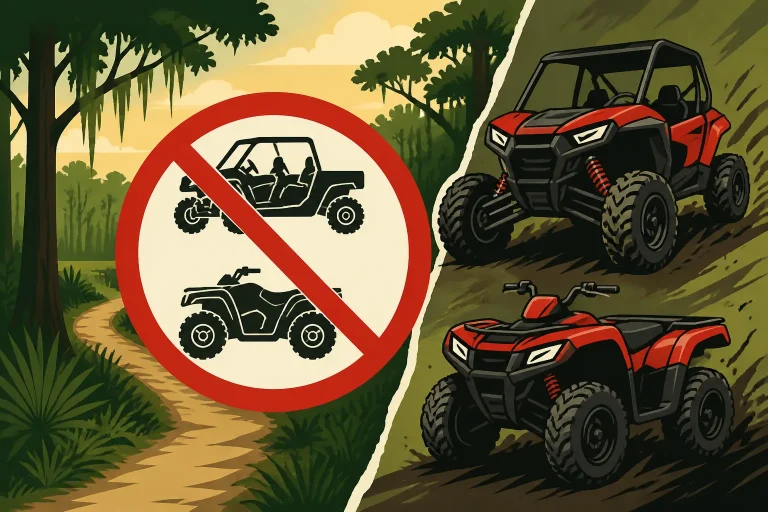
Do not assume a rule for a quad applies to a side-by-side. Some land managers set separate limits for ATVs and UTVs, and a trail system that allows one class may restrict the other. Check the machine category used in the official rules, not just the name you use for your vehicle.
For WMA riding, review the specific guidance for Louisiana WMA Riding Rules for Quads or Louisiana WMA Riding Rules for UTVs. Pay attention to any listed limits on weight, dimensions, tires, or route use. The rules can be more restrictive than what you encounter at a private park or on your own property.
Tire and equipment rules can matter
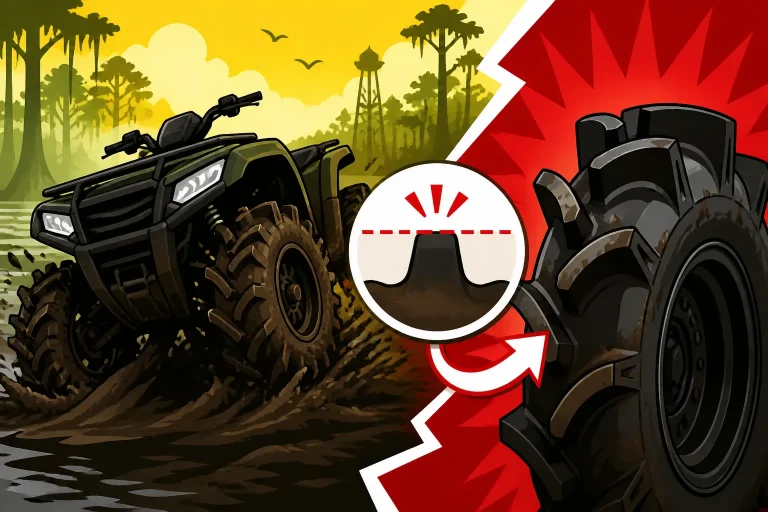
Some public-land rules address tire size, lug height, pressure, or tread type. A setup built for deep mud may not be acceptable on a managed trail. This can surprise riders who assume that bigger, more aggressive tires are always better for Louisiana conditions. They may be useful in mud, but they can damage sensitive trail surfaces or conflict with land-manager limits.
Compare the machine’s actual specifications with the current rules before you travel. Do not rely on a sales listing or a vague description like “stock tires.” If you have changed tires, wheels, suspension, or other parts, check the machine as it is now configured. The guide to Louisiana WMA Tire Rules Explained can help identify the kinds of specifications to verify.
Also check whether the machine has required safety equipment, working lights, a spark arrester, or other features for the place you plan to ride. Requirements vary by land and activity. Do not treat road equipment rules as a full checklist for off-road trails, or vice versa.
Season and hours can restrict access
A trail shown on a map may not be open throughout the year. WMAs can have seasonal riding restrictions, and trail closures can also follow local conditions or management needs. Hours may be limited as well. Before setting out, verify the season, daily riding window, and any exceptions that apply to the specific route.
Do not assume hunting-season access means motorized riding is allowed, or that a route is open simply because another part of the property is open. See Louisiana WMA Season Closures for background, then verify the current dates and any temporary notices from the managing agency.
A Practical Pre-Trip Check for Visiting Riders
A quick, deliberate check before leaving can prevent an expensive wasted trip. Keep the answers in one place—on your phone and, if reception may be poor, on paper.
- Name the exact riding area. Write down the trail, unit, or access point rather than only the forest or parish.
- Identify the manager. Confirm whether the land is managed by a state agency, federal agency, private operator, or another authority.
- Check the route designation. Make sure the trail or road is open to the type of machine you are bringing. Do not infer permission from a line on a general map.
- Check current closures and conditions. Look for seasonal restrictions, storm damage, maintenance closures, fire notices, or other temporary limits.
- Confirm permits and passes. Find out what you must obtain, where to obtain it, and whether each rider or machine needs a separate one.
- Resolve the out-of-state document question. Check whether your home-state registration or decal is accepted for your situation and whether a Louisiana decal is required.
- Compare machine specifications. Confirm the ATV or UTV category, weight, width, tires, and any required safety equipment against the current rules.
- Prepare ownership documents. Carry the documents that identify the machine and show your right to use it. A photo of a document may be convenient, but do not assume it will be accepted when an original or specific form is required.
- Save contact details and directions. Download maps and official notices in case cell service is unreliable near the trail.
- Recheck shortly before departure. Conditions and closures can change after you have planned the trip.
For proof-of-ownership questions, see Louisiana Proof of Ownership on the Trail. If you are unsure what a local official may ask to see, keep your documents organized and accessible instead of buried under riding gear. Your home-state paperwork can be particularly useful when a machine is borrowed, recently purchased, or titled to someone who is not on the trip.
Useful items to bring include a printed or downloaded map, a pen for a paper permit, a tire gauge if pressure limits apply, and a way to secure documents away from water and mud. Amazon may be one place to look for a waterproof document pouch, but the pouch does not need to be specialized; the important part is keeping paperwork readable and available. A basic tire gauge from Amazon can also be handy if the riding area publishes a pressure limit—use a reliable gauge and check the rule before airing down. If you use Amazon to find a map case or small first-aid kit, confirm that the item suits your actual trip rather than assuming a product listing replaces an official trail map or safety plan.
Avoid These Common Assumptions
“My machine is legal at home, so it is legal here”
Home-state compliance does not settle Louisiana rules. A registration or decal may address the machine’s status in your home state, but Louisiana can have separate requirements, and public-land managers can impose additional access rules. Check both layers.
“One permit covers the whole trip”
A pass for one trail system does not necessarily cover another, even if both are nearby. A WMA permit and a forest-use pass are not interchangeable. If your trip includes more than one property, check each separately.
“The map shows a road, so I can ride it”
A road’s appearance on a map does not mean it is open to ATVs or UTVs. It may be a public road with separate traffic rules, a management road closed to public motorized use, a private road, or a route with seasonal restrictions. Use official route designations and posted signs.
“A permit means I can ride anywhere on the property”
A permit completes an access requirement; it does not erase route limits, closures, vehicle specifications, or time restrictions. Stay on authorized routes and obey signs at gates and trail junctions.
“The machine fits, so the setup does too”
A model may meet a weight or width limit while its altered tires or equipment do not. Check the specifications that apply to the machine as currently equipped. Do not wait until you reach the gate to discover that a modification conflicts with the rules.
“Someone online rode there last month”
That report may refer to a different trail, a different season, or a different machine. Conditions and rules can change. Treat personal reports as useful clues, not official permission. Confirm directly with the relevant manager, especially if the trip depends on a particular trail being open.
If You Get Conflicting Answers
When one source says a home-state decal is enough and another suggests a Louisiana decal may be needed, pause before you ride. Save the conflicting statements, then contact the office responsible for the specific requirement. A trail manager can answer access questions for the area; a state office can address a state decal or registration question. One office may not be able to settle both.
Ask a specific question and give the details that could affect the answer:
- You are visiting from another state.
- The machine is an ATV or UTV, and you can provide its make, model, or classification.
- The machine is titled or registered in a particular state, if applicable.
- You have a named home-state registration or off-road decal.
- You plan to ride at a named Louisiana location on a particular type of route.
- You want to know whether you need a Louisiana decal, a land-manager pass, a WMA permit, or more than one of these.
If you receive an answer by phone, note the date, office, and name or position of the person who helped you. If written guidance is available, save it offline. That record can help you avoid repeating the same question, though it does not override a later official rule or a posted closure.
If the issue remains unclear, the safest practical option is to wait for confirmation rather than assuming the most convenient interpretation. A nonrefundable trip, trailer rental, or event booking can cost more than checking in advance. This is especially true when your route crosses several public properties or when your machine has nonstandard tires or dimensions.
Finally, treat public-land access as only one part of the trip plan. Check towing and parking arrangements, fuel, weather, and communication coverage. A route may be open but still be a poor choice after heavy rain or when you lack a way to navigate without cell service. For visiting riders, preparation is less about carrying every possible document and more about matching the right documents, machine, and permit to the exact place you intend to ride.
Disclaimer
This article is for general informational purposes only and does not constitute professional advice. Laws, prices and regulations vary by location and change over time. Consult a qualified professional for guidance on your specific situation.