Louisiana Private Park Waivers and Rules
A private Louisiana ATV park can feel informal, but its waiver is a legal document and its posted rules can affect whether you ride, bring passengers, camp, or get admitted at all. The tricky part is knowing what you are agreeing to, which rules are park-specific, and which laws still apply. This guide helps you prepare before you unload.
What a private park waiver does and does not do
A waiver is usually part of the park’s admission process. By signing it, you may be acknowledging risks such as collisions, rollovers, submerged hazards, changing trail conditions, mechanical failures, and injuries caused by other riders. The form may also describe how the park handles claims, property damage, photographs, or emergency treatment.
The exact language matters. Waivers differ from one property to another, and a sign at the gate may not say the same thing as the form you sign. Read the document rather than assuming it is a standard release.
A waiver does not turn a private park into a law-free zone. Louisiana traffic, alcohol, trespass, and other applicable laws remain relevant. If a park lets riders use a public road, the park’s permission does not automatically make that use legal. Likewise, an event pass or waiver does not authorize you to ride beyond the park’s property or on neighboring land.
It also does not necessarily settle every possible dispute. Whether a particular waiver is enforceable can depend on its wording and the circumstances. If you are being asked to sign something you do not understand, pause and ask the operator to explain it. If the consequences matter to you, consider getting legal advice before signing.
A practical way to think about the document is:
- The waiver describes the risks and terms you accept to enter.
- The park rules describe what you may and may not do on that property.
- The law sets requirements that apply whether or not the waiver mentions them.
- Your insurance policy determines what coverage you may have; a waiver does not create coverage.
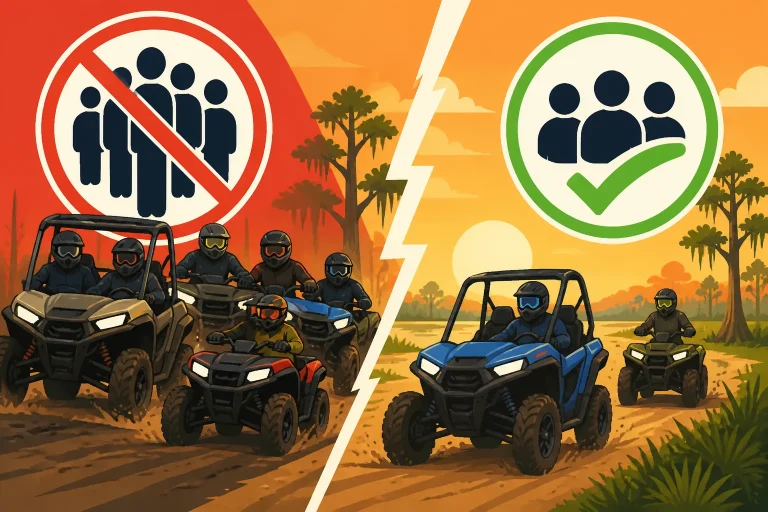
Parks may require each adult rider to sign separately. A parent or legal guardian may have to sign for a minor, and a park may impose an age limit even when a parent is present. If you are bringing a group, do not assume one person can sign for everyone. Ask the park how it handles minors, passengers, and guests who are not riding.
A waiver can also be different from a rental agreement. If you rent an ATV or UTV, there may be additional terms about damage, fuel, return condition, late returns, deposits, or who is permitted to operate the machine. Read both documents. An admission waiver may cover entry to the property without answering what happens if a rented machine is damaged.
Before a visit, check the park’s current rules directly. Private properties set their own operating conditions, and they can change those conditions for a specific event, weather situation, or area of the property. For a broader look at common restrictions, see Louisiana Private Park Waivers and Rules only if you are linking to a separate page? No. Since this is the current title, do not link to itself. A useful companion is Louisiana Private Park Waivers and Rules prohibited own. Instead use available related title [Louisiana Private Park Helmet Rules] and others in relevant spots.
Read the rules before you arrive
Do not wait until you are in a line at the gate to learn that your machine, passenger, or planned activity is not allowed. Look for the park’s rules page, event information, admission terms, and any required forms. If the details are unclear, call or message the operator and keep the reply where you can find it.
Private parks do not all have the same rules. A venue might be built around family trail riding, deep mud, organized events, camping, or a mix of activities. Its restrictions may reflect the property’s layout, staff capacity, local conditions, insurance requirements, or past incidents. A rule that seems unusual at one park may be standard at another.
| Rule area | What to confirm before leaving home | Why it matters |
|---|---|---|
| Waiver and admission | Who must sign, whether forms can be completed ahead of time, and what identification is needed | Missing forms can delay or prevent entry |
| Rider age | Minimum ages for operators and whether supervision changes the requirement | A parent’s presence may not override the park’s age rule |
| Helmets and gear | Which riders need helmets and what other protective equipment is required | Requirements can differ by rider age, machine, or activity |
| Passengers | Whether passengers are allowed on your machine and whether age or seat rules apply | A machine’s seats do not automatically determine park permission |
| Machine type | Whether ATVs, UTVs, dirt bikes, or other vehicles are accepted | Some areas or events may exclude certain machines |
| Vehicle limits | Width, tire, sound, or other equipment restrictions | A machine may be refused or kept out of designated areas |
| Riding hours | Whether night riding is allowed and which routes remain open | Hours may change by event or property area |
| Camping | Site types, reservations, fires, generators, quiet hours, and pets | Camping rules may be separate from riding admission |
| Weather and closures | How the park announces closures or changes | Rain can change access, trail conditions, and event plans |
| Insurance and damage | Any proof requested and how the park handles damage or incidents | Admission terms may not match your personal coverage |
Save a copy or screenshot of important rules, especially for a group ride. If a rule is posted only at the entrance, take time to read it before unloading. If the park’s website and gate signage differ, ask staff which instruction applies rather than guessing.
The rules may apply to the whole group
The person driving is not always the only person covered by park policies. A passenger, visitor, camper, or person walking near the riding area may have to follow separate conditions. Some venues require all adults to sign a release even if they are not driving. Others may restrict where non-riders can go.
Make a list of everyone coming, including children and guests who plan to stay at camp. Ask who needs to sign, whether a parent must be present, and whether one adult can complete paperwork for a minor. Do not assume that a signed form from a previous visit still works; a park may require a new form for each visit, event, or calendar period.
Rules can change between areas or event days
A property may have designated areas for different machine types, skill levels, or activities. A trail that is open during an ordinary weekend may be closed during an event, after heavy rain, or while staff perform maintenance. A park may also set event-specific rules for staging, parking, camping, or riding hours.
Treat old social media posts and advice from friends as clues, not confirmation. A quick check with the operator is more reliable than arriving with a machine that does not meet current requirements. If you plan to attend a large event, read the event’s instructions separately from the park’s general rules.
Age, supervision, helmets, and passengers
Age rules are among the easiest requirements to misunderstand. A private park may set its own minimum age for operating a machine, riding as a passenger, or entering certain areas. Those limits may be stricter than what a family expects, and a parent’s signature does not necessarily make a rider eligible.
Ask the park about the specific child and machine. “My child is old enough to ride” is not enough detail if the park distinguishes between an ATV and a UTV, or between driving and riding as a passenger. Confirm whether the child must be accompanied by an adult on the trail, remain within a designated area, or use a machine below a size or power limit.
For a deeper look at what private venues may require, see Louisiana Private Park Age Minimums and Louisiana Supervision at a Private Park. These are park-entry questions, not a substitute for checking the venue you plan to visit.
Helmets and protective equipment
A park may require helmets for some or all riders, regardless of whether a particular machine has a roll cage. It may also require eye protection, sturdy footwear, or other equipment. Do not infer the rule from what you see other riders wearing in photos. Check the park’s current policy, including any separate requirements for children or passengers. [Louisiana Private Park Helmet Rules] covers this topic in more detail.
Bring correctly sized equipment for every rider. A helmet that is loose, damaged, or uncomfortable may not be useful when it matters, and sharing one helmet among several riders can create both fit and hygiene problems. If you need to buy basic items, Amazon may be one way to compare availability, but check fit, certification details, condition, and return terms rather than choosing by a product photo alone. Buy helmets from a source you trust, inspect them before the trip, and follow the manufacturer’s care instructions.
Passengers and seat belts
A machine with two seats does not automatically mean every park permits a passenger. Ask whether passengers are allowed on your vehicle, whether there are passenger age limits, and whether the park requires the passenger to use a seat belt or other restraint. A park may treat a youth riding on an adult’s ATV differently from a passenger in a UTV.
Do not carry someone on a cargo rack, fender, or improvised seat. If the manufacturer did not design the position for a passenger, it may not provide a secure place to sit or hold on. Park permission cannot make an unsafe seating arrangement safe.
For UTVs, check the park’s passenger rules and follow the machine’s seating and restraint instructions. Keep arms, legs, and heads inside the vehicle where required, and do not let riders use a roll cage as a handhold if the manufacturer warns against it. A passenger who is frightened or unsteady can distract the driver, so take a slower route or return to camp if someone is uncomfortable.
Supervision means more than being nearby
A park may expect an adult to supervise a youth rider, but “supervision” can mean different things. It might require the adult to ride alongside, remain within sight, or be present on the same property. Ask rather than assuming you can supervise from a campsite or parking area.
Parents should also match the route and machine to the young rider’s ability. A child who can manage a quad on open ground may struggle with mud, ruts, water, crowds, or steep approaches. Start with the easiest permitted area, agree on a stop signal, and make sure the child knows not to follow another rider into an unfamiliar obstacle.
Riding conduct, machine restrictions, and responsibility
Private park rules often focus on preventing collisions, protecting trails, and keeping machines under control. The operator may restrict speed, reckless riding, racing, wheelies, jumping, passing, or riding outside marked routes. These restrictions can apply even when a trail looks wide open.
Ride at a speed that lets you stop within the distance you can see. Mud, dust, vegetation, glare, and standing water can hide holes, branches, or another machine. Leave room behind the rider ahead, especially when climbing, descending, or approaching a mud hole. If visibility drops, slow down and increase spacing rather than trying to keep pace with the group.
Do not follow another rider just because they appear to know the property. They may have permission to use a route that is closed to others, or they may simply be off course. Use the park map and posted signs. A closed gate, rope, or barrier is a direction to stop, not an invitation to go around.
Check your machine against the park’s limits
Some private venues screen machines for width, tire setup, noise, safety condition, or other characteristics. The limits are park-specific. Ask for the exact requirements before you tow a large UTV, install special tires, or bring a heavily modified mud machine.
Check ordinary maintenance too. Look at tires, brakes, steering, throttle return, belts, lights, and visible leaks. Make sure the machine is appropriate for the terrain and that you know how to shut it down. Mud can conceal mechanical problems and make recovery more complicated. A machine that arrives with loose steering or damaged brakes creates risk for its operator and everyone nearby.
If the park has a sound check or equipment inspection, treat it as an admission condition rather than a challenge to work around. Do not try to silence a machine temporarily or conceal a modification. Ask staff what correction is acceptable. A park may refuse entry or limit where a machine can ride if it does not meet its stated requirements.
For machine-specific restrictions at private venues, Louisiana Private Park Age Minimums is relevant to youth use, while Louisiana Private Park Waivers and Rules would duplicate this article and should not be linked. Instead, see Louisiana Private Park Alcohol Rules for another commonly overlooked policy.
Alcohol and other impaired riding
A park’s alcohol policy may cover riding areas, campsites, event grounds, or all of the property. Read the rule before bringing alcohol, and do not assume a campsite exception exists. Some parks prohibit drinking while operating; others may have broader restrictions. Louisiana Private Park Alcohol Rules explains the kind of venue-specific policy to check.
Regardless of a park’s policy, do not operate an ATV or UTV while impaired by alcohol, cannabis, medication, or anything else that affects judgment and coordination. The fact that the ride takes place on private property does not make impaired operation safe. If someone in your group has been drinking, arrange a sober driver or end the riding for that person. Keep keys away from anyone who should not drive.
Stay within the property and follow staff directions
A private park’s boundaries are not always obvious in woods, fields, or wetlands. Follow marked routes and do not cross fences or enter neighboring land. If you are unsure whether a trail is open, turn back or ask staff. Permission to ride at the park does not extend to an adjoining timber tract, road, canal bank, or trail.
Staff directions may be needed when trails close, emergency vehicles enter, machines become stuck, or weather worsens. Stop where directed and give recovery or medical personnel room. Do not block a gate or trail with a parked machine. If a staff member asks you to leave a closed area, comply first and raise questions afterward at a safe location.
The rules of a private park also do not grant permission to use public roads. If you intend to ride on a road outside the property, check the relevant Louisiana rules separately. Louisiana ATV Road Rules Under 32:299 and Louisiana UTV Road Rules Under 32:299.3 are useful starting points. A park waiver or staff member’s verbal suggestion does not replace public-road requirements.
Camping, pets, noise, and event logistics
Riding parks often combine trails with campgrounds, event areas, cabins, or RV spaces. Each area may have separate rules. A campsite reservation does not necessarily include riding access, and a riding admission may not include a reserved overnight site. Confirm what your booking covers, what time you may arrive, and where you are allowed to park a truck and trailer.
Quiet hours, generators, and fires
If you are staying overnight, check quiet hours and generator policies. A machine that is permitted during riding hours may not be allowed to run late at night. The campground may set restrictions on generator location, exhaust, extension cords, or operating times. Respect nearby campers even where a particular sound is technically permitted.
Ask about fires before packing firewood or bringing a portable fire pit. Conditions can change quickly in dry weather, and a park may restrict open flames or require a particular fire setup. Never leave a fire unattended. Follow instructions for extinguishing it, and do not dump hot coals where they could ignite brush or damage a campsite.
Pets and children away from the trails
Pet policies can address leashes, campground areas, breed or behavior concerns, and whether animals may enter riding zones. Do not assume a dog can stay loose at camp or ride on a machine. A loud engine, unfamiliar animals, and fast-moving vehicles can frighten a pet and create a collision risk. See Louisiana Private Park Pet Rules before bringing an animal.
Plan a safe place for children who are not riding. Campground roads, staging areas, and parking lots can still have moving machines and trailers. Keep children away from loading ramps, winch lines, and recovery operations. If the park has a designated family or non-riding area, use it rather than treating the campground as a play space.
Events, reservations, and weather
An event weekend can have different procedures from an ordinary visit. The operator may use separate entry points, check-in times, parking zones, ride schedules, or wristbands. Confirm whether you need to register in advance, whether the event has capacity limits, and what happens if weather forces a closure.
Rain can make a trail more difficult, but it can also make it unsafe or unusable. A park may close low areas, restrict certain machines, or pause riding while staff assess conditions. Mud does not mean every route is open. Follow closures rather than trying to find an unofficial way around them.
If you are booking a cabin or campsite, review the cancellation and refund terms before paying. Ask what happens if the event is canceled, the park closes, or your site is unavailable. For private venues, fees and policies are set by the operator, so confirm current details directly instead of relying on an old post or another rider’s memory.
Prepare your group and handle problems calmly
A short plan prevents many gate delays and trail disputes. Before you leave, choose one person to keep the paperwork, confirm everyone’s waiver status, and make sure the group knows the park’s basic signals and meeting point. Share the address and arrival plan with everyone, especially if vehicles are towing separately.
Before you tow
Use this checklist:
- Confirm the park is open. Check the property’s current schedule, event calendar, and closure notices.
- Read the current rules. Verify age, passenger, helmet, machine, riding-hour, alcohol, and camping requirements.
- Complete required forms. Ask whether waivers can be completed ahead of time and how minors must be handled.
- Check every machine. Inspect tires, controls, brakes, lights, restraints, and visible damage.
- Pack protective gear. Bring properly fitted helmets and any required eye protection or footwear.
- Plan for breakdowns. Carry a basic tool kit, recovery gear suitable for your machine, drinking water, and a way to contact your group.
- Keep records accessible. Save the booking confirmation, park rules, waiver instructions, and emergency contact information.
- Set a group plan. Choose a meeting point and agree that no one will leave the property or enter a closed trail without checking first.
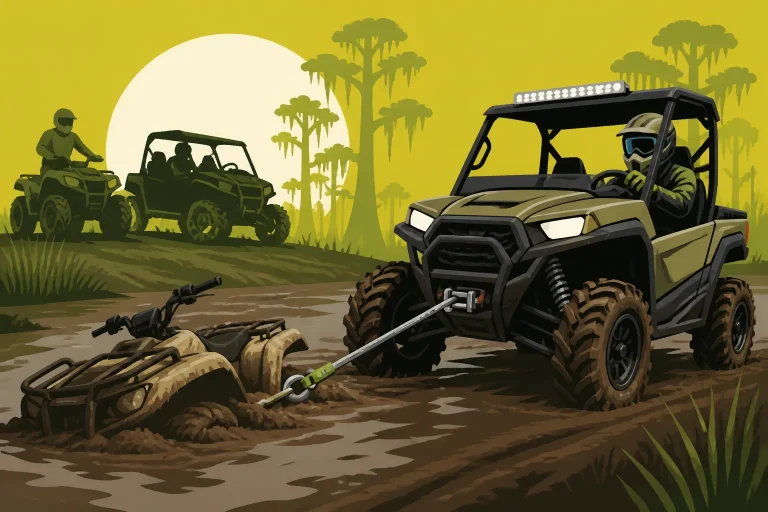
The right equipment depends on the ride. A spare belt may matter to one UTV, while a tire repair kit may be more useful for a different machine. Do not buy recovery gear because it looks impressive; learn how to use it safely. A winch line under load can injure someone, and a poorly attached strap can damage a vehicle. If you need supplies, Amazon can help you compare items such as a tire gauge, first-aid kit, or waterproof storage, but verify that the item fits your machine and intended use.
At the gate
Give yourself time to check in. Have identification and booking details ready if the park requires them, but do not hand over documents without understanding what is being requested. Ask staff about any confusing rule before unloading. If a machine is refused, ask what requirement it does not meet and whether there is a safe, permitted alternative.
Do not sign a form for another adult unless the document clearly authorizes you to do so and you understand the responsibility involved. For minors, confirm that the person signing has the authority the park requires. If a group member is uncomfortable with a waiver, the answer is not to pressure them at the gate; let them decide whether to participate.
A useful question is: “What are the most common reasons riders get turned away or sent back to camp?” Staff can often tell you about practical issues such as an equipment limit, passenger rule, or closed trail that is not obvious from a general brochure.
If there is an injury, collision, or damage
Stop and make the area safe before trying to sort out fault. Keep other machines away from the injured person, contact park staff, and call emergency services when needed. Give the dispatcher the park’s entrance location or the nearest marked access point. Do not move someone with a possible head, neck, or back injury unless there is an immediate danger.
After the urgent response, document what happened while details are fresh. Record the time, location, people involved, machine information, and names of witnesses. Take photos of the scene and visible damage if it is safe and appropriate. Keep copies of any incident report or communication from the park.
Tell your insurer promptly if the event may involve a claim. Coverage depends on your policy and the circumstances; do not assume that a park’s waiver means your insurer will deny or accept a claim. If the operator asks you to sign a statement beyond a routine incident report, read it carefully and ask for a copy. For a serious injury or significant property damage, consider speaking with a qualified professional before making detailed statements about liability.
If staff enforce a rule
Stay calm, stop riding where directed, and ask for the specific rule or safety concern. Do not argue while operating a machine or block a trail to make your point. If you believe a rule was applied incorrectly, ask to speak with a manager at the office or another safe location.
If you are told to leave, comply with the instruction and make sure your group can exit safely. A disagreement about admission, a waiver, or a trail closure is not a reason to ride through a gate or ignore staff. Keep receipts, booking confirmations, and written communications if you later need to ask about a refund or resolve a complaint.
Private park rules work best when you treat them as part of the trip plan, not paperwork to rush through. Check the current requirements, make sure every rider understands the limits, and choose a route that matches the group’s ability. That makes the day safer and reduces the chance of a surprise at the gate.
Disclaimer
This article is for general informational purposes only and does not constitute professional advice. Laws, prices and regulations vary by location and change over time. Consult a qualified professional for guidance on your specific situation.