Louisiana WMA Seasonal Riding Ban
Louisiana’s WMA riding ban can catch riders off guard: a trail that was open during winter may be closed to ATVs and UTVs for much of the year, even when the gate is still accessible. This guide explains the seasonal restriction, the limited spring exception, how to check a particular area, and what to do before unloading your machine.
What the Louisiana WMA seasonal riding ban means
Louisiana Wildlife Management Areas are public lands managed for wildlife and recreation, but access is not the same as permission to ride a machine. A WMA can remain open for hiking, fishing, hunting, or other approved activities while motorized recreation is restricted.
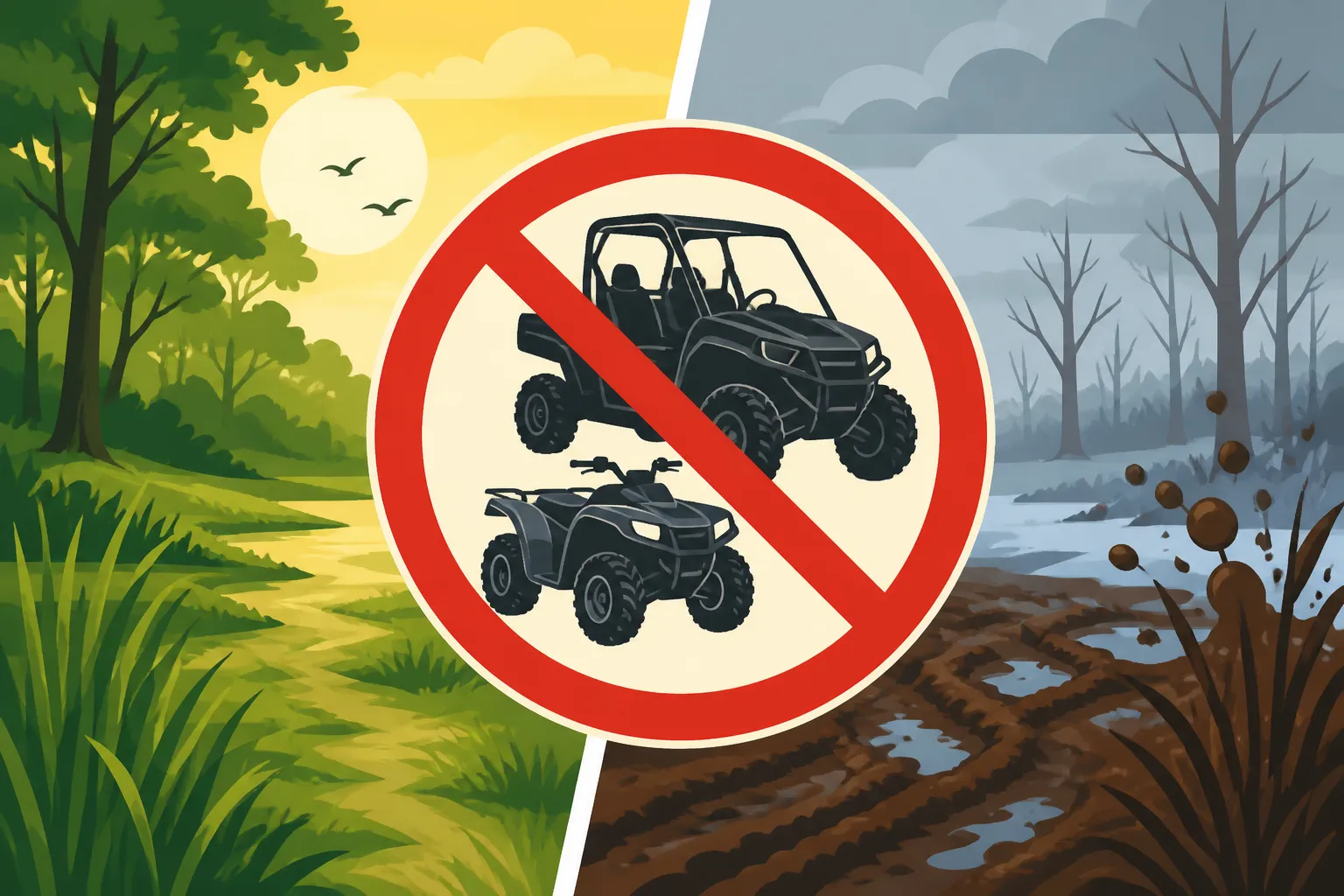
The general seasonal pattern for ATV and UTV riding on WMAs is a ban from March through August. In practical terms, riders should expect many WMA trails to close to machines during those months and reopen only when the applicable rules allow. The restriction helps protect wildlife and habitat during sensitive periods and reduces damage to trails and soils.
That broad pattern is useful for planning, but it is not a substitute for checking the specific WMA’s current rules. The dates, permitted routes, exceptions, and access conditions can depend on the area and the current regulations. A trail shown on a map or remembered from a previous visit is not automatically open today.
The ban concerns riding a machine on WMA land. It does not mean that every WMA is closed to every visitor during the restricted period. Nor does it give a rider permission to use a nearby public road, forest road, levee, or private property instead. Those places have separate access rules.
A few distinctions help keep the rule clear:
- A WMA being open does not mean its motorized trails are open.
- An open gate does not prove that riding is allowed. Gates may serve other users or remain open when a route is restricted.
- A riding area on a map may have seasonal closures or route-specific restrictions.
- A machine’s title, decal, or registration does not override a WMA closure.
- A seasonal exception is limited to the conditions stated in the current rules. It should not be treated as a general extension of the riding season.
If you are still learning how public-land access and machine paperwork fit together, Louisiana WMA Riding Rules for Quads and Louisiana WMA Riding Rules for UTVs provide useful companion topics. For the seasonal issue itself, though, start with the WMA’s current access information rather than relying on a general rule alone.
Why the ban is seasonal
A seasonal closure is a land-management measure, not simply a judgment about whether a trail looks dry enough to ride. Wildlife needs, soil conditions, habitat protection, and the timing of public uses can all affect when motorized access is permitted.
A trail may appear firm and passable while still being closed. Conversely, an area may be open during a permitted period even though recent weather has made conditions poor. The legal question is whether riding is authorized; the practical question is whether conditions are safe and responsible. Riders need to consider both.
Seasonal restrictions can also help keep machines away from places where repeated traffic would damage sensitive ground or interfere with wildlife management. In Louisiana, rain and humidity can make ground conditions change quickly. A route that handled traffic well last month may rut badly after heavy rain, while a trail that looks dry at the entrance may become soft farther in.
The closure also reduces confusion around shared public lands. A WMA can have hunting seasons, wildlife projects, access limits, and different recreational uses operating at different times. Keeping motorized recreation within its allowed season and designated routes helps avoid conflicts with people on foot, hunters, habitat work, and other visitors.
This is why “I have ridden there before” is not enough. Rules can change, a route can be closed for a particular season or project, and a map can show a trail without showing every temporary restriction. Treat older trip notes, social media posts, and advice from a friend as leads to verify, not as authorization.
It also helps to separate the seasonal riding ban from ordinary trail closures. A trail can be closed outside the March-through-August period because of flooding, fire danger, maintenance, wildlife activity, or another area-specific reason. The reverse is also possible: a limited exception may allow riding under specific conditions during an otherwise restricted period. The posted and current rules for that WMA are what matter.
When the spring squirrel exception may apply
Louisiana’s general seasonal restriction has a limited spring squirrel exception in certain circumstances. The exception is not a blanket permission to ride any WMA trail during the closure. It is tied to the applicable hunting season and WMA rules, and it may apply only to certain routes, riders, or activities.
Before relying on the exception, confirm all of the following:
- The spring squirrel season is open for the area and date you plan to visit. Season dates can vary or change. Check the current official hunting regulations rather than assuming the season is open because it was open at the same time in a previous year.
- The particular WMA allows the exception. Do not assume a rule that applies on one WMA applies on another.
- The route is one where machine use is allowed. The exception does not necessarily open every trail, road, or access route.
- Your activity fits the exception. A hunting-related access rule should not be treated as permission for a recreational trail ride.
- Any required permit or check-in steps are completed. An exception to a seasonal riding restriction does not automatically waive other WMA requirements.
The practical difference is important. If you are using a machine to reach an authorized hunting area under an applicable exception, your trip may qualify if every condition is met. If you are visiting for a general ride, taking a family trail outing, or exploring without a qualifying purpose, do not assume that the spring exception covers you.
Verify the rule before you load the machine. If the official description is unclear, ask the WMA office or the relevant state agency a direct question about the area, date, route, and intended activity. Keep the answer or the current regulation details available during the trip. A casual “someone told me it was fine” is not a dependable plan.
The exception also does not make a closed trail safe or suitable. If the route is muddy, damaged, blocked, or marked closed, respect the closure. Turning around is better than creating ruts, getting stuck, or causing trouble for other visitors and land managers.
For a closer look at the limited seasonal allowance, see The Spring Squirrel Exception to the WMA Ban. If your plans involve hunting access rather than recreation, Louisiana WMA Squirrel Season Access and [Louisiana Hunting License and Land Access] can help you identify other requirements to check.
How to check whether a WMA is open to riding
Check the specific area, the specific route, and the date of your trip. “Louisiana WMA rules” is not a single trail status. Area regulations, posted notices, maps, and temporary closures may all be relevant.
Confirm current official information
Start with current information from the state agency responsible for the WMA and its wildlife regulations. Look for the WMA’s name, motorized access rules, designated trail map, seasonal dates, and any notices about closures or restrictions. If the site has a current brochure or map, make sure it applies to the season you plan to visit.
If a rule is hard to interpret, contact the managing office and ask a precise question. For example: “Is an ATV allowed on this named trail on this date, and does the spring squirrel exception apply to this use?” That is more useful than asking generally whether “the WMA is open.”
Before leaving, confirm:
- The riding season is open for that WMA.
- Your intended trail is designated for motorized use.
- There is no temporary closure, storm damage notice, or seasonal wildlife restriction.
- The machine type is permitted on the route.
- Any required access permit or self-clearing form is current.
- Any limits on machine size, weight, tires, or operating hours apply to your vehicle.
- The entrance and parking area are open and suitable for your trailer.
If you cannot confirm that a route is open, the safe answer is not to ride it until you can. A map, an old photograph, a trail app, or a forum post can be useful for locating a trail, but those sources may not reflect current closures.
Read signs at the entrance and along the route
Pay attention to signs at the entrance, trailhead, and junctions. A notice at the gate may state a restriction that is not obvious from a map. Signs farther along may close a section or direct riders to a different route.
Do not pass a closed gate, barrier, or sign because there are tire tracks beyond it. Tracks could be old, unauthorized, or left by a land-management vehicle. If signs conflict with information you found online, stop and seek clarification instead of choosing the interpretation that lets you proceed.
Keep a record of what you checked
A saved map or screenshot can help you navigate and remember which route was designated, but it is not a permit and does not replace an official closure notice. Save useful information before leaving home, especially if the area has limited cell coverage. A paper map is worth carrying as a backup.
An inexpensive waterproof map case or tire-pressure gauge found through retailers such as Amazon can be useful for a WMA trip, but gear does not make a closed route legal. The most important preparation is checking current rules and having the right map and access documents.
For a step-by-step overview of the required permit process, see [Louisiana Self-Clearing Permit Steps]. If you need to understand what permit applies to a particular visit, Why Louisiana WMAs Need a Self-Clearing Permit explains the purpose of the check-in system.
Other rules that can still apply during an open riding period
A seasonal opening does not mean unrestricted riding. Once the seasonal ban is no longer in effect, the route may still be subject to trail, machine, permit, equipment, and time-of-day rules. Riders should check each requirement before heading out rather than treating “open season” as all-clear permission.
Use designated trails only
On a WMA, riding is generally limited to routes designated for motorized use. A visible path, utility track, firebreak, or route used by another visitor is not automatically an ATV trail. Do not make a new route to get around a wet spot or a closed section. Stay on the marked trail and turn back if the route is blocked or becomes unsafe.
The designated-trail rule matters for more than compliance. Riding off trail can damage plants and soil, disturb wildlife, and widen the path as other riders follow the same detour. For map-reading advice, see Reading a WMA Map Before You Unload. If a route does not appear on the current WMA map or is not clearly marked for machines, verify it before riding.
Check machine limits
Some WMAs have rules concerning machine weight, width, tires, tread, or other equipment. A machine that is legal to own and ride elsewhere may not meet a particular WMA’s limits. This is especially important for modified mud machines, larger UTVs, and machines fitted with oversized tires or aggressive lugs.
Check the current area rules before arrival rather than trying to judge compliance at the gate. The reference topics Louisiana WMA Machine Size Limits, Louisiana WMA Tire Rules Explained, and Louisiana WMA Weight Limits Explained cover common restrictions riders should review.
Do not assume that a side-by-side is treated exactly like a quad. Some areas set different standards for ATVs and UTVs, and a machine’s width or weight can determine whether it is allowed. If the rules use a measurement such as vehicle weight or tire dimensions, confirm how the agency defines and checks it.
Complete required permit and check-in steps
A seasonal opening does not waive a required WMA access permit or self-clearing permit. Follow the current instructions at the entrance or in the official regulations. If the process requires you to keep part of a permit, keep it. If it requires a check-in before entering, do that before riding.
Do not assume that a hunting license, an off-road decal, a title, or a permit from a private park satisfies a WMA access requirement. Different documents serve different purposes. [Louisiana WMA Permit Requirements] and Filling Out a Self-Clearing Permit at the Gate can help you distinguish the paperwork from the riding rules.
Respect hours and other seasonal restrictions
Even when a trail is open, riding may be limited to particular hours. Night-riding restrictions, hunting activity, temporary closures, and area-specific limits can still affect your plans. Check the regulations for the exact WMA and date.
A machine being quiet enough, properly equipped, or registered does not create an exception to an hours restriction. Likewise, a trail being open during the day does not mean it stays open after dark. If your trip could run late, plan to be back at the trailhead within the allowed period.
Planning around the closure
The seasonal ban is easiest to manage when it is part of your riding calendar, not something you discover after towing to a gate. Riders who plan ahead can use the restricted months for maintenance, paperwork, and finding alternative places where motorized access is actually allowed.
Build your trip calendar from official dates
Start with the broad March-through-August closure pattern, then confirm each WMA’s current dates and any applicable exception. Do not treat the same schedule as guaranteed for every area or every season. Put the official opening date, seasonal closure, and any permit renewal reminders on your calendar only after checking the current information.
If you ride several WMAs, keep a separate note for each one. Record the designated trails, vehicle limits, entry point, permit steps, and the source of the information. This is more reliable than a single note that says “WMA season open,” especially if one area has a different rule or temporary closure.
Have a backup plan
Before towing, identify another legal destination or be prepared to turn around. A backup could be a private riding area, a forest trail that allows your machine, or a different WMA whose rules you have already confirmed. Do not assume that nearby public land allows the same kind of riding.
If you are considering a national forest route instead, check that trail’s own access rules and closures. [Louisiana Forest Trail Use Passes] and Checking a Trail Status Page First are helpful starting points for a different type of public riding area. A WMA permit does not automatically authorize use of a forest trail, and a forest pass does not open a WMA route.
Make a pre-trip checklist
A short checklist can prevent the most common mistakes:
- Confirm the WMA and trail are open to motorized use on your trip date.
- Check current maps, signs, seasonal restrictions, and temporary notices.
- Confirm that your machine type and configuration meet the area’s limits.
- Complete the required permit or check-in process.
- Pack proof of ownership and any other documents the rules require.
- Bring a current map and a backup navigation method.
- Check weather and trail conditions, then be willing to cancel if the route is unsafe.
- Tell someone where you are going and when you expect to return.
- Follow posted speed, noise, parking, and operating-hour rules.
- Turn around rather than bypassing a barrier or riding around a closure.
An Amazon map case, compact first-aid kit, or tire-pressure gauge can be practical additions to the equipment list. Keep purchases tied to real needs, though: a new accessory cannot replace official route information, correct permits, or a closed-season plan.
Common mistakes that lead to trouble
Most seasonal-ban problems start with an assumption. A rider sees another person on a trail, remembers riding there last year, or finds a route on a navigation app and concludes that access must be allowed. Those clues do not establish current permission.
Treating the exception as a general riding season
The spring squirrel exception is narrow. It does not convert a closed WMA into a recreational riding area for the season. If your purpose, route, date, or machine does not meet the stated conditions, do not rely on the exception.
Confusing ownership documents with access permission
A title establishes ownership information. A decal or registration may meet a separate machine requirement. Neither one authorizes riding on a closed WMA trail. Likewise, carrying a hunting license does not prove that a route is open to an ATV or UTV.
Following tracks or informal advice
Tire tracks do not tell you whether the rider had permission, whether the tracks are recent, or whether the route is now closed. Advice from a friend may be accurate for another date or another WMA but wrong for your trip. Verify the current official information.
Riding around a barrier
A closed gate, barricade, or posted trail closure is a clear reason to stop. Going around it can damage land, create safety risks, and turn a simple day trip into an enforcement or recovery problem. Do not take an alternate path through vegetation, a field, or an unmarked route.
Assuming the whole WMA has one status
An area can have multiple routes with different access conditions. One trail may be open while another is closed; a hunting access road may not be a recreational riding trail. Check the route, not only the WMA’s name.
Arriving without a way to confirm conditions
Some riding areas have limited reception. Check notices before leaving home, save a map offline, and carry a paper copy if practical. A phone with a dead battery or no signal is a poor time to discover that you are unsure where a designated route begins.
The same basic rule applies whether you ride a quad or a side-by-side: verify the current area requirements before you unload. A little planning avoids wasted travel and helps keep public riding opportunities available.
Disclaimer
This article is for general informational purposes only and does not constitute professional advice. Laws, prices and regulations vary by location and change over time. Consult a qualified professional for guidance on your specific situation.