How Old Does a Louisiana Rider Have to Be?
Louisiana does not set one simple minimum age for every ATV and UTV ride. The answer depends on whether a child is riding private land, a managed trail or a public road—and on the machine and site rules. The key distinction: private off-road riding is not the same as road use, where specific legal requirements apply.
The short answer depends on where you ride
For ordinary off-road riding on private property, Louisiana does not have one statewide minimum age that applies to every rider and machine. That does not mean every child can safely operate every quad or side-by-side. The landowner, riding area, machine manufacturer and other rules can set limits, and a parent or guardian still needs to assess the child’s ability and the risks.
Public-road use is different. Louisiana law allows only limited ATV and UTV use on public roads, and each type of machine has separate requirements. In particular, the state’s road-use rule for a UTV requires its driver to be at least 21. That age requirement applies to the qualifying road use; it is not a general minimum age for a child operating a UTV off-road on private land.
For an ATV, do not assume that an adult’s permission makes road use legal. Louisiana’s narrow roadway exceptions have conditions related to where and why the machine is being operated, and may require a valid driver’s license. A child who cannot meet the applicable requirements cannot use an ATV on a public road under that exception, even if the same child may be permitted to ride off-road. Read Louisiana ATV Road Rules Under 32:299 and Louisiana UTV Road Rules Under 32:299.3 before planning any road travel.
| Riding situation | What age rule to keep in mind | What else to check |
|---|---|---|
| Private property | No single statewide minimum age covers every off-road ride | Owner permission, machine suitability, supervision and safety gear |
| Private riding park | The park may set its own minimum ages and supervision requirements | Current waiver, machine and passenger rules |
| Managed public trail or wildlife area | Follow the rules for that specific location; do not assume private-land rules apply | Permits, allowed machines, trail restrictions and any youth conditions |
| ATV on a public road | Only limited statutory use is allowed; any applicable licensing requirement matters | Purpose, route, time, location and other conditions |
| UTV on a public road | The qualifying road-use statute requires a driver to be at least 21 | License, insurance, designated-road and equipment requirements |
The practical answer for a parent is to ask two questions before the ride: “Is this child allowed to operate here?” and “Is this machine appropriate for this child?” A child’s age alone does not settle either one.
If you are checking the legal details for an ATV or a side-by-side, start with Can You Ride an ATV on the Road in Louisiana? and Louisiana UTV Street Legal Rules by Parish. Those topics explain why a road-use exception should not be mistaken for general permission to drive on public streets.
ATV age rules: private riding is not road riding
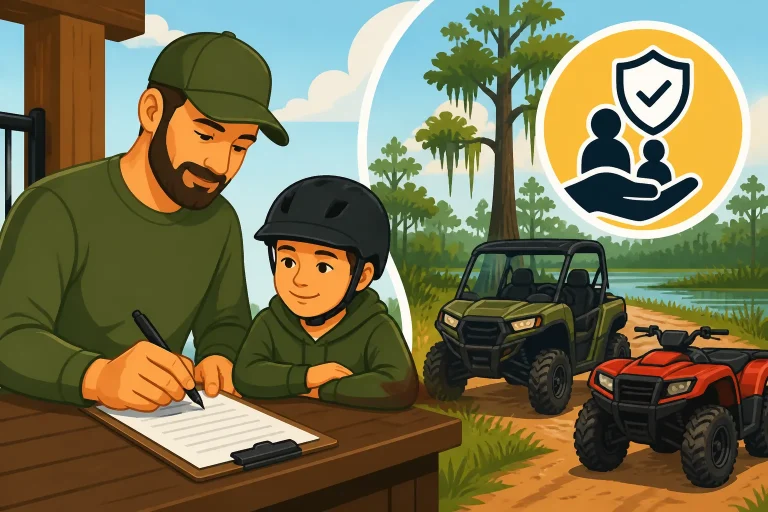
A child may be allowed to ride an ATV on private property even when that child cannot legally operate one on a public road. These are separate questions, governed by different considerations.
On private land, the owner’s permission is essential. A landowner can restrict who rides, what machines may be used and where they can travel. A private park can also set age limits that are more restrictive than a parent’s preferences or the machine manufacturer’s guidance. Check those rules before loading the ATV or paying for entry. Louisiana Private Park Age Minimums covers the kinds of limits a park may impose.
Public land brings another layer of rules. A trail or wildlife management area can restrict which machines may enter, when they may be used, and where they may travel. A child being permitted to ride at home does not automatically mean the child may ride on a managed public trail. Check the current site rules and any permit requirements before leaving home. Louisiana WMA Riding Rules for Quads explains why access rules can differ from one kind of riding area to another.
When an ATV goes near a public road
Louisiana does not generally treat an ATV as a road vehicle that can be driven wherever a car can go. The state allows limited kinds of road use under specific conditions. The fact that an ATV can physically travel along a shoulder or cross a road does not itself make that trip legal.
For an ATV, the relevant exception may depend on factors such as the purpose of the trip, the road location and whether the operator meets the law’s requirements. If a driver’s license is required for the particular use, a child who does not hold the qualifying license cannot meet that condition. Do not use a child’s age as a shortcut for deciding whether a trip is allowed; check the exact exception and route.
Even a short trip between fields or across a road can raise questions about whether the exception applies. When in doubt, transport the ATV rather than riding it on the road. See Louisiana Rules for Crossing a Highway for the distinction between an allowed crossing and an extended road ride.
Helmets and other protective gear
Age and permission do not make a ride safe by themselves. Children need protective equipment sized for them, and an adult helmet that is loose or poorly fitted may not provide dependable protection. Louisiana has helmet requirements for some ATV riding circumstances, and a park or landowner may require helmets more broadly. Check the rules that apply to the ride, rather than assuming that a helmet is optional because the machine is off-road.
A properly fitted helmet is a sensible baseline for a young rider, along with eye protection, gloves, long sleeves, long pants and boots that cover the ankles. Review Louisiana ATV Helmet Rules for more on when state requirements apply.
If you are buying safety gear through a retailer such as Amazon, check that the helmet is intended for the activity, has recognized safety certification, fits the child securely and can be returned or exchanged if the fit is wrong. A helmet that is too large, too small or not designed for riding is not a good substitute for a correctly fitted one.
For more child-specific considerations, see Louisiana Rules for a Teen Rider, [Louisiana Rules for a Ten-Year-Old Rider] and [Louisiana Rules for a Sixteen-Year-Old Rider]. The right decision still depends on the machine, setting and rider, not just the number of candles on a birthday cake.
UTV age rules are different
A UTV, often called a side-by-side, is not governed by the same road-use age rule as an ATV. Louisiana’s qualifying UTV road-use law requires the driver to be at least 21. This is a rule about the driver operating a UTV under the statute’s limited public-road provisions. It does not create a statewide minimum age of 21 for all off-road UTV operation.
That distinction matters for families. A teenager may be allowed to operate a UTV on private land under the property owner’s rules, while still being too young to drive that same machine on a public road under the statutory exception. Likewise, an adult’s presence in the passenger seat does not make an underage driver meet the age requirement.
Road use has more conditions than age
Meeting the minimum age is only one part of qualifying road use. Louisiana’s rules may also address the driver’s license, insurance, designated roads, signage and the route or purpose of the trip. A UTV is not automatically street-legal just because it has lights, mirrors or a license plate from another jurisdiction. Check the road’s designation and all applicable requirements before using it.
For the full set of road-use conditions, see Louisiana UTV Street Legal Rules by Parish and Louisiana’s 21 Age Minimum for UTV Drivers. If the planned trip is not clearly allowed, haul the UTV on a trailer instead of testing the limits on a public road.
Off-road operation still needs a suitability check
The 21-year road-use requirement does not answer whether a child should drive a UTV off-road. On private property, consider the child’s size, strength, judgment and ability to understand the controls. A side-by-side can be heavy and powerful, and it may carry passengers who rely on the driver to make safe decisions. A child’s ability to reach the pedals or steering wheel does not prove that the child can handle the machine in changing terrain.
Follow the manufacturer’s instructions for the particular machine. Check the operator age guidance, passenger limits, seat belt and restraint requirements, and any restrictions related to the machine’s size or power. Those recommendations are important safety guidance, but they do not replace Louisiana law or the rules of the place where you ride.
Parents should also explain that a UTV is not a car. Its handling, rollover risk, braking and exposure to terrain differ from a passenger vehicle. Before a child drives, an adult should go over the controls and safety systems and choose a controlled area with enough room to stop and turn. A child who is not ready should ride as a passenger only if the machine’s rules permit it and the child can be properly restrained.
Rules at private parks and public riding areas
A ride that is legal on private land may be prohibited at a particular park or public site. Places that allow off-road machines often have their own rules on age, supervision, passenger eligibility, helmets, riding hours and machine type. These are site-specific conditions, so confirm them with the park or managing agency before making the trip.
Private parks can set their own age limits
A private riding park may require a minimum age for drivers, require an adult to accompany younger riders or apply different rules to children driving their own machine and children riding as passengers. It may also limit which machines a child can use. A child who is old enough to operate an ATV on a family property may still be too young to operate one at a particular park.
Ask the park direct questions before arrival:
- What is the minimum age to drive each type of machine?
- Does the child need an adult physically nearby, or must the adult ride too?
- Are the age rules different for ATVs and UTVs?
- Can a child ride as a passenger, and what restraints or helmet rules apply?
- Are there required waivers, identification or equipment checks?
Do not rely only on a social media post, an old waiver or a friend’s memory. A park can change its rules, and event weekends may have additional requirements. Louisiana Private Park Age Minimums and [Louisiana Private Park Helmet Rules] are useful starting points, but confirm the specific site’s current policy.
Public trails and wildlife areas have separate access rules
A public riding location is not the same as an open field. Wildlife management areas, national forest trail systems and other managed lands can have designated routes, access permits, machine restrictions and seasonal closures. The rules may also distinguish between an ATV and a UTV. A permit or access pass does not necessarily authorize riding everywhere on the property.
Before taking a child onto public land, check the official information for that specific location. Confirm that the trail is open, the machine is allowed, and the rider has any required permit. Review [Louisiana Self-Clearing Permit Steps] if your destination is a wildlife management area, and Louisiana Trail Closures and Seasons if you are planning a forest-trail ride.
If a location’s age or supervision policy is unclear, contact the managing office before unloading. That is especially important when a child will be operating a machine, not simply accompanying an adult. Rules can vary by area and activity, so one site’s approach should not be treated as a statewide standard.
A parent’s decision still matters
A child might meet a park’s minimum age and still lack the skill or judgment for a particular machine. Choose a machine with controls and power the child can manage, and keep the first rides on uncomplicated terrain. Set clear rules about speed, stopping, distance from adults and what to do if the machine stalls or tips.
An adult should remain close enough to supervise effectively. “Nearby” is not useful if the adult cannot see the rider, communicate with them or intervene when needed. Avoid putting young riders on steep slopes, deep water, mud holes or crowded routes before they have the ability and experience to handle those conditions.
Consider the whole ride, not only the machine. Heat, fatigue, noise, dust and the presence of faster or larger vehicles can make a familiar route more difficult for a child. Plan rest and water breaks, and stop riding when the child is tired or overwhelmed. Louisiana Trails for Kids can help with finding more suitable riding options.
A practical age and readiness checklist
Use this checklist before a child rides. It helps separate legal permission from the practical decision about whether the ride is suitable.
1. Identify the machine and the activity
Confirm whether the machine is an ATV or UTV, who will drive it, and whether it will be operated off-road or on a public road. Do not apply the UTV road-use age rule to every off-road UTV ride, and do not assume the ATV and UTV road rules are interchangeable.
If any part of the route uses a public road, check the exact statutory exception and its requirements. A short distance does not automatically mean an exception applies. If you cannot confirm that the trip is allowed, transport the machine.
2. Check the owner’s and site’s rules
Get permission from the landowner or riding venue. For a public trail or managed area, check its current rules and official access information. Look for age restrictions, supervision requirements, passenger rules, permitted machine types and open dates.
If the operator or staff cannot clearly confirm a child’s eligibility, do not assume the answer is yes. Find out before making the trip.
3. Match the machine to the rider
Use the manufacturer’s guidance for the specific machine. Check whether the rider can sit in the proper position, reach the controls, steer and brake effectively, and understand the operating instructions. A larger machine may be inappropriate even if the child is confident or experienced on a smaller one.
For a UTV, make sure every occupant can use the restraint system as intended. Do not carry a child in a seat or position the manufacturer does not designate for a passenger. Louisiana Rules for Passengers on a UTV covers passenger-related considerations.
4. Prepare and supervise
Use a correctly fitted helmet and other suitable protective gear, and follow any stricter site requirements. Explain where the child may ride, what hazards to avoid and how to stop. Choose a simple, visible area for initial practice and supervise from close enough to respond.
Do not allow a child to ride alone in a remote area. Carry a way to communicate, know the route and establish a clear stop signal. If the child cannot follow directions consistently, is too tired or seems uncomfortable, end the ride.
5. Recheck before every outing
A child’s skill changes over time, but so do the conditions. A route that was manageable in dry weather may become slippery after rain. A machine may be different from the one the child has used before, and a park may have updated its rules.
Before setting out, check weather, trail status and operating conditions. For night riding, do not assume a child can ride after dark just because the machine has lights; legal restrictions and site rules may apply. See Louisiana Rules for Riding After Dark for more on that issue.
The safest useful answer to “How old does my child have to be?” is therefore: first determine the place and type of riding, then check its rules, and finally decide whether the child is ready for that specific machine and setting. For ATV and UTV road use, follow the separate statutory requirements rather than relying on private-property permission.
Frequently Asked Questions
Can a child ride an ATV on private land in Louisiana?
There is no single statewide minimum age that covers every private off-road ride. The landowner’s rules, machine guidance and safety considerations still matter. Public-road use is governed by separate requirements.
Does a 21-year minimum apply to every UTV ride?
No. The 21-year requirement applies to the driver using the qualifying statutory road-use provisions for a UTV. It is not a blanket minimum age for every off-road UTV ride on private land.
Can an adult passenger make an underage UTV road trip legal?
No. An adult riding along does not remove the statutory age requirement for the UTV driver. Check Louisiana UTV Road Rules Under 32:299.3 before planning any public-road use.
Does a riding park have to follow the same age policy as private land?
A park can set its own age and supervision rules for entry and operation. Contact the park directly, and check the current rules before bringing a child or machine.
Disclaimer
This article is for general informational purposes only and does not constitute professional advice. Laws, prices and regulations vary by location and change over time. Consult a qualified professional for guidance on your specific situation.