Louisiana Rules for Crossing a Highway
It's incredibly frustrating when you're out enjoying your ATV or UTV, trying to get from one fantastic riding spot to another, only to hit a public road and wonder, "Can I even cross this highway?" Many riders in Louisiana face this exact dilemma, worried about breaking the law or, worse, getting into an accident. This guide will meticulously break down Louisiana's rules for crossing a highway with your off-road machine, helping you understand the legalities and practical steps to stay safe and compliant.
Understanding Louisiana's Core Off-Road Vehicle Road Rules
Let's be brutally honest: Louisiana is not like some states where you can just zip your ATV or UTV down any road. Our laws are pretty specific, and largely, they want off-road vehicles to stay off the pavement. This can be a real bummer when your favorite hunting grounds are split by a state highway, or you need to access a different section of trails.
The core of the issue lies in how Louisiana defines and regulates these machines for road use. Generally, ATVs are considered recreational vehicles intended for off-road use only. UTVs, or side-by-sides, have a slightly different, though still restricted, set of rules. For most situations, riding your ATV or UTV on a public highway for any significant distance is a big no-no. It's a common misconception that if you just stay on the shoulder, you're fine, but that's rarely the case outside of very specific, narrowly defined exemptions. [Louisiana ATV Road Rules Under 32:299] and [Louisiana UTV Road Rules Under 32:299.3] are the statutes you need to be aware of. They lay out the groundwork for what you can and cannot do.
The Difference Between Riding and Crossing
This is where a lot of confusion, and potential trouble, can arise. When we talk about "riding on the road," we're generally referring to operating your machine along a public roadway for a sustained period, using it as a mode of transportation from point A to point B on that road itself. This is almost universally prohibited for ATVs and UTVs in Louisiana, save for very few exceptions.
"Crossing a highway," on the other hand, is a brief, direct maneuver to get from one legal riding area on one side of the road to another legal riding area on the opposite side. Think of it as merely intersecting the flow of traffic to continue your journey off-road. The key here is "incidental." The law considers these crossings permissible only if they are truly incidental to your off-road operation, not if they're part of a larger plan to use the highway as a travel route. This distinction is critical because it's what separates a quick, legal maneuver from a ticket for illegal road use.
Farm and Property Access Exceptions
Now, Louisiana law does make allowances for agricultural use. If you're genuinely operating an ATV or UTV for farming purposes, you might have certain privileges that recreational riders don't. For instance, if you're moving between fields on your farm property that are separated by a public road, you might be allowed to cross that road, and in some cases, even ride the shoulder for a limited distance. The famous "5-mile farm radius" comes to mind here. However, this isn't a blanket pass to ride anywhere. It's strictly tied to legitimate agricultural operations, and you typically need to carry proof, often an affidavit, stating your machine is used for farm work. [Louisiana's 5-Mile Farm Radius] and [Louisiana Farm Affidavits for Road Use] detail these specific allowances.
It's also important to note that these exemptions usually require your machine to be equipped with specific safety features, like lights and reflective tape, and often, you must hold a valid driver's license, typically a Class E. Even then, the purpose must be directly related to farming or managing your land. You can't just slap a "farm use" sticker on your quad and expect to cruise down the highway to the nearest fishing spot. The law is designed to support legitimate agricultural activities, not to open up public roads for recreational vehicles.
Specific Rules for Crossing a Highway Incidental to Off-Road Use
Alright, let's get into the nitty-gritty of highway crossings. This is often the most confusing part for riders. You're out in the woods, the trail ends, and there's a paved road blocking your path to the next section. What do you do? The general rule is simple but critical: a crossing must be direct, quick, and as safe as possible. You are essentially entering a legal grey area, and your responsibility is to minimize your presence on the roadway.
The "Incidental" Crossing Clause
Louisiana Revised Statute 32:299 (for ATVs) and 32:299.3 (for UTVs) allow for what's known as "incidental crossing." This means you can cross a public road, including a state highway, to get from one off-road area to another if that crossing is an incidental part of your continuous off-road journey. It's not about convenience; it's about necessity for uninterrupted off-road travel.
Imagine you're riding a trail in Kisatchie National Forest, and the trail system requires you to briefly cross a minor state highway to access the next section. That's an incidental crossing. What's not incidental? Deciding to ride your UTV ten miles down Highway 1 to get to a friend's camp because it's "quicker" than trailering. That's illegal road use. When you make an incidental crossing, you must yield to all traffic, cross at a right angle, and proceed with extreme caution. Your primary goal is to get off the paved surface as quickly and safely as possible. [Louisiana Rules for Crossing a Highway] is exactly what this article is about, but knowing the nuances of "incidental" is key.
Equipping Your Machine for Safe Crossing
Even for a brief crossing, your machine needs to be visible and safe. Think about it: a relatively small, often dark-colored ATV or UTV can be hard to spot by fast-moving traffic on a highway, especially at dawn, dusk, or in bad weather. While not all items are explicitly mandated for an incidental crossing, it’s always best practice to have your machine equipped as if it were making a quick road appearance.
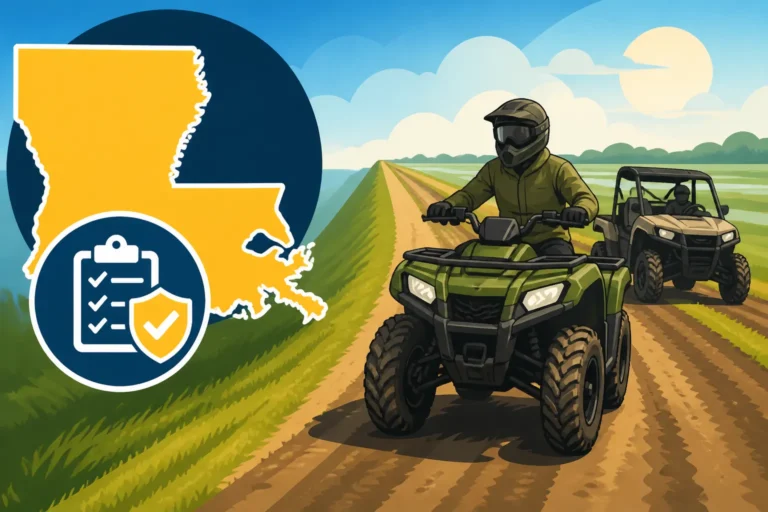
Here's a checklist of what you should consider:
- Headlights and Taillights: These are non-negotiable. Ensure they are fully functional and illuminated, even in broad daylight, to maximize your visibility.
- Brake Lights: Essential for signaling to any following traffic that you are slowing or stopping.
- Reflective Material: Adding reflective tape or decals to your machine, especially on the front, rear, and sides, can significantly increase your visibility to other drivers, particularly in low-light conditions. Companies like SuperATV offer a range of lighting and visibility accessories that can make a huge difference in how well other drivers see you.
- Rear-View Mirrors: Though not always required for off-road use, having at least one rear-view mirror is incredibly helpful for checking traffic before and during a crossing. You need to know what's coming up behind you.
- Horn: A functional horn can be a lifesaver for alerting others to your presence if needed, though primarily you should be yielding to road traffic.
- Turn Signals: While not strictly required for incidental crossings of off-road vehicles, if your machine is equipped with them (especially UTVs that might be outfitted for limited road use in designated parishes), use them. Clarity of intention is paramount.
Remember, the goal is to make yourself as conspicuous as possible to avoid any surprises. High-visibility gear for yourself, like a bright helmet or vest, also goes a long way.
The Role of a Valid Driver's License and Insurance
Another crucial point often overlooked is the driver. Even if you're just crossing a highway, Louisiana law typically requires the operator of any vehicle on a public road to possess a valid driver's license. For most adults, this means a standard Class E license. Don't think that just because you're on a quad and off-road most of the time, the rules of the road completely vanish when you touch pavement. [What a Class E License Lets You Do] applies to you too.
Furthermore, while Louisiana does not mandate insurance for off-road machines used exclusively off-road, if you're taking your machine onto a public highway, even for a crossing, the game changes. Technically, [Louisiana Insurance Proof on Demand] could be requested by law enforcement if they stop you on a public road. While the direct answer to "Does Louisiana Require Insurance on an Off-Road Machine?" is generally no for off-road use, when you venture onto public roadways, even briefly, you expose yourself to the same liability risks as any other vehicle operator. It's always wise to carry liability insurance that covers your machine for these incidental road uses. Imagine an accident during a crossing – without insurance, you could be on the hook for significant damages.
Essential Gear and Preparations for Highway Crossings
Preparation is key, not just for the ride itself but specifically for those moments when you interact with public roadways. This isn't just about legality; it's about your safety and the safety of others. Nobody wants to be the cause of an accident, especially when it could be avoided with a little foresight.
Pre-Crossing Checklist and Safety Procedures
Before you even think about putting a tire on that highway pavement, run through a quick mental checklist:
- Stop Completely: Never roll right up to the edge of a highway and try to cross. Come to a complete stop, well clear of the roadway itself, where you have a clear view of traffic in both directions.
- Look Both Ways (and Again): Treat it like a blind intersection. Look left, right, left again. Pay attention to the speed of oncoming vehicles. Highway traffic moves fast, and closing distances can be deceptive.
- Listen: Sometimes you can hear traffic before you see it, especially around blind corners or crests.
- Signal Your Intent: If your UTV has turn signals, use them. If not, make a clear hand signal if you're visible and it's safe to do so, though the primary signal should be your machine's orientation and quick, decisive movement.
- Cross Directly and Swiftly: Once you've confirmed it's clear, cross at as close to a right angle as possible. Don't meander. Don't turn and ride parallel for a bit. Get across the travel lanes and onto the other side safely.
- Yield to All Traffic: This cannot be stressed enough. You are the one entering the roadway from an unpaved area. You must yield to all vehicles already on the highway. They have the right-of-way.
| Action | Legal Requirement | Best Practice (Highly Recommended) |
|---|---|---|
| Stopping | Stop completely before entering the roadway. | Stop well clear of the roadway, in a safe, visible spot. |
| Visibility | Headlights/Taillights on if applicable to conditions. | Headlights/Taillights on at all times, reflective gear on machine/rider. |
| Signaling | No specific signal requirement for ATVs; UTVs with signals should use them. | Use turn signals if equipped; otherwise, clear hand signals if safe. |
| Observation | Yield to all traffic. | Look multiple times, listen for traffic, assess speed and distance. |
| Crossing Angle | Cross as directly as possible. | Cross at a right angle (90 degrees) to minimize time in traffic. |
| Speed | Cross swiftly and safely. | Accelerate smoothly but quickly to clear the roadway. |
| Driver's License | Class E or equivalent required. | Always carry your valid driver's license. |
| Insurance | Not required for off-road only; recommended for road use. | Carry liability insurance covering incidental road use. |
Enhancing Visibility: Lights, Flags, and Reflectors
When you're dealing with highway speeds, visibility is your best friend. Even if you're just crossing, you want to be seen from as far away as possible.
- Bright Lights: Ensure your headlights and taillights are clean and bright. If your machine allows, consider upgrading to brighter LED lights. Many riders add auxiliary lights for trail riding, which can double as excellent visibility enhancers for road crossings. SuperATV offers robust light bars and cube lights that not only illuminate the trail but also make you stand out on the road.
- Whip Flags: While often associated with dune riding, a brightly colored whip flag on your ATV or UTV can significantly increase your vertical profile, making you more noticeable over brush or dunes, and by extension, to traffic over dips or hills.
- Reflective Tape: This is cheap, effective, and easy to apply. Put reflective tape on the front, back, and sides of your machine. You can also add it to your helmet and riding gear. The more reflective surface area you have, the better.
- High-Visibility Clothing: Wear a fluorescent yellow, orange, or green vest or jacket, especially if your machine isn't brightly colored. Every little bit helps.
Remember, you're competing for attention with cars, trucks, and even 18-wheelers, many of whom might not be expecting an off-road vehicle to appear on a highway. Making yourself as obvious as possible is paramount.
Penalties and Avoiding Missteps
Nobody wants to get a ticket, much less be involved in an accident, because they misunderstood the rules. The penalties for misusing an ATV or UTV on Louisiana public roads can range from hefty fines to impoundment of your machine, and in severe cases, even jail time. Understanding these consequences is a strong motivator to follow the rules carefully.
Common Mistakes Riders Make
It's easy to make a mistake, especially when you're trying to navigate complex regulations that aren't always crystal clear in every situation. Here are some of the most common missteps riders make regarding highway crossings:
- Riding "Just a Little Bit" on the Shoulder: This is perhaps the most frequent infraction. Riders often think if they just stick to the shoulder, they're not really "on" the highway. However, the shoulder is still part of the public right-of-way, and riding on it generally falls under illegal road use, unless it's a designated farm exception. [Louisiana Penalties for Illegal Road Riding] are no joke.
- Assuming "Farm Use" Is a Blanket Exemption: While farm use does have specific allowances, it's not a free pass. Your machine must be actively engaged in agricultural operations, and you need the proper documentation to prove it. If you're using a "farm machine" to go fishing, you're likely violating the rules.
- Failing to Equip for Visibility: Even if you're confident in your crossing, if you're not visible, you're putting yourself and others at risk. A dull, dark machine with no lights on a busy highway is an accident waiting to happen.
- Not Yielding to Traffic: The road is for road vehicles. Your off-road machine is the visitor. Always, always yield.
- Not Carrying Proof of Ownership/Registration: While not directly tied to road rules, if you're stopped, law enforcement will want to see proof of ownership for your machine. [Louisiana Requires an Assigned Title for a Used One] or [Louisiana Requires an MSO for a New Machine] means you should always have your title or MSO accessible, perhaps a laminated copy.
Consequences of Illegal Road Use
The penalties for operating an ATV or UTV illegally on a public road in Louisiana can be significant. It's not just a slap on the wrist.
- Fines: You're looking at fines that can quickly add up, easily into hundreds of dollars, plus court costs.
- Impoundment: Law enforcement has the authority to impound your machine if it's being operated illegally on a public road. Getting it back means paying impound fees, storage fees, and often proving you've rectified the violation, which can be a huge hassle and expense. [Louisiana Impoundment for No Decal] often applies to illegal road use too.
- Criminal Charges: In more severe cases, especially if reckless operation or an accident is involved, you could face criminal charges beyond just traffic violations.
- Insurance Issues: If you're involved in an accident while illegally operating your machine on a public road, your insurance company might deny coverage, leaving you personally liable for damages and injuries. This is a very real, very scary prospect.
Planning Your Routes to Minimize Road Exposure
The best way to avoid these headaches is to plan your rides carefully. Use maps (both digital and paper, especially in areas with poor cell service) to identify trails and legal riding areas. Look for designated crossing points, or routes that minimize your time on public roads.
Consider trailering your machine to the actual riding area. I know, it's a pain to load and unload, but it's often the safest and most legal option. If you're traveling a significant distance between off-road areas, trailering your machine for the road portions is always the recommended approach. It eliminates all doubt and keeps you out of trouble.
If you absolutely must cross, ensure it's a truly incidental crossing as described above, and that you're taking every precaution. Be smart, be safe, and understand that while our regulations can feel restrictive, they're ultimately there to keep us all safe on Louisiana's roads and trails.
Disclaimer
This article is for general informational purposes only and does not constitute professional advice. Laws, prices and regulations vary by location and change over time. Consult a qualified professional for guidance on your specific situation.