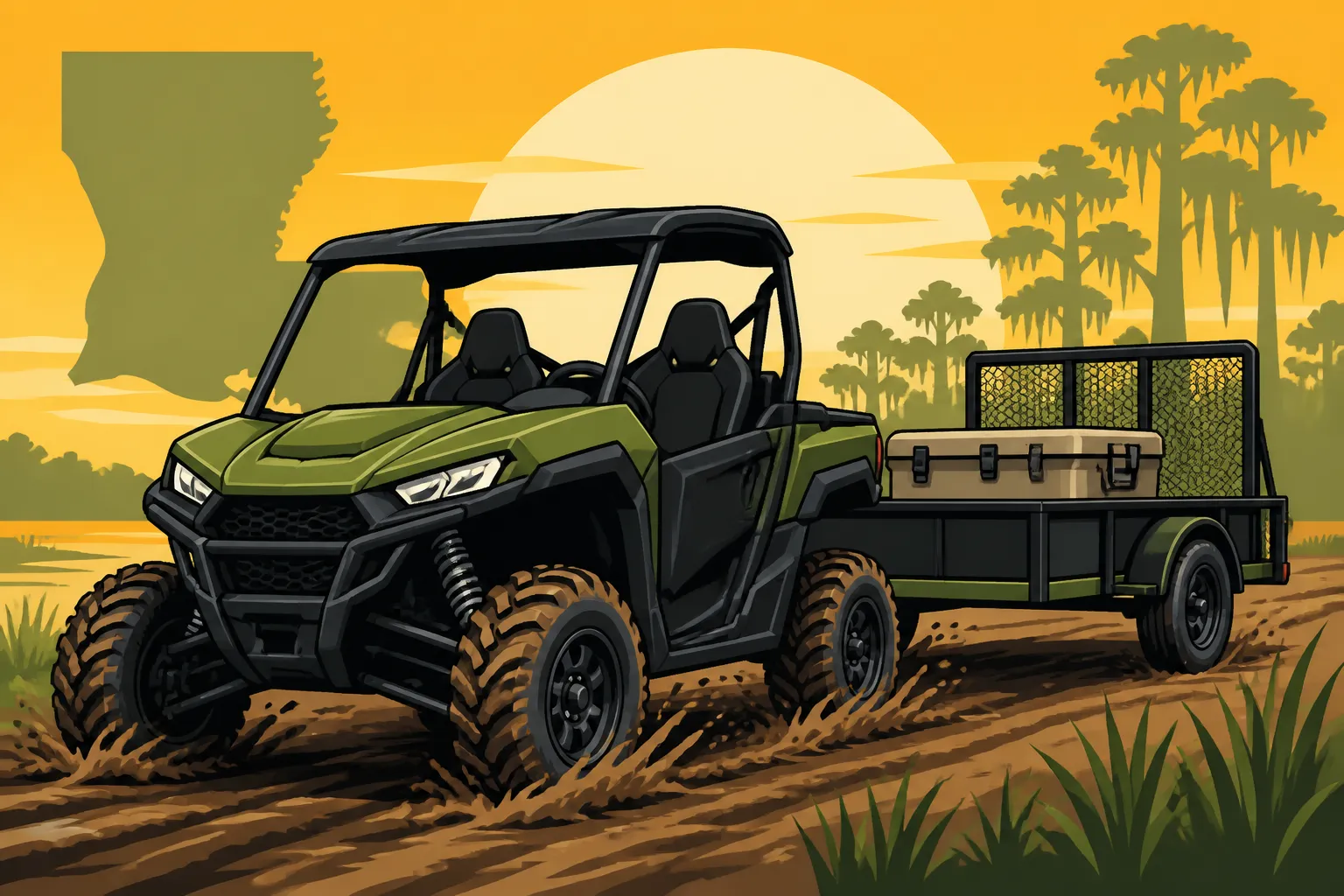
Towing a Trailer Behind a Louisiana Side-by-Side
Navigating the rules for off-road machines in Louisiana can feel like a trek through dense swampy terrain, especially when you start thinking about the practicalities of using your side-by-side for more than just trail riding. One common question that trips up a lot of folks is whether you can legally and safely tow a trailer behind your UTV, particularly if you ever plan to leave private land. This guide will cut through the confusion, explaining Louisiana's specific regulations and practical considerations for towing a trailer with your side-by-side, whether you're heading to the hunting camp, moving feed on the farm, or just taking trash to the curb on a designated parish road.
Understanding Louisiana's Core Rules for UTVs on Public Roads
Before we even get into towing, it's absolutely vital to understand the foundational rules for operating a side-by-side on any public road in Louisiana. Many riders mistakenly assume that because they have a UTV, they can just hop on any street, but that's simply not the case. Louisiana law is very specific about where and how UTVs can be operated on public roadways, and any towing activity is entirely dependent on meeting these core requirements first. Ignoring these rules can lead to significant fines, or worse, an accident.
The Basics: Designated Roads and Driver Requirements
The most critical piece of information for any UTV owner in Louisiana is that you can only operate your side-by-side on public roads that have been specifically designated by local parish or municipal authorities. This isn't a blanket permission for every road; it requires a conscious decision and signage from your local government. If a road isn't clearly marked as designated for UTV use, you cannot legally operate your machine on it, trailer or no trailer. This is a common pitfall, and many riders get caught out simply because they didn't realize their local parish hadn't opted in or put up the necessary signs. You'll often find that [Louisiana Parishes Must Designate and Sign Roads] to allow UTV traffic.
Beyond the road itself, the driver of the UTV also has to meet specific criteria. First off, Louisiana law states that UTV drivers must be at least 21 years old. This isn't an age where you can get by with a parent's permission or a provisional license; it’s a strict age minimum for operating these machines on public roads. Additionally, you must hold a valid Class E driver's license, which is your standard passenger car license. This means a learner's permit won't cut it, and if your license is suspended or revoked, you're absolutely out of luck. These age and license requirements are in place for a reason – to ensure that anyone operating a UTV on public roads has a certain level of driving experience and maturity to handle the machine safely, especially when [Towing a Trailer Behind a Louisiana Side-by-Side].
Equipment and Insurance Necessities
Once you're on a designated road and meet the driver requirements, your UTV itself needs to be properly equipped to be road-legal, and these requirements extend to anything you might be towing. A side-by-side must have working headlights, taillights, brake lights, and turn signals. It also needs a horn, a rearview mirror, and a windshield. These aren't suggestions; they are mandatory safety features designed to make your UTV visible and controllable in traffic. If you're adding accessories, consider how they might integrate with these requirements. For instance, if you're installing a robust hitch receiver, perhaps from a company like SuperATV, make sure it doesn't obstruct your taillights or license plate.
Speaking of license plates, your UTV will need one, along with proof of registration. This is different from the off-road decal you might have for trail riding; it's specific to making your machine road-legal. Most importantly, you are absolutely required to carry proof of liability insurance that meets Louisiana's minimum coverage limits. Just like driving your truck, if you're operating a UTV on a public road, you must be insured. [Louisiana UTV Insurance Minimums] are there to protect everyone on the road in case of an accident. Without it, you're not only breaking the law but exposing yourself to immense financial risk if something goes wrong. When you're towing a trailer, the stakes are even higher, so proper insurance is non-negotiable.
Specifics of Towing a Trailer with a UTV in Louisiana
Now that we’ve covered the groundwork, let's talk brass tacks about actually hitching up a trailer to your side-by-side in Louisiana. While the law is clear about if you can drive your UTV on certain roads, it’s less verbose on the specifics of towing with it. This means you need to blend legal understanding with a heavy dose of common sense and safety.
Legal vs. Practical Considerations for Trailer Towing
Legally, if your UTV meets all the requirements to be on a designated public road, and the trailer you're towing also meets basic road-worthiness standards (working taillights, proper hitches, safety chains, etc.), then the act of towing itself isn't explicitly prohibited by state statute on those designated roads. However, this is where "legal" often diverges from "practical" and "safe."
UTVs are not full-sized trucks. They have significantly lower towing capacities, often ranging from a few hundred pounds to around 1,500-2,000 pounds, depending on the model. Exceeding your UTV's manufacturer-recommended towing capacity is incredibly dangerous and can lead to a host of problems: loss of braking power, instability, damage to your UTV’s drivetrain, and increased risk of jackknifing. Always check your specific UTV's owner's manual for its maximum towing capacity and never, ever exceed it. Many riders who plan on doing consistent towing might even look into aftermarket upgrades like heavy-duty hitches or suspension components, perhaps from a trusted supplier like SuperATV, to help manage the load better, but these still won't magically increase your UTV's inherent towing limit.
The type of hitch and trailer connection is also crucial. You'll need a proper hitch receiver compatible with your UTV, a hitch ball of the correct size for your trailer, and sturdy safety chains that cross under the trailer tongue to catch it if the primary hitch fails. The trailer itself must have functioning lights that mirror your UTV's brake and turn signals. If your trailer is wide enough to obscure your UTV's lights, it absolutely needs its own set of lights, properly wired into your UTV's electrical system. For heavier loads, trailer brakes are not just a good idea, they are often legally required if the trailer exceeds a certain weight threshold, though this can vary by specific parish ordinances or even the type of road. Always make sure your trailer’s tires are properly inflated for the load you're carrying, too!
Essential Safety Checks Before You Roll Out
Before you even think about pulling out of your driveway with a trailer attached to your side-by-side, a thorough safety check is non-negotiable. This isn't just about avoiding a ticket; it's about preventing a serious accident.
First, inspect your hitch connection. Is the hitch ball securely tightened to the receiver? Is the trailer coupler fully latched onto the ball? Are the safety chains properly crossed and secured to your UTV's frame or hitch? A loose connection is an accident waiting to happen. Second, check your trailer'lights and wiring. Connect the wiring harness and have someone verify that all your trailer lights (running lights, brake lights, turn signals) are working in sync with your UTV's lights. A burnt-out bulb or a loose connection can be a huge hazard, especially if you're going to be sharing the road with other vehicles.
Third, and perhaps most overlooked, is load security and distribution. Whatever you're hauling, it needs to be securely tied down. Loose items can shift, causing the trailer to sway violently, or worse, fly off the trailer into traffic. Distribute the weight evenly, aiming for about 10-15% of the total trailer weight to be on the tongue (the part resting on the hitch ball). Too much tongue weight can overload your UTV's rear suspension, while too little can make the trailer unstable and prone to swaying. Think about how [Towing a Load Across Private Timber Ground] requires a different approach than towing down a designated parish road. Always drive slower, allow more braking distance, and take wider turns when towing. The added weight and length drastically change how your UTV handles.
What You Can (and Can't) Haul with Your Side-by-Side
The type of load you plan to haul and the location where you'll be doing the hauling dramatically influence the rules and best practices. There's a big difference between moving a deer stand across your property and taking a utility trailer full of lumber down a public road.
Farm Use and Private Land Exclusions
On private property, the rules are significantly relaxed. If you're staying entirely on land you own, lease, or have explicit permission to use, then state laws regarding road-legal UTVs generally don't apply. This means you can often tow much heavier loads (within your UTV's mechanical limits, of course) for purposes like [Louisiana Farm Affidavits for Road Use] without needing to worry about designated roads, age minimums, or specific equipment requirements beyond what's safe for your operation. Many agricultural operations rely heavily on UTVs for moving feed, tools, and even small livestock trailers around large properties.
The key here is private land. The moment even one wheel touches a public road (designated or not), you're subject to all state and local regulations. However, Louisiana does have a specific exception for agricultural use. A farmer can operate a UTV or ATV on the shoulder of a public road, or even cross public roads, for a distance of up to five miles from the point of origin, provided the machine is being used for legitimate agricultural purposes. Even then, the machine still needs to display a proper off-road decal. This exception is primarily for moving from one field to another or reaching adjacent parts of a farm. If you're utilizing this exemption, carrying an affidavit swearing to the farm use can be helpful.
Navigating Designated Roads with a Trailed Load
If your intention is to tow a trailer on a designated public road, then every single rule we discussed earlier comes into play. You must be on a designated road, the driver must be 21 with a valid Class E license, and your UTV and trailer must meet all lighting, signaling, and insurance requirements. This is where you might be using your UTV to tow a small utility trailer to a local hardware store for supplies, or perhaps moving camping gear to a nearby campsite that’s accessible via designated parish roads.
You’ll also need to consider local ordinances, which might have additional restrictions on the size or type of trailer that can be towed, or even speed limits specific to UTVs with trailers. Always check with your local parish or municipal office about their specific rules before you head out. Driving with a trailer adds length, width, and weight, impacting your visibility, maneuverability, and stopping distance. It’s imperative to drive defensively, maintaining plenty of space between you and other vehicles. While you might be legally allowed to tow, remember that your UTV is not designed for highway speeds or heavy loads typical of trucks, and other drivers may not expect a UTV with a trailer on the road. Safety should always be your absolute top priority.
Here's a quick comparison of towing scenarios in Louisiana:
| Feature | Private Property / Farm Use (on own land) | Designated Public Roads (with UTV road legal) |
|---|---|---|
| Driver Age | No state minimum (follow manufacturer recs) | 21 years old |
| Driver License | Not required by state law | Class E (standard car license) required |
| Road Designation | N/A (on private land) | Required by parish/municipality |
| UTV Equipment | Follow manufacturer safety guidelines | Headlights, taillights, brake/turn signals, horn, mirror, windshield |
| Trailer Equipment | Basic safety (secure hitch, load) | Working taillights, brake/turn signals (if trailer lights obscure UTV's), safety chains, proper hitch |
| Insurance | Optional (but highly recommended) | Liability insurance legally required |
| Load Capacity | Limited by UTV mechanical limits | Limited by UTV mechanical limits (drive with caution) |
| Speed Limits | Follow internal safety rules | Must obey posted road speed limits (drive slower with trailer) |
| Agricultural Exemption | N/A (already on farm) | Yes, for up to 5 miles on shoulder or crossing for farm use |
| Aftermarket Parts | Free to use (e.g., SuperATV for heavy duty) | Free to use, but must maintain legal equipment requirements |
| Penalties | None (unless trespassing/reckless endangerment) | Fines, potential impoundment, liability for accidents |
Remember, whether you're working the back forty with your machine or making a quick trip down a parish road, knowing and respecting these rules will keep you, your side-by-side, and your precious cargo safe.
Disclaimer
This article is for general informational purposes only and does not constitute professional advice. Laws, prices and regulations vary by location and change over time. Consult a qualified professional for guidance on your specific situation.