The One Parish the Statute Skips Entirely
It's a common assumption that state laws apply equally across every single corner of Louisiana, especially when it comes to something as specific as riding your ATV or UTV on public roads. However, if you've ever tried to make sense of the regulations, you know it's rarely that simple. This guide is here to untangle a very particular and often confusing aspect of Louisiana's off-road vehicle statutes: the one parish that stands entirely apart when it comes to road use, leaving many riders scratching their heads.
Understanding Louisiana's ATV and UTV Road Use Statutes
Before we dive into the exception, it's crucial to understand the general rule. Louisiana state law does provide specific, albeit limited, avenues for ATV and UTV owners to operate their machines on certain public roads. This isn't a free-for-all, and it’s certainly not akin to registering a car for unrestricted street use. Instead, it’s a carefully crafted set of rules designed to balance the needs of off-road enthusiasts, particularly those in rural and agricultural communities, with public safety.
The statutes recognize that for many in our state, an ATV or UTV isn't just a recreational toy; it's a vital tool for work, especially on farms and timberland. That said, even in the most accommodating parishes, there are strict limitations. You can't just hop on your quad and cruise down Main Street, even if your local hardware store is just a block away. The intent is to facilitate incidental use, not everyday commuting.
The General Rules for Riding on Public Roads
For the vast majority of Louisiana's parishes, the possibility of riding your ATV on a public road falls under [Louisiana ATV Road Rules Under 32:299]. This statute lays out the conditions under which an all-terrain vehicle can legally operate on a public road or highway, and it’s quite restrictive. Generally, it permits ATVs on the shoulder of certain public roads if the parish or municipality has specifically authorized such use by ordinance. There are also stipulations about speed, visibility, and the necessity of carrying proof of ownership and a valid decal.
For UTVs, the rules are slightly different and are outlined in [Louisiana UTV Road Rules Under 32:299.3]. This statute, amended more recently, often allows for a bit more flexibility, permitting UTVs on designated parish or municipal roads themselves, not just the shoulder. However, it comes with its own set of requirements, including an age minimum for drivers, often 21, and proof of insurance. Both statutes generally require the operator to possess a valid Class E driver’s license, which is your standard Louisiana operator's license. [Louisiana Requires a Class E License] for these types of machines when on public roads.
It’s important to remember that these state laws are enabling statutes. They allow parishes and municipalities to designate roads, but they don't force them to. So, even where state law opens the door, local authorities still have the final say on which roads, if any, are open to off-road machines.
Why Local Ordinances Matter Outside Orleans Parish
Even outside the unique case of Orleans Parish, understanding local ordinances is absolutely critical. The state laws provide the framework, but the specifics are determined at the parish and municipal level. This means that a road that’s perfectly legal for your side-by-side in one parish could be strictly off-limits just across the parish line. It's a patchwork quilt of regulations, and getting it wrong can lead to serious penalties, from hefty fines to impoundment of your machine.
Many riders mistakenly believe that if the state says it's possible to ride on a shoulder, then they can do so anywhere. Not true. [Louisiana Parishes Must Designate and Sign Roads] for these state allowances to take effect. If your parish hasn't passed an ordinance specifically designating certain roads or shoulders for ATV/UTV use, then the state allowances don't apply. This is why you might see signs in some rural areas indicating shared use, while in others, there are none, and local law enforcement will enforce a blanket ban on public road riding. Riders absolutely need to do their homework and look up [Louisiana Parish Ordinance Lookups] for where they plan to ride. It’s not just about knowing the state law; it’s about understanding how your local government has adopted and implemented it.
Orleans Parish: The Unique Exemption
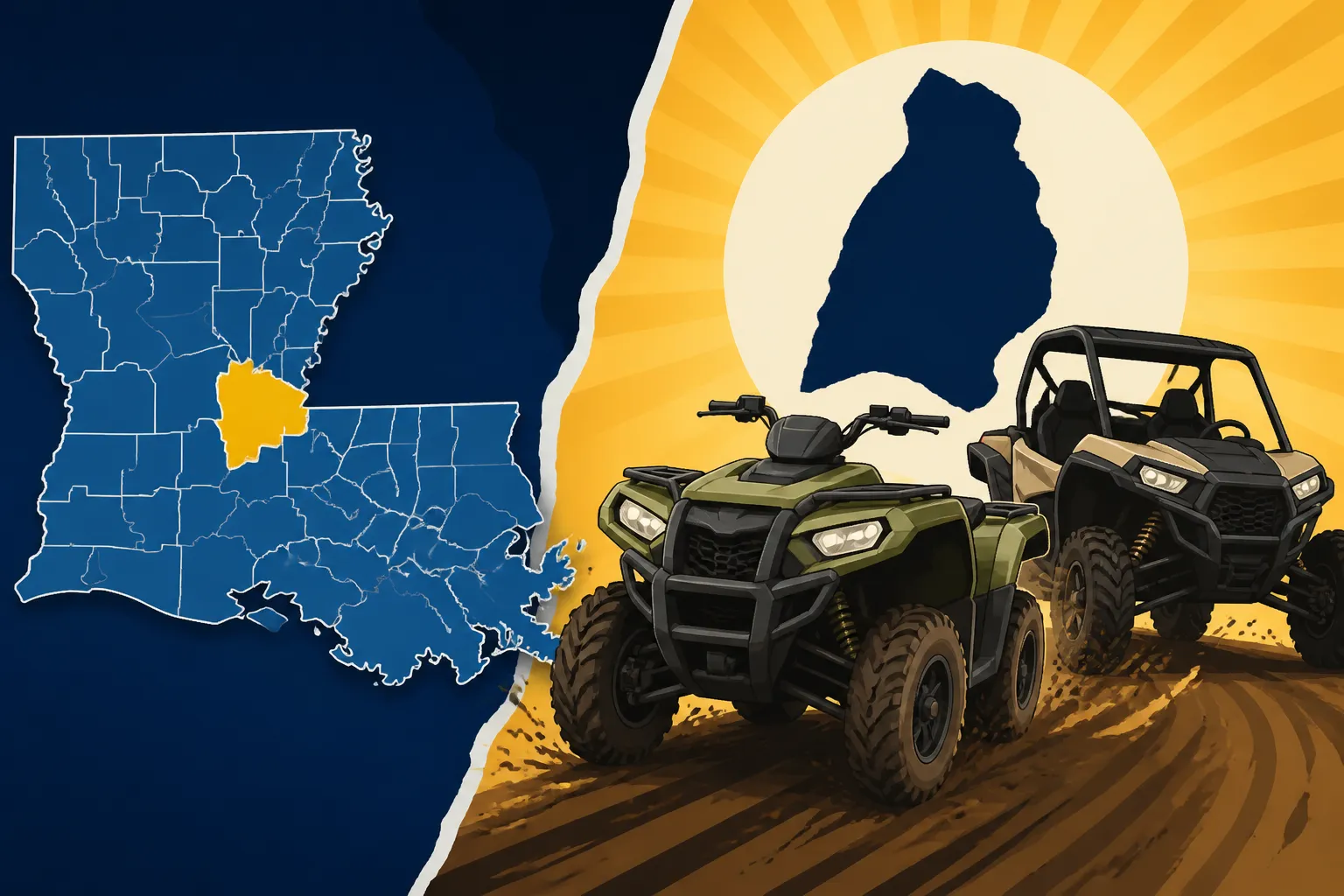
Now, let's talk about the elephant in the room – or rather, the parish that stands completely outside these general state rules: Orleans Parish. While the rest of Louisiana's parishes and municipalities navigate the nuances of R.S. 32:299 and 32:299.3, Orleans Parish operates under a different set of expectations entirely. This isn't a subtle difference; it's an explicit exclusion written into the very text of the state statutes.
For many riders planning a trip, or perhaps even moving to the New Orleans area with their machine, this comes as a significant surprise. They assume that if there are rules for ATVs and UTVs on roads in Louisiana, those rules would at least apply everywhere, even if the local government then chooses to prohibit it. But Orleans Parish is a special case, and it completely sidesteps the state's framework for off-road vehicle road use.
The Specific Language of the Statute
The crucial detail lies directly within the state laws governing ATV and UTV road use. Louisiana Revised Statute 32:299, which pertains to ATVs, explicitly states: "The provisions of this Section shall not apply in Orleans Parish." A similar exclusion exists for UTVs within R.S. 32:299.3. This clear and unambiguous language means that all the conditions, permissions, and restrictions that apply to ATVs and UTVs on public roads in the other 63 parishes of Louisiana simply do not apply within the boundaries of Orleans Parish.
This isn't an oversight or a loophole; it's an intentional legislative decision. What it practically means is that the state of Louisiana has essentially ceded all authority over ATV and UTV road use in New Orleans to the local government there, without providing any state-level framework for such use. So, while other parishes can use the state statute as a basis to create ordinances allowing limited road access, Orleans Parish has no such foundation. For all intents and purposes, [Orleans Parish Is Exempt From Louisiana's ATV Statute] means that if you're riding an off-road machine on a public road in New Orleans, you're doing so without any state-level authorization whatsoever.
Navigating Off-Road Machine Use in New Orleans
Given the explicit exemption, navigating off-road machine use in New Orleans becomes incredibly challenging, if not impossible, on public thoroughfares. Since the state statutes offering limited road access don't apply, any potential for street-legal ATV or UTV operation must come solely from local Orleans Parish ordinances. And given the dense urban environment and historical context of the city, it's highly unlikely that such ordinances would permit widespread, or even limited, road use for ATVs and UTVs. New Orleans is simply not built for off-road vehicle integration into its public street system.
This means that if you're in New Orleans, your ATV or UTV is essentially confined to private property with the landowner's explicit permission. Riding on public streets, sidewalks, parks, or levees within Orleans Parish would almost certainly be considered illegal operation of an unregistered vehicle, or similar infractions, leading to immediate citations and potential impoundment. It’s critical to exercise common sense here; New Orleans is a bustling metropolitan area, not a rural landscape. Your SuperATV-equipped machine, with all its rugged durability and trail-ready components, is designed for the bayous and pine forests, not the cobblestone streets of the French Quarter. While SuperATV products make your machine more capable, they don't grant it legal road access in areas where it's explicitly prohibited.
For anyone traveling to or through New Orleans with an off-road machine, the safest and only truly legal approach is to transport it on a trailer. There are no designated trails or areas for recreational riding within the city itself. If you're looking for a ride, you'll need to venture far outside the parish borders to find suitable and legal locations. [Louisiana Rules for Riding in New Orleans] are, in essence, "don't ride on public land."
Implications for Riders and Visitors
The unique status of Orleans Parish has significant implications for anyone who owns or plans to operate an ATV or UTV within its borders. It’s a common pitfall for riders who are familiar with the rules in their home parish, only to find a completely different reality when they enter the Crescent City. This isn't just a minor technicality; it’s a fundamental difference in how off-road machines are treated by law enforcement and local authorities.
Understanding this distinction is not just about avoiding a ticket; it's about respecting local laws and ensuring the safety of yourself and others in a densely populated urban area where off-road vehicle operation simply isn't part of the established traffic flow. The vibrant culture and historic architecture of New Orleans are best experienced on foot, by streetcar, or in a conventional vehicle, leaving the off-road machines for appropriate environments.
What to Expect if You Bring a Machine to New Orleans
If you decide to bring an ATV or UTV to New Orleans, you should fully expect that any attempt to operate it on public streets, sidewalks, bike paths, or even certain public greenspaces will be met with immediate enforcement. There's no state-level "shoulder riding" or "designated road" exception here. Law enforcement officers are highly likely to consider any such operation as illegal, potentially leading to citations, significant fines, and the impoundment of your machine. [Louisiana Penalties for Illegal Road Riding] can be severe, and in an urban environment like New Orleans, enforcement is often swifter and less forgiving than in a remote rural parish.
Your off-road machine is best kept on a trailer, used strictly on private property with explicit permission, or securely stored. If you’re visiting or have family in the area and plan to bring your machine for use in other parts of the state, ensure it stays trailered while in Orleans Parish. Trying to quickly run to a store or cross a short distance on your quad could land you in serious trouble. The urban environment simply isn't designed for such vehicles, and local regulations will reflect that reality.
Contrasting Orleans with Other Louisiana Parishes
To truly grasp the unique situation in Orleans Parish, it helps to put it into contrast with how ATV and UTV road legality is approached in the rest of Louisiana. This isn't just about different rules; it's about a completely different legal philosophy regarding off-road vehicles on public ways. The table below illustrates this fundamental divergence.
| Feature | Orleans Parish (New Orleans) | Typical Rural Parish (e.g., Rapides, Webster) |
|---|---|---|
| State Statute Application | Explicitly Excluded (R.S. 32:299 & 32:299.3) | Applies (with local designation) |
| Road Use Framework | Purely local ordinances, if any exist | State statutes provide framework; local designates roads |
| Primary Authority | Orleans Parish municipal government | Parish/Municipal government (under state guidelines) |
| Likelihood of Public Road Use | Extremely low; generally prohibited | Possible on designated roads/shoulders by local ordinance |
| Enforcement Posture | Strict against public road use | Varies by local ordinance; usually strict on non-designated roads |
| Typical Environment | Dense urban, historic streets, high traffic | Rural, agricultural, timberland, lower traffic volume |
As you can see, the difference is stark. In a typical rural parish, [Can You Ride an ATV on the Road in Louisiana?] often leads to a "yes, under specific conditions and if designated" answer. In Orleans Parish, the answer is almost universally "no" on public property, unless you're a government vehicle or have very specific, rare permits.
Best Practices for Louisiana Riders
Given the complexities of Louisiana's off-road vehicle laws, especially when considering the Orleans Parish exception, adopting a proactive and informed approach is key to enjoying your machine responsibly and legally. Whether you're riding in the deep woods of Kisatchie National Forest or navigating the rural roads of a farming community, understanding and adhering to the rules is paramount. It not only keeps you out of trouble but also helps preserve access for all riders.
Remember, the goal is to have fun and explore, but never at the expense of safety or legality. Investing in quality gear, like robust suspension components or durable tires from a company like SuperATV, is a smart move for whatever legal riding you do. However, no aftermarket part will ever grant you legal access to prohibited areas.
Always Check Local Ordinances
This cannot be stressed enough: always check local ordinances for any parish or municipality where you plan to ride your ATV or UTV. State law provides the broad strokes, but the local government paints in the details. What might be permissible in one parish could be strictly forbidden just miles away. This is especially true if you are planning to ride on any public road, shoulder, or even publicly accessible land. Many parishes require specific designations for roads, as well as adherence to speed limits, time-of-day restrictions, and proof of insurance for UTVs.
Don't rely on hearsay or what a friend told you about "their parish." Laws change, and enforcement priorities shift. A quick call to the parish sheriff's office or checking the parish's official website for ordinances related to ATVs and UTVs can save you a world of trouble. This diligence is particularly important if you're traveling, as you certainly don't want to get pulled over by [What a Louisiana State Trooper Can Ask to See] only to find out you're breaking local rules.
The "When in Doubt, Don't" Approach
When it comes to off-road machine use on public roads or property, especially in areas with complex or ambiguous rules, the safest approach is often "when in doubt, don't." If you're unsure whether a particular road or area is legal for your ATV or UTV, assume it's not. This cautious mindset can prevent hefty fines, impoundment, and even legal complications. It also helps you avoid conflicts with local residents or property owners who may not appreciate off-road vehicles in their area.
This principle applies tenfold in urban or suburban environments, and nowhere more so than in Orleans Parish. Because the state statute explicitly excludes Orleans, there is no state-level basis for any public road use. Trying to push the boundaries in such an environment is a recipe for trouble. Beyond the legal consequences, such as [Louisiana Impoundment for No Decal] or illegal operation, it's also about rider responsibility. By being responsible and adhering to legal riding areas, we help ensure that these privileges, where they do exist, are not revoked. After all, the actions of a few can sometimes impact access for the many. Being an informed and respectful rider is the best way to enjoy your machine for years to come.
Disclaimer
This article is for general informational purposes only and does not constitute professional advice. Laws, prices and regulations vary by location and change over time. Consult a qualified professional for guidance on your specific situation.