Passenger Rules at a Private Mud Park
Taking a passenger to a Louisiana mud park can seem simple until you arrive and find the machine, rider, or passenger doesn’t meet the park’s rules. Policies differ by park, and an ATV and a side-by-side are not treated the same. Check the machine’s seating, the passenger’s age and gear, and the park’s current rules before you haul out.
Start With the Machine’s Designed Seating
A private park can set its own entry and riding rules, but the machine’s design is the first practical limit. A passenger should ride only in a seat the manufacturer designed for a passenger. A long seat, rear rack, cargo bed, or roomy-looking fender does not turn a single-rider ATV into a two-person machine.
ATVs can be especially easy to misjudge. Some have a passenger seat and handholds; many are designed for one rider. On a single-rider model, carrying someone on the back can interfere with balance, steering, and the rider’s ability to shift their weight. A passenger who slides or leans the wrong way can make a turn or a muddy climb harder to control. If you are unsure how your ATV is configured, check its owner’s manual and model information before inviting anyone aboard.
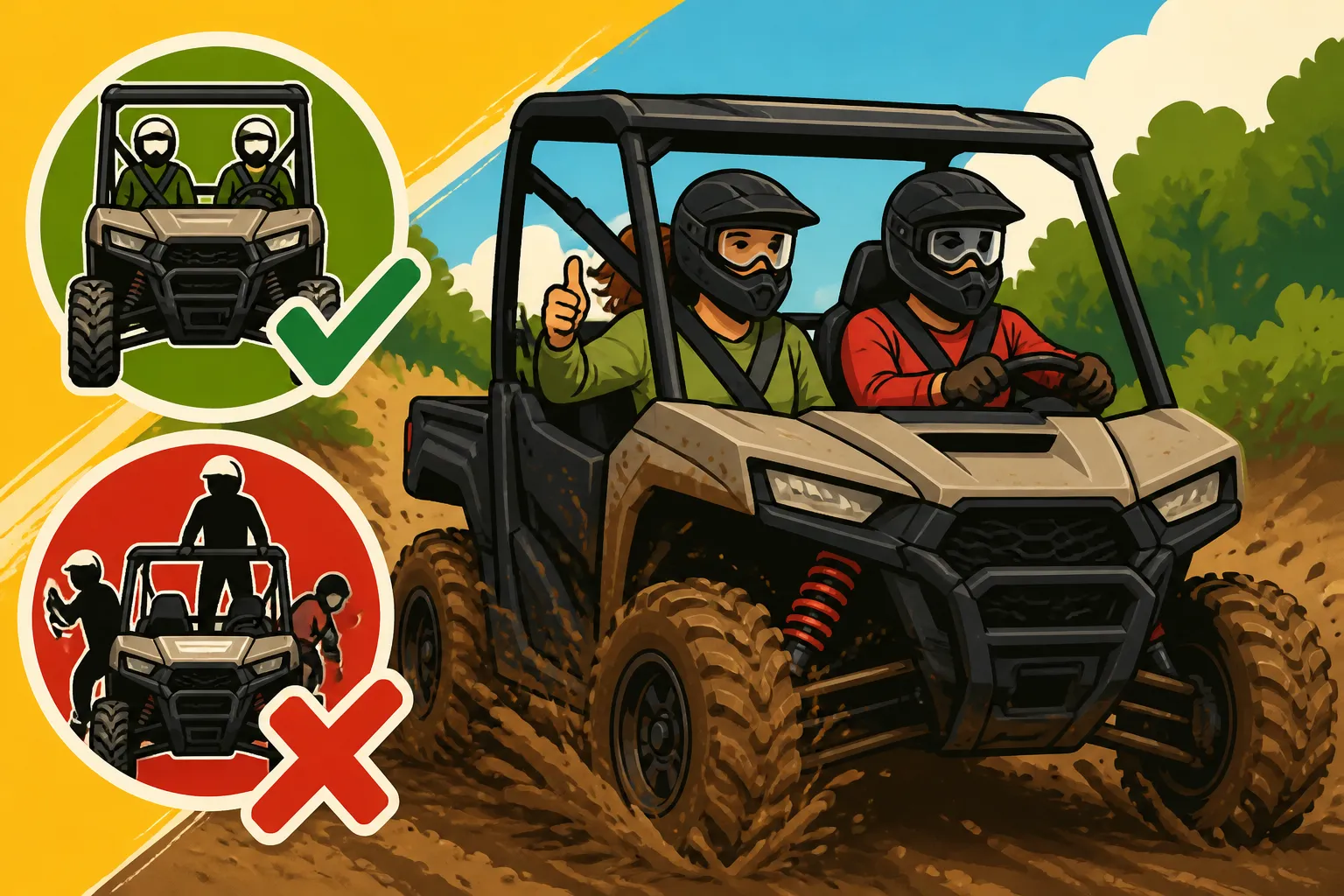
A side-by-side, often called a UTV, generally has a defined seating area, but that does not mean every model can carry the same number of people. Count the manufacturer-designated seats, not the number of people who can squeeze inside. Each occupant should have an appropriate seat and use the restraint system provided for that seat. Riding in a cargo bed or sitting on a lap is not a safe substitute for an available seat.
| Machine or position | Practical passenger check |
|---|---|
| Single-rider ATV | Carry only the operator; do not add a passenger to a rack or rear fender |
| ATV designed for two | Use the designated passenger seat and handholds; follow the manual |
| UTV with individual seats | Keep each person in a designated seat and use the assigned restraint |
| Cargo bed, rack, or lap | Not a passenger seat; do not carry a rider there |
The park can be stricter than the machine’s capacity. It may allow passengers only on certain types of machines, limit the number of occupants, or prohibit passengers on some trails or during certain activities. Its rules can also distinguish between a passenger who rides in a designated seat and someone who merely accompanies the operator. Confirm the details with the park rather than assuming that an extra seat automatically means an extra ticket or permission to ride.
For a broader comparison of public-road rules and passenger limits, see Can You Carry a Passenger on a Louisiana ATV? and Louisiana Rules for Passengers on a UTV. Those rules address a different setting from a private mud park, so don’t use them as a substitute for checking the park’s own policy.
Check Age, Supervision, and Protective Gear
A park’s minimum age for riders or passengers is a separate question from whether the machine has a seat. A child may be allowed to enter the park but not to ride as a passenger, or may be allowed only with an adult and under specific conditions. Parks set policies according to their own terrain, activities, and risk rules, so there is no safe assumption that one park’s age policy applies everywhere.
Ask the park about the passenger’s age before the visit, and give the age accurately. Find out whether the rule changes based on machine type, whether children must ride with a parent or guardian, and whether the park has a separate rule for operating a machine. A passenger who is too young to sit securely, reach the handholds, or stay in position may not be a suitable passenger even if the park permits their age group.
For related information, [Louisiana Private Park Age Minimums] and Louisiana Rules for a Child Passenger cover questions to check before riding. The park’s current written policy is still the final word for entry and use of its property.
Protective equipment is another point to confirm rather than guess. Parks may set helmet requirements, specify what kinds of helmets they accept, and require additional gear. A passenger needs equipment that fits them, not a spare helmet that is too large or a helmet intended for a different use. Ask whether the park requires eye protection, boots, long pants, or other clothing, and whether the rules differ for children.
If you need to purchase or replace gear, check the fit and safety information before ordering from a marketplace such as Amazon. A helmet that arrives quickly but does not fit securely is not a useful solution. The park can tell you what it accepts, but proper sizing and the manufacturer’s instructions matter too. See Helmet Rules a Private Mud Park Enforces for the park-policy side of that question.
Before the ride, make sure the passenger understands how to sit, where to hold on, and how to follow the operator’s movements. On an ATV designed for two, the passenger should use the designated handholds and footrests. In a UTV, the passenger should stay seated and use the restraint intended for that seat. Neither passenger should lean out, stand on a seat, or move around while the machine is underway.
Ask the Park Before You Load Up
A short call or message can prevent a wasted trip. Park websites and social media pages may summarize rules, but event weekends, trail conditions, and operating policies can change. Check the park’s current information and ask about passengers specifically. A general question such as “Are passengers allowed?” may not be enough if the answer depends on whether you are bringing an ATV or a UTV.
Use a checklist like this:
- Name the machine. Give the make, model, and type, and explain whether it is designed for one rider or more than one.
- Ask whether passengers are allowed on that machine. Confirm whether the answer changes by trail, event, or activity.
- Confirm age limits. Ask about both passenger age and any supervision requirements.
- Ask about required equipment. Check helmet, eye protection, footwear, and clothing rules, including rules for children.
- Check the occupant limit. For a UTV, ask whether every person must have a designated seat and restraint. For an ATV, confirm that the model’s passenger seating is accepted.
- Ask how the park handles waivers and admission. Find out whether passengers need their own waiver, wristband, or other check-in step, and whether a parent or guardian must complete paperwork for a minor.
- Ask about exceptions and enforcement. If a passenger has a particular mobility or safety need, explain it before arriving. Do not assume an exception will be available at the gate.
A park may require a waiver from each participant or additional paperwork for minors. Read the forms before signing and make sure the passenger or guardian understands what they cover. A waiver does not make an unsafe seating arrangement acceptable, and it does not replace the park’s riding rules. Louisiana Private Park Waivers and Rules explains why it is worth reviewing a park’s policies before the day of the ride.
Save the park’s response or a screenshot of its posted policy if you are planning around a specific rule. That does not guarantee admission if conditions or policies change, but it gives you something concrete to refer to when you arrive. If you get an unclear answer, ask a follow-up question and describe the actual machine rather than relying on a broad label like “four-wheeler.”
Set the Passenger Up for a Safer Ride
Even when the park permits a passenger, the operator remains responsible for choosing a suitable route and speed. Mud parks can include ruts, standing water, steep banks, sudden holes, and other obstacles that are difficult to judge from the seat. A passenger changes the machine’s load and can affect how it handles. Follow the owner’s guidance for passenger use and payload, and do not assume that a machine can safely carry its maximum load through every obstacle.
Before leaving the staging area, check that the passenger is seated correctly and that any seat belt or restraint is fastened as intended. Make sure the passenger can reach the designated handholds or controls for comfort without interfering with the operator. For a child, check fit again after they put on a helmet and other gear; equipment can make it harder to sit securely or reach a handhold.
Agree on a simple way to communicate. Noise, helmets, and engine vibration can make conversation difficult. The passenger should know how to signal that they want to stop, and the operator should stop in a safe place if the passenger is uncomfortable or gear needs adjustment. Do not try to talk through a difficult section or continue because the group is waiting.
Choose a route that matches both the machine and the least experienced person on it. If a passenger has never ridden before, start with easier terrain and a calm pace. Avoid deep mud, abrupt climbs, or fast group traffic until you know the passenger can stay positioned and the operator can control the machine with the added weight. A park’s trail rating or staff guidance can help, but conditions can change during the day.
If the park does not allow a passenger on your ATV, do not improvise by adding a seat, carrying someone on a rack, or switching to an unapproved machine arrangement. Options may include riding separately on machines that meet the rules, renting an approved vehicle if available, or leaving the passenger off the trail. The simplest plan is to confirm the rules before departure and bring only equipment that is suitable for the intended riders.
A final pre-trip check should cover both paperwork and the physical setup: the passenger’s eligibility, the park’s current policy, correctly fitting protective gear, designated seating, and working restraints where fitted. Keep the park’s contact details handy in case a rule or event schedule needs clarification. For park-specific requirements beyond passenger seating, see Louisiana Private Park Waivers and Rules and [Louisiana Private Park Age Minimums].
Disclaimer
This article is for general informational purposes only and does not constitute professional advice. Laws, prices and regulations vary by location and change over time. Consult a qualified professional for guidance on your specific situation.