Louisiana WMA Fishing Access by Machine
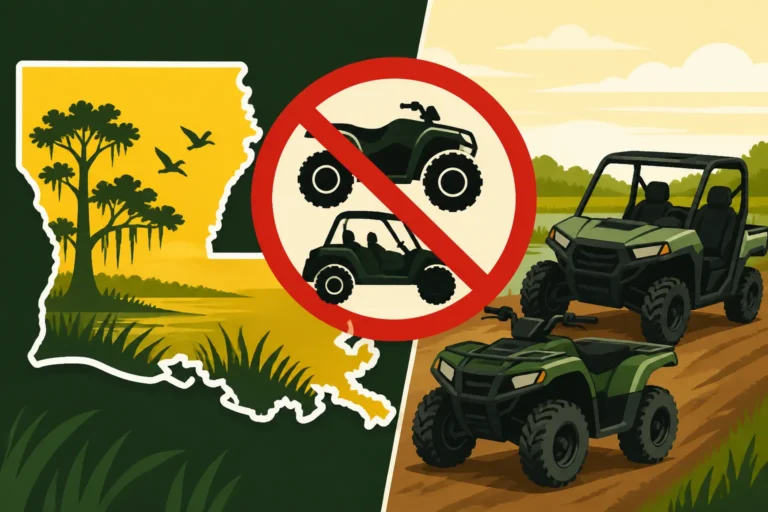
A WMA may look like the quickest way to reach a fishing spot, but a fishing destination is not automatically an approved ATV or UTV route. Access depends on the area’s current rules, open roads and trails, permits, and seasonal restrictions. Here’s how to plan a trip without assuming that permission to fish also gives you permission to ride anywhere.
Start With the WMA’s Access Rules
Wildlife Management Areas are not all interchangeable. A route that allows motorized travel on one area may be closed, restricted, or limited to certain machines on another. Before unloading, check the current rules for the specific WMA, including its map, access information, and any seasonal notices.
The key question is not only whether fishing is allowed. It is whether your machine may travel on the route you intend to use, on the day you plan to go, and under the conditions in effect then.
Fishing access is not blanket riding access
Having a lawful reason to visit a WMA does not by itself authorize riding across the property. A fishing trip still has to follow the area’s motor-vehicle rules. In practice, that means staying on roads or trails that are open to your type of machine and not using an ATV or UTV to cut across woods, marsh, fields, or other closed ground to get closer to the water.
Pay attention to the difference between a road that appears on a general map and a route officially open to motorized use. A visible track, a worn path, or another rider’s tire marks are not reliable proof that a route is open. Use the WMA’s current official map and signs at the access point.
For a broader explanation of how marked routes work, see Louisiana WMA Designated Trails Only. If your intended route is not clearly shown as open to machines, do not assume it is allowed. Ask the managing agency or choose a route whose status is clear.
Check permits before you enter
WMA access requirements can depend on the area, your reason for visiting, and your own licensing or exemption status. Some trips may involve a self-clearing permit or other access credential, and fishing license requirements are a separate question from vehicle access. Check both rather than assuming one permit covers everything.
Start with Louisiana WMA Access Permits and Louisiana Self-Clearing Permits. Follow the instructions for the particular area, including any permit box or online process specified for visitors. If a self-clearing form has a portion you must keep, complete it as directed and retain it during the visit.
An ATV or UTV permit, where one is required, does not necessarily replace an access permit, fishing license, or other requirement. Think of these as separate checks:
- Are you authorized to enter the WMA for your planned activity?
- Do you need to complete a self-clearing permit or carry another access document?
- Do you meet the current fishing license rules?
- Is your machine allowed on the route you plan to use?
- Is that route open on the date and at the time of your trip?
Confirm the current answers with the managing agency before traveling. WMA access details and notices can change, and a rule that applied on a prior visit may not apply to the next one.
Choose a Legal Route to the Fishing Spot
The most dependable plan is to identify an approved place to park or unload, then follow a route that the WMA clearly allows for your machine. A short walk from an authorized parking area is often a better choice than trying to ride all the way to the shoreline.
Match the route to your machine
Some WMA rules distinguish between ATVs and UTVs, and some limit vehicle size or equipment. Do not assume that a route open to one kind of machine is open to every machine. A side-by-side may be subject to different restrictions than a small ATV, and a machine that is allowed on one designated route may still be barred from another.
Review Louisiana WMA Machine Size Limits before you go. Check the current requirements for machine dimensions, weight, tires, and any other equipment rules that apply to the area. A machine’s appearance or ability to fit between trees does not establish that it meets the rules.
Also verify whether a trail is open to motorized traffic at all. Some mapped routes may be intended for other users, while certain WMA trails may have narrow operating windows or restrictions. If the map or posted notice does not make the route’s status clear, get clarification before riding it.
Don’t turn a water’s edge into an off-trail shortcut
A fishing spot may be close to a road but separated from it by soft ground, vegetation, a drainage, or a bank. That does not make it legal to ride across the intervening ground. Avoid using a machine to reach the water by crossing closed areas, driving along a shoreline, or making a new path through vegetation.
Park only where the WMA allows parking, and keep the machine out of places where it could block a gate, road, trail, launch, or access for emergency and management vehicles. Do not leave it on a narrow route simply because you plan to be away from it for a short time.
When the approved route ends, continue on foot if the area allows access to the fishing location. If walking access is not clear, ask the area manager rather than treating the machine’s ability to reach the spot as permission.
| Trip question | What to confirm before riding |
|---|---|
| Is the WMA open to visitors for your planned activity? | Current area access rules and any closure notices |
| Can your machine enter? | Machine type, size, and equipment restrictions |
| Is the route open to your machine? | Current WMA map, route signs, and seasonal status |
| Do you need paperwork? | Access permit, self-clearing process, and fishing license rules |
| Can you reach the water by machine? | Whether the route actually continues to an approved parking or access point |
| What if the route is unclear? | Contact the managing agency or choose a clearly open route |
Pay attention to seasonal and time restrictions
A trail’s status can change with the season, habitat conditions, wildlife management, or other area-specific needs. A route that was open during one visit may be closed later. Check notices close to your trip and again when you arrive, especially if you have not visited the WMA recently.
Seasonal riding rules are not the same as fishing seasons. The fact that fishing is allowed does not mean motorized access is open. Review Louisiana WMA Seasonal Riding Ban for more on how closures can affect riding plans, and check the specific WMA’s current schedule rather than relying on a general recollection.
Time restrictions matter too. Do not assume that a fishing trip that begins early or ends late allows you to ride outside the WMA’s permitted hours. Confirm any riding-hour limits and plan enough time to return to the designated parking area before access closes.
Prepare for a Fishing Trip That Includes an ATV or UTV
A little preparation reduces the chance of getting turned around at a gate or finding that the route to the water is closed. It also helps keep a fishing trip from becoming an avoidable recovery or access problem.
Check the map and notices before loading
Use the official WMA map or other current information for the exact area you intend to visit. Mark the entrance, approved parking, open motorized routes, and the point where you will leave the machine. If you are relying on a phone, save the map or take a screenshot before you enter. Cell service may be limited, and a digital map that will not load at the trailhead is not much help.
For practical planning, compare the map with posted signs when you arrive. Signs may indicate a closure or restriction that is not obvious from a route viewed on a screen. If posted information conflicts with your plan, follow the restriction and choose a permitted alternative.
Keep the route simple. A route that stays on a clearly open road or designated trail is easier to check and easier to explain if a manager or officer asks where you are headed. Avoid making a plan that depends on crossing private land, an unmarked cut-through, or a closed area.
Pack for the walk as well as the ride
If the machine must stay on an approved route, you may need to carry fishing gear the rest of the way. A compact tackle setup, water, sun protection, and footwear suited to wet or uneven ground can make that walk more manageable. Keep gear secured so it cannot fall onto the road or trail.
Bring the documents and information you need, and keep them protected from rain and splashes. A waterproof phone pouch from a retailer such as Amazon can help protect a phone, but it is not a substitute for having the route information available offline. Carry enough water for the conditions, particularly when heat or humidity makes a short walk feel more demanding.
If you are fishing with children or someone who may have difficulty walking, choose an access point with that in mind. Do not solve an accessibility problem by riding on a closed path. Ask the WMA manager whether an approved access option is available.
Avoid common assumptions
Several mistakes come from treating a WMA visit as one general permission rather than a set of separate rules.
- “I can fish there, so I can ride there.” Fishing access and motorized access are separate. Check both.
- “There are tracks, so the trail must be open.” Track marks do not confirm current permission.
- “My machine is small enough to fit.” Physical fit does not establish that a machine meets the WMA’s requirements.
- “The route was open last time.” Seasonal schedules and closures can change.
- “I can ride along the bank if I stay near the water.” Shoreline riding may still be off-route travel.
- “A permit covers everything.” Access paperwork, fishing requirements, and machine rules may be separate.
If the machine’s tires or setup are a concern, review Louisiana WMA Tire Rules Explained before departure. Do not make a last-minute adjustment at the gate based on what another visitor says; use the current posted or official requirements.
What to Do When Access Is Unclear
If you cannot establish that a route is open to your machine, do not ride it until you have a reliable answer. A wrong turn on a WMA can lead to a closure violation, damage to sensitive ground, or a machine stranded away from an approved route. When there is doubt, stop at the entrance, read the signs, and contact the managing agency.
Ask a specific question
A useful question includes the name of the WMA, the type of machine, the date of your visit, and the route or access point you want to use. Instead of asking only, “Can I ride here to fish?” ask whether your ATV or UTV may travel on the specific road or trail to the planned access point, whether the route is open that day, and what permit or equipment rules apply.
If the answer depends on the exact route, request the relevant map or directions. Keep in mind that permission to enter an area does not necessarily mean every road or trail is available for motorized travel.
Have a backup plan
Choose an alternative fishing access point before leaving home. If a road is closed or the machine cannot use the route, you may be able to park at an approved location and walk, use a different legal access point, or postpone the trip. A backup avoids pressure to take an unmarked trail just because the original plan did not work.
If you regularly visit WMAs to fish, save the official maps and check them again before each trip. Recheck closures and seasonal notices rather than relying on old screenshots. For a wider overview of the paperwork side of WMA visits, see Louisiana WMA Permit Requirements.
The practical rule is straightforward: plan the fishing destination and the machine route as two separate parts of the trip. Confirm access paperwork, verify that the route is open to your exact machine, and stop riding where motorized access ends. That approach may mean a short walk, but it is far safer than treating a fishing spot as automatic permission to ride there.
Disclaimer
This article is for general informational purposes only and does not constitute professional advice. Laws, prices and regulations vary by location and change over time. Consult a qualified professional for guidance on your specific situation.