Louisiana Title for a New Resident
Moving to a new state is exciting, full of fresh starts and new adventures, but it also comes with a seemingly endless checklist of administrative tasks. If you've just arrived in the Bayou State with your beloved ATV or UTV, you might be wondering about the specific requirements for getting it properly registered and titled here. It’s a common frustration to unpack your life, only to find the vehicle you've owned for years suddenly needs new paperwork. This guide is dedicated to helping new Louisiana residents navigate the often confusing process of titling an off-road vehicle, ensuring you can hit our fantastic trails and camps with peace of mind and full legal compliance.
Understanding Louisiana's Titling Requirements for New Residents
Bringing an off-road machine from another state into Louisiana means entering a new legal landscape, and it's essential to understand why the state has its own specific rules. Your out-of-state title, while valid proof of ownership where you came from, isn't automatically recognized as a Louisiana title. The state needs to officially integrate your vehicle into its records, and this involves a clear process managed by the Office of Motor Vehicles (OMV).
Why Louisiana Needs to See Your Out-of-State Machine
Louisiana's OMV, not the Department of Wildlife and Fisheries, is the primary agency responsible for the titling of ATVs and UTVs in the state. [Louisiana Titles ATVs Through the OMV] When you move here with an off-road machine that was previously titled elsewhere, Louisiana treats it much like any other vehicle entering its jurisdiction for the first time. This isn't just about collecting fees; it's a crucial step for several reasons, including preventing vehicle theft, establishing a clear chain of ownership within Louisiana's records, and ensuring that all state and local sales and use taxes are properly addressed.
Imagine you've just relocated to a charming spot outside Baton Rouge, bringing your trusty side-by-side with you. You've always had a clear title from your previous state, and you assume it's good to go. However, without formally titling it in Louisiana, the state has no official record of you being the owner of that specific VIN within its borders. This can cause significant issues down the line, whether you're trying to sell the machine to another Louisiana resident, if it's ever involved in an incident, or if law enforcement needs to verify ownership. The OMV ensures that every vehicle intended for use or ownership within Louisiana meets its standards for documentation.
This process can feel like an unnecessary hurdle when you're already swamped with setting up a new home. Yet, taking the time to properly title your off-road machine promptly upon moving to Louisiana protects you as the owner and ensures you're compliant with state laws. It prevents future complications and provides legitimate proof of ownership should you ever need it, giving you peace of mind as you explore your new home state.
Key Documents You'll Need to Bring
Preparing for your OMV visit by gathering all necessary documents is the most critical step in ensuring a smooth process. Your original out-of-state title is the cornerstone of your application; it serves as undeniable proof that you are the legal owner. Without it, you'll face significant delays and additional steps. In addition to the title, you'll need to demonstrate your new residency in Louisiana.
The OMV typically requires proof that you are now a bona fide resident. This often means presenting two current documents bearing your new Louisiana address, such as a utility bill, a rental agreement or mortgage statement, or a bank statement. These documents, combined with your current valid driver's license or state ID, which should also reflect your new Louisiana address, verify your identity and residency. [Louisiana Photo ID at the Counter] If your machine is a used one, which most out-of-state transfers are, the OMV will be looking for a properly assigned title from your previous state. [Louisiana Requires an Assigned Title for a Used One]
If there's still a lien on your ATV or UTV from a loan taken out in your previous state, you'll need to bring all relevant loan documentation. The OMV will record this lien on your new Louisiana title, maintaining the legal interest of your lender. If, on the other hand, you've paid off the machine since moving, a lien release from your previous lender will be essential. Make sure you have this document in hand to prove free and clear ownership, otherwise the OMV will continue to show a lien on the vehicle.
The Step-by-Step Process to Title Your Machine in Louisiana
Once you understand the "why" behind the requirements, the next step is to tackle the "how." The titling process for a new resident's off-road machine in Louisiana involves careful preparation and a visit to the OMV. Getting all your ducks in a row before you leave home will save you time and frustration at the counter.
Gathering Your Paperwork and Essential Information
The first and most crucial phase is compiling all your necessary paperwork. Beyond your out-of-state title, proof of residency, and identification, you'll need to consider sales and use tax. Louisiana is very particular about ensuring sales tax has been paid on vehicles operating within its borders. If you purchased your machine recently and paid sales tax in another state, you'll need an itemized dealer invoice or sales receipt clearly showing the amount of sales tax paid. [What an Itemized Dealer Invoice Must Show] If you didn't pay sales tax, or if your previous state's rate was lower, you'll be responsible for paying the difference or the full Louisiana use tax. [Louisiana Sales Tax Proof at the Counter] This can be a significant and unexpected cost, so be prepared.
You'll also need to complete the Louisiana Vehicle Application Form, often referred to as form DPSMV 1799. This form is typically available for download on the Louisiana OMV website, and filling it out accurately before your visit can drastically speed up the process. Ensure every section is completed legibly, especially the Vehicle Identification Number (VIN) and your personal details. Any missing information or errors can lead to your application being rejected and sending you back to square one. [Louisiana Form DPSMV 1799 Explained]
For private sales, even if your previous state didn't require it, a notarized bill of sale is highly recommended. This provides additional layers of proof of ownership and purchase price, which can be invaluable, especially when it comes to demonstrating how sales tax was handled. While not always strictly mandated for an out-of-state title transfer, having a robust bill of sale from your original purchase, possibly even one you've drafted using a template from a service like LawDepot, can smooth over any questions the OMV might have about the transaction details. [Louisiana Notarized Bills of Sale]
Your Visit to the OMV Office
With your stack of documents neatly organized, your next step is to visit a Louisiana OMV office. Timing your visit can make a big difference; avoiding peak hours like Monday mornings or Friday afternoons often means shorter wait times. Upon arrival, you'll present your complete packet of documents to an OMV clerk. They will meticulously review everything, checking for completeness, accuracy, and proper signatures. They will also verify your identity against your photo ID and ensure all proofs of residency meet their requirements. [Louisiana Photo ID at the Counter]
The clerk will then process your application, inputting your vehicle's information into the Louisiana system. They will calculate the total fees due, which include the Louisiana title fee, an OMV handling fee, and any applicable sales or use tax if not already satisfied. It's important to have your payment method ready, as these fees are collected at the time of application. Be aware that most OMV offices accept various payment methods, but it's always wise to confirm this beforehand.
Once your application is approved and payment is processed, the OMV clerk will issue you a temporary receipt or registration. This document serves as proof that you've initiated the titling process. Your official Louisiana title will not be printed on the spot; instead, it will be mailed to your Louisiana address within a few weeks. Make sure to keep this temporary documentation in a safe place, and ideally, carry a copy of it with you when operating your ATV or UTV until your permanent title arrives.
Understanding Fees and the Timeline
When budgeting for your Louisiana title, there are a few distinct costs to consider. The primary charges include the Louisiana title fee, which is a flat rate for issuing a new title, and an OMV handling fee, a small administrative charge applied to most transactions. While specific figures can fluctuate, these are standard fees you will encounter. [Louisiana Title Fees for an ATV] The most variable cost, and potentially the largest, will be any unpaid sales or use tax. [Louisiana Use Tax on a Machine Brought Home] If you didn't pay sales tax on your machine in your previous state, or if that state's sales tax rate was lower than Louisiana's combined state and parish rate, you will owe the difference to Louisiana. This is a critical point that often catches new residents by surprise, so be prepared for this expense.
As for the timeline, patience is a virtue. Once you've submitted all your paperwork and paid the required fees at the OMV counter, your application will be processed. The physical Louisiana title certificate is then printed and mailed to the address on file. [Louisiana Title Processing Time] This process typically takes anywhere from a few weeks to sometimes over a month, depending on the OMV's current workload and mail service. It's not an immediate over-the-counter transaction for the final title document itself.
During this waiting period, your temporary receipt or documentation from the OMV is your proof that you have legally started the titling process. It allows you to operate your machine without being cited for not having a Louisiana title. However, make sure you understand any limitations of this temporary proof, and always keep it accessible. It’s essential to avoid riding without any form of proof of ownership or pending title application, as this could lead to unnecessary complications if you're ever stopped by law enforcement or park officials.
Common Challenges and How to Overcome Them
Even with careful preparation, unforeseen issues can arise when titling an out-of-state ATV or UTV in Louisiana. Being aware of these potential roadblocks and knowing how to address them can save you a great deal of stress and time.
Dealing with a Missing or Incomplete Out-of-State Title
One of the biggest hurdles new residents face is dealing with an out-of-state title that is lost, damaged, or incomplete. If your original title is simply missing, the OMV cannot proceed with issuing a Louisiana title, as they need a clear chain of ownership. Your first and most crucial step in this scenario is to contact the Department of Motor Vehicles (or equivalent agency) in the state where the machine was last titled and apply for a duplicate title. This process can take time, sometimes weeks or even months, so it's imperative to initiate it as soon as you realize the title is gone.
In other cases, you might have the title, but it's incomplete – perhaps a previous owner failed to sign it over properly, or there’s a missing date. The OMV is very strict about proper assignment. If a signature is missing, you might need to track down the previous owner, which can be a difficult task if they are no longer easily reachable. In such situations, the OMV may require additional supporting documents or affidavits to establish your ownership. This is where services like LawDepot can be useful for creating professional, legally sound affidavits to present to the OMV, though you'd still need to confirm what specific forms of supplementary proof the OMV would accept for your unique situation. [Louisiana Title Without a Bill of Sale]
For situations where an original title is genuinely unobtainable and you've exhausted all avenues in the previous state, you might be looking at a more complex process involving a bonded title. This usually entails purchasing a surety bond for a percentage of the vehicle's value, which protects the state and any potential prior owners. However, this is a last resort and involves more paperwork and expense. For most new residents, the path of securing a duplicate title from the originating state is the most straightforward, albeit sometimes lengthy, solution.
Navigating Sales and Use Tax Hurdles
Sales and use tax often become a surprising point of contention for new residents. Louisiana has a state sales tax, and most parishes add their own local sales tax, resulting in a combined rate that can be significant. If you purchased your ATV or UTV in another state and did not pay sales tax, or if the sales tax rate in that state was lower than Louisiana's, you will owe the difference (or the full amount) to Louisiana. The OMV will not issue a title until this tax liability is satisfied. [Louisiana Sales Tax Proof at the Counter]
This can be a substantial expense that many new residents don't anticipate, as they assume tax was covered when they initially bought the machine. For instance, if you purchased your UTV in a state with no sales tax on private vehicle sales, or a much lower rate, Louisiana will require you to pay the full state and parish use tax based on the vehicle's value. To avoid delays, bring clear proof of any sales tax you did pay in your previous state, such as an itemized dealer invoice. [What an Itemized Dealer Invoice Must Show]
If you cannot provide adequate proof of sales tax payment, the OMV will assess the use tax based on the machine's current fair market value, often using valuation guides like NADA. This can sometimes lead to a higher assessment than you might expect, especially for newer models. Being prepared for this potential expense and having funds available is crucial. If you're unsure about your specific sales tax liability, it’s advisable to contact the OMV or a local tax professional before your visit.
After the Title: What Else New Residents Need to Know
Securing your Louisiana title is a significant achievement, but for many off-road enthusiasts, it's just one piece of the puzzle. Understanding other Louisiana-specific regulations will ensure you're fully compliant and ready to enjoy your machine responsibly.
The Importance of the Off-Road Vehicle Decal
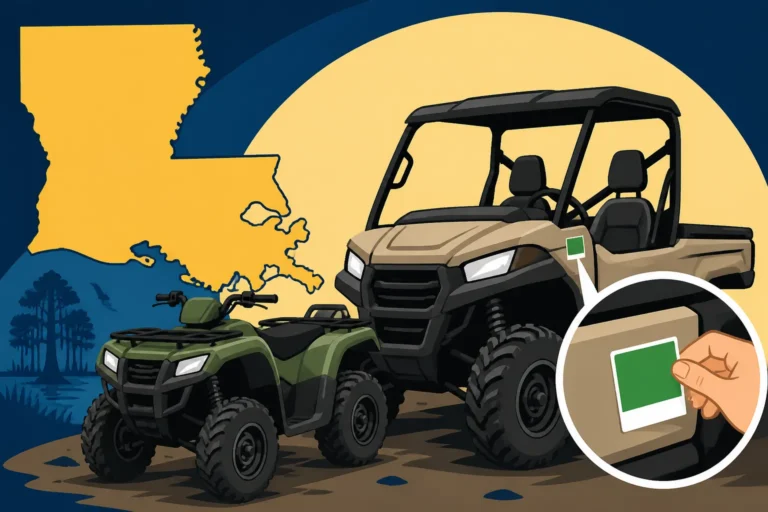
While your Louisiana title proves ownership, it doesn't automatically grant you permission to ride on public lands or certain designated areas. For that, you'll need a Louisiana Off-Road Vehicle (ORV) decal. This small, typically inexpensive decal is required for most ATVs and UTVs operated on public lands, such as national forests and Wildlife Management Areas (WMAs), and even on public road shoulders where their operation is allowed under specific conditions. [Louisiana ORV Decals and Titles Explained]
The ORV decal is issued separately from the title and signifies that your machine is registered for off-road use within the state. It typically has a yearly renewal cycle and must be prominently displayed on your machine, usually on the front or rear fender, where it is easily visible to park rangers or law enforcement. Failing to have a current decal, even with a valid Louisiana title, can result in fines and legal issues if you're caught riding in an area where it's required.
It's a common misconception among new residents that once a machine is titled, it's ready for any type of use. However, the decal system is an additional layer of regulation specific to the operation of off-road vehicles. Make sure you understand where and when the decal is required for your planned riding activities. You can often apply for the decal at the same OMV visit where you title your machine, making it convenient to handle both tasks at once.
Understanding Road Use Rules and Exemptions
This is perhaps one of the most misunderstood aspects for new residents bringing an ATV or UTV to Louisiana. Despite having a Louisiana title and an ORV decal, your off-road machine is generally NOT street legal. Louisiana has very strict laws regarding the operation of ATVs and UTVs on public roads, with only a few limited exceptions. This is a critical distinction, especially if you're coming from a state with more permissive road-use laws for these types of vehicles.
The primary exceptions for road use in Louisiana typically involve agricultural purposes, allowing ATVs and UTVs to operate on public road shoulders within a five-mile radius of a farm. Even under this agricultural exemption, specific rules apply, such as daylight-only operation and adherence to traffic laws when crossing roads. Some parishes may also have local ordinances that designate certain low-traffic roads for UTV use, but these are often few and far between and require specific signage. Always check with local parish authorities and the OMV for the most current regulations in your area.
Riding your ATV or UTV on undesignated public roads, highways, or interstates in Louisiana is illegal and can lead to severe penalties, including hefty fines, vehicle impoundment, and even points on your driver's license. The title simply proves you own the machine; it does not grant you permission to operate it on public roadways. Before you take your machine out for a ride, thoroughly research and understand Louisiana's ATV/UTV road use laws and local ordinances to ensure you stay safe and compliant.
Disclaimer
This article is for general informational purposes only and does not constitute professional advice. Laws, prices and regulations vary by location and change over time. Consult a qualified professional for guidance on your specific situation.