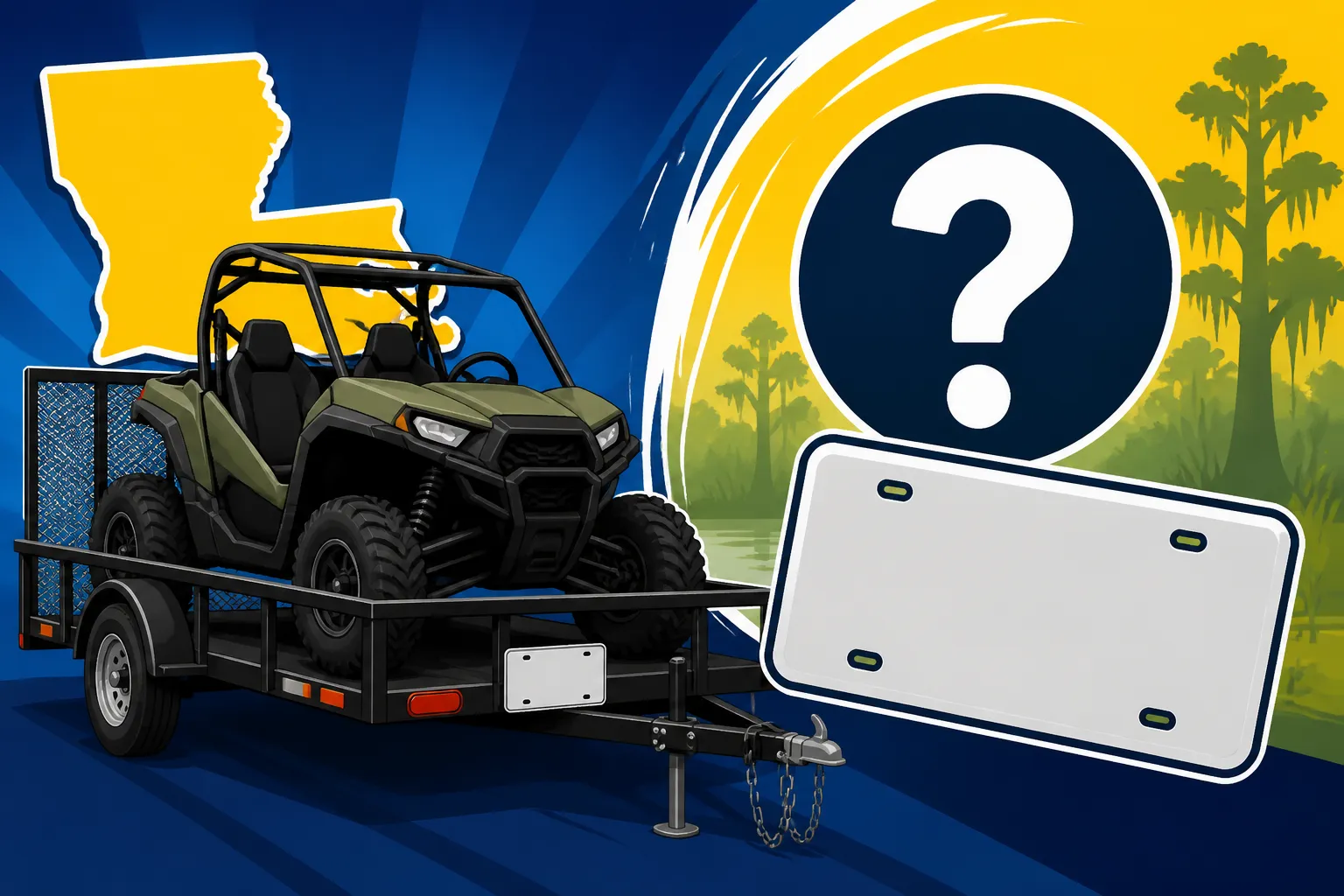
Does Your Utility Trailer Need Its Own Plate?
One of the most common head-scratchers for Louisiana ATV and UTV owners, especially those new to the off-road lifestyle, isn't just about getting their machine legal, but also about the equipment they use to get it to the trails. Many folks wonder: "Does that utility trailer I use to haul my quad need its own license plate?" It’s a valid concern that can lead to confusion and, frankly, a lot of unnecessary stress if you don’t have the right information. This guide will walk you through the ins and outs of Louisiana’s rules for utility trailers, helping you avoid fines and enjoy a smoother journey to your next adventure.
Understanding Louisiana's Trailer Registration Basics
Before you hitch up and head out, it’s crucial to understand the foundational rules Louisiana has in place for utility trailers. These aren't just arbitrary regulations; they're designed to ensure safety on our roads and to keep track of vehicles that share the public highway. Ignoring them can lead to a roadside stop that quickly sours your day.
What Constitutes a "Utility Trailer" in Louisiana?
When the Louisiana Office of Motor Vehicles (OMV) talks about "utility trailers," they’re generally referring to any non-motorized vehicle designed to be pulled by another motor vehicle and used for transporting property. This is a pretty broad category, and it covers a lot of what we use as off-road enthusiasts. Think about the small open-bed trailer you use to haul your single ATV to the local mud park, or the larger enclosed cargo trailer you've outfitted to carry two side-by-sides along with all your gear for a weekend at [Muddy Bottoms ATV Park in Louisiana]. Even boat trailers and specialized ATV/UTV trailers fall under this umbrella.
The key distinction here is "transporting property." This separates them from things like travel trailers or fifth-wheel campers, which are considered recreational vehicles and have their own distinct set of rules regarding registration and titling. For our purposes, we're focusing on those workhorse trailers that help us move our machines, our tools, and our adventure gear from point A to point B. It’s important to recognize that while the type of trailer might vary, the OMV's classification often centers on its primary function.
The Weight Factor: When a Plate Becomes Mandatory
Here’s where the rubber meets the road, quite literally. In Louisiana, the most significant factor determining whether your utility trailer needs its own license plate and registration is its gross weight. Specifically, trailers with a gross weight (GVW) of 3,000 pounds or more are required to be titled and registered with the OMV. This is a critical threshold to remember. The gross weight isn't just the weight of the trailer itself; it's the trailer's empty weight plus the maximum weight of the cargo it’s designed to carry. You'll often find this figure listed as the Gross Vehicle Weight Rating (GVWR) on a sticker or plate somewhere on the trailer's frame, usually near the tongue or axle.
For many single-axle ATV trailers, especially the smaller, more basic models, you might find that their GVWR falls comfortably under that 3,000-pound mark. If your trailer has a GVWR of, say, 2,500 pounds, then technically, Louisiana doesn't require it to be registered or plated. However, if you’re pulling a larger enclosed trailer, a dual-axle utility trailer, or even a heavy-duty single-axle trailer designed for multiple machines, it's highly likely to exceed the 3,000-pound threshold. Always check the manufacturer's GVWR. Don't just guess; an incorrect assumption could lead to an unexpected ticket from a state trooper.
Exceptions and Exemptions to Trailer Registration
While the 3,000-pound rule is the main one, there are a few other nuances and potential exemptions to keep in mind, though they generally apply to very specific situations. As we just discussed, the most common "exemption" is simply that your trailer's GVWR is under the 3,000-pound threshold. These smaller, lighter trailers are generally not required to be titled or plated for road use in Louisiana. This is a huge relief for many casual riders who just need to transport a small quad a short distance.
Another area where you might encounter different rules is with agricultural equipment. Farm-specific trailers, particularly those used exclusively on private land or within a limited radius for farm operations, might have different registration requirements or exemptions. For example, some farm implements are not considered motor vehicles and don't require traditional registration. However, these exemptions are usually quite strict and specific, often requiring the trailer to be exclusively used for farming purposes and sometimes even limiting its travel to certain distances on public roads. It's not a blanket exemption for hauling your ATV on a farm road; it’s usually for things like hay wagons or specialized harvesters. Always verify with the OMV if you believe your trailer falls into a unique agricultural category, as misinterpreting these rules could still land you in trouble.
The Process of Titling and Plating Your Trailer
So, you've checked your trailer, seen that GVWR, and realized it definitely needs a plate. Don't sweat it too much! While bureaucracy can sometimes feel like a slow churn through molasses, the process is straightforward once you know what to expect. Think of it like getting your ATV titled, but for something that doesn't have an engine.
Required Documents for Trailer Registration
To title and register your utility trailer in Louisiana, you'll need to gather a few essential documents. The exact list can vary slightly depending on whether the trailer is brand new or a used purchase, but here's a general rundown of what the OMV will be looking for:
First and foremost, you'll need proof of ownership. If you're buying a new trailer from a dealership, this will typically be the Manufacturer’s Statement of Origin (MSO) – basically, the birth certificate for your trailer – along with an [Louisiana Itemized Dealer Invoices] that shows the purchase price and any fees. For a used trailer purchased from a private seller, you’ll need a properly executed bill of sale. Ideally, this should be a [Louisiana Notarized Bills of Sale] to ensure its validity and avoid any disputes down the road. This helps prove legitimate transfer of ownership. Without clear proof of ownership, the OMV won't even start the process.
You'll also need proof of sales tax payment. Louisiana requires that sales tax be paid on the purchase price of the trailer before a title can be issued. This is a non-negotiable step. Whether you pay the sales tax at the dealership or owe use tax on a private sale, you must show the OMV that the state has received its due. [Louisiana Requires Proof of Sales Tax First] before they proceed with any titling. Finally, don't forget your photo identification, like a valid driver's license. The OMV needs to confirm you are who you say you are.
Navigating the OMV and Associated Fees
Once you have all your documents in hand, your next stop will be your local Louisiana OMV office. It's usually best to go prepared, especially if you want to avoid multiple trips. You’ll typically fill out a Vehicle Application form (often form DPSMV 1799, though forms can change), declaring all the necessary information about your trailer and yourself. Be ready to provide details like the trailer's make, model, year, VIN (Vehicle Identification Number), and its gross weight rating.
There will be several fees associated with titling and plating your trailer. While specific amounts can fluctuate, generally you’ll encounter a title fee (similar to the [Louisiana Title Fee of $68.50] for ATVs), a registration fee for the license plate itself, and an administrative or [Louisiana Handling Fee of $8]. These fees cover the cost of processing your paperwork and issuing your official documents. The OMV accepts various [Louisiana Title Payment Methods], usually including cash, checks, money orders, and often credit or debit cards, but it’s always wise to call ahead to confirm accepted payment types at your specific branch. The goal is to get everything done in one visit, and being prepared with all documentation and payment options helps immensely.
DIY vs. Dealer-Assisted Registration
For those buying a new utility trailer from a licensed dealership, the good news is that they will usually handle most, if not all, of the titling and registration paperwork for you. This is a huge convenience, as the dealer will submit the MSO, bill of sale, sales tax, and application directly to the OMV on your behalf. They'll often charge a "dealer documentary fee" for this service, which is a standard practice and saves you the hassle of a trip to the OMV. You’ll just need to provide them with your identification and payment for the trailer, taxes, and fees, and they’ll typically mail your plate and title to you once processed.
If you purchase a used trailer from a private seller, however, you’re entirely responsible for the registration process. This means gathering all the necessary documents, preparing your bill of sale (potentially with the help of a tool like LawDepot to ensure it's legally sound), calculating and paying sales tax (if not already paid by the seller and credited to you), and making that trip to the OMV yourself. While it requires more effort, it's certainly doable. Just be meticulous with your paperwork, and don't hesitate to call the OMV with any specific questions about your situation. They're there to help you get it right.
Common Pitfalls and How to Avoid Them
Even with the best intentions, it's easy to overlook a detail or make an assumption that can lead to problems down the road. When it comes to trailer registration, understanding the potential pitfalls can save you from a lot of frustration, and even legal trouble. Nobody wants their riding day cut short by an unexpected interaction with law enforcement.
The Perils of Unregistered Trailers
Picture this: you’re towing your newly acquired side-by-side to a fantastic new trail system, maybe [Sandstone's 36 Miles in Louisiana], and you get pulled over. If your trailer has a GVWR of 3,000 pounds or more and you haven't bothered to get it registered and plated, you're in violation of Louisiana law. The consequences can range from a hefty fine to, in some cases, the impoundment of your trailer until proper registration is obtained. A state trooper has the authority to issue citations for such violations, and they often do. They’re trained to spot vehicles that aren't compliant. [What a Louisiana State Trooper Can Ask to See] includes your trailer's plate and registration, just like for your tow vehicle.
Beyond the immediate legal ramifications, driving with an unregistered trailer can also create issues with insurance. In the event of an accident, your insurance company might deny coverage if the trailer was not legally registered for road use, leaving you personally liable for damages. It's a risk that simply isn't worth taking, especially when the registration process is relatively simple compared to the potential headaches it can prevent. Don't let a small oversight turn your adventure into a financial nightmare.
Keeping Your Trailer Paperwork Current
Getting your trailer registered is the first step, but keeping that registration current is equally important. Just like your vehicle, your trailer’s license plate registration will have a renewal cycle, typically on an annual basis. The OMV usually sends out renewal notices, but it's ultimately your responsibility to ensure your registration is up-to-date. Missing a renewal means you're driving with an expired plate, which is another easy way to get a ticket.
Furthermore, if you move, remember to update your address with the OMV. Your title and registration records need to reflect your current residence. [Louisiana Title Address Change] is a straightforward process, but if you don't do it, renewal notices might go to an old address, leading to missed deadlines and potential penalties. And what if your plate or registration certificate gets lost or stolen? You’ll need to report it and apply for a duplicate. The OMV has procedures for ordering a duplicate plate or registration, ensuring you remain legal on the roads. Maintaining accurate and current paperwork for your trailer is a small but vital part of responsible ownership.
Interstate Travel with a Louisiana Trailer
For many of us in Louisiana, our off-road adventures aren't limited to just our home state. We might venture into Mississippi, Arkansas, or Texas for new trails or events. The good news is that generally, if your utility trailer is legally registered and plated in Louisiana, it will be recognized as legal for road use in other states due to reciprocity agreements between states. This means you typically don't need to register your Louisiana-plated trailer in another state just to drive through it.
However, it's always wise to exercise a bit of caution and common sense. Each state has its own specific laws regarding towing, equipment, and trailer requirements (like safety chains, brake lights, or even trailer brake requirements for heavier loads). While your Louisiana plate is usually sufficient for registration, ensuring your trailer meets the equipment standards of the state you're visiting is a smart move. Always carry all your relevant documents – your driver's license, your tow vehicle's registration, and your trailer's registration and title. This ensures that if you are stopped, you have all the necessary proof to demonstrate your compliance, making for a much smoother interaction with any out-of-state law enforcement officers.
Integrating Your Trailer with Your ATV/UTV Lifestyle
Your utility trailer isn't just a piece of equipment; it's an integral part of your off-road lifestyle, enabling you to explore new places and take on bigger adventures. Making sure it’s the right trailer for your needs and that it's always ready for the road is just as important as maintaining your ATV or UTV.
Choosing the Right Trailer for Your Off-Road Machines
Selecting the perfect trailer for your ATVs or UTVs involves a bit more than just finding one that fits your budget. You need to consider the type of riding you do, the number of machines you typically haul, and the kind of terrain you’ll be encountering. Open utility trailers are popular for their versatility and often lower cost, allowing easy loading and unloading, but they leave your machines exposed to the elements. Enclosed cargo trailers offer protection from weather and theft, plus extra storage space for gear, but they are heavier, more expensive, and can be more challenging to maneuver. Specialized ATV/UTV trailers often have features like integrated ramps, multiple tie-down points, and robust suspension designed specifically for off-road machines.
Think about the capacity you need. Are you hauling a single lightweight quad, or two heavy side-by-sides with all your camping gear? This dictates the required GVWR, axle count (single vs. tandem axle), and braking system. Consider ramp options: fold-up, slide-out, or gate-style. And don't forget quality tie-downs – securing your expensive machines properly is paramount. The right trailer makes [Hauling a Machine to a Mud Park] or a remote trail system a breeze, while the wrong one can be a constant source of frustration.
Ensuring Your Trailer and Machine Are Legal for Hauling
Beyond the trailer itself needing to be registered (if over 3,000 lbs GVWR), the entire hauling setup needs to be safe and legal. First, your tow vehicle must be capable of safely pulling the loaded trailer. Always check your truck or SUV’s owner's manual for its maximum towing capacity and never exceed it. Overloading your tow vehicle is incredibly dangerous and illegal. The hitch itself needs to be rated for the combined weight, and you must use safety chains that are properly crossed and attached, acting as a backup in case the primary hitch fails.
Ensure all lights on your trailer are functioning correctly: brake lights, turn signals, and running lights. For heavier trailers, especially those exceeding 3,000 pounds, Louisiana law often requires electric or surge brakes. Make sure these are properly installed and working. And while we’re talking about legality, remember that your ATV or UTV itself needs to have proper documentation. For instance, you should always have your [Louisiana ORV Decals and Titles Explained] readily available for your off-road machine, whether you're riding it or just hauling it to the next destination. If your ATV or UTV isn't properly titled or registered (where required), that can also cause issues if you're ever questioned.
Documenting Your Trailer for Peace of Mind
Even for trailers that don't legally require a title or plate (those under 3,000 lbs GVWR), it's still a good practice to keep robust records. Having a clear bill of sale, even if it’s just a simple handwritten one, serves as your proof of ownership. This is crucial if the trailer is ever stolen or if there's a dispute over ownership. Consider using a template from a service like LawDepot for your bill of sale, even for these smaller, untitled items; it provides a professional framework and ensures all necessary information is included.
Photographing the VIN (if it has one), taking pictures of any unique features, and documenting the trailer's condition when you buy it can also be invaluable. Store these documents and photos digitally, perhaps in a cloud service, so you always have access to them. This level of documentation not only protects you in case of theft or damage but also makes selling the trailer in the future much smoother. Even if the OMV doesn't need to see a title for your lightweight utility trailer, clear documentation can provide immense peace of mind. And if you ever find yourself in a situation where you need to prove ownership but have lost key papers, services like LawDepot can often help create affidavits or other legal documents to support your claim, preventing a headache like [Louisiana Title Without a Bill of Sale] for your machine.
| Trailer Type | Typical GVWR Range (Lbs) | Louisiana Registration/Plate Required? | Key Considerations |
|---|---|---|---|
| Small Open Utility | 1,000 – 2,999 | No (if under 3,000 lbs) | Easy to maneuver, basic, exposed cargo |
| Single Axle ATV/UTV | 2,500 – 4,000 | Yes (if 3,000 lbs or more) | Often specialized for machines, ramps |
| Tandem Axle Utility | 5,000 – 10,000+ | Yes | Heavy loads, better stability, brakes often required |
| Enclosed Cargo | 3,000 – 10,000+ | Yes | Secure, weather protection, heavier, higher cost |
| Boat Trailer | Varies widely | Yes (typically, as boats are heavy) | Specific to boat size, specialized bunks |
Disclaimer
This article is for general informational purposes only and does not constitute professional advice. Laws, prices and regulations vary by location and change over time. Consult a qualified professional for guidance on your specific situation.