Louisiana Private Mud Parks Compared
Louisiana riders often plan a mud-park weekend around one big question: will the place suit their machine, group, and idea of a good ride? A sprawling park and an event-focused destination can offer very different experiences. This guide compares Louisiana’s private mud-park options, explains what to check before towing, and helps you choose a weekend that fits.
How Louisiana private mud parks differ
A big riding property is not the same as an open trail system
Private mud parks can feel like small riding destinations, but their layout and operating style are different from a public forest trail network. A park may have mud holes, wooded routes, open areas, campgrounds, and event spaces, while access is controlled by the operator. You’re riding under the park’s rules, not simply turning onto a public trail whenever you arrive.
That distinction matters when you are planning a spontaneous trip. Some parks are known for event weekends rather than daily riding, so you can’t assume the gate will be open just because the property is there. Check the park’s calendar and arrival instructions before you load the trailer. A long tow from Baton Rouge, Lake Charles, or the Northshore is a frustrating way to learn that a park is closed between events.
The scale of a property also doesn’t tell you everything about the riding experience. A large site may offer more room to spread out, but the amount of usable riding can depend on weather, maintenance, closures, and the specific event setup. Ask what areas are open to your machine during the dates you’re considering, especially if your group includes both ATVs and side-by-sides.
Event weekends shape the whole experience
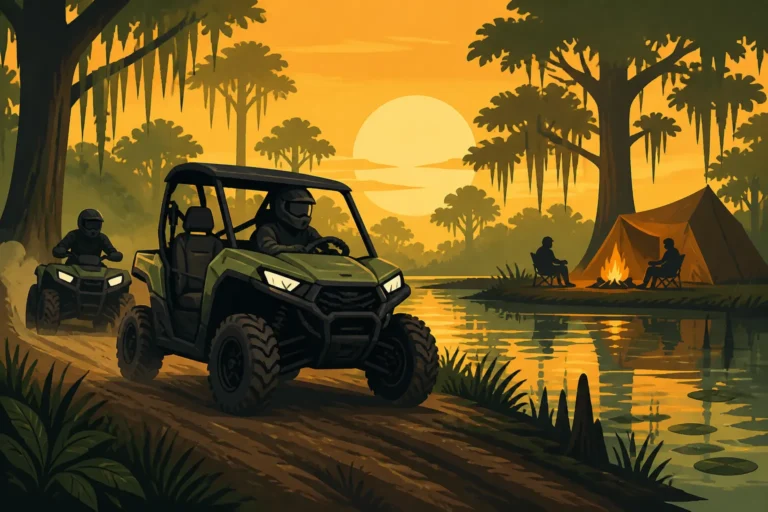
At an event-focused park, the weekend may include far more than riding. Camping, music, food, vendors, family activities, and social gatherings can be part of the appeal. That atmosphere is a big plus if your group wants a full weekend away rather than a quiet day on trails. It can also mean more crowds, busier facilities, and a need to reserve or plan ahead.
A busy event can change how a property feels from hour to hour. One group may love the energy and enjoy seeing different machines on the trails. Another may prefer a quieter ride, less waiting, and a campsite away from the loudest areas. If you’re traveling with young children, older relatives, or a first-time rider, ask about the event layout and quieter camping options instead of assuming the whole property has the same pace.
Before committing, check the operator’s current event details for the exact weekend. Confirm the gate schedule, camping arrangements, machine rules, and whether the riding areas you care about will be open. For more on the event format at one well-known destination, see Louisiana Mudfest and Event Weekends.
Comparing Louisiana’s best-known private mud parks
Muddy Bottoms near Sarepta
Muddy Bottoms ATV Park is associated with a large private riding property near Sarepta in Webster Parish. Its scale is part of the draw for riders who want a destination weekend and room to explore. The park is known for operating around event weekends, so checking its calendar is especially important when you are choosing travel dates. See Muddy Bottoms ATV Park in Louisiana for a closer look at the park itself.
A substantial property can work well for a mixed group because riders may have different ideas of a good day. One person may be eager to work through muddy sections, while another prefers a more relaxed route or wants to spend time around camp. Still, don’t assume that every route or section is open to every machine. Ask about current riding access, restrictions, and the way the event divides the property.
Camping can be part of the draw for a longer visit. If your group is considering a cabin or RV stay, check what needs to be booked ahead, what is included, and what you need to bring yourself. Park facilities and availability can vary by event, and a campsite that suits a small family may not work for a large group with multiple trailers. The park’s [Muddy Bottoms' Event Calendar in Louisiana] and [Muddy Bottoms' Cabins in Louisiana] pages are useful starting points for trip planning.
Louisiana Mudfest near Colfax
Louisiana Mudfest is another private destination riders may compare when planning a Louisiana mud weekend. It is associated with a site near Colfax and is often discussed as an event-oriented experience. Its appeal may be less about finding a quiet trail system and more about combining riding, camping, and the atmosphere of a gathering. For a closer look at its footprint, see [Louisiana Mudfest's 600 Acres].
As with any event-focused property, the best fit depends on your group’s expectations. If you want the buzz of an organized weekend, a gathering can make the trip feel like a vacation rather than a simple ride. If your priority is steady riding with minimal crowds, ask the organizer what the event is likely to feel like and whether the schedule includes quieter periods or less busy areas.
Don’t compare two parks using acreage alone. A smaller property with an event layout that suits your group might be a better weekend than a larger one with a schedule or rules that don’t match your plans. Check current access, permitted machines, campground setup, and the facilities available for the specific date. A park’s event description is more useful than a broad assumption based on its name or size.
| Comparison point | Muddy Bottoms near Sarepta | Louisiana Mudfest near Colfax |
|---|---|---|
| General character | Large private riding destination with event-focused weekends | Event-oriented mud-park experience |
| Best suited to | Groups looking for a destination stay and room to explore | Riders who enjoy an organized gathering atmosphere |
| Planning priority | Confirm event dates, riding access, and camping arrangements | Confirm event schedule, access rules, and camping arrangements |
| Ask before booking | Which areas and machines are open during your visit | What the event setup and riding access will be like |
| Useful reference | Muddy Bottoms' 5,000 Acres in Louisiana | Louisiana Mudfest and Event Weekends |
This table is a starting point, not a promise that every feature is available at every event. Confirm details directly with the park before towing.
Choosing a park for your group
Match the park to the riders, not just the machines
A group of experienced mud riders may be looking for challenging conditions and a long day in the saddle. A family group may care just as much about bathrooms, shade, food options, campsite distance, and whether children have activities between rides. It’s worth asking each person what would make the weekend successful before you pick a park.
Think about how many people will ride and how many will come along without riding. A couple of passengers or spectators can affect where you camp, how you pack, and whether the park’s facilities are comfortable for everyone. If one person needs a quieter place to rest while others stay out late, ask about the layout and event noise before booking a shared campsite.
Machine mix matters, too. A group with small ATVs, full-size quads, and UTVs should confirm that the park allows each type and whether any size or equipment restrictions apply. Don’t assume a side-by-side can use every route that an ATV can, or that a passenger can ride on every machine. Review the park’s [Louisiana Private Park Waivers and Rules] before you sign or unload.
Think about the ride you actually want
The word “mud park” can cover several different experiences. Some riders want deep mud and a chance to test their machines. Others are happier with wooded trails, open riding areas, a social event, or a weekend of camping with a few rides mixed in. There’s no wrong preference, but disappointment is easy when your group expects a quiet trail ride and arrives at a busy event.
Be realistic about your machine and your recovery plan. If your quad is lightly modified and your group is new to deep mud, the most difficult-looking route may not be the best first choice. Talk with the park staff or event organizers about conditions, suitable areas, and what recovery equipment is expected. A winch, tow strap, basic tools, and a plan to ride with a partner can make a tough day more manageable.
Also consider the value of non-riding time. A destination with camping and event amenities may be a better fit when your group wants to stay overnight, while a day-focused visit may suit people who would rather ride and head home. For trip ideas and nearby options, browse Louisiana Private Mud Parks Compared alongside [Louisiana Riding Areas With RV Hookups].
Planning around weather and ground conditions
Rain can change the ride quickly
Louisiana weather can make a route feel completely different from one weekend to the next. Rain may create more mud and deeper water in some areas, but it can also make routes impassable, increase recovery risks, or lead an operator to close sections. Dry weather can bring dust and hard-packed ground. Neither condition is automatically better; it depends on your machine, experience, and appetite for recovery work.
Before leaving, check the park’s updates and ask what the ground is like in the areas you plan to ride. A forecast for the nearest town won’t tell you exactly how a specific section of the property is holding up. If heavy rain is expected, ask whether the event is proceeding as planned, what areas may be closed, and whether there are any changes to camping or access.
Use maps as planning aids, not permission slips. An app such as onX Offroad can help organize a route or identify where your group is in relation to roads and nearby places, but a digital map does not replace the park’s current directions or rules. Keep the operator’s instructions handy, especially where signal is weak or routes are unfamiliar. For more on conditions, see [Louisiana Trail Conditions After Rain].
Prepare for heat, standing water, and recovery
Even a short ride can become exhausting in humid heat, especially when riders are working machines out of mud or stopping frequently to help one another. Bring drinking water for the whole group, take breaks before people feel worn down, and make sure passengers and children have a comfortable place to cool off. Don’t count on finding supplies exactly where you need them once you are deep into a property.
Standing water and mud can hide ruts, debris, and sudden changes in depth. If you can’t judge a hole safely from the seat, stop and assess it rather than charging in because another machine made it through. A route that worked for a lighter quad might not suit a longer, heavier UTV. Keep a safe distance between machines and agree on a recovery signal before the group splits up.
Carry practical recovery gear and know how to use it. A winch, rated recovery strap, gloves, a basic tool kit, and a first-aid kit are sensible starting points, but the right setup depends on your machines and the conditions. Don’t attach a strap to an unsuitable point or stand in the line of tension. If a machine is stuck in deep water or unstable mud, take time to plan the recovery rather than risking an injury to save a few minutes.
Booking, camping, and getting to the park
Confirm the details before you hitch up
A phone call or direct message before departure can prevent a surprising number of problems. Verify that the park is open on your dates, that your machine type is accepted, and that your group understands check-in and unloading procedures. Ask whether riding access begins immediately after arrival or only during certain hours or event periods.
Get the practical details in writing where possible: what your reservation includes, where to park a truck and trailer, what camping setup is permitted, and what happens if weather changes the schedule. If you are bringing a large group, confirm that everyone is covered by the same reservation or has completed any separate sign-up process. Small misunderstandings can become stressful when you arrive late with several machines and no clear staging area.
If your trip includes a cabin, RV site, or primitive camping, ask what facilities are available and what you need to bring. A listing or event post may not answer questions about water, power, showers, quiet hours, or where generators can run. For park-specific planning, check [Louisiana Riding Areas With RV Hookups] and confirm all details with the operator.
Plan the haul as carefully as the ride
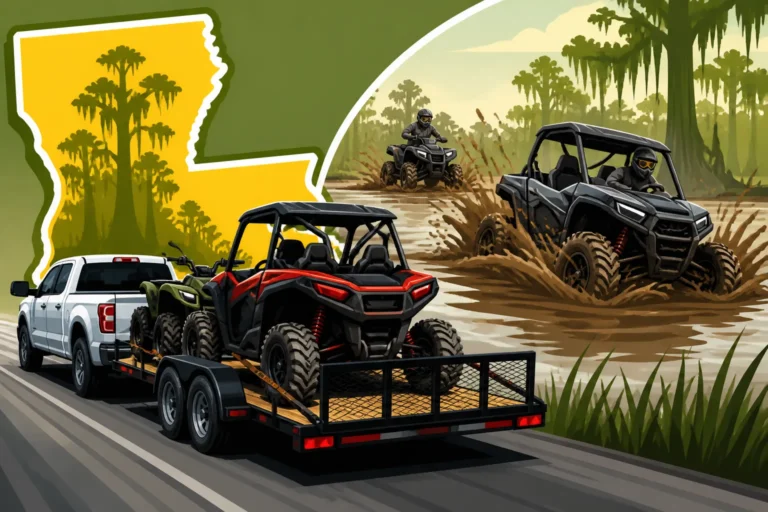
Getting to a rural park with a truck and trailer can involve narrow roads, limited services, and long stretches between fuel stops. Map the route before leaving, and make sure your trailer setup is suitable for the machines you’re carrying. Check tie-down points, trailer lights, tire condition, hitch connection, and the load distribution before you get on the highway.
Don’t rely entirely on cell service for directions. Save the address and instructions, note the last reliable place to fuel up, and keep a paper or offline map as a backup. onX Offroad can be useful for organizing route notes and helping your group stay oriented, but use the park’s directions for the final approach and follow posted signs. A map app may show a road or track that is not a permitted entrance.
Think through the return trip, too. Mud, water, and loose debris can make a machine harder to secure safely, and a muddy trailer can be unpleasant to unload at home. Bring straps, gloves, a shovel or scraper, and whatever cleanup supplies you normally use. For a deeper checklist, see [Trailering to a Mud Park].
Rules, safety, and responsible riding
Read the waiver and park rules closely
Private parks set rules for access, riding behavior, passengers, alcohol, camping, noise, and age limits. Rules can differ between properties and may be updated for an event, so don’t rely on what a friend remembers from a previous visit. Read the current waiver before you sign, and make sure every adult in your party understands the conditions.
Age rules deserve particular attention when children and teens are coming along. Ask the park about minimum riding ages, supervision requirements, helmet expectations, and whether rules differ for passengers or specific machines. A parent’s comfort level and a park’s minimum rule are not always the same thing; plan for the stricter requirement.
Ask about equipment and machine restrictions before loading. Some properties may set rules for passengers, helmets, lights, noise, vehicle dimensions, or riding areas. If you have a modified machine, clarify anything that could affect admission or use. A small call ahead is easier than discovering at the gate that the machine does not meet the event’s requirements. Review [Louisiana Private Park Age Minimums] as part of your planning.
Respect other riders and the property
A private park is shared space, even when your group is traveling together. Keep speed under control near campsites and busy areas, give other machines room, and avoid splashing people who are walking or stopped. Yield when a route narrows, and don’t assume a rider ahead of you can see or hear your machine.
Stay on routes the park permits. Cutting through vegetation, riding around a closure, or driving into a water feature that is off-limits can damage the property and create a safety risk for other visitors. If a trail is blocked or looks different from the map, turn around or ask staff rather than making a new route. Keeping a saved map in onX Offroad can help you keep track of your plan, but the park’s markers and directions take priority.
Pack out what you bring in, secure trash at camp, and respect quiet areas and posted hours. Mud parks can be lively, but neighboring campers still need room to sleep and families may be sharing the same facilities. If something goes wrong, tell park staff promptly and avoid trying to hide property damage or a collision. A good weekend depends on people leaving the site safe and usable for the next group.
A simple way to decide between parks
Use a short pre-booking checklist
Start with your group’s non-negotiables. If you need a cabin, a particular kind of camping, or access for a specific machine, filter parks based on those requirements before comparing anything else. A park that looks exciting online may not be the right choice if the setup doesn’t work for your crew.
Then compare the ride itself. Ask how much of the property is open during your visit, what kinds of routes are available, whether the event is likely to be crowded, and how conditions may change after rain. If the park can’t give a clear answer to a question that matters to you, treat that as a reason to clarify before you pay or tow.
Finally, consider the trip as a whole: drive time, arrival window, food and fuel access, campsite comfort, and the energy level your group wants. A weekend at a mud park is more than time on the machine. Choosing the destination that fits your crew is usually more rewarding than chasing the biggest acreage or the most dramatic event photos.
Questions to ask the operator
Use these questions when contacting a park:
- Is the property open to riders on the dates we are considering?
- Which types and sizes of machines are permitted?
- Which riding areas will be available during our visit?
- Are there age, passenger, helmet, or supervision requirements?
- What camping options are open, and what facilities are included?
- Where should trucks and trailers park?
- Are there special rules for lights, noise, alcohol, or generators?
- How will heavy rain affect access or the event schedule?
- What recovery equipment should riders bring?
- Where should we check for official updates before leaving?
Keep the answers with your reservation details and share them with everyone in the group. That way, the driver who arrives first and the family member who checks in later are working from the same information.
A sensible final step is to check the travel route, weather, park updates, and machine setup the day before departure. That small routine helps catch the details that are easy to miss during a busy week: a changed gate time, a forgotten helmet, a loose trailer strap, or a machine that needs maintenance before a long ride.
Disclaimer
This article is for general informational purposes only and does not constitute professional advice. Laws, prices and regulations vary by location and change over time. Consult a qualified professional for guidance on your specific situation.