Louisiana WMA Tire Rules Explained
A tire setup that works at a private mud park may not be allowed on a Louisiana Wildlife Management Area. WMA rules address tire size, tread, and inflation, and a machine can be turned away if it misses a limit. Here’s what to check before loading up, how to read common tire markings, and what to do when the specs are unclear.
The tire limits to check before you ride
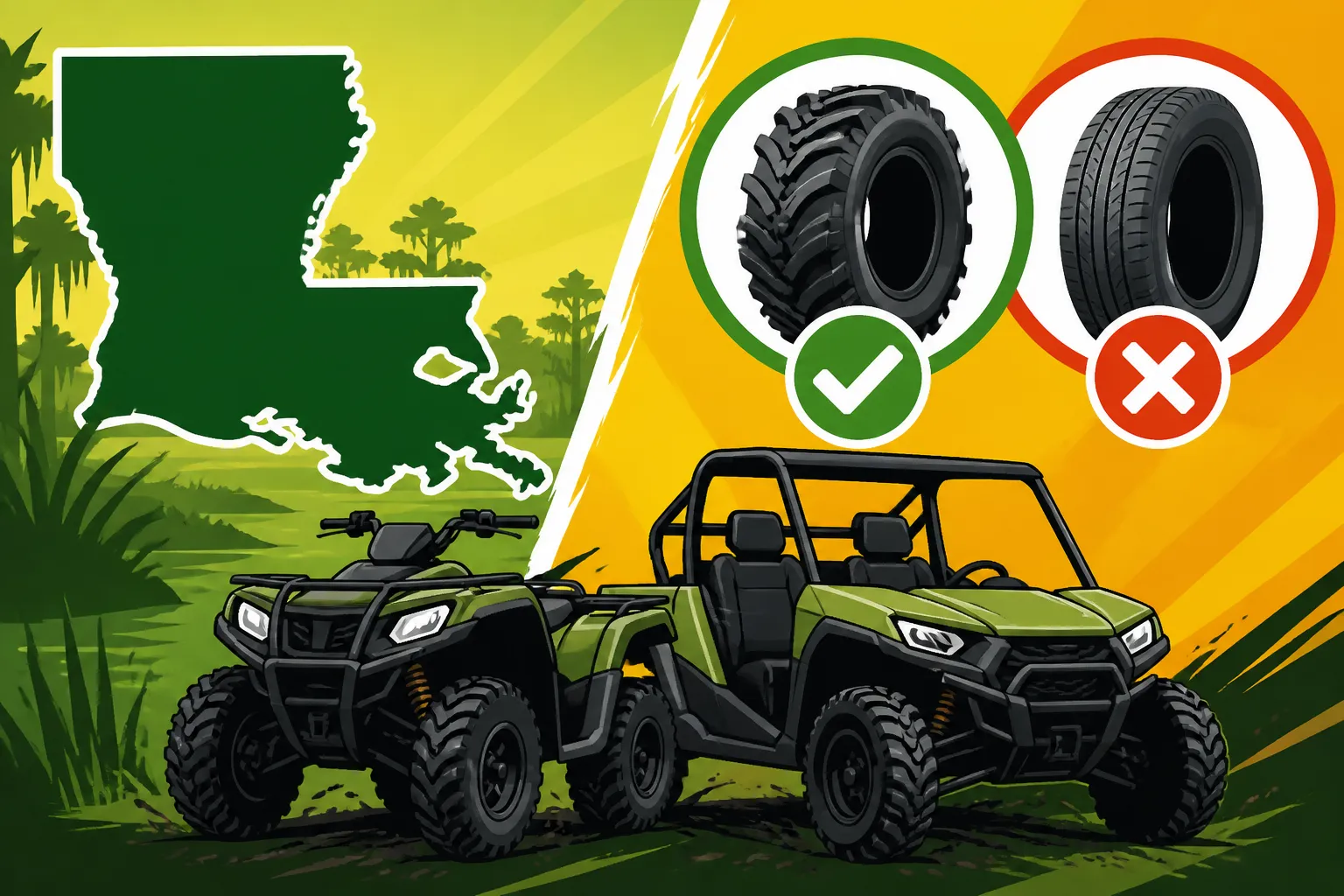
Louisiana WMA rules set limits on tire size, lug height, and tire pressure, and prohibit farm-tread tires. These requirements are separate: meeting the size limit does not make an otherwise prohibited tread legal, for example. Check every item rather than assuming that a stock or commonly used tire will qualify.
| Tire rule | What to check | Practical takeaway |
|---|---|---|
| Tire size | The listed size and the tire’s dimensions | Keep within the applicable 26-by-12 limit |
| Lug height | The height of the tread lugs | Lugs must not exceed 1 inch |
| Tire pressure | Pressure measured with a gauge | Do not exceed 12 PSI |
| Tread type | Whether the tire is a farm-tread design | Farm-tread tires are prohibited |
The size limit is often summarized as tires no larger than 26 by 12. In plain language, that refers to a tire’s nominal diameter and width, not its rim size. A tire marked 26×12 is generally at the stated limit; a tire with a larger listed dimension may not comply. For detail on how the limit applies, see Twenty-Six by Twelve Tires.
Tread height is a separate measurement. A tire can fit within the size limit and still have lugs that are too tall. The limit is 1 inch, so check the tread itself rather than relying on the tire’s overall diameter or its marketed description. Why WMA Rules Cap Lug Height at 1 Inch explains why the two measurements matter independently.
Pressure is also capped at 12 PSI. That is a maximum, not a recommended pressure for every machine. A lower pressure may still be inappropriate for a particular tire, load, or riding condition. Follow the tire and vehicle manufacturers’ guidance while staying within the WMA limit. A simple pressure gauge makes it easier to check than relying on how firm a tire feels. For the pressure limit, see 12 Pounds of Pressure.
Finally, farm-tread tires are not allowed. These are typically designed for agricultural traction rather than ordinary ATV or UTV use. The category can be less obvious than a size marking, so don’t assume that a tire is acceptable just because it is sold for an off-road machine or fits within the size and lug limits. See Why Farm Tread Tires Are Banned on WMAs for more on this restriction.
These rules apply to riding on WMAs, not automatically to every trail, private park, or piece of private land in Louisiana. Other places can have their own requirements. Before a trip, confirm the rules for the specific WMA and trail you plan to use, including any posted instructions or current agency guidance. The broader operating requirements are covered in Louisiana WMA Riding Rules for Quads and Louisiana WMA Riding Rules for UTVs.
How to check your tires accurately
A quick look can catch an oversized tire or a clearly agricultural tread, but it is not enough to verify all four requirements. Check markings, measure where needed, and confirm pressure with a gauge before leaving home.
Read the tire marking
Look for the size molded into the sidewall. A marking such as 26×12 usually identifies nominal tire dimensions in inches. Tire labels may use a different format, and the exact format can vary by tire. If the marking is hard to find, clean the sidewall and check both sides; some information may be molded on the inside-facing side.
Do not confuse the rim diameter with the tire diameter. The rim size is only one part of the tire specification. If you are looking at a product listing, confirm the complete tire size rather than using a short product name or a photo as proof that it fits the WMA limit.
A sidewall size is useful, but it may not answer every question about an unusually modified or oversized setup. If the number is close to the limit, or the tire has been altered, check with the WMA office or managing agency before hauling the machine out. Avoid counting on an informal estimate at the trailhead.
Check lug height separately
The lug-height rule refers to the tread projections, not the total tire diameter. Use a ruler to check the tallest lugs. Measure from the base of the tread to the top of a lug, rather than measuring across the full outside diameter of the tire.
If the tire has uneven wear, check more than one lug and use the tallest intact lug as your reference. A worn tire is not automatically compliant: its size, pressure, and tread type still matter. If the tread pattern looks like an agricultural or tractor-style design, verify whether it qualifies before riding. The farm-tread prohibition is not replaced by meeting the lug-height limit.
If you are comparing replacement tires online, including on Amazon, rely on the full specifications and clear sidewall information rather than a product title alone. When the description does not make lug height or tread type clear, ask the tire seller or manufacturer. A listing that says “mud,” “trail,” or “off-road” does not by itself establish that a tire meets WMA requirements.
Measure pressure with a gauge
Check tire pressure with a gauge instead of squeezing the tire or judging its appearance. Tire pressure changes with temperature, so check it shortly before riding and recheck if conditions change substantially. Make sure the gauge is working and that you are reading it correctly; an inaccurate or unfamiliar gauge can give a false sense of compliance.
Do not assume that setting every tire to exactly 12 PSI is the best choice. The rule sets a ceiling, while the machine and tire manufacturers provide guidance for operating pressure. Keep pressure at or below the WMA limit, but do not reduce it below a safe operating level for your machine, load, and tire. Very low pressure can affect handling or contribute to tire damage or bead problems.
If a machine has different front and rear tire sizes or pressures, check each tire individually. A single reading does not confirm that the whole setup complies. Before a ride, a useful routine is to check sidewall size, lug height, tread type, and pressure on all tires.
Common mistakes and what to do about them
Many tire-rule problems come from treating one requirement as if it covers the others. A tire that looks small enough may have lugs that exceed the limit. A tire with short lugs may still be a prohibited farm-tread design. And acceptable tire markings do not prove that the pressure is within the cap.
Assuming stock tires are automatically allowed
Factory equipment can be a reasonable starting point, but “stock” is not a substitute for checking the rules. Owners may have changed tires without knowing the WMA limits, and different machines can come with different original setups. Confirm the actual tires on the machine rather than relying on the model name or a previous owner’s assurance.
The machine also has separate weight limits. Tire compliance does not settle whether the vehicle meets its applicable weight requirement. Check Louisiana WMA Weight Limits Explained as part of the same pre-ride review.
Confusing tire size with lug height
The tire’s nominal size tells you about its overall dimensions; it does not tell you whether its lugs meet the separate height cap. Likewise, a tire that is within the lug-height limit may still exceed the permitted size. Keep both checks on your list.
Treating low pressure as an advantage
Riders sometimes air down for traction, especially in soft ground. On a WMA, do not let that practice distract from the 12 PSI maximum or from the tire manufacturer’s safe operating guidance. The limit does not mean every pressure below it is suitable. A low reading is not proof that a setup is safe.
Assuming a tire is acceptable because it is sold for an ATV
Product categories are broad. A tire advertised for mud or off-road use might still have a size, lug height, or tread design that conflicts with WMA rules. If you are buying replacements, check the full specifications before ordering and keep the manufacturer’s product information available in case you need to clarify a marking.
Planning only around the tire rules
A compliant setup is only one part of being ready to ride. WMAs may restrict riders to designated routes, require permits, and close trails during certain periods. Review Louisiana WMA Designated Trails Only, Why Louisiana WMAs Need a Self-Clearing Permit, and Louisiana WMA Season Closures before choosing a destination. Trail access and permit requirements can be as important as the equipment check.
If a tire’s markings are missing, a measurement is borderline, or you cannot confidently identify the tread type, pause before traveling. Contact the managing office for the WMA you intend to visit and describe the tire, machine, and route. A clear answer before departure is more useful than finding out at the entrance that the setup is not accepted.
A simple pre-trip tire check
Use this sequence before you load the machine:
- Identify the WMA and trail you plan to ride, then review the current rules for that location.
- Read the complete tire-size marking on every tire. Confirm that the listed dimensions stay within the 26-by-12 limit.
- Measure the tallest tread lugs and make sure they do not exceed 1 inch.
- Check that the tread is not a prohibited farm-tread design. If you are unsure, ask the managing office before traveling.
- Measure each tire’s pressure with a gauge. Keep it at or below 12 PSI while following safe pressure guidance for the machine and tire.
- Check the machine’s applicable weight limit and other WMA requirements separately.
- Recheck the setup if you change tires, carry a different load, or use a different machine.
This routine does not replace the current rules for a specific WMA, but it helps catch common problems before the trip. Tire limits are easy to overlook when choosing a machine for mud or hunting use, particularly if the setup was selected for a private park rather than public land. Build the check into your pre-ride planning, and verify any uncertain tire specification with the relevant office before you head out.
Disclaimer
This article is for general informational purposes only and does not constitute professional advice. Laws, prices and regulations vary by location and change over time. Consult a qualified professional for guidance on your specific situation.