Louisiana Commercial Guiding Rules
Commercial ATV and UTV guiding in Louisiana can involve more than choosing a trail and collecting a trip fee. The rules depend on who controls the land, what the service includes, and whether the route crosses public roads. Before advertising or taking clients out, identify each land manager and get the permissions that apply to the actual activity.
Start with who controls the land
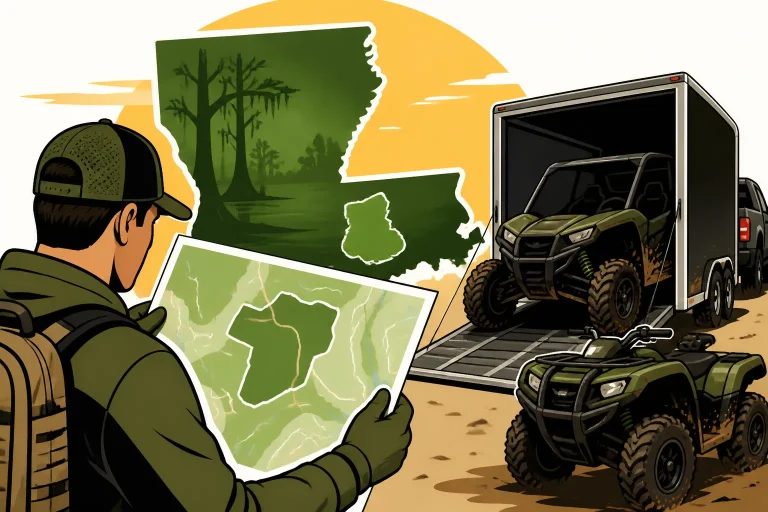
There is no safe assumption that one statewide permit covers commercial riding everywhere in Louisiana. A guide may need different approvals for different parts of one trip: a forest trail, a Wildlife Management Area, private property, or a public road can each have its own rules.
The key question is not only whether riders are allowed on a route. It is whether a business may take paying clients there, provide guiding or support services, and use the route in the way planned. A land manager’s public recreation rules may allow personal riding without authorizing a commercial operation.
| Riding location | Who controls access | What a commercial guide should confirm |
|---|---|---|
| Kisatchie National Forest | U.S. Forest Service | Whether commercial guiding or outfitting requires written authorization, and which routes and activities it covers |
| Wildlife Management Area | Louisiana Department of Wildlife and Fisheries | Whether commercial use is allowed and whether specific written permission or other approvals are required |
| Private land or private riding park | Landowner or park operator | Permission for the business activity, client access, and any park-specific operating rules |
| Parish or municipal road | Relevant state and local authorities | Whether the road is legally open to the vehicle and whether the proposed commercial use is allowed |
| Mixed-land route | Each manager along the route | Separate approval for every segment, plus confirmation that the route can legally connect |
National Forest land is not automatically open to commercial trips
Kisatchie National Forest has designated places and trails where off-highway vehicle use may be allowed subject to current rules. That access should not be treated as blanket permission to lead paid rides. Commercial guiding on National Forest System land can require a special use authorization from the Forest Service, and the agency determines what activity, location, and operating terms are permitted.
A recreation pass or day-use fee is not the same thing as authorization to conduct a business. Before promoting a trip, ask the Forest Service whether the specific service counts as commercial outfitting or guiding and what application or review applies. Describe the real business model, including whether clients pay for a guided ride, machine rental, transportation, instruction, or a package combining these services.
For general riding information, see Kisatchie National Forest OHV Trails in Louisiana and Louisiana Forest Trail Use Passes. Those topics can help with recreation access, but a pass alone does not answer whether a commercial guide may operate.
WMA access needs its own check
A Wildlife Management Area is not interchangeable with a national forest or private park. Louisiana WMA rules may limit where and when machines can ride, and those rules do not automatically grant commercial operators permission to bring clients onto the property.
Contact the agency or office responsible for the particular WMA and ask directly about paid guiding. Identify the WMA, the planned route, the dates or season, the size of the group, the machines, and what clients will pay for. If permission is given, get it in writing and keep a copy with the business records. Do not assume a regular access permit or self-clearing permit authorizes commercial use.
WMA riding may also have separate requirements for designated trails, vehicle size, tires, seasonal closures, and permits. Review Louisiana WMA Riding Rules for Quads, Louisiana WMA Riding Rules for UTVs, and Louisiana WMA Permit Requirements for recreation rules that could affect a proposed itinerary. Confirm current details with the land manager before taking clients.
Private land still needs clear permission
On private land, permission from the owner or authorized operator is central. A verbal invitation to ride does not necessarily settle whether the landowner has agreed to a recurring business, paid clients, vehicle staging, parking, or commercial use of access roads.
Put the arrangement in writing. It should identify where the business may operate, which routes or areas are included, the dates or operating period, the number and type of machines, and whether the guide may collect fees on the property. It should also cover practical matters such as gates, parking, emergency access, cleanup, and what happens if the owner closes the route.
A private riding park may have its own conditions for guides, vendors, groups, waivers, insurance, and event operations. Ask the operator before advertising a guided outing there. A park’s general admission policy does not necessarily authorize a separate guide business to use its property or market trips there.
Work out what your guiding service actually includes
The word “guiding” can describe several different arrangements. A business might lead clients on machines they own, rent machines, teach riding skills, transport riders to a trailhead, arrange lodging, or organize an event. Each added service can involve separate land-use, insurance, business, or transportation questions.
Before contacting a land manager, write a plain description of the service. Include:
- Whether clients pay for the guide’s time, access, instruction, equipment, or a package.
- Whether the business supplies or rents ATVs or UTVs.
- Whether clients bring their own machines.
- Where the trip starts and ends, and every property or road it uses.
- The expected group size and number of guides.
- Whether the trip includes camping, food, transportation, or an organized event.
- How the operator handles breakdowns, injuries, weather, and route closures.
This level of detail makes it easier for an agency or landowner to decide which rules apply. It also helps prevent a common misunderstanding: receiving permission to ride a property personally is not necessarily permission to conduct a paid service there.
Charging clients does not change the land rules
Taking payment can change how an activity is treated, but the details matter. A customer might pay a guide directly, pay a tour company that contracts with a guide, or buy a package that includes a ride along with equipment or lodging. Do not assume that avoiding a separate “guide fee” makes a commercial trip noncommercial. Ask the relevant land manager how it classifies the actual arrangement.
Likewise, a group ride is not automatically a commercial tour just because many people attend. But advertising, collecting money, supplying equipment, or routinely leading customers can make it important to seek a clear determination. Keep the answer from the land manager in writing rather than relying on an informal interpretation.
Commercial guiding also should not be confused with a public event. A one-time ride, charity event, filming project, or large organized gathering may need a different authorization from a recurring guided service. Ask whether the planned use falls under a commercial guiding process, an event process, or both. See Louisiana Event Permits for a Ride for the separate event-planning issue.
Public-road segments can create a separate problem
A trail route may connect to a road, shoulder, levee, or other public right-of-way. Permission from a landowner or trail manager does not make that connection legal for an ATV or UTV. Vehicle access rules and local designations still matter, and a commercial guide cannot authorize clients to use a road that is closed to their machine.
Plan a route that stays on land where the machines are allowed. If it includes public-road use, verify the rules for that exact road and vehicle type before offering the trip. The distinctions in Louisiana ATV Road Rules Under 32:299 and Louisiana UTV Road Rules Under 32:299.3 are useful starting points, but a route should be checked against current state and local requirements. A crossing that is permitted under a narrow rule should not be treated as permission to ride along the road.
For trips that use parish roads, also confirm whether a local ordinance or designation changes access. Avoid relying on a map app, an old ride track, or another rider’s account as proof that a commercial group may use a route.
Get approvals, insurance, and operating details in writing
A practical approval process begins with the route, not the marketing. Map every property and road the trip will touch. Identify who controls each segment, then ask each manager whether the proposed paid activity is allowed and what paperwork is required. If a route crosses several jurisdictions, one approval does not replace the others.
Use this sequence before accepting bookings:
- Map the full route. Mark trailheads, parking areas, access roads, fuel stops, private parcels, public land, and any road crossings.
- Identify each land manager. Confirm who can grant permission for each segment. For public land, contact the responsible agency; for private property, contact the owner or authorized operator.
- Describe the commercial activity accurately. Explain the fees, equipment, group size, frequency, route, and any instruction or support included.
- Request written authorization. Ask what conditions apply, how long the approval lasts, and whether it must be renewed or amended if the service changes.
- Confirm insurance requirements. Ask the land manager and your insurance professional what coverage the activity requires. Make sure the policy actually covers guided off-road use and the machines involved.
- Set client rules and emergency procedures. Give customers the route limits, equipment requirements, conduct rules, cancellation terms, and a plan for breakdowns or injury.
- Recheck before each operating period. Trail access, closures, land conditions, and agency requirements can change. Confirm that the authorization remains valid before taking clients out.
Do not treat a waiver as a permit
A client waiver may explain risks and document a participant’s acknowledgment, but it does not grant access to land or replace an authorization. It also does not guarantee that a business has adequate insurance or that every legal obligation has been met. Have a qualified attorney review customer documents for the business and activity.
Insurance needs careful attention because ordinary personal ATV coverage may not cover paid guiding, rental use, instruction, or business liability. Describe the operation fully to an insurance professional. If the business supplies machines, ask specifically about coverage for customers operating them, damage to equipment, injury claims, and transport or storage. Do not assume that a policy covers commercial use simply because it covers the same machine for personal riding.
Keep records of landowner permission, agency correspondence, insurance documents, client agreements, maintenance checks, and trip logs. If an incident occurs, those records can help establish where the group was authorized to ride and what procedures were in place.
Group size and route control matter
Even when a land manager permits guided use, the approval may set limits on group size, operating dates, routes, staging locations, or the number of trips. Follow the actual conditions rather than relying on a general statement that guiding is allowed.
Plan for riders to stay together without blocking other trail users. Give clients a clear briefing on passing, stopping, wildlife, weather, and what to do if separated. For a large group, ask whether the land manager treats the activity as an organized event or imposes separate group limits. Louisiana Group Size on Forest Trails may help identify another issue to raise when planning a route.
A guide should also have a realistic plan for mechanical problems and changing conditions. Wet weather can make a trail unsuitable, and a route that is passable for one machine may not be safe for an inexperienced client or a larger group. Set a clear turnaround point and do not improvise onto unapproved land when a trail is blocked.
Business requirements are separate from land permission
Authorization to guide on a property is only one part of operating a business. Depending on how the service is structured and where it operates, the business may also need to address business registration, local requirements, tax obligations, equipment rental terms, transportation rules, or consumer disclosures. Requirements depend on the business and location, so confirm them with the appropriate state or local office and a qualified professional.
If the business rents or sells machines, do not assume the guiding approval covers those transactions. If it transports clients or machines, check the rules for that service as well. Keep the scope of the land authorization aligned with what customers are actually buying.
A practical pre-launch checklist
Before announcing a guided ATV or UTV trip, be able to answer these questions:
- Do I know who controls every piece of land on the route?
- Has each manager confirmed that paid guiding is allowed?
- Do I have written permission or authorization covering the real service?
- Are the machines allowed on the proposed trails and roads?
- Have I checked current trail closures, seasonal restrictions, and group limits?
- Does my insurance cover commercial guiding and any rental activity?
- Are client documents and emergency procedures ready?
- Do I know how the business will handle weather, breakdowns, and route changes?
- Can I show clients where they may and may not ride?
If any answer is uncertain, pause promotion and bookings until it is settled. A route that is legal for private recreation may not be approved for commercial use, and land access can change across a short distance. Clear written answers from the relevant managers are more useful than assumptions based on old maps or another operator’s practices.
For trips on public forest land, start by confirming the rules with the Forest Service and separating recreation-pass questions from commercial authorization. For a WMA, ask the agency responsible for that specific area. For private property, get the owner’s consent for the business itself, not just casual riding. Then verify any road segments and local requirements independently.
Disclaimer
This article is for general informational purposes only and does not constitute professional advice. Laws, prices and regulations vary by location and change over time. Consult a qualified professional for guidance on your specific situation.