Why WMA Rules Cap Lug Height at 1 Inch
Louisiana WMA tire rules can be easy to misread: the one-inch limit refers to the height of a tire’s tread lugs, not the tire’s overall diameter. If you ride an ATV or UTV on Wildlife Management Area trails, knowing how to check that measurement can help you avoid turning up with tires that do not meet the rules.
What the one-inch lug-height limit means
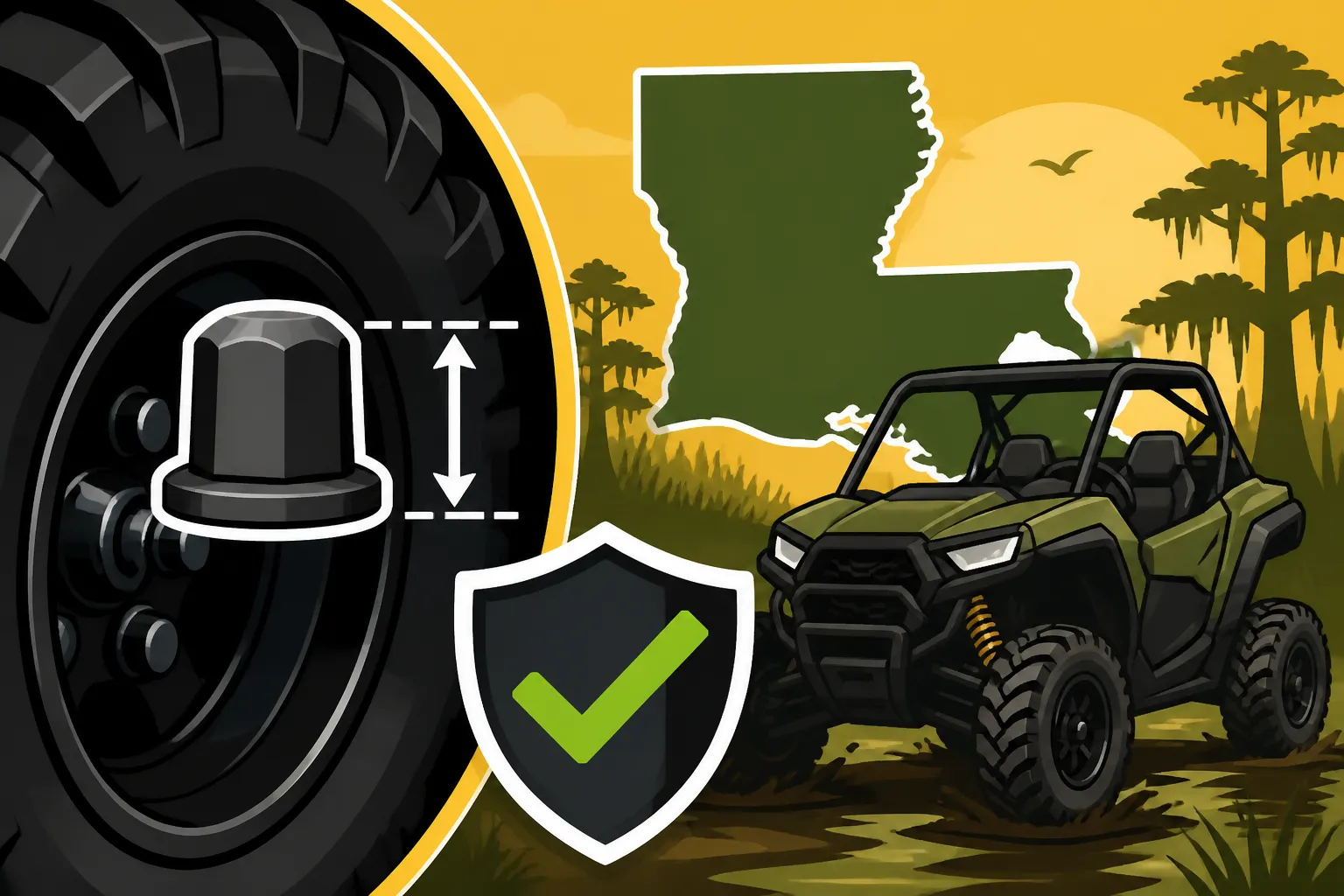
On Louisiana Wildlife Management Areas, off-road machines using designated trails must meet tire requirements that include a maximum lug height of one inch. A lug is a raised block of rubber on the tire tread. Lug height is the distance from the lower part of the tread between the blocks to the top of a block.
That measurement is different from the tire’s overall height. A tire can be within a permitted overall size and still have lugs that exceed the limit. Conversely, a tire with shallow lugs may meet the lug-height requirement but fail a separate size requirement. Each rule is a separate check.
| Tire detail | What to check | Why it matters |
|---|---|---|
| Lug height | No more than one inch from the tread valley to the top of a lug | A tire can be too aggressive even if its overall size is allowed |
| Tire dimensions | Check the applicable width and diameter limits, including the 26-by-12-inch limit described in WMA rules | Correct lug height does not make an oversized tire compliant |
| Tire pressure | WMA rules also limit pressure to 12 pounds per square inch | A compliant tire can still be set above the allowed pressure |
| Tread type | Farm-tread tires are not allowed on WMA trails | Tire style matters as well as measurements |
The one-inch figure is a maximum, not a target. Lugs that measure exactly one inch are at the limit; lugs that rise higher do not meet it. If a tire is close to the line, measure carefully and check the current instructions for the WMA where you plan to ride. Don’t assume that a sales description such as “mud tire” or “aggressive tread” tells you whether the tire is allowed.
Also keep the location in mind. WMA requirements are not automatically the rules at a private riding park, on private land, or on a public road. Different places can have different requirements, and a tire that is acceptable at one riding area may not be acceptable at another. For an overview of how the WMA requirements fit together, see Louisiana WMA Tire Rules Explained and Louisiana WMA Riding Rules for Quads.
Why the rule matters on WMA trails
Tire lugs are designed to grip. Taller, more widely spaced lugs can help a machine find traction in mud, but that same aggressive tread can affect the surface under the tire. Depending on the ground and conditions, a lug can dig into soft soil, disturb the trail surface, or make it harder for a rider to control the machine when traction changes.
A limit on lug height helps set a boundary for the tires permitted on WMA trails. It also gives riders a measurement they can check before entering an area. The rule does not mean every tire at or under the limit will behave identically: tread layout, tire condition, soil, water, and rider choices all affect how a machine handles. It does mean that choosing a more aggressive tire is not a free choice when you plan to ride on a WMA.
This is one reason to think about where you ride before selecting tires. A setup intended for deep mud may not suit a trail system with tire restrictions. Swapping to a compliant set before a WMA trip may be necessary, and carrying an extra set does not make an otherwise noncompliant tire acceptable while it is fitted to the machine.
The one-inch limit is only one part of access. Meeting it does not by itself authorize you to ride a WMA. Riders still need to follow the rules for designated trails, applicable permits, seasonal access, machine dimensions, tire pressure, and other restrictions. Start by confirming the trail is open and listed for machine use. Louisiana WMA Designated Trails Only explains why a trail being visible or rideable does not necessarily mean it is open to machines. Seasonal restrictions are another separate check; see Louisiana WMA Season Closures.
If you are planning a visit, review the current area information before loading the machine. Rules, access conditions, and closures can vary by area and may change. Reading a WMA Map Before You Unload can help you make the map check part of your preparation rather than a decision made at the trailhead.
How to measure lug height at home
A visual guess is not a dependable way to judge a tire near the one-inch maximum. Tread blocks can be uneven, worn, or shaped in ways that make their height look different from the actual measurement. A ruler or an appropriate tread-depth gauge gives you a more useful answer.
Measure from the tread valley
Look at the space between two adjacent tread blocks. Place the measuring tool at the lower surface of the tread valley and measure vertically to the top of the lug. The important point is to measure the raised lug itself, not the tire’s full diameter or the rubber thickness from the inside of the tire.
Check more than one spot. Some tires have different tread patterns across the center and shoulders, and a tire may have wear or damage that makes one lug noticeably different from another. Check the tallest relevant lugs on each tire, not just the easiest ones to reach. If the tire’s shape makes the result unclear, take a close-up photo with the ruler in place and ask the relevant WMA office how it interprets the measurement.
A basic tread-depth gauge may work, but check that its scale can measure the full lug height you need to assess. A small ruler can also help if you can hold it steadily and read the mark without bending it. If you are purchasing a gauge or compact ruler through Amazon, confirm that the tool’s range and shape suit an off-road tire; not every automotive tread gauge is designed to measure a tall tread block conveniently.
Use a consistent method
Before measuring, clean mud and stones from the tread. Debris packed between lugs can make the valley seem shallower, while dried mud on top can make a lug seem taller. Measure the rubber, not whatever is stuck to it.
Keep the tool straight and steady. Avoid measuring at an angle, which can produce an artificially large number. If the result is close to one inch, repeat the measurement in several places and use the highest reliable reading as your decision point. A close call is a reason to verify the rule’s measurement method with the relevant authority, not a reason to round down.
Record what you find. A note with the tire’s make and model, the measurement, and the date can be useful if you swap tires or use more than one machine. It is not a permit or official approval, but it helps prevent relying on memory when the tread wears or you change equipment.
Tread changes with use. Wear may reduce lug height, but damage, replacement tires, or a different set of wheels can change the setup. Recheck after any tire change and before a trip if you have not used the machine on a WMA recently. If the tires are obviously above the limit, do not count on a trailhead inspection to settle the question in your favor.
Check the other tire rules separately
Lug height is not the only tire measurement that matters. WMA tire requirements also include limits on overall dimensions and inflation pressure, and they restrict farm-tread tires. A machine can satisfy one requirement while failing another, so treat each item as its own check.
Overall tire size
The listed 26-by-12-inch limit concerns tire dimensions, not lug height. A tire with lugs under one inch can still be too large under the applicable size rule. Likewise, a tire that fits the size limit can still have lugs that are too tall. Check the sidewall markings and confirm how the WMA rules apply to the tire dimensions on your machine.
Do not assume a tire’s advertised size will match its measured size in every setup. Manufacturer labels, wheel fitment, and inflation can affect the actual dimensions. If a tire is close to a stated limit, ask the appropriate WMA authority how it checks size rather than relying only on a retailer’s description. For more on this separate restriction, read Why Tires Over 26 by 12 Are Turned Away.
Tire pressure
Pressure is another separate check. The WMA limit described in the rules is 12 pounds per square inch. Use a tire-pressure gauge rather than judging pressure by how firm a tire feels. Pressure can change with temperature and use, so check it before riding rather than relying on a measurement taken days earlier.
Measure when the tires are cool, follow the gauge instructions, and use an accurate tool. If one tire reads above the limit, adjust it and check again. Do not confuse the WMA maximum with the pressure recommended by the tire or vehicle manufacturer for other riding conditions. Those recommendations address equipment use; the WMA rule addresses access. When requirements differ, confirm what is required for the place you are riding. See 12 Pounds of Pressure for more on the pressure restriction.
Farm-tread tires
A farm-tread tire may look useful for Louisiana mud, but that does not make it suitable for WMA trail access. The WMA rules separately prohibit farm-tread tires. This is not something a rider can resolve by lowering pressure or showing that the tire’s lugs measure under one inch. Tire type, lug height, size, and pressure are different checks.
If you are unsure whether a particular tread pattern counts as farm tread, identify the exact tire model and ask the relevant WMA office before travelling. A general label from a seller may not answer how the restriction applies. Why Farm Tread Tires Are Banned on WMAs discusses that distinction.
For a broader checklist of machine requirements, Louisiana WMA Weight Limits Explained covers another category that riders should not confuse with tire compliance. Meeting the tire rules does not automatically mean a machine meets the WMA’s weight or other access requirements.
Prepare before you tow to a WMA
A quick pre-trip check can save time and reduce the chance of reaching a trailhead with equipment that cannot be used there. Make it part of loading the ATV or UTV, alongside checking the trailer, fuel, and riding gear.
- Choose the WMA and trail first. Confirm that the area allows the type of machine you plan to bring and that the trail is open. Use current official information rather than assuming that a trail shown on an older map remains open.
- Check each tire requirement. Measure lug height, verify tire dimensions, inspect tread type, and check pressure. Don’t treat a pass on one check as proof that the rest are acceptable.
- Look at the tires as they are fitted. Confirm the tires on the machine match the tires you measured. A spare set in the trailer does not change the setup on the vehicle you intend to ride.
- Confirm permits and access requirements. Tire compliance does not replace a required permit or any other WMA condition. If you are uncertain what applies to your visit, review [Louisiana WMA Permit Requirements] and the current information for the specific area.
- Ask about close calls before leaving home. Provide the office with the tire’s make and model, its marked size, and your measurement. A clear question is more useful than asking generally whether “mud tires” are allowed.
- Recheck after a change. New tires, different wheels, repairs, or a machine swap can affect whether the setup complies. Measure and check pressure again before using the machine on WMA land.
Keep a record of the information you relied on, especially if you ride several areas with different conditions. Save the relevant area page or note the date you checked it. When there is a conflict between an old forum post and current official information, do not treat the forum post as permission to ride.
A compliant machine must still be used on authorized routes and during allowed access periods. Check closures and trail conditions before departure; Checking a Trail Status Page First offers a useful reminder to confirm access rather than relying on last season’s plans. Be ready to change your destination if the trail is closed or your tires do not meet the requirements.
Frequently Asked Questions
Does the one-inch rule mean the tire can be one inch tall?
No. The limit refers to the height of the raised tread lugs, measured from the lower tread area to the top of a lug. It does not describe the tire’s overall height or diameter.
Is a tire allowed if its lugs are under one inch?
Not necessarily. You must also check the WMA requirements for tire dimensions, pressure, and tread type, along with the rules for the specific trail and machine.
Can I ride a WMA trail with a tire that is exactly one inch?
One inch is the stated maximum. If your measurement is right at the limit or difficult to take, verify the measurement method with the relevant WMA office before travelling.
Does the WMA tire rule apply at every Louisiana riding area?
No. WMA rules do not automatically apply to private parks or private land, and those locations may have their own requirements. Confirm the rules for the place you intend to ride.
Disclaimer
This article is for general informational purposes only and does not constitute professional advice. Laws, prices and regulations vary by location and change over time. Consult a qualified professional for guidance on your specific situation.