Louisiana WMA Tire Pressure Limits
Louisiana WMA Tire Pressure Limits
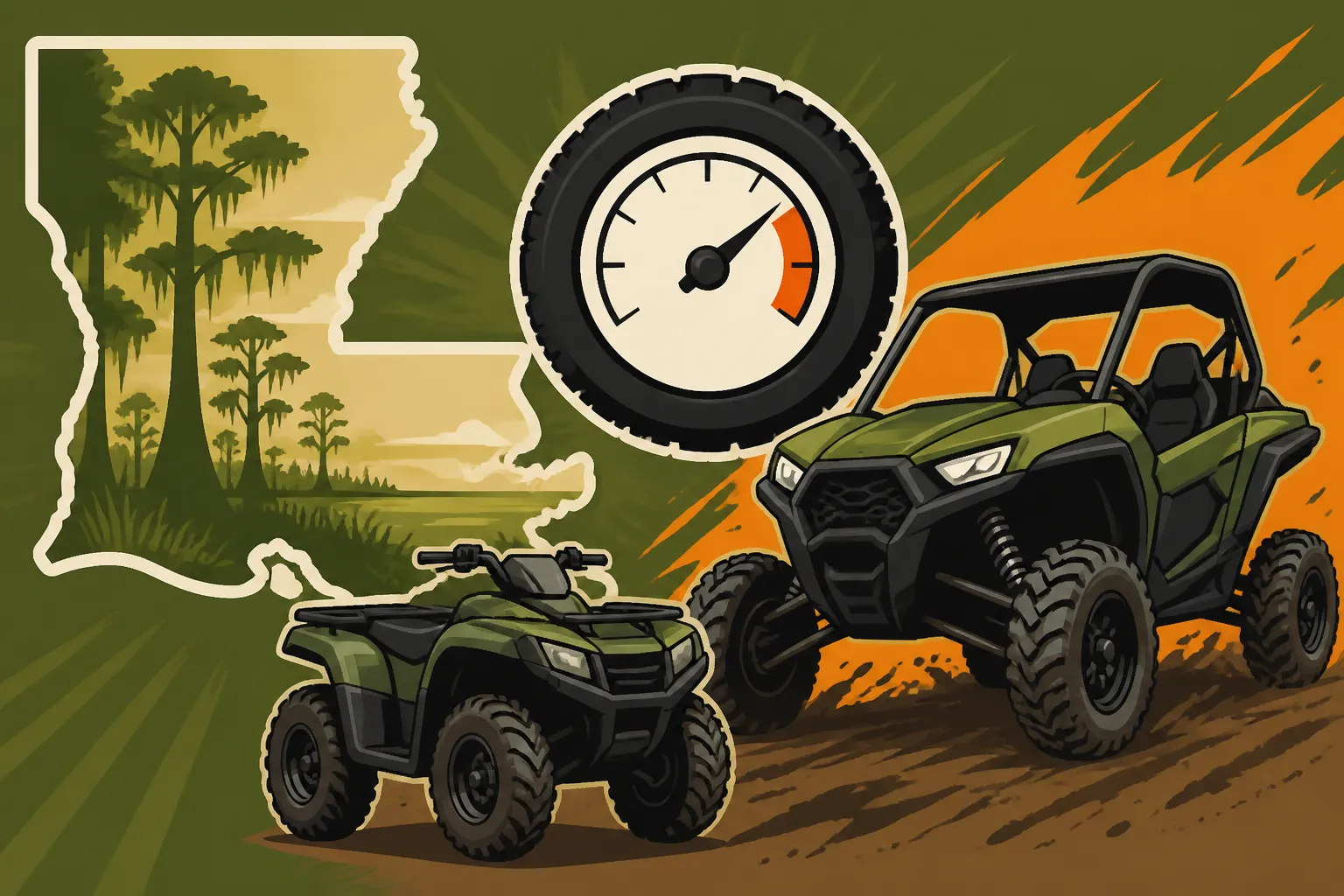
A tire that works well in deep mud may not meet the rules for a Louisiana Wildlife Management Area trail. For eligible ATV and UTV use, the WMA tire-pressure limit is 12 pounds per square inch. Here’s how to check it, what the limit does and doesn’t mean, and what else to verify before you unload.
The 12 PSI Limit and What It Means
Louisiana WMA rules set a maximum tire pressure of 12 pounds per square inch for machines using designated trails where the ATV and UTV requirements apply. In plain terms, a tire inflated above 12 PSI can make a machine ineligible for that trail, even if the machine is otherwise permitted and the rider has the required access paperwork.
Treat 12 PSI as a ceiling, not a target that every tire must reach. If your tires are already at or below the limit, do not assume that all other WMA requirements are satisfied. Tire dimensions, tread, machine weight, permitted routes, seasonal closures and access rules may also matter. For an overview of related ATV requirements, see Louisiana WMA Riding Rules for Quads and Louisiana WMA Tire Rules Explained.
| Item to check | What to look for before riding |
|---|---|
| Tire pressure | No more than 12 PSI where the WMA rule applies |
| Tire size | Confirm the applicable width and diameter limits |
| Lug height | Check that the tread does not exceed the applicable limit |
| Tread type | Farm-style tread may be prohibited |
| Machine weight | Check the category-specific WMA limit |
| Route access | Ride only on trails open to your machine |
| Season | Confirm that riding is allowed on the date of your visit |
| Access paperwork | Check permit and self-clearing requirements |
The pressure limit is about the machine’s tires, not the rider’s weight, the size of the tire, or the pressure needed to support a particular load. A tire marked for a much higher maximum pressure does not gain an exception. Likewise, using a low-pressure tire does not make a machine eligible if its size, tread, weight or route use violates another rule.
A low-pressure reading also does not guarantee a safe setup. Tires need enough pressure to stay seated on the rims and handle the machine, passengers and cargo. The right operating pressure depends on the tire and machine manufacturer’s guidance, as well as the terrain and load. The legal maximum and the manufacturer’s recommended operating range are separate things to check.
The practical goal is to arrive with pressures that are both within the WMA limit and suitable for the machine. If those requirements do not overlap for your setup, do not treat the public-land rule as a reason to run a tire below its safe operating range. Ask the WMA manager or the Louisiana Department of Wildlife and Fisheries (LDWF) about access for your machine before making the trip.
Why the limit matters on a WMA
WMA rules are not the same as the rules at a private riding park, on private property, or on every public forest road. A pressure that is allowed at a commercial mud park may still exceed the WMA maximum. And a low-pressure setup that meets this one requirement does not grant permission to ride outside designated areas.
Before you travel, check the specific WMA’s current instructions, trail map and posted notices. WMA access can be limited by the area, the season, the trail type or the condition of the land. A route shown on an old map or remembered from a previous visit may not be open now. [Louisiana WMA Permit Requirements] and Louisiana WMA Season Closures cover two other parts of trip planning that can affect whether you can ride.
The rule is also distinct from vehicle registration or an off-road decal. Having the right ownership paperwork or decal does not automatically meet a WMA’s access requirements. Similarly, a permit for public-land access does not authorize riding on a closed route. Check each requirement separately instead of relying on one document or one machine modification to cover everything.
How to Check Pressure Before You Leave
A dependable pressure check takes only a few minutes, but it requires a gauge that works at the low pressures common on ATV and UTV tires. A regular passenger-car gauge may not make it easy to read small changes near 12 PSI. Choose a gauge with a range and graduations that let you check that level clearly.
A low-pressure dial or digital gauge is one option. A compact gauge can be useful to keep with your riding kit, provided it is protected from mud and water and checked periodically against a known-good gauge. You can find suitable gauges at automotive or hardware stores and through retailers such as Amazon; the important thing is the gauge’s usable range and condition, not where you buy it.
Use a consistent process for every tire:
- Check the applicable WMA rules. Confirm the current pressure limit and any additional tire, vehicle or trail requirements for the specific area.
- Park on firm, level ground. Avoid checking in deep mud, on a slope or while the tire is carrying an uneven load.
- Check tires before the ride. Cold tires provide a more repeatable starting reading than tires that have been heated by travel or riding. If you have already driven a long distance or ridden, note that the reading may differ from a cold check.
- Use the gauge squarely on the valve stem. A poor seal can let air escape and give you an inaccurate reading.
- Check all tires, not just one. On a UTV, inspect each wheel. On an ATV, check every tire, including the spare if it will be used on the WMA.
- Make small adjustments. Add or release air gradually, then take another reading. Recheck the tire after each adjustment rather than estimating by feel.
- Recheck after loading. Passengers and cargo can change how a tire behaves, even though they do not change the stated PSI ceiling.
- Keep the gauge accessible. A quick check at the trailhead is easier if the tool is not buried under gear.
Do not use the tire’s appearance as a substitute for a gauge. ATV tires are designed to flex, so a tire can look soft while still exceeding the limit. The reverse can also happen: a tire that looks normal may be substantially underinflated. Squeezing the sidewall or comparing one tire’s shape to another is not a reliable way to establish a PSI reading.
A tire-pressure monitoring system, if the machine has one, may be useful as a general warning but may not display pressure with the precision you need near the limit. Check the system’s display against a handheld gauge and understand how it rounds readings. If the display shows whole numbers, a value of 12 may not distinguish a reading just under the limit from one just over it.
Temperature and recent use can affect readings. A tire may show a higher pressure after it warms up, and the gauge itself can have some measurement variation. If the WMA limit is 12 PSI, leaving a modest margin below it can reduce the risk of arriving at the boundary because of rounding or gauge differences. Do not compensate by letting air out until the tire falls below the manufacturer’s safe operating range.
There is no need to chase tiny changes while riding unless you have a reason to suspect a leak or a damaged tire. What matters is a reliable check before access, plus attention to handling and tire condition during use. If you lose air on the trail, stop somewhere safe and assess the tire. A damaged tire is not made safe just by staying under a pressure maximum.
The Pressure Limit Is Only One Tire Rule
Pressure is easy to measure, so it often gets the most attention. But it is only one part of the WMA tire requirements. Tire size, tread design and lug height can each affect eligibility. Machine weight can also matter, with different limits applying to different types of machines.
That is why “my tires are at 10 PSI” is not a complete compliance check. A tire can be under the pressure ceiling and still be too large, have prohibited tread, or exceed a lug-height limit. Likewise, a machine can meet tire specifications and still exceed an applicable weight limit. Review Louisiana WMA Weight Limits Explained and Louisiana WMA Machine Size Limits alongside the tire requirements.
Pressure, tire size and lug height are different checks
These terms describe separate measurements:
- Pressure is how much air is inside the tire, measured in PSI.
- Tire size describes dimensions such as diameter and width. Check the current rule for the maximum allowed dimensions rather than assuming a familiar tire size will qualify.
- Lug height is the height of the raised tread blocks. A tire that looks aggressive may have lugs above the allowed limit even if it is a common ATV tire.
- Tread type describes the pattern and intended use. Farm-style tread may be barred under WMA rules even when its pressure and dimensions appear acceptable.
- Machine weight concerns the vehicle, not its tire pressure. Confirm which weight limit applies to the type of machine you plan to bring.
Do not rely on a tire’s marketing name or a sidewall marking to prove it qualifies. Sidewall information can help identify the tire’s size and construction, but it does not necessarily tell you whether the tire meets a particular WMA’s current access requirements. If the dimensions or tread are borderline, ask the area manager before hauling the machine.
Do not modify a tire to solve a different issue
Letting air out will not make a tire narrower or reduce the height of its tread lugs. It also will not make an overweight machine compliant. Similarly, changing tires does not automatically make a trail open to a UTV that the area does not allow.
If a machine fails one of the other checks, identify the exact issue before making changes. For example, confirm whether the question is tire width, lug height, tread type or the machine’s weight. Guessing from appearance can lead to wasted work and a denied trip. If your setup is close to a published limit, verify the measurement method with the WMA rather than assuming a small difference will be overlooked.
The limits and access rules can be especially important for UTVs. They are larger and heavier than many ATVs, and trails that allow one vehicle category may not allow another. Check the requirements in Louisiana WMA Riding Rules for UTVs before packing a side-by-side.
WMA Access, Other Riding Areas and Out-of-State Machines
A WMA is not interchangeable with every other public or private riding area in Louisiana. The WMA tire rules apply to the land and activity covered by those rules; a different location may have its own restrictions. Do not assume a machine that is legal at a mud park, on a private tract or on another public trail is automatically eligible for a WMA trail.
Before leaving home, confirm four things for the exact destination:
- The WMA is open to the kind of riding you plan to do.
- The specific trail is designated for your type of machine.
- Your machine, tires and equipment meet the current requirements.
- You have the required permit or access documents.
WMA procedures can include a self-clearing permit or other area-specific access steps. Read the instructions for the location rather than relying on a general assumption about what every WMA requires. A permit is not a substitute for obeying trail, equipment or season rules. For the process, see [Louisiana Self-Clearing Permit Steps].
The rules do not become irrelevant because a machine is registered, titled or based in another state. Out-of-state ownership, registration or decals may affect some paperwork questions, but they do not by themselves establish that a machine meets the WMA’s tire or route requirements. Confirm the applicable land-access rules before traveling with a visiting machine. Riding Louisiana Public Land on an Out-of-State Machine explains the separate issue of public-land access for visiting riders.
Similarly, an off-road decal or title does not replace the WMA’s trail rules. Riders sometimes treat registration, land access and equipment compliance as one package, but they answer different questions:
| Question | What it addresses |
|---|---|
| Is the machine titled or properly documented? | Ownership and vehicle records |
| Does it carry the required decal? | Applicable off-road identification or registration requirements |
| Does the rider have WMA access paperwork? | Access or permit requirements for the area |
| Does the machine meet the tire rules? | Pressure, size, tread and other equipment conditions |
| Is the route open? | Where and when riding is allowed |
If you plan to ride both a WMA and a private park during one trip, prepare for each destination separately. Do not set pressure for a private park and assume it will be suitable for the WMA. Check the WMA requirements first, then make sure the resulting setup is safe for the machine and the trip between locations. Do not ride on a public road unless the machine and route are separately lawful for road use; an off-road decal is not street-legal registration.
A Practical Pre-Trip Checklist
A short checklist helps catch the problems that are easy to miss while loading. Complete it before driving to the trailhead, then check posted notices when you arrive.
Before you load
- Identify the specific WMA and trail you intend to use.
- Check the current LDWF information for closures, permitted routes and equipment restrictions.
- Confirm whether your machine type is allowed on the trail.
- Check tire pressure with a suitable gauge, including every tire.
- Compare the tire’s dimensions and tread with the current rules.
- Check lug height if the rule applies to your tires.
- Confirm the machine meets the applicable weight requirement.
- Review the access permit or self-clearing instructions for the area.
- Bring a working gauge and a way to add or release air.
- Make sure a spare tire, if carried, also meets the relevant requirements.
At the trailhead
Read the posted signs before unloading or riding. A sign may provide location-specific instructions, alert riders to a temporary closure, or direct them to a particular trail. If the posted information conflicts with what you expected from an old map or a previous visit, pause and confirm the current rule with the responsible office or area manager.
Keep your gauge available rather than buried in the trailer or gear. If you make an adjustment at the trailhead, measure again after the change. Do not estimate pressure by letting air out for a set number of seconds. A brief release can remove more air than expected, especially from a small tire.
If an officer or WMA staff member raises a concern about your setup, stay calm and ask which requirement applies and how they are measuring it. A digital or dial gauge may differ slightly from another gauge. That is one reason to avoid arriving exactly at the limit if the manufacturer’s safe operating range allows a little room below it. If there is a disagreement you cannot resolve at the trailhead, do not ride until you have confirmed your machine is eligible.
If a tire is over the limit or the setup is uncertain
If the pressure is above 12 PSI, use your gauge to release air in small increments and retest. Then check the manufacturer’s guidance to make sure the adjusted pressure remains suitable for the tire, machine and load. If it cannot safely be brought within the WMA limit, do not ride that machine on the WMA trail.
If the issue is tire size, lug height, tread type or machine weight, lowering tire pressure will not correct it. Confirm the requirement and contact the area manager for clarification. If the trail is closed or your vehicle category is not allowed, choose a different lawful riding area rather than trying another route on the same WMA.
If the pressure reading is inconsistent, test the gauge on another tire or use a second gauge. Inspect the valve stem for dirt or damage and make sure the gauge forms a good seal. A leaking valve or damaged tire needs attention before riding; repeatedly adding air without finding the cause can leave you with a tire that loses pressure on the trail.
Frequently Asked Questions
Is 12 PSI the minimum pressure for a Louisiana WMA?
No. It is a maximum where the applicable WMA tire rule applies. A tire can be below 12 PSI, but it still needs to be within a safe operating range for the tire, machine and load, and it must meet the other WMA requirements.
Does being below 12 PSI make any ATV tire legal on a WMA?
No. Pressure is only one check. Tire dimensions, tread type, lug height, machine weight, allowed vehicle category, designated trails and closures can also affect access.
Should I check pressure before or after riding?
Check before riding, ideally when the tires are cold, for a consistent baseline. If you have already driven or ridden, the tires may be warm and the reading may differ. Follow the tire and machine manufacturer’s instructions, and confirm current WMA requirements.
Do out-of-state riders have to follow the pressure limit?
Check the current rules for the WMA you plan to visit. Out-of-state ownership does not by itself exempt a machine from applicable land-access and equipment requirements. Review Louisiana Rules for an Out-of-State Machine before traveling.
Disclaimer
This article is for general informational purposes only and does not constitute professional advice. Laws, prices and regulations vary by location and change over time. Consult a qualified professional for guidance on your specific situation.