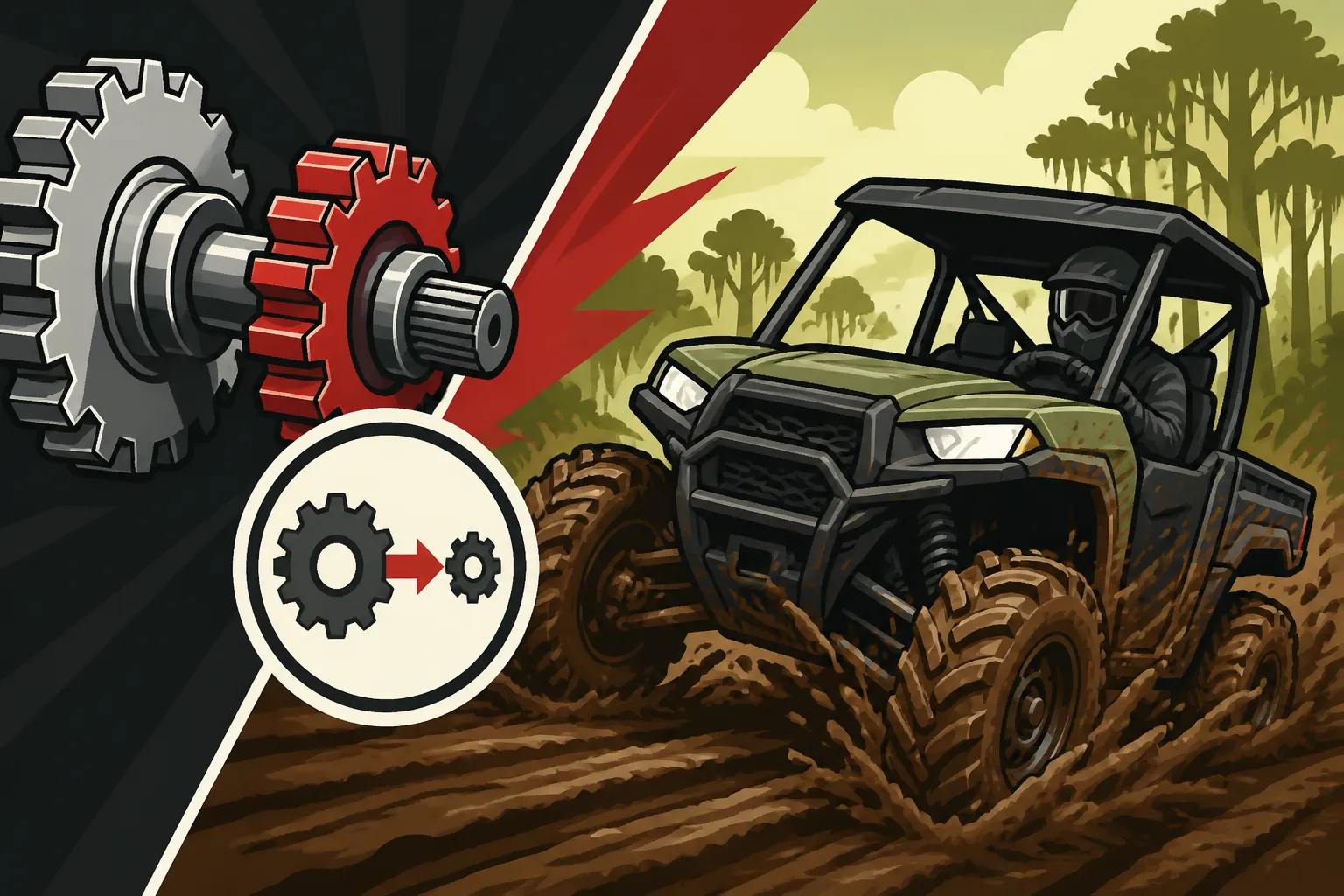
Why Heavy Mud Calls for Gear Reduction
When Louisiana mud turns a trail into thick, suctioning muck, an ATV or UTV can struggle to keep moving even with the throttle open. The tires bog down, the belt gets hot, and the machine may lurch instead of crawl. Gear reduction can help by trading top speed for more torque at the wheels—but it works best when matched to the machine, tires, and terrain.
What gear reduction does in heavy mud
More torque at the wheels, less speed
Gear reduction changes the relationship between engine speed and wheel speed. With lower gearing, the wheels turn more slowly for a given engine speed, while the drivetrain multiplies the torque delivered to them. That extra turning force can help the tires keep rotating through sticky mud instead of stopping as soon as they meet resistance.
It does not give the engine more horsepower. Think of it like choosing a lower gear on a bicycle to climb a steep hill: pedaling may feel easier at the wheels, but you move more slowly. In deep Louisiana mud, that slower, more controlled pace can be useful when a machine needs to crawl through a rut or pull itself out of a soft spot.
The tradeoff is reduced speed in that gear range. A machine geared for strong low-speed pulling may feel less suited to fast trail riding, especially if the gearing is changed substantially. Gear reduction is most helpful when a rider regularly encounters demanding conditions, rather than as a universal upgrade for every ATV or UTV.
Why thick mud makes the drivetrain work harder
Mud resists a tire differently from firm ground. A tire may sink, pack with mud, or grip and release unpredictably. Oversized or heavy mud tires can add to the load, and sticky ground can make the machine work hard just to maintain wheel rotation. Those demands are one reason riders compare tread patterns and tire size in Tires for Deep Southern Mud.
Many ATVs and UTVs use a continuously variable transmission, or CVT, with a belt. When the machine is asked to move slowly under heavy load, the belt and clutch system may work harder and build heat. Repeatedly spinning the tires, letting the machine bog, or trying to power through a deep hole at an unsuitable speed can add to that strain. The exact effects depend on the machine and its setup, so gear reduction should be treated as one part of a broader drivetrain plan—not a guarantee against belt wear or overheating.
Gear reduction is not the same as low range
Some machines have a factory low-range setting. It is intended for slower, higher-load work, though the right operating mode depends on the manufacturer’s instructions and the specific terrain. If your machine has low range, check the owner’s manual for when and how to use it before buying aftermarket parts.
Aftermarket gear reduction changes the machine’s gearing beyond the factory setup. Depending on the design, it may involve internal transmission gears or other drivetrain components. That is a more involved change than selecting low range, and it can affect speed, engine behavior, and loads on other drivetrain parts.
| Option | What it changes | When it may help | Main tradeoff |
|---|---|---|---|
| Factory low range | Uses a slower factory gear range | Slow, demanding travel when the manual permits it | Lower speed while selected |
| Aftermarket gear reduction | Changes gearing to increase torque multiplication and reduce wheel speed | Frequent deep mud, larger tires, or sustained low-speed pulling | Less top speed and possible added stress elsewhere in the drivetrain |
| Tire or clutching adjustment | Changes traction, rotating weight, or how the CVT responds | A setup that is mismatched to tire size or riding style | Needs careful matching to the machine |
| Better line choice | Avoids some of the deepest or most resistant ground | Variable trails and unfamiliar mud holes | Cannot make every obstacle passable |
Signs your machine may benefit from lower gearing
The machine bogs or struggles to crawl
A common clue is that the machine cannot maintain a steady, controlled crawl in the mud conditions you ride. The engine may labor, the tires may stop turning, or the machine may surge when you add throttle. If that happens repeatedly, consider the whole setup before assuming gearing is the only issue.
Start with basic checks: confirm the tires are appropriate and in good condition, make sure the machine is maintained according to its manual, and note whether the problem appears only in unusually deep mud or on routine rides. If the issue occurs across different terrain, a mechanical fault or maintenance need may be involved. A gear change should not be used to mask a problem that needs repair.
It also helps to pay attention to how the machine behaves in factory low range, if it has one. If low range noticeably improves slow-speed control, that may suggest lower gearing would suit your use. If the machine still bogs, slips, or behaves abnormally, have the belt, clutch, and drivetrain checked before modifying it.
You have added larger or heavier tires
Larger tires can change the effective gearing. A taller tire travels farther with each rotation, which can make the machine feel geared taller: it may take more effort to turn the tire under load, and low-speed response can suffer. Heavy tires may also increase rotating weight. These effects vary with tire design, size, machine, and other modifications.
That does not mean every mud tire requires gear reduction. Some riders are satisfied with a modest tire change and the factory gearing. Others who run substantially larger tires, carry equipment, or spend long stretches in deep mud may find the stock setup less comfortable or less capable at low speeds.
Consider your full setup before choosing parts. Tire diameter, tread, vehicle weight, passenger and cargo load, riding style, and the depth and consistency of the mud all matter. A shop familiar with your make and model can help assess the combination instead of recommending a reduction ratio based on tire size alone.
Your rides involve sustained low-speed pulling
A short muddy patch is different from a long ride where the machine repeatedly pulls through deep, resistant ground. Frequent slow travel, heavy loads, or long sections where the tires are constantly working can expose the limits of a setup sooner than an occasional mud hole.
Keep a simple ride log: note the tire setup, gear range, terrain, load, and what the machine did. Was it hard to hold a steady pace? Did it lose wheel rotation? Did you need repeated throttle bursts to keep moving? Patterns across several rides are more useful than one difficult crossing.
For example, a rider who occasionally encounters a wet section on a marked forest trail may be better served by careful line choice and factory low range. A rider who regularly visits deep-mud areas with larger tires may have a stronger case for discussing gear reduction and clutching with a qualified technician. Before riding after heavy rain, check Louisiana Trail Conditions After Rain and local access rules; muddy conditions can also lead to closures or trail damage.
Choosing and installing a gear reduction
Match the change to the machine and tires
There is no single gear reduction ratio that fits every ATV or UTV. The right setup depends on the machine’s original gearing, tire diameter and weight, engine characteristics, transmission design, intended speed, and the kind of mud you actually ride. A ratio chosen for a heavily modified mud machine may be a poor fit for a mostly stock trail vehicle.
Be clear about your goal. Do you want better low-speed control, support for larger tires, or more consistent pulling in demanding mud? Do you still need to travel comfortably on firm trails? The more specific you are, the easier it is for a technician to recommend a balanced setup.
A useful conversation includes your make and model, tire size, other drivetrain modifications, typical passenger or cargo load, and where you ride. If you use onX Offroad to plan trips, it can help you keep track of the kinds of routes and terrain you tend to choose; pair that planning with local trail rules and current access information. Mapping does not establish that every muddy track is open or legal to ride.
Think about clutching and other supporting parts
Gearing and clutch behavior are closely connected on many CVT machines. Changing tire size or gearing can alter how the engine and belt respond under load. Depending on the machine and modifications, clutch tuning may be worth discussing alongside gear reduction. The goal is a setup that operates predictably within the manufacturer’s intended limits, not simply one that feels aggressive when the throttle is opened.
Also consider the rest of the drivetrain. More torque at the wheels can mean greater loads on axles, CV joints, belts, gears, and other components, particularly when a tire suddenly catches traction after spinning. Gear reduction may make it easier to turn a large tire, but it does not make every component stronger. A poor match between gearing and riding style can shift strain rather than eliminate it.
Before installation, ask what components are changed, whether the machine’s intended use or warranty may be affected, and what maintenance or operating changes the installer recommends. Use a shop familiar with your specific model, and follow the machine and component manufacturers’ instructions. A shortcut that saves installation time can become expensive if the gearing is incorrect or the work is not done properly.
Set realistic expectations
Gear reduction may improve low-speed control, but it cannot make a machine immune to mud. Deep holes, hidden stumps, soft shoulders, water-filled ruts, and abrupt changes in traction can still stop or damage a vehicle. It also cannot compensate for poor judgment about whether a crossing is safe.
If you ride with a group, avoid treating a lower-geared machine as permission to force a route that others cannot safely follow. Discuss alternate lines and recovery plans before entering difficult ground. For riders comparing terrain and skill levels, Louisiana Trail Difficulty Ratings can help frame a trip plan, while Reading a Mud Hole Before You Ride Into It offers practical guidance for assessing an obstacle before committing.
Riding and caring for a machine in heavy mud
Use smooth inputs and choose a line carefully
Lower gearing can make slow movement easier to control, but smooth throttle still matters. Sudden bursts can make the tires spin without moving the machine forward, dig the vehicle deeper, or create a sudden grip change that shocks the drivetrain. If the machine begins to bog, avoid reflexively holding the throttle wide open. Pause, assess the situation, and follow the recovery guidance in the owner’s manual.
Look for a route that avoids the deepest part of a rut when it is safe and lawful to do so. Watch for water hiding holes, uneven ground, and soft edges. Never assume that a familiar trail has the same surface after heavy rain. When you are unsure whether a crossing is passable, stopping to reassess is usually wiser than committing to it.
A winch can be useful for recovery, but it needs to be used carefully, with appropriate anchor points and equipment. Gear reduction and recovery gear solve different problems: one helps manage low-speed pulling, while the other can help extract a stuck machine. Neither makes an unsafe route safe.
Reduce avoidable strain and check the machine afterward
Before a ride, inspect the machine as its manual recommends. Pay particular attention to tires, drivetrain components, cooling openings, and any added equipment. Mud can cover warning signs, so stop periodically if the machine is struggling or behaving differently than usual.
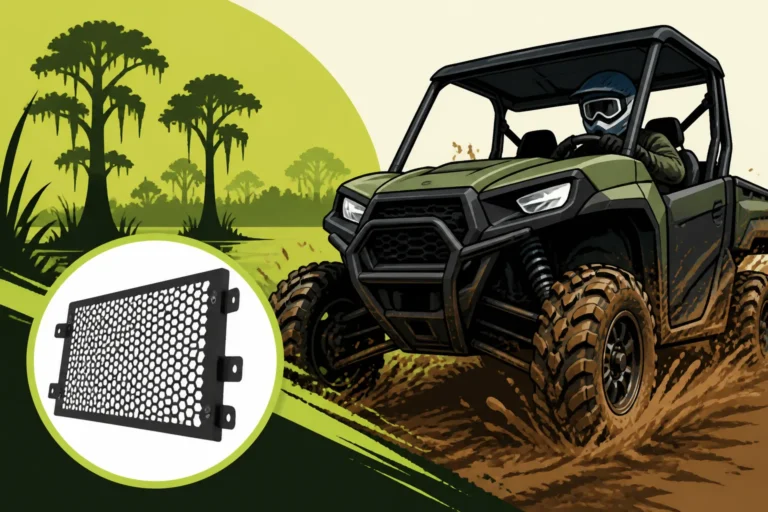
After a muddy ride, remove packed mud and inspect for damage, loose parts, or signs of leaks. Pay attention to areas where mud can collect and interfere with cooling or moving components. A thorough cleanup matters even when the machine made it through the ride without an obvious problem. Washing a Machine After a Mud Weekend covers the cleanup side, while Radiator Screens for Mud explores one issue riders may need to consider when mud threatens cooling airflow.
Plan around the place you are riding, too. Some trails close or restrict riding when conditions are wet to limit erosion and damage. Check Louisiana Trail Closures and Seasons before heading out, and follow posted rules and access boundaries. onX Offroad may help organize route planning, but verify access with the land manager or trail authority rather than treating a map track as permission.
Respect the trail and know when to turn around
Heavy mud can be entertaining, but repeated spinning and rutting can damage trails and make them harder for everyone to use. Stay on permitted routes, avoid creating new lines around obstacles, and follow closures. If a trail is deteriorating badly, turning around protects both your machine and the riding area.
For group outings, agree on a turnaround point and recovery plan before the hardest section. Keep enough distance to avoid a stuck machine creating a second problem, and make sure everyone knows how to signal for help. onX Offroad can be part of trip planning when riders want to review their intended route, but confirm the route’s legal status and conditions separately.
Gear reduction is best understood as a tool for a demanding setup—not a substitute for maintenance, safe technique, or good trail decisions. If your machine repeatedly struggles in mud you ride often, start by documenting the setup and symptoms, then discuss gearing, clutching, tires, and drivetrain limits with a knowledgeable technician. That approach is more likely to produce a useful, reliable change than choosing parts based on one muddy afternoon.
Disclaimer
This article is for general informational purposes only and does not constitute professional advice. Laws, prices and regulations vary by location and change over time. Consult a qualified professional for guidance on your specific situation.