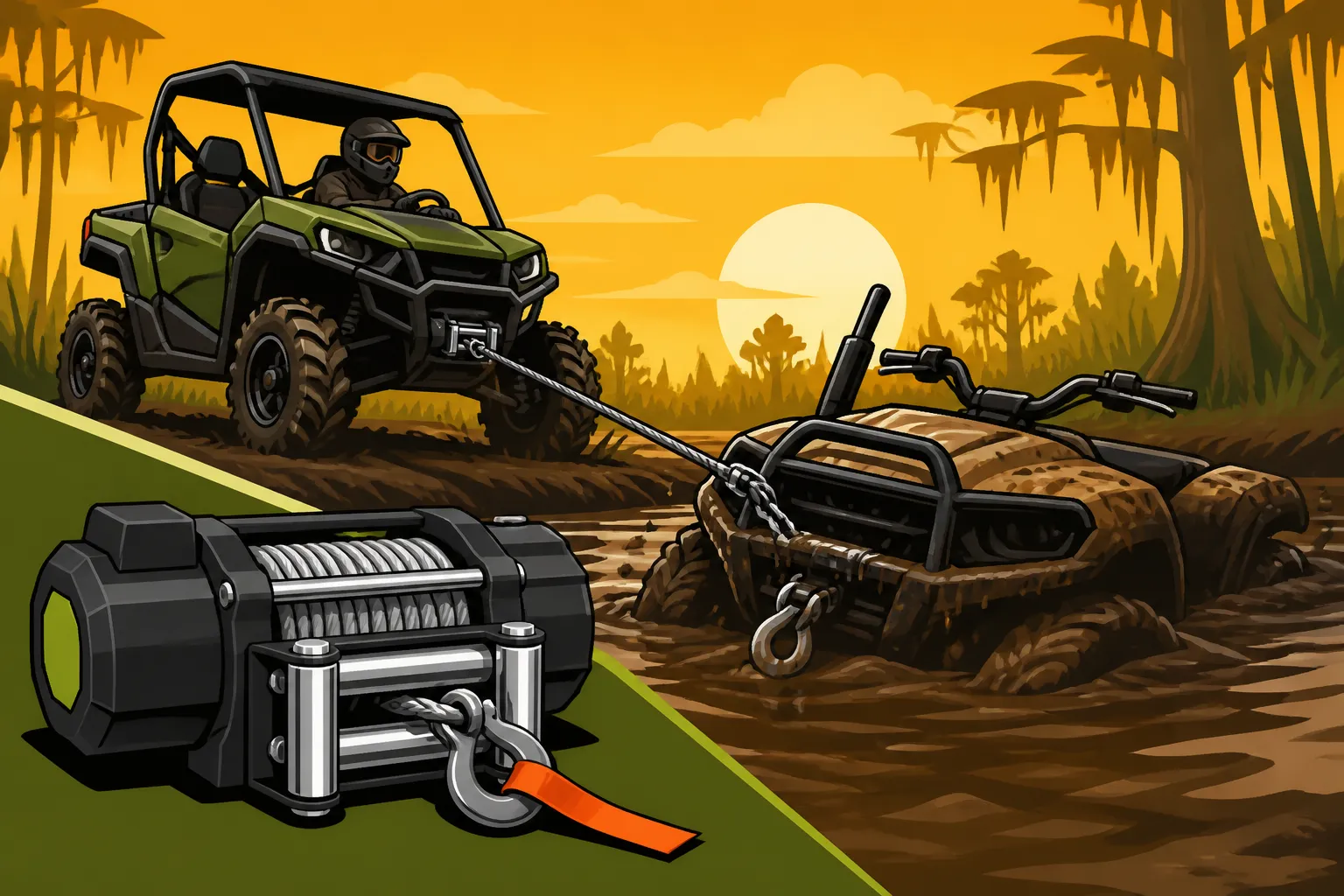
Winches for a Buried Machine
A buried ATV or UTV can turn a fun Louisiana ride into a muddy, stressful recovery fast, especially when the tires are spinning and the trail edge is soft. A winch helps you recover in a controlled way, but only if it is properly matched to the machine and used with safe anchor points, sound equipment, and a clear plan.
Choose a Winch for Your ATV or UTV
Match the winch to the machine and the conditions
A winch’s rated pulling capacity is only one part of the decision. A machine sunk into sticky clay, tangled in roots, or tilted into a rut can take much more effort to move than one sitting on firm, level ground. Choose a winch using the machine manufacturer’s guidance and the winch maker’s specifications, with extra capacity for the kinds of recoveries you expect. Don’t assume a small winch is adequate simply because your ATV is light on a dry driveway.
Think about how the machine is set up, too. A heavy bumper, cargo, passengers, mud packed into the fenders, and added accessories all affect recovery. A four-seat UTV carrying people and gear has different needs from a compact youth quad. If you ride deep holes at a mud park, you may need a different setup than someone who sticks mostly to marked forest trails. For more on choosing a machine and equipment for soft ground, see Tires for Deep Southern Mud.
Also consider the rest of the system. The mounting plate, wiring, battery condition, control switch, rope or cable, and fairlead all need to be compatible and in good condition. A winch that is powerful enough on paper can still let you down if its mount is loose, its electrical connections are corroded, or its line is damaged. Follow the manufacturer’s instructions for installation and use rather than improvising a mount or wiring arrangement.
Compare the recovery gear you’ll carry
A winch works best as part of a small recovery kit. A tree-saver strap, suitable shackles, gloves, and a recovery damper can help make a pull safer and easier to manage. The exact gear depends on your machine and the winch maker’s guidance. Before a ride, check that every accessory is rated for the load and type of use you intend.
| Gear | What it helps with | Important check |
|---|---|---|
| Winch with compatible mount | Pulls the machine toward a suitable anchor | Confirm the mount, electrical system, and winch are compatible |
| Tree-saver strap | Connects to a tree without wrapping the winch line around it | Use a strap intended for recovery, not a narrow rope or chain |
| Rated shackle or connector | Joins compatible recovery components | Check its condition and working-load guidance |
| Winch gloves | Protects hands while handling line | Keep hands away from the fairlead and moving line |
| Recovery damper | Helps reduce line movement if a line fails | Use it as directed and keep everyone clear of the line |
| Pulley block, if appropriate | Can change the pull direction or help with a difficult recovery | Follow the winch maker’s instructions and account for added loads |
Don’t use a trailer hitch ball, a random chain, or a strap whose rating and purpose you can’t confirm as a winch anchor or connection point. Those shortcuts can fail suddenly. A proper recovery point should be designed for the load, securely attached, and approved for the intended use. When you’re unsure whether a piece of equipment is suitable, leave it out of the rigging until you can verify its use.
Set Up a Safe Recovery Before You Pull
Assess the machine and the ground first
Before touching the winch control, stop and look at the whole situation. Is the machine upright? Are the wheels buried, or is the frame resting on a stump or bank? Is there enough room for it to move without striking a tree, another vehicle, or a person? Check whether water, a ditch, or soft ground could cause the machine to slide sideways as it comes free.
If the machine is leaning sharply, suspended, or trapped in a position where a pull could make it roll, don’t treat the winch as a simple solution. A winch can move a machine in an unpredictable direction when the line angle changes or the tires suddenly gain traction. Ask everyone to step back, keep passengers off the machine unless the manufacturer’s instructions say otherwise, and reassess whether professional or experienced help is needed.
It can help to use the machine’s recovery points and the winch line in a straight, stable direction whenever possible. Avoid pulling from a weak body panel, rack, bumper, or component that isn’t designed for recovery. If the machine needs to move around an obstacle, use only equipment and techniques permitted by the winch manufacturer, and make sure the anchor and rigging can handle the resulting forces.
Choose an anchor and clear the danger zone
A tree can be a suitable anchor only when it is healthy, stable, and large enough for the pull. Place a tree-saver strap around the trunk and connect the winch line with a compatible rated connector. Never wrap the winch cable or rope directly around a tree: it can damage the tree and may create an unsafe connection. Don’t anchor to a loose stump, a fence, a small sapling, or another ATV that hasn’t been positioned and secured for recovery.
Before pulling, agree on who is operating the winch and how the group will communicate. Keep everyone well away from the line, the anchor, and the space where the machine may move. Nobody should stand over, straddle, or step across a loaded line. Avoid standing directly in line with the rope or cable, and don’t handle it near the fairlead while the winch is operating. A recovery damper can be placed as directed by its maker, but it does not make it safe to stand close to a loaded line.
Louisiana’s wet ground can make a seemingly solid anchor unreliable. A tree may be rooted in saturated soil, or a bank may crumble as the machine begins to move. If the anchor shifts, stop the pull immediately and reassess. Don’t keep increasing tension to “see if it holds.” A safe recovery is slower than a rushed one, but it’s far better than a broken line or a machine pulled into a worse position.
Winch a Buried Machine Step by Step
Prepare the line and the route
Read the winch instructions before the ride, not for the first time while your machine is buried. Know how to operate the controls, engage or release the clutch as directed, and stop the winch. Inspect the rope or cable for fraying, kinks, crushed sections, corrosion, or other damage. If you find a problem, don’t put the line under load.
Clear loose mud, branches, and gear from the intended path if you can do so safely. If the machine is stuck because the belly is resting on a ridge, you may need to reduce the obstruction or reposition the machine rather than simply applying more pulling force. Check whether the wheels can roll freely and whether the steering is pointed in a direction that avoids an obstacle. Small, safe changes can reduce the strain on the winch.
Keep the recovery simple. Connect the line only to a suitable recovery point, route it so it won’t rub sharply against an edge, and make sure it is properly seated on the fairlead. Don’t let the line wrap around a tire, axle, or suspension part. Once everything is connected, move the group clear and give the winch operator a clean view of the machine and line if possible.
Use steady tension and stop when anything changes
Take up slack slowly, following the manufacturer’s instructions. Once the line is taut, use short, controlled pulls and watch the machine, anchor, line, and mounting points. Keep people clear throughout. If the rope or cable shifts, the anchor moves, the mount flexes, or the machine starts to tip or slide sideways, stop and release tension only as instructed. Don’t reach for a loaded line or attempt to reposition rigging while it is under tension.
Avoid jerking the line with the throttle or using sudden acceleration to help the winch. A shock load can strain the line, anchor, mount, and vehicle. If a careful pull isn’t moving the machine, stop and look for the reason. The tires may be wedged, the frame may be grounded, or the pull angle may be wrong. More force isn’t automatically the answer; it can turn a manageable recovery into a dangerous one.
As the machine comes free, keep the line controlled and don’t let it pile up loosely on the drum. When the machine is on stable ground, stop the winch and disconnect the equipment as directed. Give the line and mount a quick inspection before moving on. If a recovery involved a hard pull, check the machine for damage and make sure steering, brakes, tires, and other essential parts are working properly before riding again.
Prevent Winch Problems on Louisiana Rides
Reduce the chances of getting buried
A winch is a recovery tool, not a reason to drive into every hole. Louisiana mud can hide deep ruts, submerged branches, and abrupt changes in ground level. If you can’t tell how deep a crossing is or what lies below the surface, walk the route only if it is safe to do so, ask riders familiar with the area, or choose another path. Don’t ride alone into a section where a recovery would be difficult.
Tire choice and pressure affect how a machine moves through mud, but more aggressive equipment isn’t a substitute for judgment. Read Louisiana Trail Conditions After Rain before a trip and check the rules and access information for the place you plan to ride. Conditions at a private mud park can differ from a public trail, and a route that was passable earlier may become slick or rutted after rain.
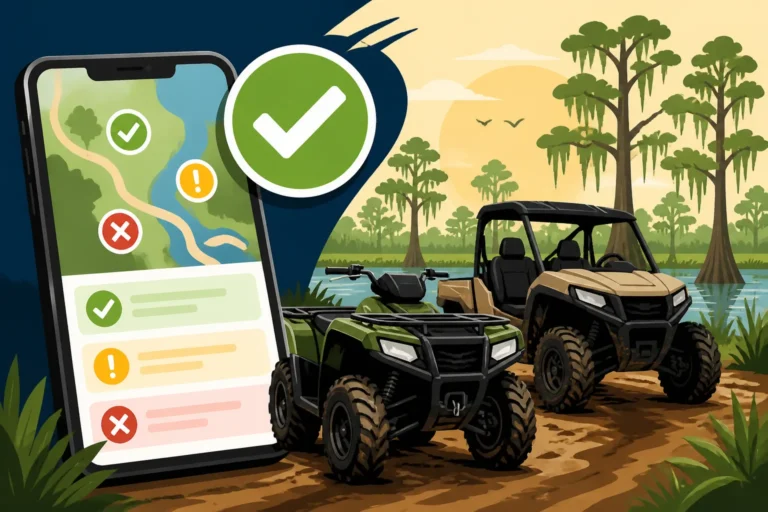
For unfamiliar places, use an offline map or saved route when cell service may be weak. onX Offroad can be one way to keep route information available, but a phone map does not replace posted signs, landowner permission, park rules, or current trail-status checks. Save what you need before leaving coverage and tell someone where you plan to ride. This is especially useful when exploring wooded areas where a wrong turn can add a long walk or complicate a recovery.
Clean and inspect the winch after a muddy ride
Mud and water can hide damage and work into parts of the machine. After a recovery or a muddy day, rinse and clean the winch according to its manufacturer’s instructions. Don’t direct high-pressure water into electrical connections, seals, or sensitive components unless the manufacturer permits it. Let the equipment dry as recommended, then inspect the line, fairlead, hook or connector, mount, and wiring.
If you have synthetic rope, look for cuts, melted or glazed areas, abrasion, and embedded grit. If you have steel cable, check for kinks, broken strands, flattening, and rust. Damaged line should not be put under load; follow the manufacturer’s replacement guidance. Rewind the line neatly and under controlled tension as instructed so it doesn’t bunch or cross badly on the drum. For the machine itself, Washing a Machine After a Mud Weekend covers the broader cleanup that helps keep mud from lingering in hard-to-see places.
Keep your recovery gear together and check it before the next outing. Replace worn straps and damaged connectors rather than hoping they last one more ride. If you use onX Offroad to plan rides, add a recovery check to the same pre-trip routine: confirm the route, weather and access details, then confirm the winch kit is complete and usable. For a longer day out, bring a charged phone, a backup way to communicate, and enough water and basic supplies to wait safely if the machine can’t be moved.
The safest winch recovery is usually the one you prepare for before the tires stop turning. Choose equipment suited to your machine, use a sound anchor and designated recovery points, keep people out of the danger zone, and stop if the setup shifts or the pull becomes unpredictable. If the machine is unstable or the rigging is beyond your experience, don’t force it; get qualified help.
Disclaimer
This article is for general informational purposes only and does not constitute professional advice. Laws, prices and regulations vary by location and change over time. Consult a qualified professional for guidance on your specific situation.