Spark Arrestors at a Forest Gate
A machine that runs well at home can still be turned away at a forest trailhead if its exhaust does not meet the riding area’s rules. On Kisatchie National Forest land, an approved spark arresting device is required year-round. Here’s how to check your ATV or UTV, avoid confusing the arrestor with a muffler, and confirm the trail is open before you tow.
What the Forest Service Requires
The Forest Service requires all OHVs on Kisatchie National Forest lands to have a Forest Service-approved spark arrestor year-round. That applies to ATVs, UTVs, motorcycles and other off-highway vehicles, whether you ride in a hot, dry season or cooler weather.
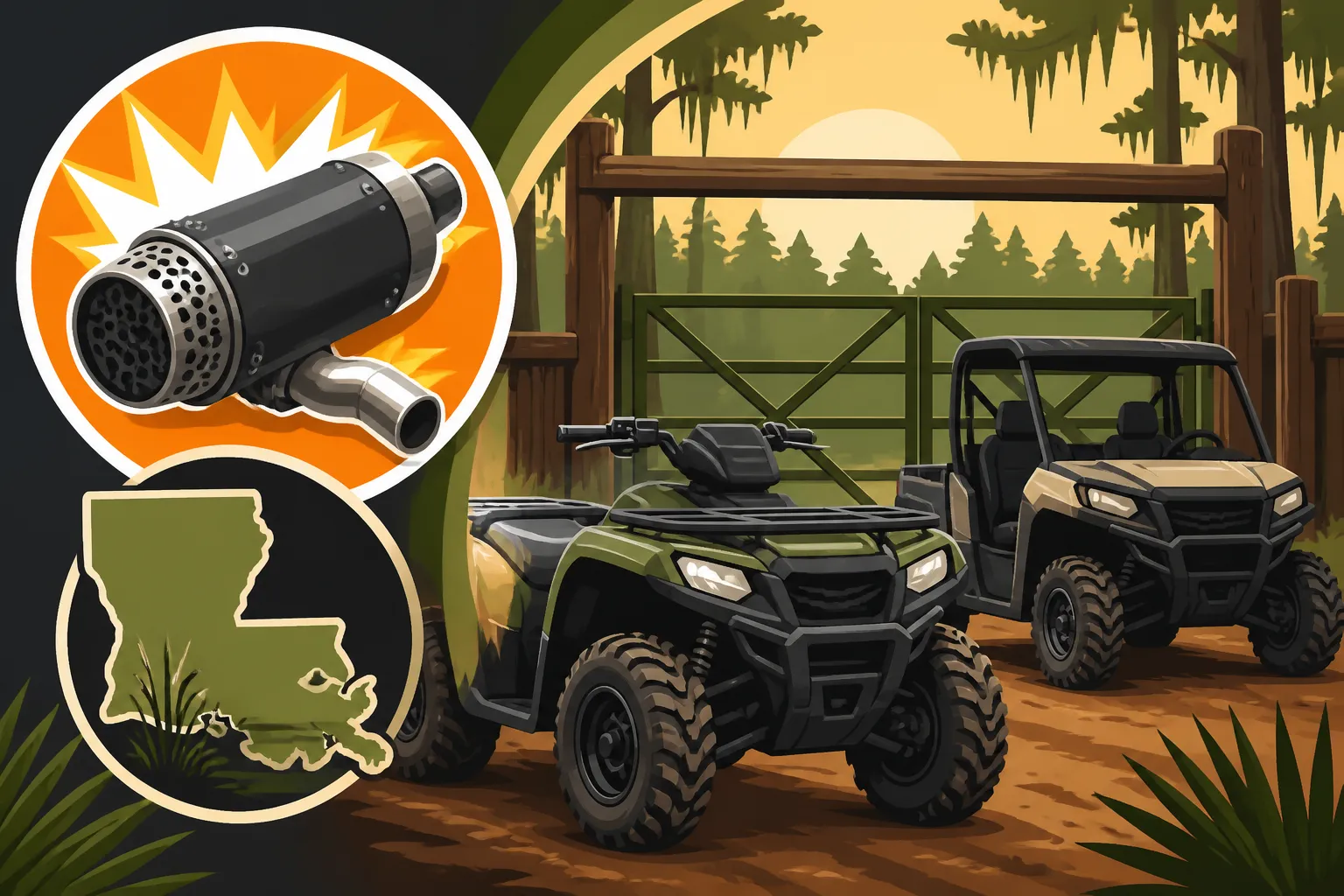
A spark arrestor is part of the exhaust system. Its job is to help keep sparks or hot particles from escaping the exhaust and reaching dry vegetation. It does not make a machine fireproof, and it is not a substitute for careful riding or following any fire restrictions in effect. But it is a specific equipment requirement, not an optional accessory for Kisatchie riding.
The key phrase is Forest Service-approved. An exhaust part that looks like a screen, or a device described as a spark arrestor by a seller, may not necessarily meet the requirement. Check the device’s documentation and its fit for your particular machine. If you cannot establish that the installed device is approved, contact the relevant Forest Service office or confirm the requirement with the trail’s managing district before making the trip.
The Forest Service also requires muffled sound at 99 decibels or less. A spark arrestor and a muffler serve related but different functions: an arrestor helps contain sparks, while the exhaust system also needs to meet the sound limit. A quiet machine does not automatically have an approved spark arrestor, and an approved arrestor does not by itself guarantee that the machine meets the sound rule.
| What to check | What the Forest Service requires | What to do before riding |
|---|---|---|
| Spark arrestor | A Forest Service-approved device is required year-round on Kisatchie National Forest lands. | Verify approval and compatibility using the device documentation or by checking with the Forest Service. |
| Exhaust sound | Sound must be muffled to 99 decibels or less. | Keep the exhaust system in proper condition and confirm the applicable requirement if you have modified it. |
| Vehicle width | OHVs exceeding 50 inches in width are prohibited. | Check the machine’s overall width rather than assuming every trail accepts it. |
| Lights | Headlights and taillights must work and be used during limited visibility. | Test both before you leave home. |
| Registration | Louisiana requires OHV registration, according to the Forest Service. | Confirm your registration is current and bring the required ownership or registration documents. |
These are related checks, but they are not interchangeable. A machine can have the right width and working lights and still be missing an approved spark arrestor. It can have an arrestor and still be too wide for the area. Review the machine and the rules as a set, not as a single gate requirement.
For broader planning, Kisatchie National Forest OHV Trails in Louisiana and Louisiana Forest Trail Status Pages can help you identify where to ride and what to check before departure. Forest access and trail availability are separate from whether your machine meets the equipment rules.
How to Check Your ATV or UTV Before You Go
Start with the exhaust system that is actually installed on the machine. A receipt for an arrestor, a product listing, or a previous owner’s assurance does not prove that the device is still present, correctly fitted or suitable for your model. Look at the installed equipment and compare it with the manufacturer’s information.
Confirm the device is the right kind
Look for documentation that identifies the part as a spark arrestor and indicates that it is Forest Service-approved. Check the manufacturer’s instructions for the machine and exhaust setup. If the device was installed as part of a replacement exhaust, confirm that the relevant arrestor is included in the configuration you have, rather than assuming every exhaust component includes one.
If you are buying a replacement, use the machine’s make, model and exhaust details to check compatibility. A part that fits physically may not have the approval or performance documentation you need. If an online listing is vague, ask the seller or manufacturer for the relevant documentation before relying on it. That applies whether you shop through Amazon or another retailer; a search result or product title alone is not confirmation of Forest Service approval.
Do not treat “spark arrestor ready” or similar wording as proof that the device is already installed. It may mean the exhaust can accept a separate part, or it may describe a product configuration that differs from yours. Check the instructions and inspect the machine.
Inspect condition and fit
Before loading up, make sure the device is seated and secured as its manufacturer specifies. Look for obvious damage, missing parts, loose connections or signs that the exhaust has been altered. If anything appears broken or incomplete, do not assume it will pass a check just because the machine ran normally on a private property ride.
Follow the manufacturer’s guidance for inspection and cleaning. Do not remove an arrestor to make the machine run louder or to change exhaust flow before heading to a forest trail. If you are unsure how to inspect it, a qualified mechanic or the machine’s service documentation can help you identify the installed part and its condition.
A phone photo of the device and its identification or documentation can be useful when you are checking details away from the machine. Keep the original paperwork or a copy accessible, too. The goal is not to create a substitute for the installed equipment; it is to make it easier to answer questions about what is fitted.
Check the rest of the machine
The spark arrestor is only one part of a pre-ride check. The Forest Service prohibits OHVs exceeding 50 inches in width, and it requires headlights and taillights to work and be used during limited visibility. Measure or confirm the machine’s overall width, then test the lights before you tow.
The Forest Service also states that Louisiana requires OHV registration. Check that your registration is current and that the vehicle information matches the machine you plan to take. For help sorting out Louisiana paperwork, see Louisiana ORV Decals and Titles Explained and How to Get a Louisiana ORV Decal.
Those requirements do not turn a forest trail into a public road. Forest OHV access is limited to designated trails, and the Forest Service prohibits year-round cross-country travel by motorized vehicles, including OHVs. If your plan involves riding on a public road or shoulder to reach a trail, check the separate rules before you go. Louisiana Rules for Riding a Parish Road explains why a machine’s trail equipment and its authority to use a road are different questions.
Plan Around Trail Access and Other Rules
A properly equipped machine does not guarantee an open trail. Kisatchie National Forest has four designated multiple-use trail systems that include OHV riding: Claiborne, Sandstone, Livingston and Enduro, according to the Forest Service. Trail status can change, so confirm access close to your trip rather than relying on an old map, a past visit or a saved social post.
The Forest Service says visitors can call the OHV Hotline at any time of day to confirm trail status. Use that option before towing, especially after storms or when your destination has had closures. Checking a Trail Status Page First is also useful when comparing access information before you leave.
Sandstone has a seasonal operating window. The Forest Service says OHVs may use the Sandstone Trail from May 1 through December 31; the trail closes seasonally from January 2 through April. Check the latest Forest Service information before planning around the opening period, since a seasonal window does not override an unexpected closure. See Sandstone Trail Closes to Motors January Through April and Sandstone Trail Opens to OHVs on May 1 for more on that trail’s schedule.
Other operating details matter once you arrive. The Forest Service limits riding in campgrounds to 5 MPH and sets day-use hours as 6:00 a.m. to 8:00 p.m. or daylight to dark. Quiet time in camping areas is 10:00 p.m. to 6:00 a.m. Follow posted instructions and any district-specific notices, even if you have ridden the same area before.
Do not assume that a trail is open simply because it appears on a map. The Forest Service reports that the Claiborne Multiple-Use Trail System is open, while the Enduro Multiple-Use Trail System is closed due to hurricane damage and the Livingston Multiple-Use Trail System is partially open. Those conditions can change; check the OHV Hotline or the Forest Service’s current trail information for the trail you intend to ride.
The forest’s designated trails are not permission to travel wherever the terrain looks passable. The Forest Service prohibits cross-country motorized travel year-round, including by OHVs. Stay on trails that are open to your vehicle type, obey closures and follow signs at the trailhead. For a broader look at places and access options, see Louisiana OHV Trails: Where to Ride.
A Practical Pre-Trip Checklist
A short check before loading can prevent a long drive to a closed or unsuitable trail. Use this sequence when preparing your ATV or UTV:
- Confirm your destination and trail status. Check the Forest Service information or call the OHV Hotline before departure. Confirm that the particular trail—not just the broader forest—is open to OHVs.
- Verify the spark arrestor. Make sure the machine has a Forest Service-approved device installed, and confirm that it is in good condition and fits the exhaust setup.
- Check the rest of the exhaust. The Forest Service requires sound to be muffled to 99 decibels or less. Do not assume the spark arrestor alone proves sound compliance.
- Confirm width and lights. The Forest Service prohibits OHVs wider than 50 inches. Test the headlights and taillights, which must work and be used during limited visibility.
- Check registration and documents. The Forest Service states that Louisiana requires OHV registration. Bring the paperwork you need and make sure it corresponds to the machine you are transporting.
- Review the trail’s additional rules. Check hours, closures, signs and any site-specific notices. An open trail may still have operating limits that affect your plan.
- Do not ride if a required item is missing or uncertain. Resolve questions about approval, installation or compatibility before entering the trail system.
If you find that the arrestor is missing or its status is unclear, the safest practical choice is to delay the ride until you have confirmed or corrected the equipment. Replacing the device at the last minute without checking approval and fit may not solve the problem. Ask the manufacturer, a qualified service shop or the Forest Service for clarification rather than guessing at the gate.
Keep in mind that permits, registration, equipment and access rules address different things. A registration does not establish that a trail is open; an open trail does not waive its equipment rules; and an approved arrestor does not authorize riding outside designated routes. Checking each item separately makes it easier to arrive ready and avoid a trip that cannot go ahead.
Sources
- Louisiana State Legislature — Louisiana Laws – Louisiana State Legislature (checked November 3, 2026)
- USDA Forest Service — Kisatchie National Forest | Off-Highway Vehicles (OHV) | Forest Service (checked November 3, 2026)
- Forest Service — Kisatchie National Forest | Off-Highway Vehicle Trail Status | Forest Service (checked November 3, 2026)
- Forest Service — Kisatchie National Forest | Claiborne Multiple-Use Trails | Forest Service (checked November 3, 2026)
- Forest Service — Kisatchie National Forest | Enduro Trail | Forest Service (checked November 3, 2026)
- Forest Service — Kisatchie National Forest | Hickman Trailhead (Trail) | Forest Service (checked November 3, 2026)
- Forest Service — Kisatchie National Forest | Off-Highway Vehicles (OHV) | Forest Service (checked November 3, 2026)
- Forest Service — Kisatchie National Forest | Off-Highway Vehicles (OHV) | Forest Service (checked November 3, 2026)
Disclaimer
This article is for general informational purposes only and does not constitute professional advice. Laws, prices and regulations vary by location and change over time. Consult a qualified professional for guidance on your specific situation.