Louisiana WMA Tire Size Limits
Louisiana WMA trails have tire limits that can catch riders out, especially if a quad has oversized mud tires or a UTV has been modified. Knowing the size, tread and pressure rules before you tow helps avoid a wasted trip. Here’s how to read tire markings, check your setup and confirm that the trail you plan to ride is open to your machine.
Louisiana WMA tire limits at a glance
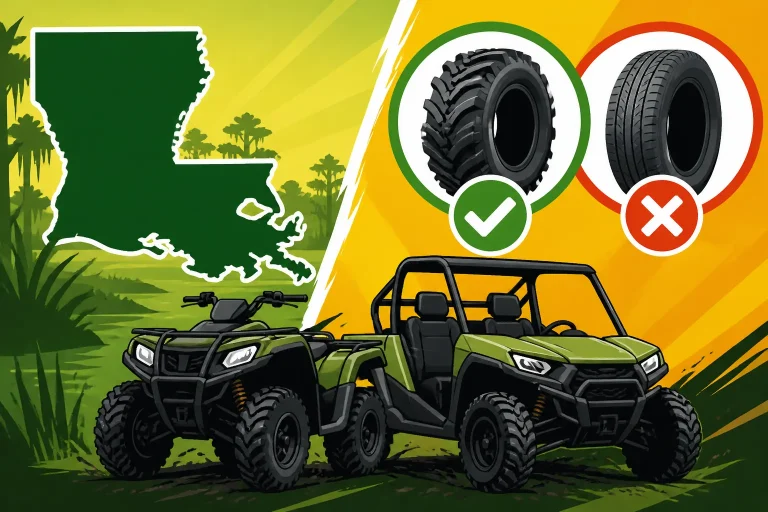
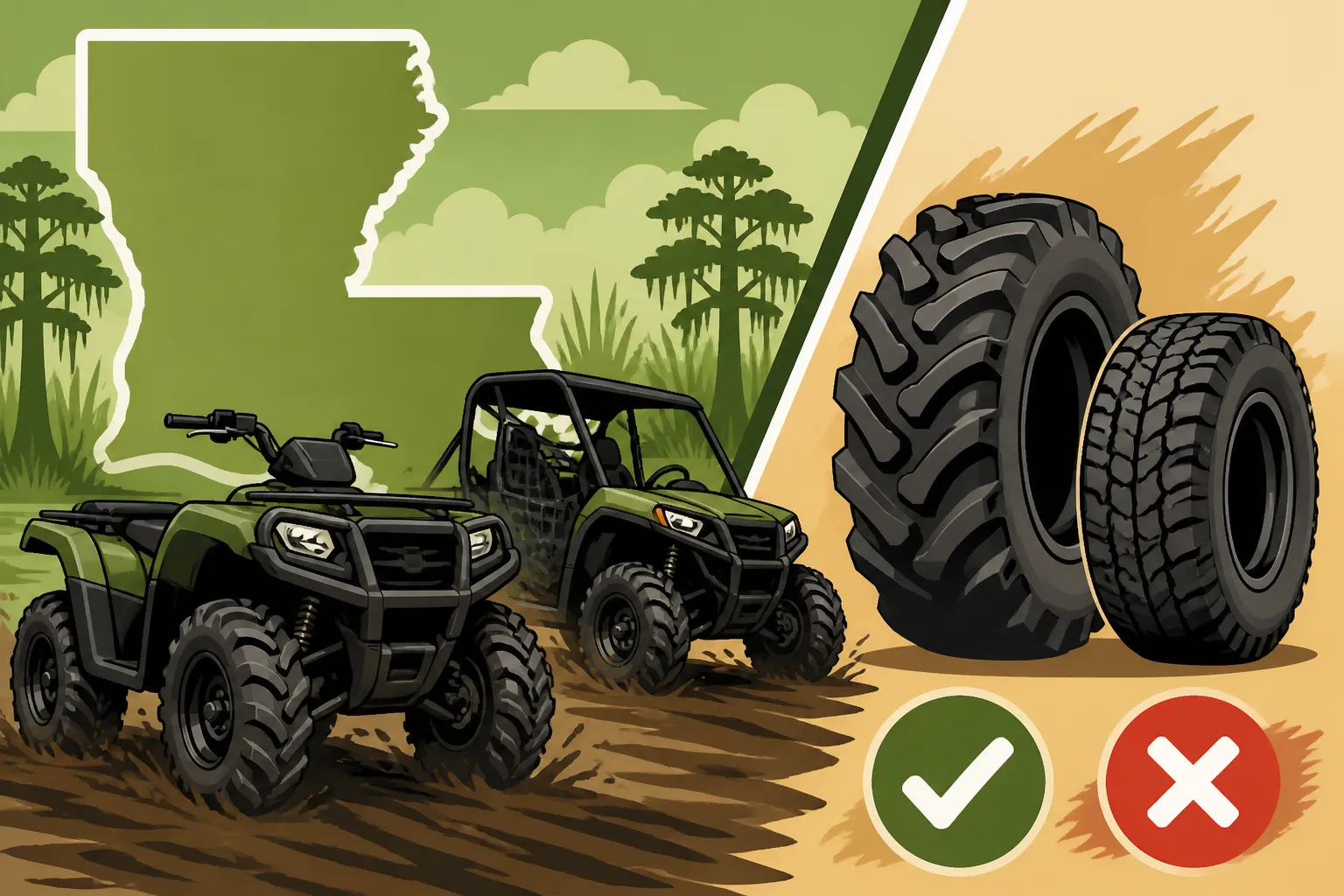
For riding on Louisiana Wildlife Management Area trails, the listed tire limits include a maximum tire size of 26 by 12 inches, a maximum lug height of 1 inch and tire pressure no higher than 12 pounds per square inch. Farm-tread tires are also prohibited. These are separate checks: a tire can meet the size limit but still fail the tread or pressure rule.
| Tire or trail check | WMA limit or requirement | What to verify |
|---|---|---|
| Tire dimensions | No larger than 26 by 12 inches | The tire’s outside diameter and width, not the wheel rim diameter |
| Lug height | No more than 1 inch | How far the tread lugs extend from the tire surface |
| Tire pressure | No more than 12 PSI | Pressure in each tire before riding |
| Farm tread | Not allowed | Whether the tread is an agricultural or prohibited farm-tread pattern |
| Trail access | Use marked, permitted routes | The current WMA map and posted trail signs |
Treat these as separate conditions, not a single size test. For example, a tire marked 26×12 may meet the nominal size ceiling, but you still need to check lug height, pressure and tread type. A tire that seems close to the limit is not automatically acceptable just because it fits beneath the fender.
Also confirm that your machine is eligible for the specific area and trail. WMAs can have restrictions beyond tires, including vehicle weight, permitted routes, closures and hours. The broader Louisiana WMA Riding Rules for Quads and Louisiana WMA Riding Rules for UTVs help explain those separate requirements.
A practical rule is to check the machine as it will arrive at the trailhead. Tire changes, added equipment and different pressures can affect whether the setup meets the rules. If you have altered the machine since your last visit, check it again rather than relying on memory.
How to read tire size markings
Tire size markings can be confusing because they describe more than one measurement. Off-road tires commonly show three numbers in a format such as 26×10-12. In that example, the first number generally indicates the tire’s nominal outside diameter, the second its nominal width, and the last the wheel rim diameter. The rim measurement is not the tire’s overall diameter.
The WMA limit is commonly summarized as 26 by 12 inches. Use the manufacturer’s tire specifications to check the first two dimensions. Do not treat the last number in the marking as a tire-size limit: it identifies the wheel the tire fits.
Check all four tires
A quad may have different tire sizes front and rear. Read each tire marking and compare both dimensions with the applicable limit. Do not assume that matching tires came with the machine or that front tires are automatically within the rules.
UTVs also need a tire-by-tire check. Their size, width and tread may differ from an ATV setup, and the machine must also satisfy any separate UTV restrictions for the area. For details beyond tires, see Louisiana WMA Weight Limits Explained.
Nominal size is not the whole story
The numbers molded onto a tire are useful, but an actual tire’s dimensions can vary by manufacturer, model and the wheel it is mounted on. If the tire is close to the maximum, look up the manufacturer’s specifications for that exact tire rather than guessing from its appearance.
A tire can also be modified or replaced with a larger model while still looking similar to the original. If the marking is worn, obscured or missing, identify the tire before relying on an estimate. Keep the manufacturer’s product information available if you need to explain the tire’s specifications at a check.
Do not confuse a wheel-size marking with the allowed tire diameter. A 12-inch rim, for instance, does not mean the complete tire is 12 inches tall. The outside diameter is much larger and is represented by a different part of the tire marking.
Lug height, pressure and tread type
The size limit is only one part of the inspection. WMA tire rules also address tread, lug height and inflation pressure. These matter because two tires with similar outer dimensions can have very different tread patterns and profiles.
Lug height
The listed maximum lug height is 1 inch. Lug height refers to how far the tread blocks project from the tire’s underlying surface. It is not the tire’s overall height, nor is it the distance from the ground to the top of the tire.
Inspect the tallest lugs, not just the center of the tread. Mud tires often have pronounced blocks that extend farther than ordinary trail tires. If you are unsure how to assess a tire near the limit, use the applicable official guidance or ask the managing office before hauling the machine to the WMA.
Avoid assuming that a tire is compliant because it is sold as an ATV tire or marketed for trail use. Product descriptions are not a substitute for measuring or checking the tire specifications against the area’s rules.
Pressure
The listed pressure ceiling is 12 PSI. Check every tire before riding and do not assume that a tire’s appearance tells you its pressure. A low-pressure gauge designed for off-road tires is easier to use accurately than relying on a high-range vehicle gauge.
A basic low-pressure tire gauge from an auto-parts store or Amazon can be useful to keep with your riding gear. Follow the gauge instructions, check each tire consistently and make sure the reading is in PSI. If you adjust pressure, recheck it after inflation or deflation rather than estimating by feel.
Pressure changes as tires warm and as conditions change. The safest approach is to check the setup before riding and follow current WMA instructions about the applicable measurement. Do not deliberately start above the stated maximum on the assumption that pressure will fall later.
Tire pressure also affects handling and the chance of tire damage. The WMA limit is a compliance ceiling, not a recommendation to inflate every tire to exactly that figure. Follow the tire and machine manufacturer’s guidance while staying within the land manager’s requirements.
Farm tread
Farm-tread tires are prohibited on WMA trails. This restriction is distinct from the lug-height limit: a tire can have lugs that appear short enough and still have a prohibited farm-tread design.
If a machine is used for agricultural work, do not assume its farm tires are acceptable for recreation on a WMA. Check the tread design against the rule and use a compliant tire setup for the public-land ride. If the tire’s classification is unclear, ask the appropriate WMA or agency contact before traveling.
The broader Louisiana WMA Tire Rules Explained can help with the relationship between tire dimensions, tread, lug height and pressure. These details are worth checking together, especially when a machine has been set up primarily for farm use or deep mud.
Check the whole machine and the trail before unloading
A compliant set of tires does not by itself authorize riding anywhere on a WMA. Access can depend on the particular management area, trail designation, vehicle type, machine weight, season and other posted conditions. Plan the trip around the rules for the place you are visiting, not a general assumption that all WMA routes have the same access.
Confirm the trail is open to your machine
Use the current area map and obey signs at the trailhead. A road or path that looks rideable is not necessarily open to ATVs or UTVs. Public-land riding may be limited to designated trails, and off-trail travel can be prohibited even when the machine itself meets every equipment limit.
Review Louisiana WMA Designated Trails Only and Louisiana WMA Off-Trail Bans before setting out. If the route is not clearly shown as open to your type of machine, do not treat it as an authorized trail. Check with the managing agency when a map, sign and online status information seem to conflict.
Check seasonal closures and other limits
Trail availability can change with seasons, habitat management, weather or local conditions. A route that was open on a previous visit may be closed now. Review current closure notices and trailhead postings before unloading. Louisiana WMA Season Closures explains why a WMA ride may be restricted during part of the year.
Tire compliance is only one layer of preparation. The machine may also need to meet weight or width restrictions, and some areas have specific rules about night riding, permits or access. Check the full set of requirements for the exact WMA and vehicle. Do not assume that a quad’s rules automatically apply to a UTV.
Handle permits as a separate requirement
A tire-compliant machine can still be turned away if the rider has not met the applicable access or permit requirements. Check whether the area requires a permit, where it is obtained and how to complete any self-clearing process before riding. See [Louisiana Self-Clearing Permit Steps] for more on that process.
Keep any required permit or proof with you as instructed, and do not rely solely on a permit to prove that your vehicle and tires qualify. Permit compliance and equipment compliance are different checks.
For an organized pre-trip process, Reading a WMA Map Before You Unload can help you confirm that the route is open and avoid mistaking an unmarked road for an authorized trail.
A practical tire-check routine
Use a repeatable check before each WMA outing, particularly after changing tires, lending the machine to someone or using it for farm work. A few minutes in the driveway can prevent a long tow to a trailhead where the setup does not qualify.
- Identify the WMA and intended route. Check the current map, posted notices and rules for that area. Confirm that your machine type is allowed on the route.
- Read the markings on every tire. Check front and rear tires individually. Record the nominal diameter and width, and identify the manufacturer and model if a tire is near the size ceiling.
- Check the actual tire specifications. Use manufacturer information for tires with worn markings or dimensions close to the limit. Do not mistake the rim diameter for overall tire diameter.
- Inspect the tread. Look for farm-tread patterns and assess the tallest lugs against the 1-inch maximum. If the classification or measurement is uncertain, get clarification before going.
- Measure pressure in each tire. Use a suitable low-pressure gauge and stay at or below the 12 PSI limit. Recheck after making an adjustment.
- Review other machine restrictions. Confirm weight, width or other applicable limits for your ATV or UTV. Do not assume tire compliance means the vehicle meets every requirement.
- Check permits and access conditions. Complete any required permit steps, then check for seasonal closures, designated-trail rules and posted restrictions.
- Recheck at the trailhead. Read the signs and compare them with your plan. If a notice changes access or the machine’s eligibility, follow the current posting.
This routine is particularly important when someone has installed aftermarket tires. A tire may fit the machine, perform well in mud and still exceed a public-land limit. Fitment and performance are not the same as WMA compliance.
For a close call, do not rely on a seller’s description, a forum comment or another rider’s setup. Confirm the exact tire and the current area rule through reliable official information. When the rule or measurement is unclear, postponing the ride is safer than arriving and hoping the setup will be accepted.
Common mistakes and how to avoid them
Looking only at the tire diameter
Riders sometimes focus on the first number in a size marking and overlook width. The listed limit includes both dimensions, so check both rather than deciding based on overall height alone.
Treating the rim size as the tire size
The final number in common tire markings refers to the wheel diameter. It does not tell you the tire’s outside diameter. Read the full marking and confirm what each number means.
Checking only one axle
Some quads use different sizes at the front and rear. Inspect every tire, including a spare if you plan to carry one for use on the WMA. A compliant front set does not make an oversized rear set compliant.
Assuming a mud tire is allowed because it is common
A tire designed for mud may have tall lugs or a prohibited tread pattern. Popularity and off-road performance do not establish whether it meets WMA rules. Check lug height and tread type independently.
Guessing pressure by squeezing the tire
Visual inspection and hand pressure are not accurate substitutes for a gauge. Use a gauge that reads low pressures clearly, and check each tire rather than relying on one reading as representative.
Assuming last trip’s rules still apply
Management-area access can change. A previous visit, an old map or another rider’s recent comment may not reflect current conditions. Verify the rules and closures for the specific area before each trip.
Assuming a compliant tire setup opens every route
Vehicle eligibility and route access are separate questions. Even a quad within all tire limits must stay on authorized routes and meet other applicable conditions. Review Louisiana WMA Riding Rules for Quads or Louisiana WMA Riding Rules for UTVs as appropriate, then confirm the trail itself is open.
Frequently Asked Questions
What is the maximum tire size for a Louisiana WMA trail?
The listed maximum is 26 by 12 inches. Check both the tire’s nominal diameter and width, and verify the current requirements for the specific WMA.
Does the limit apply to every tire on a quad?
Check every tire, including different front and rear sizes. Do not assume that only the largest tire or one axle is subject to the limit.
What is the maximum lug height?
The listed maximum lug height is 1 inch. Farm-tread tires are prohibited separately, so meeting the lug-height limit does not automatically make a farm-tread tire acceptable.
Can I ride with tire pressure above 12 PSI?
The listed ceiling is 12 PSI. Check all tires before riding and follow current area instructions. A pressure reading that exceeds the limit may make the setup noncompliant.
If my tires meet the limits, can I ride any WMA road?
No. You must also follow the applicable permit, designated-trail, vehicle and closure rules. Confirm that the exact route is open to your type of machine before unloading.
Disclaimer
This article is for general informational purposes only and does not constitute professional advice. Laws, prices and regulations vary by location and change over time. Consult a qualified professional for guidance on your specific situation.