Louisiana Parks That Open Only for Events
Event-only ATV parks can be easy to mistake for ordinary ride-anytime destinations. You see a familiar park name, load the machines, and then discover the next public event is weeks away. This guide explains how to plan around Louisiana’s event-based riding areas, check what access actually includes, and avoid towing to a closed gate.
What an event-only riding park means
Event dates are not the same as regular opening hours
An event-based park may welcome riders during scheduled weekends or organized gatherings without operating as a conventional, open-every-day trail system. Between events, the property may be closed to recreational riding, even if trails, campsites, or other facilities are visible from an access road. A listing that says a park is open “for events” should not be read as permission to show up whenever the weather looks good.
That distinction matters because event access can depend on more than the calendar. The organizer may require advance registration, a specific admission process, or compliance with rules that apply only during that gathering. Some weekends may be designed around riding; others may include music, camping, competitions, or family activities. Before planning around any one feature, check the details for that exact event.
For an overview of the area, see [Louisiana Private Mud Parks Compared]. It helps to distinguish a private, event-oriented venue from a public trail system where access is managed through separate land or agency rules.
Why a park may open only for scheduled events
Private riding areas have to manage land, trails, parking, sanitation, staffing, security, and environmental wear. Opening for a limited number of organized weekends can give the operator a more controlled way to handle those demands. It can also concentrate maintenance and visitor services around dates when staff and facilities are available.
For riders, the tradeoff is straightforward: an event weekend can feel lively and well organized, but it offers less flexibility than a public trail you can visit on a spontaneous Saturday. A group coming from Baton Rouge or New Orleans may need to coordinate time off, a rental, a trailer, and overnight plans around a narrow date window. If one person assumes the park is open every weekend while another checks the event schedule, the mismatch can turn into a long, frustrating drive.
Event-based access also changes what “open” means. A park may have a date on its calendar while some activities or facilities remain limited, require separate arrangements, or depend on conditions. Confirm the event’s riding access, not simply whether the event itself is happening.
Event parks and public trails are different kinds of destinations
Louisiana has public-land riding opportunities as well as private parks. Those options should not be treated as interchangeable. Public routes may have designated riding areas, permits, seasonal restrictions, or machine requirements. A private park may instead set its own event dates, admission process, safety rules, and camping arrangements.
For example, riders researching [Louisiana ATV Trails: Where to Ride] may find routes that follow a different access model from a private park’s event weekend. Public-land access is not automatically available just because a nearby private venue is closed, and a private event ticket does not grant access to surrounding public or private property.
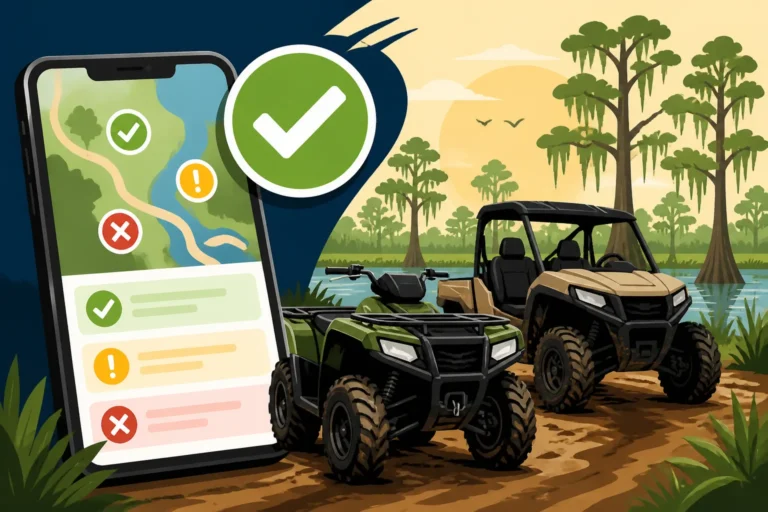
A useful planning habit is to identify the land manager before you leave home. Ask whether the destination is a private park, a public forest trail, a wildlife management area, or a combination of nearby properties. Then check the rules for that specific place. An app such as onX Offroad can help you understand your route and nearby mapped features, but a map line is not permission to ride on land that is closed or privately owned.
Louisiana parks and event-based riding
Muddy Bottoms near Sarepta
Muddy Bottoms ATV Park is a well-known private riding destination in the Sarepta area of Webster Parish. It is often discussed in connection with organized event weekends rather than as a place to assume you can ride on any date. If you are considering a trip, treat the scheduled event information as essential trip-planning material, not as a nice-to-have detail.
The park’s event format can make it a good fit for riders who want a planned gathering, a shared campground atmosphere, or a weekend where several friends can make the trip together. It may be a less convenient choice for someone who simply wants to arrive for a few hours without checking dates, admission arrangements, or available facilities. Read [Muddy Bottoms ATV Park in Louisiana] and [Muddy Bottoms' Event Calendar in Louisiana] as starting points, then confirm the details for the weekend you have in mind.
Do not assume every event offers the same combination of riding, camping, amenities, or access to particular areas. A family planning to bring children and stay overnight has different questions from a group of experienced riders driving up for a day. Check the event-specific information directly and ask about anything that affects your group, including machine access, passenger rules, camping availability, and arrival procedures.
Louisiana Mudfest and other scheduled gatherings
Louisiana Mudfest is another name riders may encounter when looking for organized off-road gatherings. Like any event-centered destination, its schedule and arrangements should be checked for the particular weekend you want to attend. A past event date, social post, or old trip report is not a reliable substitute for current event information.
The word “mudfest” can also set expectations that do not match every rider’s needs. Some visitors are looking for deep mud and a high-energy crowd; others want easier riding, a quiet overnight stay, or a suitable first outing for a newer rider. Before committing, determine what the event is built around and whether the available riding, camping, and facilities suit your group. [Louisiana Mudfest and Event Weekends] can help you frame the questions to ask.
Across the state, event-based private parks can differ in how they handle admission, registration, camping, and activities. Avoid assuming that a policy you encountered at one park applies at another. For broader context, [Louisiana Private Mud Parks Compared] can help you think through the differences without treating the venues as identical.
A quick comparison of event-based and public riding options
The right choice depends on whether you value a scheduled group atmosphere or more flexible access. This comparison is a planning guide, not a guarantee of any individual venue’s arrangements.
| Planning question | Event-based private park | Public trail or riding area |
|---|---|---|
| When can you ride? | On dates and under arrangements set for the event | During permitted access periods and subject to land rules |
| Who controls access? | The private operator or event organizer | The relevant public land manager |
| What should you check first? | Event date, registration, admission, riding access, and facilities | Closures, permits, maps, machine rules, and trail status |
| Is spontaneous arrival a safe assumption? | No; confirm that the park is open to riders that day | No; verify access and conditions before traveling |
| What can change the plan? | Event cancellation, capacity, or event-specific restrictions | Weather, seasonal closures, land rules, or trail conditions |
How to verify an event before you tow
Confirm the date and the kind of access being offered
Start with the organizer’s own event information. Confirm the exact dates and ask whether riding is included for the day you plan to arrive. A festival or gathering can be taking place without every visitor activity being available to every attendee. If the event has multiple ticket or registration options, make sure you understand what each one covers before you pay or depart.
Next, check whether you need to register in advance, reserve a site, or follow a designated arrival process. A group that rolls in with several machines may face different practical considerations from a solo rider. If you need a particular setup, such as a quiet camping area or room for a large trailer, ask early rather than assuming it can be arranged at the gate.
Keep a record of the event details you relied on. A saved confirmation, message, or screenshot can be useful if you need to double-check an arrival instruction when cell service is poor. It is also worth verifying the information again shortly before departure, especially if your trip depends on weather or on a long drive from elsewhere in Louisiana.
Ask specific questions about facilities and riding conditions
“Is the park open?” is only the first question. Ask what areas are available to ride, whether access is limited to certain routes, and whether machines such as ATVs and side-by-sides are both permitted for that event. If your group includes children, passengers, or first-time riders, ask about age, helmet, supervision, and passenger rules before you travel.
Facilities deserve the same attention. Find out what camping arrangements are actually available for your dates and whether you need to reserve them. If your plan depends on water, showers, electrical hookups, fuel nearby, or a wash area, confirm those details instead of relying on an old review. The existence of a facility on a property does not mean it will be open or included during every gathering.
Ask how the organizer communicates changes. A heavy rain can affect trails even when the event continues, and an event schedule may be adjusted for operational reasons. Check [Louisiana Trail Conditions After Rain] for broader preparation ideas, but use the venue’s own updates for the specific property and event.
Use maps as a planning aid, not an access guarantee
Before leaving, map the full route from your home to the event entrance, including the final approach. Rural roads around places such as Sarepta may involve limited services, and a towing vehicle has different needs from a car. Identify fuel and food stops before you reach the last stretch, and avoid assuming that a map’s shortest route is suitable for a truck pulling a loaded trailer.
A tool such as onX Offroad can help you review terrain and organize offline navigation when coverage is weak. Still, mapped trails or property boundaries do not establish that an area is open to the public, authorized for riding, or included in an event. Use the official event information to confirm where you are allowed to go, and follow posted signs and directions on site.
If a route crosses land you do not recognize, stop and check rather than treating a visible track as an invitation. This is especially important when a private park sits near timberland, a public forest, a wildlife management area, or another parcel with its own rules. For general preparation, [Checking Dates Before You Tow] and [Louisiana Trail Closures and Seasons] are useful reminders to verify both the calendar and the destination.
Planning the trip around a limited event window
Build a simple timeline for your group
Begin by choosing the event date, then work backward. Confirm the park’s access terms first, arrange any required registration or camping, and make sure every rider understands the rules. Only after those details are settled should you coordinate transport, lodging, food, and time off. That order prevents a common problem: booking everything around a weekend that does not actually provide the riding access your group expected.
A group from Shreveport may be close enough to make a shorter trip, while riders coming from Lafayette or New Orleans may need to plan an overnight stay. Either way, agree on a meeting point and a departure time that accounts for trailer loading and roadside stops. If different households are hauling separate machines, exchange emergency contacts and make sure everyone has the venue’s entrance information saved.
Do a machine check before event week. Inspect tires, brakes, lights, fluids, tie-down points, and any recovery equipment you expect to use. Mud and standing water can make a minor maintenance issue much harder to handle, especially when you are far from a repair shop. Pack a basic tool kit and the machine’s paperwork, and avoid relying on another rider to bring every shared item.
Prepare for camping, weather, and the ride home
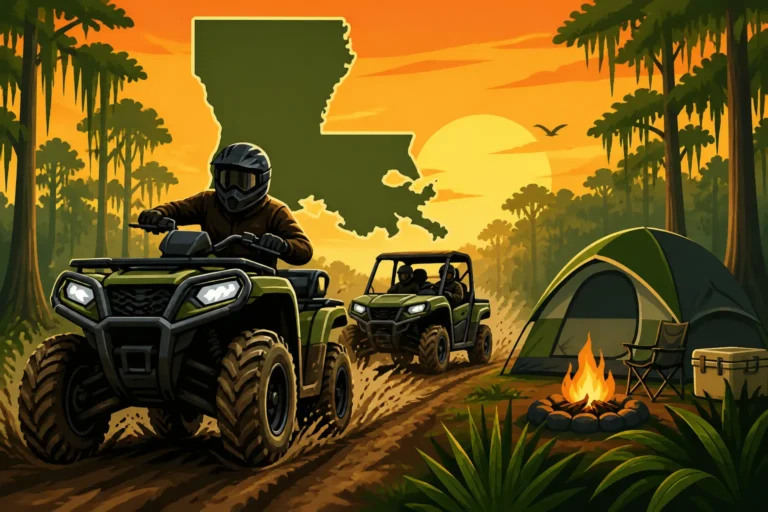
Event weekends can mean long days outside, wet gear, dust, mud, and crowded staging areas. Pack changes of clothes in sealed bags, drinking water, sun protection, insect repellent, and a way to keep phones or navigation devices charged. If you are camping, verify what the site provides and bring backup supplies for anything important. Do not assume that an event property has the same services as a full-service campground.
Think about the trip home before the first ride. Mud can add weight to a machine and make loading unpleasant, so bring straps that are in good condition and plan how you will secure wet or dirty equipment. If possible, carry cleaning supplies that will not create a mess at your campsite or on the road. Check your trailer lights and hitch connections again after loading, particularly if the machine has been through water or mud.
A park weekend is more enjoyable when the group agrees on a sensible pace and a meeting point in case riders become separated. Share the day’s plan, carry identification and essential contact information, and make sure everyone knows where to report an issue. For more on hauling preparation, see [Trailering to a Mud Park].
Keep a backup plan that does not depend on trespassing
If an event is full, cancelled, or unsuitable for your group, do not assume you can ride a nearby road, timber track, field, or trail instead. A closed private venue remains closed, and an unofficial route may cross property where you do not have permission. Having a backup destination is useful only if that alternative is genuinely open to your machine and your group on the date you plan to visit.
A good backup plan can be another confirmed event, a permitted public riding area, or a non-riding activity nearby. If you are considering public land, check its specific access rules separately; do not carry over the private park’s rules or assume the same machine types are allowed. onX Offroad may help you orient yourself and keep your route organized, but verify access with the land manager or official venue before unloading.
If a trip depends on one event weekend, build a little flexibility into lodging and travel arrangements where possible. Keep an eye on event communications, know what cancellation terms apply to your bookings, and agree in advance on what the group will do if trail conditions change. The goal is not to overcomplicate a fun weekend; it is to prevent a closed gate or muddy, unavailable route from becoming an expensive surprise.
Common planning mistakes to avoid
Treating old posts as confirmation
A search result, social media post, or friend’s memory can be a helpful lead, but it may describe a past event rather than the one you intend to attend. Dates, access arrangements, facilities, and rules can vary from one gathering to the next. Verify the specific weekend with the organizer and make sure the information refers to riding access, not simply an event taking place on the property.
This is particularly important when you find a park name mentioned in a travel forum or older ride report. Someone may have visited during a major event and described an experience that is not available during a quieter weekend. Ask for the event’s official details rather than relying on a comment that does not say when it was posted.
Assuming every part of a venue is open
Even when a park is hosting an event, all trails or facilities may not be available. Weather, maintenance, crowd management, and event programming can affect access. Follow staff instructions and posted closures, and do not enter areas that are not designated for your group.
If a favorite route is unavailable, do not try to reach it from an adjacent property or an unmarked track. Private boundaries can be difficult to recognize on the ground, and a GPS line may not reflect current permission. Use the open areas identified by the organizer and ask before exploring beyond them.
Arriving without checking rules that affect your machine
A rider may focus on admission and forget to ask whether the machine is allowed, whether passengers are permitted, or what equipment the park expects. That can create a problem at check-in, particularly when a group has driven a long distance. Confirm machine eligibility and rider requirements in advance, and make sure every person in the group understands the event’s rules.
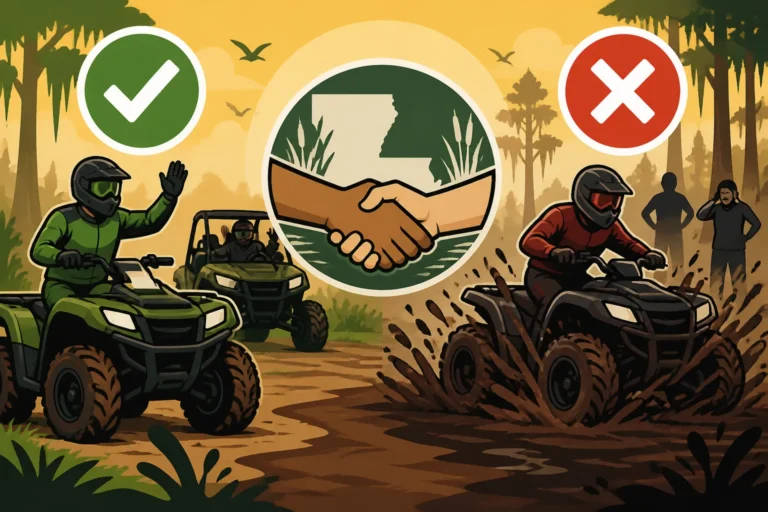
It also helps to review [Louisiana Trail Etiquette Locals Expect] before a crowded weekend. Being patient in staging areas, yielding appropriately, respecting posted limits, and keeping noise under control can make the experience better for other riders and the people who live nearby.
A little advance checking goes a long way with Louisiana’s event-based riding parks. Confirm the exact date, the riding access, the facilities, and the rules; then plan your route and backup accordingly. That way, you can spend the weekend riding instead of trying to figure out whether the gate was ever meant to be open.
Disclaimer
This article is for general informational purposes only and does not constitute professional advice. Laws, prices and regulations vary by location and change over time. Consult a qualified professional for guidance on your specific situation.