Louisiana Rules for Riding in Baton Rouge
Trying to figure out where you can legally ride your ATV or UTV in a bustling city like Baton Rouge can feel like navigating a maze blindfolded. You've got your machine, you love to ride, but you're constantly worried about whether you're breaking the law by simply taking it down the street to a friend's house or even just across town. This guide is here to clear up that confusion, lay out the facts about off-road vehicle use within Baton Rouge and East Baton Rouge Parish, and help you understand exactly what the rules are so you can ride responsibly and avoid costly mistakes.
The Statewide Rules Governing ATVs and UTVs in Louisiana
Before we dive into the specifics of Baton Rouge, it's really important to understand the bigger picture: the statewide laws that govern ATVs and UTVs in Louisiana. These laws provide the foundation, but they often leave a lot of room for local jurisdictions – like parishes and municipalities – to add their own layers of regulation. This is where a lot of the confusion comes in, because what's allowed in a rural parish might be strictly forbidden in a city like Baton Rouge.
Why City Rules Are Different and Often Stricter
Think about it: the state writes laws that apply to everyone, from the swamps of South Louisiana to the pine forests up north. These laws have to be broad enough to cover a wide range of situations. However, a major urban center like Baton Rouge has very different concerns than a small, unincorporated community. Cities have higher traffic density, more pedestrians, stricter noise ordinances, and a greater need for public safety management. Because of these factors, cities almost always impose stricter rules on off-road vehicles. They're trying to keep the streets safe for everyone, manage traffic flow, and prevent disturbances in residential areas. So, while you might find a parish elsewhere that has designated roads for UTVs, don't assume the same applies to the capital city.
Key State Statutes for Off-Road Machines
Louisiana does have specific statutes regarding the operation of ATVs and UTVs. For ATVs, you'll want to look at things like [Louisiana ATV Road Rules Under 32:299]. These state rules generally prohibit ATVs from public roads and highways, with very limited exceptions. Similarly, UTVs have their own set of regulations, often found under statutes like [Louisiana UTV Road Rules Under 32:299.3]. While UTVs might have slightly more flexibility in some parishes if those parishes have explicitly designated roads for them, the underlying principle is still that these are primarily off-road machines.
These state laws often outline things like minimum age requirements for drivers, the necessity of a valid driver's license (like a [Louisiana Requires a Class E License] for road-legal UTVs where permitted), and basic equipment requirements. However, it's crucial to remember that these state statutes don't automatically grant you permission to ride on city streets. They simply set the overarching framework within which local authorities can then create more specific, and usually more restrictive, ordinances. Always view the state law as the baseline, and then assume your city or parish will add more rules on top of it.
Specific Challenges and Regulations for Riding in Baton Rouge
Now, let's talk about the heart of the matter: what does all this mean for riding your ATV or UTV within the limits of Baton Rouge, which falls within East Baton Rouge Parish? This is where the rubber meets the road, or more accurately, where your off-road tires meet a very complex set of local regulations.
What Parishes Can and Cannot Do
Louisiana law allows parishes the ability to designate certain public roads or shoulders for ATV or UTV use, provided they meet specific criteria and are appropriately signed. This is covered by statutes like [Louisiana Parishes Must Designate and Sign Roads]. The catch, especially in urban areas, is that most parishes, and particularly their larger municipalities, choose not to designate roads for these vehicles. The criteria often involve things like lower speed limits, less traffic, and roads that aren't part of the state highway system. In a densely populated area like Baton Rouge, finding roads that meet these criteria and that the parish council would agree to designate is exceedingly rare.
The parish can also enact ordinances that prohibit the use of off-road vehicles on public property, including streets, sidewalks, and parks. This is their prerogative to ensure public safety and maintain order. For a city as large and traffic-heavy as Baton Rouge, the default position is usually one of prohibition rather than permission when it comes to riding ATVs and UTVs on public streets.
Baton Rouge's Stance on Off-Road Vehicles
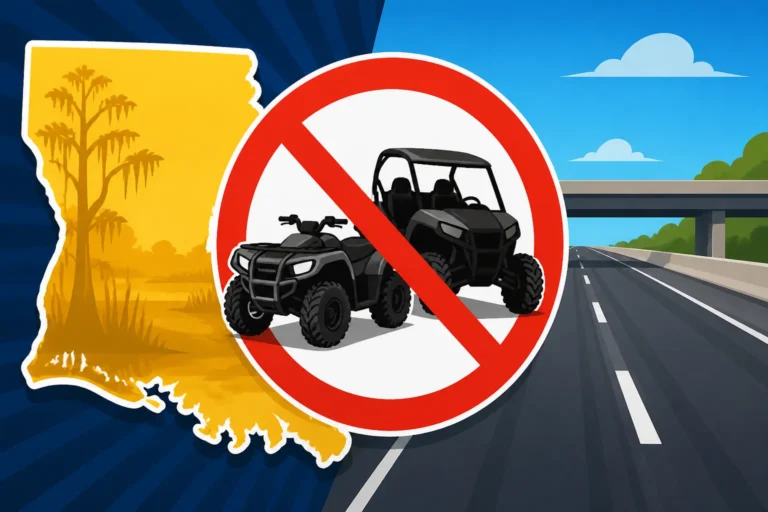
From a practical standpoint, Baton Rouge (and by extension, most of East Baton Rouge Parish's incorporated areas) does not permit ATVs or UTVs on public streets, roads, or highways. The city council and parish government generally interpret the state's framework as one that restricts, rather than promotes, the use of these vehicles in urban environments. This means that if you're thinking of taking your quad for a spin down Nicholson Drive, through downtown, or even just across a residential street, you're likely going to be in violation of a local ordinance.
To confirm the most up-to-date information, it's always best to directly consult official sources. You can look into [Louisiana Parish Ordinance Lookups] or [Louisiana Municipal Ordinance Lookups] for Baton Rouge specifically. These resources can help you find the exact text of local laws. However, based on the general approach of major Louisiana cities, you should anticipate strict limitations. The city's primary concern is the safety of drivers, passengers, and pedestrians, as well as the flow of traffic, none of which are typically enhanced by the presence of off-road vehicles on paved public thoroughfares.
The Reality of Riding an ATV or UTV on Baton Rouge Streets
Let's be realistic: if you're caught riding an ATV or UTV on a public street in Baton Rouge, you're almost certainly going to face consequences. Law enforcement, whether it's the Baton Rouge Police Department or the East Baton Rouge Parish Sheriff's Office, will enforce these ordinances. This isn't just about getting a verbal warning; it can lead to significant penalties. We're talking about [Louisiana Penalties for Illegal Road Riding], which can include hefty fines, court costs, and potentially even the impoundment of your machine.
Imagine getting pulled over on Florida Boulevard. Not only would you be issued a citation, but if your machine is deemed illegal for street use, it could be towed. Getting an impounded machine back is a process that involves more fees, paperwork, and considerable frustration. It's a situation that every ATV and UTV owner wants to avoid, and the easiest way to do that in Baton Rouge is to keep your machine off public roads entirely. The only exceptions are typically for official law enforcement, emergency services, or very specific, pre-approved events, none of which apply to the average recreational rider.
Exceptions and Designated Riding Areas Near Baton Rouge
While the news for street riding in Baton Rouge might be bleak, that doesn't mean you can't enjoy your ATV or UTV. The key is understanding the legitimate exceptions and, more importantly, finding appropriate and legal places to ride.
Limited Road Use for Farm or Emergency Operations
State law does carve out very narrow exceptions for off-road vehicle use on public roads, primarily for agricultural purposes or during emergencies. For instance, farmers might be allowed to cross a public road or travel short distances on a shoulder to access fields, often with the requirement of a sworn affidavit like those described in [Louisiana Farm Affidavits for Road Use]. However, these exemptions are highly specific, come with strict conditions (like speed limits, daylight-only operation, and proper signage), and are almost exclusively applicable in rural areas.
Trying to claim a farm exemption within the city limits of Baton Rouge is generally not viable. Urban areas simply don't have the "farm use" context that these laws were designed to address. Similarly, while law enforcement or emergency personnel might use ATVs or UTVs in their official capacity, that doesn't extend to private citizens. These are not loopholes for recreational riding; they are very limited provisions for essential tasks.
Private Property and Designated Parks
The best, safest, and most legal way to enjoy your ATV or UTV when you live in or near Baton Rouge is to ride on private property with the landowner's explicit permission, or at a designated off-road riding park. Louisiana has several excellent options for off-road enthusiasts, and while Baton Rouge itself doesn't have such a park within its immediate urban core, there are places within a reasonable drive.
Think about planning a weekend trip to a dedicated park. These places are set up specifically for off-road riding, often offering trails for various skill levels, mud pits, and sometimes even camping facilities. You can find more general information about where to ride in articles like [Louisiana ATV Trails: Where to Ride]. These parks operate under their own rules, typically requiring waivers and adherence to their safety guidelines, but they provide a legal and exciting environment for your machine. This is where you can truly let your ATV or UTV shine without worrying about citations or impoundment.
The Role of Aftermarket Parts and Compliance
Many ATV and UTV owners love to customize their machines, often with performance or utility parts from brands like SuperATV. Whether you're adding lift kits, heavier tires, winches, or enhanced lighting, these modifications are fantastic for improving your off-road experience. A robust lift kit and larger tires from SuperATV can make tackling deep mud or rocky trails a breeze, and a powerful winch can get you out of sticky situations in the backcountry.
However, it is crucial to understand that installing aftermarket parts, even those designed to make your machine more capable, does not make it street legal in areas where it's otherwise prohibited. A lifted UTV with aggressive SuperATV tires is still an off-road vehicle in the eyes of Baton Rouge law enforcement. These parts enhance your machine for the trails and private land, not for public streets where such modifications might even be seen as a further safety concern. Always remember: performance enhancements for off-road use are great, but they don't change the underlying legal status of your machine on city roads.
Practical Advice for ATV/UTV Owners in Baton Rouge
Navigating the rules for off-road vehicles can be tricky, especially in an urban environment like Baton Rouge. But with the right approach and information, you can ensure you're always on the right side of the law.
Verifying Local Ordinances
The most accurate information will always come directly from the source. Before you make any assumptions, especially if you're new to the area or if you hear conflicting advice, contact the East Baton Rouge Parish Sheriff's Office or the Baton Rouge City Clerk's office. Ask specifically about ordinances regarding ATVs and UTVs on public roads and property within city limits. Explain your situation clearly and ask for official confirmation of the rules. They are the authorities, and their guidance is what truly matters. Laws and local policies can change, so a quick call or visit can save you a lot of grief.
Transporting Your Machine Legally
Since riding your ATV or UTV on Baton Rouge streets is generally not permitted, the legal and responsible way to enjoy your machine is to transport it. This means using a trailer to haul your ATV or UTV to designated private property or an authorized off-road park. Whether you're using a small utility trailer or a more substantial enclosed trailer, make sure it's properly registered, licensed, and your vehicle is securely tied down.
This method not only keeps you in compliance with local laws but also protects your machine from wear and tear on pavement it wasn't designed for. Plus, you avoid any awkward encounters with law enforcement. Always check your trailer lights and secure your load, and remember that [What a Louisiana State Trooper Can Ask to See] includes ensuring your vehicle is transported safely and legally.
Understanding Penalties
Being caught riding an ATV or UTV illegally on Baton Rouge's public roads can lead to a range of penalties. As mentioned, fines can be substantial. [Louisiana Ticket Costs for Road Riding] can add up quickly, especially when you factor in court costs and potential surcharges. Beyond monetary penalties, law enforcement can issue orders for your vehicle to be impounded. This means towing fees, storage fees, and an administrative hassle to get your machine back, all of which can easily exceed the initial fine.
Furthermore, if you're involved in an accident while riding illegally, the legal repercussions could be even more severe. Your insurance might not cover damages, and you could face liability issues. While [Louisiana Insurance Proof on Demand] is typically for road-legal vehicles, operating an ATV or UTV on the street without proper coverage or permission can leave you extremely vulnerable. Always weigh the brief thrill of an illegal ride against the very real and significant risks and costs involved.
Here's a quick comparison of general statewide rules versus the likely reality in Baton Rouge:
| Feature | General Statewide Louisiana Rules | Typical Baton Rouge City/Parish Rules |
|---|---|---|
| Public Road Use (ATVs) | Generally prohibited on public roads and highways, except for very specific farm-related activities (e.g., crossing a road, shoulder use within a 5-mile radius with affidavit). | Almost universally prohibited on all public streets, roads, and highways within city limits. Farm exemptions are practically nonexistent in an urban setting. |
| Public Road Use (UTVs) | Prohibited on public roads and highways, unless a parish or municipality has specifically designated and signed a road for UTV use, often with age, license, insurance, and equipment requirements. | Generally prohibited on all public streets, roads, and highways. Designation of roads for UTVs is highly unlikely in Baton Rouge due to traffic density and safety concerns. |
| Age Requirement | Varies by statute and machine type. For road-legal UTVs, typically 21 years old with a Class E license. | If any hypothetical road use were permitted, it would follow state minimums, but this is largely irrelevant due to outright prohibitions. |
| Insurance | Required for any UTV operated on designated public roads. Not typically required for off-road-only ATV use on private land. | Not applicable for prohibited street use. Insurance is still highly recommended for riding on private property or at parks to protect against theft, damage, or liability. |
| Legal Riding Areas | Private property (with permission), designated state/federal trails (e.g., Kisatchie National Forest), and private off-road parks. | Primarily limited to private property (with permission) outside city limits, or dedicated off-road parks located elsewhere in Louisiana. Transport via trailer is necessary. |
| Penalties | Fines, impoundment, court costs for illegal road use or trespass. | Strict enforcement, significant fines, mandatory impoundment, and potential legal fees. Law enforcement takes illegal street riding seriously for public safety reasons. |
Ultimately, for ATV and UTV owners in Baton Rouge, the message is clear: public streets are not your playground. Embrace the fantastic opportunities Louisiana offers for off-road riding on private land or at dedicated parks, and always transport your machine legally. This approach keeps you safe, legal, and stress-free, allowing you to fully enjoy your passion for off-roading.
Disclaimer
This article is for general informational purposes only and does not constitute professional advice. Laws, prices and regulations vary by location and change over time. Consult a qualified professional for guidance on your specific situation.