Louisiana Rules for Riding a Shoulder
One of the most common frustrations I hear from fellow riders in Louisiana is the confusion surrounding where exactly you can and cannot ride your ATV or UTV on public roads – especially the shoulder. It’s easy to see folks riding on the side of the road and assume it’s always fair game, but the truth is far more nuanced and, frankly, a little complicated. This guide is here to untangle Louisiana’s specific rules about riding on road shoulders, helping you understand the legal limits and keep you on the right side of the law.
The General Rule: Why ATVs and UTVs Are Banned from Most Louisiana Public Roads
Let's start with the hard truth: for the most part, your ATV or UTV is not allowed on public roads in Louisiana. This isn't just a suggestion; it's written into law. The state sees these machines primarily as off-road vehicles, designed for trails, private land, and specific agricultural tasks, not for the asphalt and gravel of public roadways. Many riders come from states with different rules, or they see neighbors bending the rules, and it creates a real mess of misinformation. But understanding this baseline prohibition is crucial before we even talk about exceptions.
The Louisiana Revised Statute 32:299 (for ATVs) and 32:299.3 (for UTVs) are the core pieces of legislation that dictate where these machines can and cannot operate. Both statutes clearly define ATVs and UTVs and then restrict their use on public highways, streets, and rights-of-way. This means no joyrides down the main road to the grocery store, no quick trips to a friend's house a few miles away, and absolutely no cruising on interstates or multi-lane highways. The intent is clear: keep these vehicles off roads designed for cars and trucks due to concerns about safety, visibility, and differing operational characteristics. It’s a bitter pill to swallow for many, especially those who just want to get from point A to point B on their property or nearby without having to load a trailer every time.
Now, while the general rule prohibits road use, it's equally important to understand what a "public road" truly encompasses in Louisiana. This isn't just limited to paved highways. It includes most parish roads, state highways, and even many unpaved roads and rights-of-way that are maintained by a governmental entity. The ditches, the shoulders, and the travel lanes are all generally off-limits. The frustration often stems from this broad definition, as many rural residents feel that their local roads are no different from a long driveway. However, the law makes a distinction, and understanding this distinction is your first step to legal and responsible riding.
Decoding the Shoulder Exception: Agricultural Use and the 5-Mile Radius
Here’s where it gets interesting and where most of the confusion arises: Louisiana does have a specific exception that permits ATVs and UTVs to operate on the shoulder of certain public roads. But—and this is a huge "but"—it's not a blanket permission. This exception is narrowly defined and primarily serves the needs of the state's vital agricultural community. You can’t just decide you're going to ride on the shoulder because it’s convenient. There are strict conditions you must meet.
What "Agricultural Use" Really Means
The shoulder exception is explicitly tied to agricultural purposes. This means you're using your ATV or UTV for tasks directly related to farming, ranching, timber operations, or similar agricultural activities. We're talking about checking fences, moving between fields, transporting equipment for planting or harvesting, tending to livestock, or perhaps accessing a remote part of your property that's only reachable via a short stretch of shoulder. It's not about recreation, sightseeing, or running errands.
Think of a sugarcane farmer needing to move a piece of irrigation equipment a quarter-mile down a parish road shoulder to the next field, or a cattle rancher needing to check on a herd on an adjoining pasture. That’s the kind of use this exception is designed to accommodate. If you're heading to a fishing hole, visiting a friend, or going to the convenience store, that's generally not considered agricultural use under the statute. Many riders make the mistake of broadly interpreting "agricultural use" to fit their needs, but law enforcement typically looks for a clear, demonstrable link to active farming or ranching. It’s about utility, not leisure. [Louisiana Farm Affidavits for Road Use] are a crucial part of proving this.
Understanding the 5-Mile Radius Rule
Even with agricultural intent, you're not free to roam indefinitely. The law adds another critical layer: a 5-mile radius limitation. Your agricultural use of the shoulder must occur within five miles of the property where the agricultural operations are based. This radius is measured from the primary location of the farm or ranch. So, if your farm is in rural Rapides Parish, you can't ride your ATV on the shoulder of a road ten miles away for a different, unrelated agricultural task unless that task is also within five miles of that particular farm's base.
This 5-mile rule is designed to ensure that the road use is truly incidental and directly connected to the local agricultural enterprise. It prevents someone from claiming "agricultural use" to travel long distances across multiple parishes. This is a practical consideration for many working farms in Louisiana, where fields or pastures might be spread out a bit, but still relatively close to the main farmstead. However, it requires farmers to be mindful of their routes and distances. If you're equipping your UTV for heavy-duty farm work, perhaps with some robust aftermarket parts from a company like SuperATV, remember that those upgrades are for on-farm efficiency, and your road use remains constrained by this 5-mile limit. You can learn more about [The 5-Mile Farm Radius on a Shoulder].
The Mandatory Farm Affidavit
This is arguably the most critical piece of documentation for legal shoulder riding under the agricultural exception. If you intend to use your ATV or UTV on a public road shoulder for agricultural purposes, you must carry a sworn affidavit. This document, signed before a notary public, declares that your machine is being used exclusively for bona fide agricultural purposes and that any road use will adhere to the 5-mile radius rule.
Without this affidavit, even if you are genuinely engaged in agricultural work, you could still be cited for illegal road use. Law enforcement officers need a clear, legal basis to confirm your compliance with the exception. This isn’t just a formality; it’s your proof that you understand and meet the specific criteria set forth by the state. Imagine being stopped by a state trooper while moving hay bales, and you don’t have this paper. It quickly turns into a much bigger headache. [Carrying an Affidavit Sworn Before a Notary] is not an option; it's a requirement. This document is your shield against penalties and potential impoundment.
Beyond the Shoulder: Other Conditional Road Use Laws in Louisiana
While the shoulder exception is vital for agricultural users, it's also important to understand that there are other, distinct situations where ATVs and UTVs might be allowed on public roads in Louisiana. These are separate from the agricultural shoulder rule and often apply specifically to UTVs, with their own set of requirements. Knowing these distinctions is key to not accidentally breaking the law.
Designated Parish and Municipal Roads for UTVs
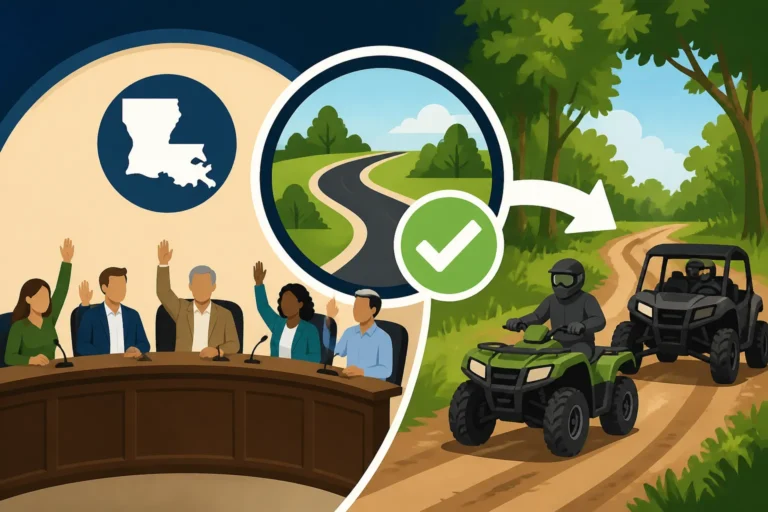
Unlike ATVs, UTVs have an additional pathway to limited road use in Louisiana. State law (specifically R.S. 32:299.3) allows parish governing authorities and municipal governing authorities to enact ordinances that designate certain roads or streets within their jurisdiction as open for UTV use. This is a significant distinction: it’s not an automatic right, but rather a power granted to local governments to make decisions based on their community’s needs and infrastructure.
If a parish or municipality chooses to designate roads for UTVs, they must also erect appropriate signage indicating which roads are open and often specifying any additional local rules. These local ordinances frequently come with their own set of requirements, such as minimum age for drivers (often 21 in Louisiana for UTVs on public roads), specific lighting, mirrors, and sometimes even insurance. Always check with your local parish or city hall to see if such ordinances exist and what their specific stipulations are. What's legal in one parish, like Beauregard, might be entirely prohibited in another, like Bossier. [Louisiana UTV Street Legal Rules by Parish] can vary wildly.
Crossing Public Roadways
Even if you can’t ride on a public road, there’s usually an exception for crossing one. This applies to both ATVs and UTVs. If your private property or a legal trail system is bisected by a public road, you can generally cross that road to continue your ride. However, this isn't an invitation to zigzag across roads whenever you feel like it. The crossing must be:
- Incidental: It means you're not riding down the road for any distance, but merely making the shortest possible transit from one side to the other.
- Perpendicular: You should cross at a 90-degree angle, or as close as safely possible, to minimize your time in the travel lanes.
- Safe: You must yield to all oncoming traffic, stop completely before entering the roadway, and ensure the crossing can be made without creating a hazard.
This exception acknowledges the reality of land ownership and trail systems that often necessitate brief interactions with public infrastructure. It’s a common-sense allowance, but one that demands extreme caution and adherence to all traffic laws during the crossing. Remember, even a quick dash across the road can lead to a serious accident if you're not paying full attention.
Staying Compliant: Paperwork, Gear, and Avoiding Penalties
Understanding the rules is one thing; consistently following them is another. To avoid legal trouble and ensure your safety when operating your ATV or UTV, especially around public road shoulders, you need to be prepared. This means having the right documents, making smart choices about your machine, and understanding the consequences of non-compliance.
Essential Documents to Carry
Beyond the aforementioned notarized farm affidavit for agricultural shoulder use, there are other crucial documents you should always have with you, regardless of where you're riding in Louisiana.
First, you need proof of ownership. This usually means your machine's title. While you might not need to display it every time you ride, having it readily accessible is important for proving that the machine belongs to you, especially in situations like an accident, a stop by law enforcement, or if your machine is ever recovered after theft. [Louisiana Requires an Assigned Title for a Used One] and [Louisiana Requires an MSO for a New Machine] so ensure you have this.
Second, your Louisiana ORV Decal. Every ATV and UTV used off-road in Louisiana (and that includes the shoulder exception) is required to display a current ORV decal. This decal signifies that you've paid the annual fee and are registered with the state. This little sticker is a big deal, and riding without it can lead to penalties. Make sure it's properly affixed and visible on your machine. You can find more information about [Louisiana's Yearly Off-Road Decal].
Third, if you're operating a UTV on a designated parish or municipal road, you'll likely need to carry proof of insurance. While ATVs generally don't require insurance for off-road use, UTVs on designated public roads often do, with specific minimum coverage requirements. Always check the local ordinance for the exact requirements. [Louisiana UTV Insurance Minimums] are something you don't want to overlook.
Finally, always carry a valid driver's license. Even if you're on private property or a specific off-road trail, if you briefly encounter any public access points or need to cross a road, you'll need a Class E license to operate a motor vehicle. [What a Class E License Lets You Do] is a standard part of driving in Louisiana.
Recommended Gear for Visibility and Safety
When you’re near or on a public road shoulder, even briefly, you’re interacting with traffic that moves much faster and is often less aware of off-road vehicles. Enhancing your visibility and safety isn't just smart; it can save your life.
- Bright Colors and Reflective Gear: Wear bright, high-visibility clothing. Add reflective tape to your machine, especially if you're out near dawn or dusk. Even in daylight, anything that makes you stand out to drivers is a plus.
- Lights: Ensure your headlights, taillights, and brake lights are fully functional. If your machine doesn't have them, consider adding aftermarket lighting. This is where brands like SuperATV come in handy, offering a wide array of lighting solutions, from LED light bars to accessory turn signal kits, which can drastically improve your visibility to other motorists. These aren't just for looking cool on the trails; they're vital safety equipment for any time you're near a roadway.
- Mirrors: While not strictly required for all off-road use, adding side mirrors can significantly improve your ability to see approaching traffic when you're on a shoulder or preparing to cross a road.
- Helmets: Louisiana has specific helmet rules for ATVs, especially for younger riders. Regardless of the law, wearing a helmet is always a good idea. For UTVs, while adults are generally not legally mandated to wear helmets, it's still a critical piece of safety gear. [Louisiana ATV Helmet Rules] should always be followed.
- First Aid Kit: Accidents can happen anywhere. A well-stocked first aid kit is a must for any ride.
The Risks of Non-Compliance
The penalties for ignoring Louisiana’s ATV and UTV road rules can be significant and far-reaching. It’s not just a slap on the wrist.
- Fines: You can face substantial fines for illegal road use, riding without a decal, or operating without the necessary documentation like a farm affidavit. These fines can quickly add up, turning a quick trip into an expensive mistake. [Louisiana Penalties for Illegal Road Riding] are designed to deter violations.
- Impoundment: Law enforcement has the authority to impound your ATV or UTV if you’re found in violation of road use laws. Getting your machine back can be a costly, time-consuming, and frustrating process, involving towing fees, storage fees, and administrative penalties. [Louisiana Impoundment for No Decal] can be a harsh reality.
- Accidents and Liability: If you’re involved in an accident while illegally riding on a public road, your liability can be greatly magnified. Your insurance policy might not cover incidents that occur during illegal activities, leaving you personally responsible for damages, medical bills, and legal fees.
- Loss of Privileges: Repeated offenses could potentially lead to loss of driving privileges or other legal repercussions.
It’s tempting to think you can get away with a quick ride on the shoulder, especially if you've seen others do it. But the law is clear, and the risks simply aren't worth it. Be a responsible rider, know the rules, and protect yourself and your machine.
| Feature | Louisiana ATV Shoulder Rules (Agricultural Exception) | Louisiana UTV Designated Road Rules (Local Ordinance) |
|---|---|---|
| Machine Type | ATV or UTV | UTV only |
| Location | Shoulder of public roads | Designated parish/municipal roads or streets |
| Purpose | Strictly bona fide agricultural purposes | General transportation (as permitted by local ordinance) |
| Distance Limit | Within 5 miles of agricultural operation base | No state-mandated distance limit, but local ordinances may apply |
| Required Document | Notarized Farm Affidavit, ORV Decal, Proof of Ownership, Driver's License | Local Ordinance may require: Proof of Insurance, ORV Decal, Proof of Ownership, Driver's License, 21+ Age |
| Local Approval | No local ordinance required, but must meet state statute's agricultural criteria | Requires specific ordinance enacted by parish or municipal government |
| Visibility Gear | Highly Recommended (bright colors, reflective tape, lights, mirrors) | Often required by local ordinance (specific lighting, mirrors, etc.) |
| Penalties | Fines, impoundment, liability issues for non-compliance | Fines, impoundment, liability issues for non-compliance |
Disclaimer
This article is for general informational purposes only and does not constitute professional advice. Laws, prices and regulations vary by location and change over time. Consult a qualified professional for guidance on your specific situation.