Why Louisiana WMAs Need a Self-Clearing Permit
A self-clearing permit can look like a small piece of paperwork beside a Louisiana WMA trailhead, but skipping it can turn a planned ride into a rules problem. The permit is a way for the land manager to record public use; it is not an ATV registration, trail pass, or permission to ride anywhere you like. Here’s how to handle it, what it does and doesn’t authorize, and what to check before unloading.
What a Louisiana WMA self-clearing permit is for
A self-clearing permit is a use-recording form associated with access to certain Louisiana Wildlife Management Areas, or WMAs. Visitors complete the form themselves rather than checking in with a staffed gate. The information helps the agency track who is using an area and for what purpose, and may help with management, safety, and enforcement.
The form is usually found at a WMA entrance or another designated access point. Its location and instructions can vary. Some forms are designed to record information before you enter; others may include a part to retain or directions about what to do when you leave. Read the actual form and signs at the site. Do not rely on a description from another WMA or assume every permit box works the same way.
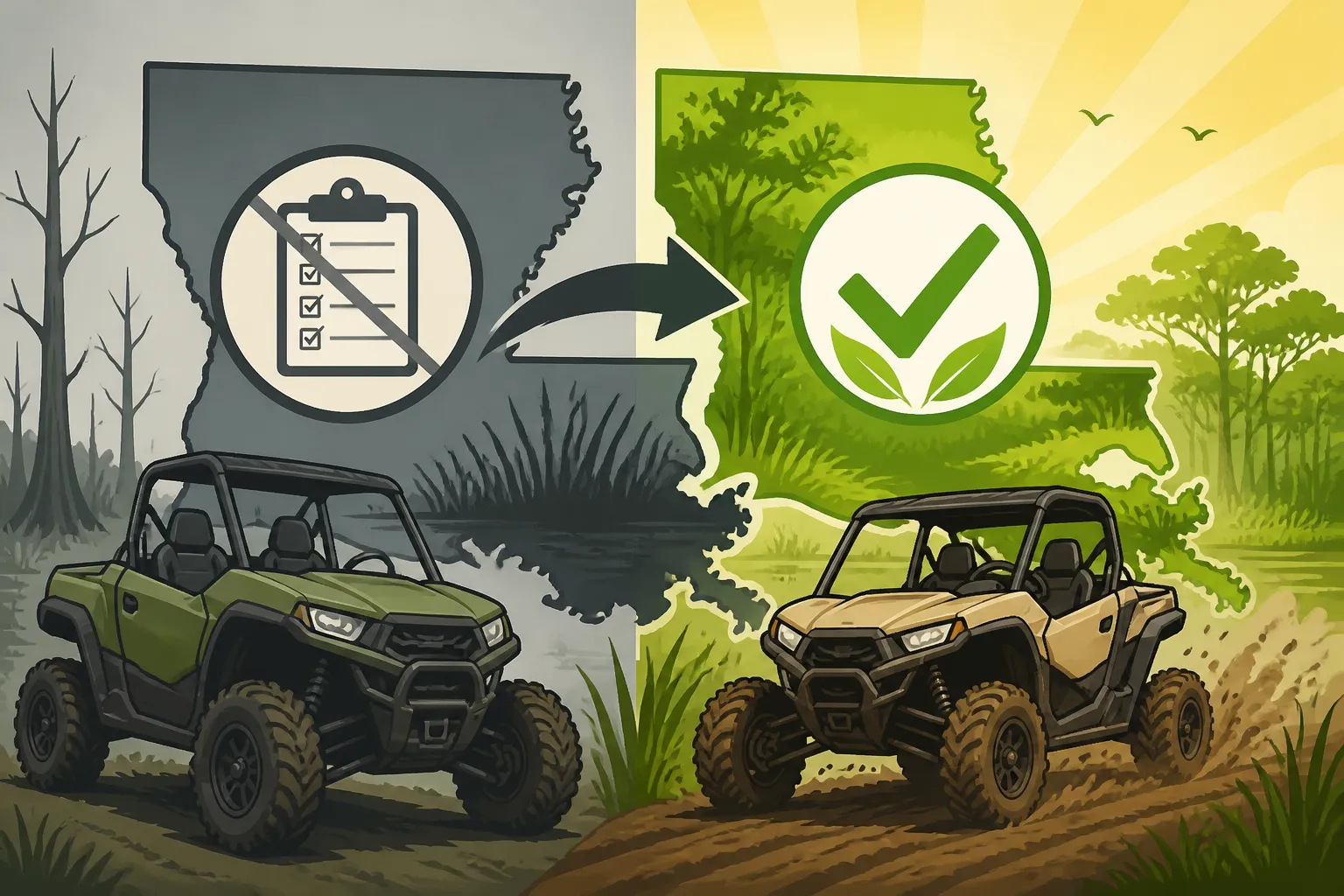
A self-clearing permit is separate from permission to ride a machine on a WMA. A completed form does not automatically make ATV or UTV riding legal on every road, trail, or piece of land in the area. The particular WMA’s access rules still control, including rules about designated routes, open seasons, machine types, tire limits, weight, hours, and closures.
It is also different from a state forest pass or an off-road decal. Those address other requirements and apply in different situations. For example, a permit form at a WMA does not replace a required ORV decal for a machine that needs one. Likewise, an ORV decal does not replace a WMA’s self-clearing form or make a closed route open.
| Item | What it generally does | What it does not do |
|---|---|---|
| WMA self-clearing permit | Records a visitor’s use of a WMA according to the posted instructions | Grant access to every part of the area or authorize riding on any route |
| ORV decal | Serves as a separate off-road machine requirement where applicable | Substitute for WMA access rules or a self-clearing permit |
| Title | Records ownership of a titled machine | Authorize riding on public land |
| Forest pass | Covers access requirements at certain forest sites | Apply automatically to a WMA or private park |
| WMA map and rules | Show where and when a specific type of use is allowed | Replace a required check-in form |
If you’re sorting out the difference between the machine’s paperwork and the area’s access requirements, [Louisiana WMA Permit Requirements] can help you consider the broader permit picture. For the vehicle side, see Louisiana WMA Riding Rules for Quads or Louisiana WMA Riding Rules for UTVs.
How to complete the permit without guessing
The safest approach is to treat the form at the entrance as the controlling instruction. If it tells you to complete a section before entering, do that before you start your ride. If it has separate entry and exit portions, follow the directions printed on the form. If a sign gives instructions that differ from what you expected, stop and read the sign carefully rather than filling out the form from memory.
A practical routine looks like this:
- Stop at the designated permit station. Do not assume a permit box is optional because no employee is present. Self-clearing systems are meant to work without a staffed counter.
- Read the sign and the whole form. Check whether the form is for general access, a particular activity, or a specific date or visit. Look for separate directions for entry and exit.
- Fill in the requested information accurately. Use the information requested on the form, such as the date, activity, party or vehicle details, when those fields appear. Do not leave required fields blank simply because they seem routine.
- Put each part where the instructions say. Some permits may include a portion to place in a box and a portion to keep. Follow the form at that location rather than copying a procedure from a different WMA.
- Keep any required receipt or stub with you. If the form instructs you to retain a portion while on the area, keep it accessible. A photo may be useful as a backup, but do not assume a photo replaces a required paper copy.
- Complete any exit step. If the form asks for information when leaving, do not skip it. The system may be intended to record both entry and exit.
- Keep the area’s rules and map available. The permit tells only part of the story. You still need to know where your activity is allowed and whether a closure or seasonal restriction applies.
Write legibly. A form that cannot be read may not serve its intended purpose. If you make a mistake, use the correction procedure printed on the form or ask the posted contact for guidance. Avoid making up a correction method, especially if the permit has multiple sections.
It can help to carry a pen in your truck or gear bag, rather than relying on one being left at the permit station. A small waterproof notebook or document sleeve can keep a retained permit from turning to pulp in wet weather. If you order basic supplies through Amazon, choose items that suit your actual riding conditions; the main point is to have a usable pen and a way to protect any paper you must carry. Do not put personal paperwork or sensitive information somewhere it can be seen by other visitors.
What information should you enter?
Use only the fields the permit asks for. A self-clearing form may ask about the visitor, party, activity, date, or other details, but forms can differ. Don’t add unnecessary personal information in a blank area, and don’t omit a required field because the ride is short.
For group rides, check whether each person needs an individual form or whether one form covers a party. Do not assume that one person’s permit covers an entire truckload. The sign or form should clarify the required unit of reporting. If it does not, contact the land manager before your trip when possible.
If you visit more than one WMA in a day, handle the form at each area as directed. A permit completed at one entrance should not be treated as a general pass for other WMAs. Keep each area’s paperwork separate so you can explain which permit applies to which visit.
A self-clearing permit does not open every trail
The most important distinction is between permission to access an area and permission to ride a particular machine on a particular route. A WMA may be open to some activities while allowing motorized riding only on marked routes, during a stated season, or under particular equipment limits. A permit form does not override those restrictions.
Before unloading, check the specific WMA’s current map and rules. Confirm the following:
- Whether motorized riding is allowed at all.
- Which routes are open to the machine you plan to bring.
- Whether the route is designated for ATVs, UTVs, or both.
- Whether a size, weight, width, tire, tread, or pressure limit applies.
- Whether the area or a route is seasonally closed.
- Whether night riding is restricted.
- Whether access is limited by a special permit, event, or management notice.
- Whether parking or unloading is allowed at your chosen access point.
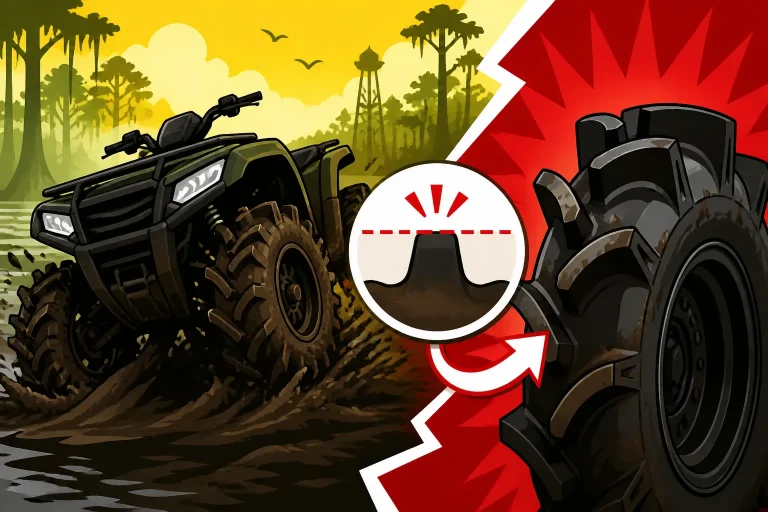
Some Louisiana WMA rules may impose requirements on machine weight, tire dimensions, lug height, or tire pressure. These details can be easy to miss if you focus only on the permit station. Check Louisiana WMA Tire Rules Explained and Louisiana WMA Weight Limits Explained for the equipment questions, and use the official WMA map or posted notice to confirm which rules apply to the specific area.
A sign at the trailhead is useful, but it may not answer every question about a route several miles away. Download or save the current map before you leave service. At the trail, stay on routes the map identifies as open to your type of use. A two-track that looks well traveled is not necessarily an authorized ATV route.
Do not treat a hunting road, service road, pipeline corridor, levee, or utility path as open simply because it appears on a map or can physically be driven. The land manager’s designation matters. In particular, a route used by trucks or agency staff may not be open to public motorized recreation.
This is why it pays to separate three questions:
- May I enter this WMA for my activity?
- May I ride my type of machine here, at this time?
- May I ride this specific route with my machine’s equipment?
The self-clearing permit addresses the first question only to the extent described by the form and applicable access rules. The map, regulations, and signs answer the others.
Timing, closures, and changing conditions
A valid permit form does not cancel seasonal restrictions. Some WMAs limit motorized use to designated areas or periods, and a route that was open on your last visit may be closed now. Seasonal access can be affected by wildlife management, soil conditions, maintenance, fire risk, hunting activity, storms, or other operational needs.
Check the current notice for the WMA shortly before traveling. A map saved months ago may not show a temporary closure, and a social media post from another rider may not be current or official. If the agency provides an official status page or contact method for the area, use that source. When a posted closure conflicts with an old map or informal advice, do not ride through the closure to find out.
In wet conditions, even an otherwise open trail can be unsafe or vulnerable to damage. Louisiana’s soft soils and standing water can make a passable-looking route difficult to recover from. Deep ruts can also create hazards for other visitors and emergency vehicles. If a route is closed after rain or a storm, respect the closure rather than trying to bypass it through brush or an adjacent road.
Seasonal restrictions can be especially confusing when a WMA remains open for other activities. A hunter, angler, or hiker may still be allowed in an area while motorized recreation is limited. The presence of other visitors—or the fact that the entrance is not gated—does not establish that your ATV or UTV may use the trails.
For more on access limits, see Louisiana WMA Season Closures. If you’re planning around a particular hunting or wildlife season, Louisiana WMA Squirrel Season Access explains why a special access period should not be mistaken for general trail access.
Plan for limited phone service
Some trailheads and remote areas have weak or no cellular coverage. Save the relevant map, permit instructions, and closure details before leaving home. A screenshot can help when a web page will not load, but it does not replace a newer closure notice posted on site.
A paper map is a sensible backup. Keep it dry and readable, and make sure it is the correct map for the WMA you are visiting. Amazon sells waterproof map sleeves and compact notebooks, but a simple sealed folder can work just as well. The useful feature is protection from rain and mud, not a particular brand.
Before setting out, share the riding area and expected return time with someone who is not on the trip. This is especially helpful when your route crosses remote ground or your group includes new riders. The permit records access; it is not a rescue plan and should not be treated as a substitute for basic trip planning.
What a self-clearing permit is not
A permit form can create a false sense that all the paperwork is handled. In practice, it is only one part of a lawful and well-planned visit.
It is not an ATV title or decal
A title is an ownership document. An ORV decal is a separate machine requirement where applicable. The WMA permit does not replace either one. If you are unsure which vehicle documents you need, start with Do You Need to Register an ATV in Louisiana? and Louisiana ORV Decals and Titles Explained.
The reverse is also true: a title or decal does not guarantee access to a WMA trail. Riding rules for the land remain separate from the vehicle’s paperwork.
It is not a general recreation pass
A self-clearing WMA form should not be confused with fees or passes required at other public recreation sites. Kisatchie National Forest, for example, has its own trail and access requirements. A WMA form does not serve as a forest pass. For that distinction, see [Louisiana Forest Trail Use Passes].
Private parks have their own admission and waiver systems, and a WMA permit does not apply there either. Always identify who manages the land before you assume a permit or pass transfers from one location to another.
It is not landowner permission
A public WMA boundary does not make adjacent private property open. Do not cut across a private field or use a farm road as a shortcut to reach a trail. If the intended route crosses land outside the WMA, get permission from the owner and confirm that the route is legally accessible. A self-clearing form cannot grant access rights on someone else’s property.
It is not an exemption from other rules
A completed form does not waive equipment standards, hunting regulations, fire restrictions, speed limits, firearm rules, or any other applicable requirement. If the area has rules about passengers, helmets, alcohol, camping, parking, or operating hours, those rules still apply.
It also does not guarantee that the route will be open when you arrive. A permit records a visit; it does not reserve a trail or prevent a closure.
Common mistakes and how to avoid them
Most permit problems are preventable. The usual cause is not a complicated form; it is assuming that a familiar routine applies everywhere.
Assuming the form is optional because it is unattended
“Self-clearing” means visitors handle the process themselves. It does not mean the form can be ignored. If a station or sign directs visitors to complete a permit, follow the instructions even when no employee is present.
Using a permit from another WMA
Forms may look alike, but the access point and instructions matter. Complete the form provided for the area you are visiting. If you go to a second WMA, stop at its designated station and follow its procedure.
Filling it out after the ride
If the instructions say to complete the permit before entry, doing it afterward defeats the purpose. Build the stop into your arrival routine: park, check the sign, fill out the form, then unload or ride.
Forgetting the portion you must keep
If the permit includes a stub or receipt that you are instructed to carry, keep it with you while on the area. A paper sleeve in a pocket or gear bag helps keep it legible. Do not leave it in the truck if the form says to retain it on the WMA.
Riding beyond the designated route
This is a more serious mistake than misplacing a form. A self-clearing permit does not make an unmarked trail legal. Stay on the routes identified for motorized use, and turn around if you cannot confirm that a trail is open.
Relying on an old screenshot or word of mouth
A previous visit, a neighbor’s recollection, or an old map does not establish current access. Rules and temporary conditions can change. Check official information shortly before your trip and read signs at the entrance.
Treating one person’s paperwork as a group pass
The form may require information about each visitor, machine, or party. Read its wording. If it is unclear whether a group needs one form or several, contact the WMA manager or agency rather than guessing.
Leaving without completing an exit step
If the form requests a return or exit section, complete it. This is easy to forget after loading a muddy machine, so make it part of your departure checklist. If the posted system has no exit requirement, do not invent one; simply follow the actual directions.
A practical pre-ride checklist
A short checklist prevents the permit from becoming an afterthought. Before leaving, identify the WMA and confirm that the kind of riding you want to do is permitted there. Save the official map and any current closure notice. Check your machine against the area’s requirements, then pack the items you need to complete and retain the form.
At the entrance:
- Stop at the designated permit station.
- Read all instructions before writing.
- Fill out every required field accurately.
- Place or retain each section as directed.
- Take a photo only as a backup, not as a substitute for paper when paper is required.
- Check the map again before choosing a route.
During the ride:
- Stay on open, designated routes.
- Carry any required permit stub or receipt.
- Respect closures and posted restrictions.
- Do not assume nearby roads or private tracks are part of the WMA trail system.
- Turn around when you cannot confirm that a route is authorized.
When leaving:
- Complete any exit step shown on the permit.
- Dispose of no forms or litter on the ground.
- Check that your group has all required paperwork and personal gear.
- Report a safety issue or damaged sign through the contact method provided by the land manager.
A small zippered document pouch can keep the permit and map together. You do not need specialized equipment; a sealed bag, a working pen, and an offline map are often enough. Amazon can be useful for finding inexpensive waterproof organizers, but test the setup before a ride instead of discovering at the trailhead that the pen has dried out or the map will not fit.
When to ask the land manager before riding
If the form is missing, damaged, or unclear, do not assume that skipping it is harmless. Look for another posted instruction at the entrance and use the official contact information for the WMA or managing agency. If you cannot confirm the required procedure, consider postponing the ride or choosing a location with clear access instructions.
Contact the land manager before traveling when:
- You cannot tell whether motorized recreation is allowed.
- The map and a posted sign appear to conflict.
- Your machine may exceed a weight, width, tire, or other limit.
- You plan to ride during a seasonal or special access period.
- Your group is large and the permit does not explain how to report everyone.
- You need to know whether one form covers multiple people or machines.
- A storm, fire, maintenance notice, or hunting activity may have changed access.
- The permit station is empty or the forms appear to be for another activity.
When you call or write, be specific. Give the WMA name, the planned date, your machine type, and the route or trail you hope to use. Ask whether a self-clearing form is required for your activity and what to do if the form station is out of service. Keep the answer with your trip information, while remembering that an official closure or updated notice may supersede earlier guidance.
If you are already at the entrance and cannot reach anyone, use the posted rules and available signs. Do not treat uncertainty as permission to ride wherever you like. A conservative decision may cost a day of riding, but it is better than entering a closed area or creating a problem for other visitors and land managers.
The basic rule is straightforward: complete the self-clearing permit exactly as directed, then separately verify that your machine and planned route are allowed. Keep the form, map, and any machine paperwork distinct in your mind. That small bit of preparation makes it easier to ride confidently without mistaking an access record for blanket permission.
Disclaimer
This article is for general informational purposes only and does not constitute professional advice. Laws, prices and regulations vary by location and change over time. Consult a qualified professional for guidance on your specific situation.