Louisiana Has No Mandatory Safety Course
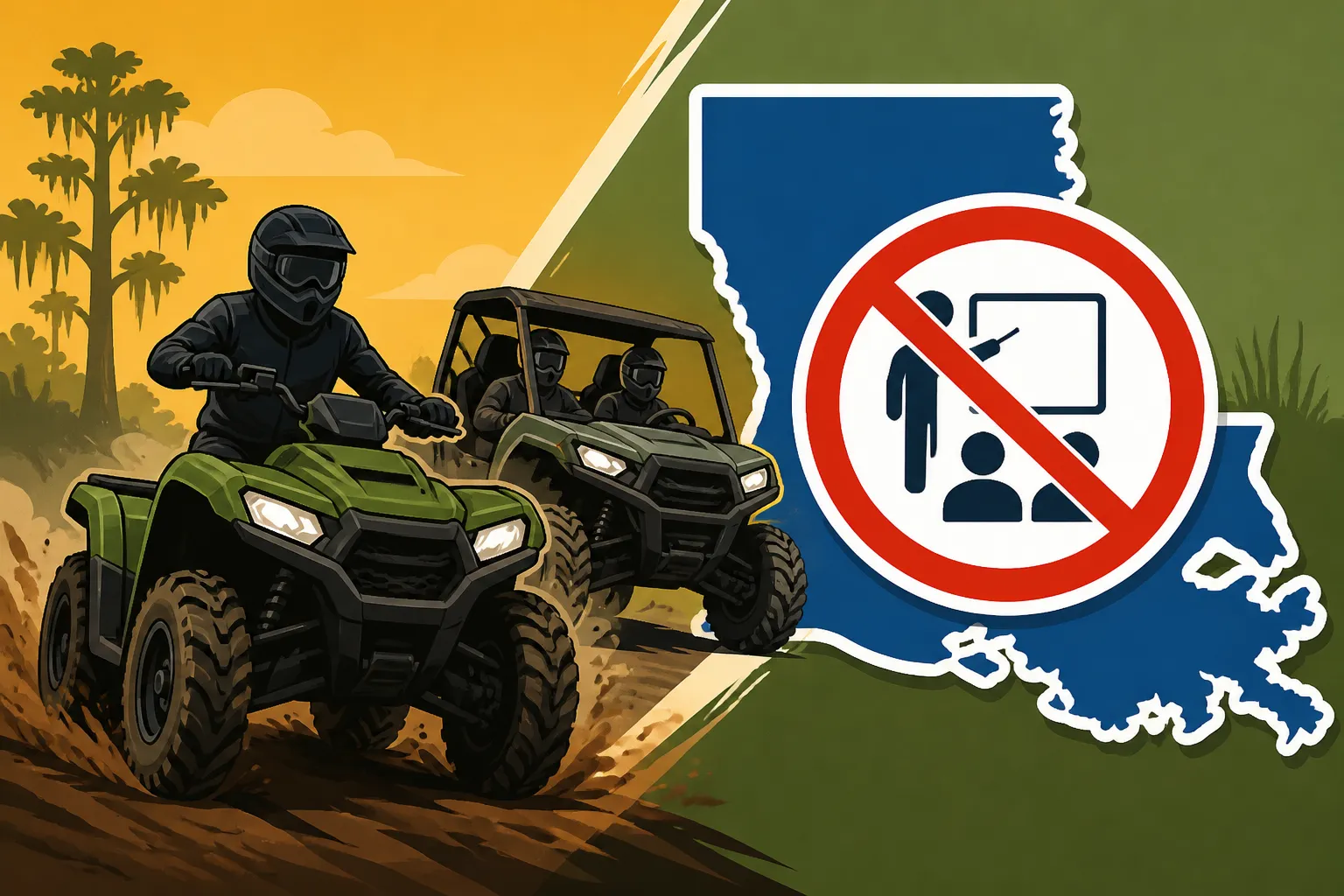
Louisiana does not generally require ATV or UTV riders to complete a safety course before riding. That can make the rules sound simpler than they are: road access, landowner requirements, age limits and equipment rules still apply. This guide explains what the lack of a statewide course mandate means, where training is available, and how to prepare a new rider responsibly.
What Louisiana’s lack of a mandatory course means
For most riders, Louisiana does not require a state ATV safety-course certificate as a general prerequisite to owning or riding an off-road machine. You can still choose to take a course, and a parent, employer, insurer, land manager or riding facility may have its own requirements. The absence of a broad state course mandate is not a declaration that training is unnecessary.
It helps to separate three ideas that are often mixed together:
- A safety course teaches practical knowledge and riding habits. Completing one may give a rider a certificate, depending on the program.
- A legal permission or qualification is something a law requires for a particular activity, such as meeting the rules for riding on a designated public road.
- A property or facility rule is set by the owner or manager of the place where you plan to ride. A private park, trail system or organized event can set conditions for entry.
A course certificate does not automatically authorize road riding, replace a driver’s license, give access to private land, or satisfy every park’s admission rules. Conversely, being legally allowed to operate a machine does not mean a rider has the skill to handle it safely.
This distinction matters especially for parents. A child might be able to ride on private property under a family’s supervision, but that does not mean the child can ride on a public road or on every public trail. Age and supervision rules depend on the setting and activity. Start with the relevant rules for Louisiana ATV Age Requirements and Louisiana Rules for a Teen Rider, then check the specific property where you plan to ride.
The same caution applies to adults. A rider who has spent years on a small quad may have little experience controlling a heavy side-by-side, towing a trailer, riding in deep mud or carrying a passenger. Familiarity with one machine is not a substitute for learning how another one steers, brakes and reacts to uneven ground.
A useful way to think about training is this: the state may not require you to prove that you took a course, but you are still responsible for knowing the rules and being able to control the machine. Training is one practical way to meet that responsibility, particularly for a new rider or anyone moving up to a larger, faster or more complex vehicle.
A course does not replace road, age or land-access rules
An off-road safety course and legal permission to ride are separate matters. Before planning a ride, identify where the machine will go and what kind of riding you intend to do. Private property, a public trail, a wildlife management area, a forest trail and a public road can all have different requirements.
Riding on public roads
Louisiana’s limited rules for off-road machines on certain public roads are not a general invitation to use an ATV or UTV as ordinary transportation. Road eligibility depends on the type of machine, the road, the rider and the conditions set by law. A safety-course certificate does not remove those restrictions.
For example, some road-use provisions have specific operator qualifications and limits, and road designation and signage can matter. Read Can You Ride an ATV on the Road in Louisiana? for the ATV rules and Louisiana UTV Street Legal Rules by Parish for the separate UTV framework. Do not assume that a road is available simply because it is rural, lightly traveled or close to your property. A course does not turn a prohibited route into an approved one.
If your plan involves public-road use, check the applicable age, license, insurance, time-of-day, route and equipment rules before leaving home. Keep the relevant documents available if the rules require proof. Training can help a rider understand hazards such as pavement transitions and traffic, but it does not change the legal status of the route.
Public trails and managed land
Public access areas may have permits, designated routes, seasonal restrictions, machine-size limits, tire requirements or other conditions. Those rules are different from a statewide safety-course mandate. A rider can have good training and still be turned away for lacking a required access permit, riding a closed trail or bringing a machine that does not meet the site’s limits.
If you plan to ride on a wildlife management area, review [Louisiana WMA Permit Requirements] and the current rules for the specific area. For forest riding, check [Louisiana Forest Trail Use Passes] and confirm trail status before towing there. Trail openings and conditions can change, so a map or an old trip report is not enough to establish that a route is currently open.
Private property, parks and events
On private land, the owner or operator can set conditions for access. A private park may have its own minimum ages, helmet requirements, passenger rules, waiver process, equipment checks or restrictions on where different machines may go. A park’s policy can be stricter than the general state rule, and it can change between ordinary riding days and special events.
Before traveling, read the current facility rules or contact the operator. Ask whether a course certificate is required, whether a parent or guardian must sign for a minor, and whether each rider needs a separate waiver. Review Louisiana Private Park Age Minimums if children will attend. Do not treat a course offered at one facility as proof that another facility will accept the same certificate.
Training options for Louisiana riders
Even without a general state course requirement, riders have useful ways to learn. The right option depends on the person’s age, experience, machine and riding environment. A first-time child rider may need close, hands-on instruction on a small machine. An adult who already rides may benefit more from practice with a side-by-side’s passenger, rollover and terrain risks.
Organized safety programs
Louisiana riders can look into voluntary safety education through local extension and youth programs. The options and availability may vary by location and season, so confirm current enrollment details directly with the organization. Louisiana Safety Course Options provides a starting point for finding possible training, while Louisiana 4-H ATV Safety Program and Louisiana LSU AgCenter Safety Program can help families investigate youth-oriented instruction.
When you contact a program, ask a few practical questions:
- Is the instruction designed for ATVs, UTVs, or both?
- Does it include hands-on practice, classroom instruction or a combination?
- What ages and experience levels does it accept?
- Does the rider need to bring a machine, helmet or other gear?
- Is an adult required to attend with a minor?
- Does the program provide a completion record, and what does that record represent?
- Are there prerequisites or limits on the machine’s size and power?
Do not assume that a course focused on quad operation covers side-by-side handling in depth. The machines have different stability characteristics, seating positions, passenger risks and controls. Ask the instructor exactly what equipment is included.
Dealer and community instruction
Some dealerships, clubs, riding groups or local organizations may provide demonstrations, new-owner orientations or informal mentoring. These can be helpful, particularly for learning the controls on a newly purchased machine. But an orientation is not automatically a formal safety course, and informal guidance may not cover the rules or hazards you need to know.
If a dealer offers a walk-through, use it to learn the machine’s controls and maintenance basics. Ask the representative to show where the parking brake, gear selector, engine shutoff and any four-wheel-drive or differential controls are located. Then read the owner’s manual and practice in a controlled area. A brief delivery demonstration should not be treated as a full substitute for rider training.
A riding club or experienced friend can also help a beginner learn trail etiquette and basic judgment. Choose a patient mentor who rides within the learner’s limits rather than someone who encourages speed, steep climbs or deep water as a test of courage. An experienced rider is not necessarily a qualified instructor, so keep the learning environment conservative.
Online material and self-study
Online videos and written guides can introduce terminology, controls and common hazards, but they cannot watch a rider’s body position, correct a poor braking habit or assess how well someone handles a real turn. Use them as preparation, not as proof of competence.
Before riding, read the owner’s manual for the exact make and model. Controls, warnings and service requirements differ. Review the machine’s load limits, passenger restrictions, recommended tire pressures, water-crossing cautions and towing guidance. If you do not have the manual, ask the manufacturer or dealer how to obtain the correct one rather than relying on a similar model’s instructions.
If you shop for basic safety equipment through Amazon or another retailer, verify that the item is designed for the intended use and fits the rider. A listing’s popularity is not a substitute for checking applicable safety standards, sizing guidance and the manufacturer’s instructions.
When more training is especially valuable
Consider structured instruction or supervised practice if the rider is:
- A child or teen with little experience.
- Moving from a small youth machine to a larger adult ATV.
- Switching from an ATV to a UTV or from a UTV to a quad.
- Returning after a long break.
- Learning to ride on public trails after only using a yard or field.
- Planning to ride in mud, sand, hills, water or crowded event areas.
- Expected to carry passengers, tow a trailer or work with a machine.
- Uncomfortable with the controls, balance or stopping distance.
A course can also be a sensible choice after a near miss, rollover, collision or other event that reveals a gap in the rider’s skills. The goal is not to earn a certificate for its own sake. It is to improve the decisions and habits that prevent the next incident.
What useful ATV and UTV training should cover
A course’s value depends on what the rider learns and practices. A short overview can be a helpful introduction, but it should not leave a new rider believing that a few minutes of instruction prepares them for every condition. Look for training that combines basic knowledge with realistic practice appropriate to the machine and learner.
Know the machine before starting
Riders should be able to identify the controls and understand how the vehicle responds. That includes starting and stopping, shifting, braking, using the parking brake, turning off the engine and recognizing warning indicators. On a UTV, the instruction should also cover seat belts, doors or nets, passenger positions and the machine’s rollover risks.
The rider should know the vehicle’s limits. Loading a rack beyond its capacity, carrying an unauthorized passenger or towing too much can affect control. A UTV may feel stable on level ground but can still overturn on a slope, rut, soft shoulder or abrupt turn. An ATV’s smaller footprint does not make it immune to rollover or ejection.
A pre-ride inspection is worth practicing until it becomes routine. Check tires and wheels, controls, brakes, lights, steering, fuel or battery condition, visible damage and any safety equipment fitted to the machine. Look for leaks or loose parts. If a control feels wrong or a tire is damaged, stop and address it rather than hoping the problem will disappear on the trail.
Balance, turning and braking
An ATV’s handling depends partly on rider position. A rider needs to stay balanced, look in the direction of travel and adjust posture for turns and terrain. A training session should give the rider a chance to practice controlled turns, starts, stops and safe speed changes in an open area before moving into a narrow or uneven route.
Braking deserves particular attention. Riders should learn how the machine’s brakes work and how stopping distance changes with speed, surface and load. Mud, loose gravel, wet leaves and slopes can reduce traction. A rider who can stop reliably on firm ground may need a wider margin on a slick trail.
UTV training should not simply copy ATV instruction. A UTV has a steering wheel and a seated passenger area, but it can carry more weight and may be less forgiving of sharp turns at speed. Its occupants need to use the restraints and follow the vehicle’s passenger limits. A person standing in a passenger area or riding outside the intended seating position can be exposed to serious injury in a sudden stop or rollover.
Reading terrain and choosing a route
Good riders do not just react to obstacles; they assess whether to approach them at all. Training should encourage riders to slow down and look ahead for drop-offs, holes, water depth, loose soil, washouts, hidden debris, branches, other vehicles and people. A mud hole can conceal a rut or a submerged object. Water can hide depth changes and damage a machine.
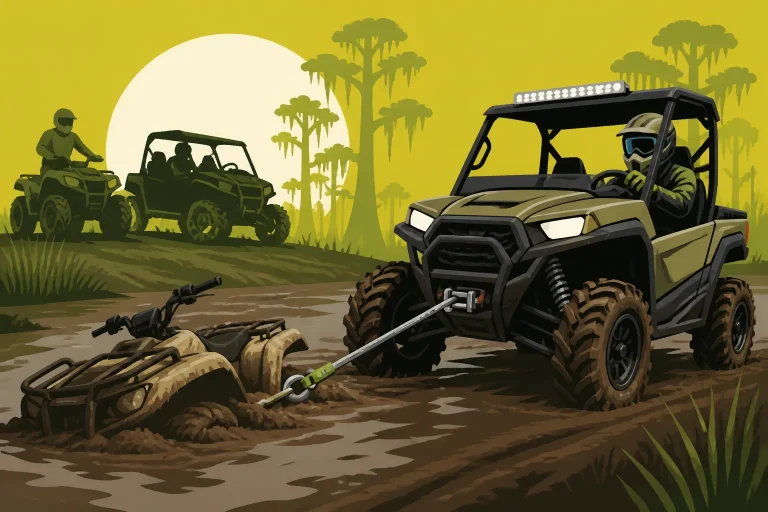
A beginner should learn that turning around is a valid choice. If a slope, water crossing or mud section is beyond the rider’s skill or the machine’s capability, stopping and choosing another route is better than committing because other riders went first. A winch or recovery strap may help retrieve a stuck vehicle, but it does not make an unsafe crossing safe.
On a shared trail, riders also need to manage speed and visibility. Leave room to stop, slow before blind corners and avoid assuming that a horse, hiker, truck or oncoming machine can move out of the way. Respect trail closures and posted instructions. A rider who knows how to operate a machine but ignores signs and other trail users is not riding responsibly.
Protective gear and emergency planning
Training should explain how to select and use protective gear, not merely tell riders to “wear safety equipment.” A properly fitted helmet is central to off-road protection. Eye protection, gloves, boots and clothing that cover exposed skin can reduce common injuries. For a UTV, seat belts and appropriate occupant restraints are essential. Follow the machine maker’s instructions and the rules of the riding location.
When comparing helmets or goggles on Amazon, check fit, intended activity, product information and return conditions before buying. A helmet that is the wrong size or worn incorrectly may not protect as intended. Have the rider try it on and confirm that it sits securely without painful pressure or excessive movement. Fit and correct use matter more than appearance.
Riders should also know what to do if someone is injured or a machine becomes disabled. Before a trip, identify the nearest access point, tell someone where the group is going and when to expect a return, and carry a way to contact help if service is available. In remote areas, do not assume a phone will work. A basic first-aid kit, water and the ability to stop a ride can be more useful than adding speed or power to the machine.
How to choose a course and set realistic expectations
A training provider should be able to explain the course’s content, format and limits in plain language. Ask who teaches it, which machines are covered, how much practice is included and whether the instructor has experience with riders at the same level. For a child, ask how supervision and machine sizing are handled.
Use a simple comparison when evaluating options:
| Training option | What it can help with | What to verify |
|---|---|---|
| Organized safety course | A structured introduction to operation, judgment and protective practices | Machine types covered, hands-on time, age range and completion documentation |
| Dealer orientation | Controls, machine features and owner’s manual basics | Whether it includes actual riding practice and whether it is more than a delivery walkthrough |
| Club or mentor session | Trail etiquette and supervised experience in a familiar setting | Mentor’s approach, terrain difficulty and whether the learner can stop or opt out |
| Online material | Terminology, pre-ride concepts and preparation | Whether the content matches the exact machine and whether practical instruction is still needed |
| Self-practice on private land | Repetition of basic controls and low-speed skills | Permission, safe terrain, protective gear, supervision and a clear stopping point |
A credible course should not promise that a certificate makes a rider safe in every situation. It should help the rider understand risks and practice within clear limits. Be cautious if instruction encourages a beginner to attempt high-speed riding, deep water or steep terrain before basic control is established.
Ask what the completion document means. Some certificates are records of attendance or completion, not a government-issued license. If a park, employer or insurer asks for proof of training, confirm what it will accept before enrolling. A document with a familiar-sounding name may not meet a facility’s particular requirement.
Training needs to match the person, not just the machine. A child’s course should address supervision and age-appropriate judgment. An adult course should account for the adult’s intended use, such as trail riding, property work or operating a side-by-side with passengers. A course that teaches basic recreational riding may not cover specialized work or recovery techniques.
Consider the setting too. Practicing in a flat, open field can help a new rider learn starts, stops and turning, but it does not prepare them for a narrow forest trail, deep mud or a busy event. Build experience gradually. If the rider is unsure, choose an easier route, go with a responsible companion and leave the difficult obstacle for another day.
If you are buying gear while arranging training, keep the list practical. A helmet that fits, eye protection, gloves, sturdy footwear and suitable clothing are a better starting point than decorative accessories. Amazon can be one place to compare basic gear, but confirm sizing and product details with the maker and do not rely on customer reviews alone. For a UTV, check that restraints and occupant protections work as intended before carrying passengers.
A practical learning plan for new and returning riders
Training works best when it continues after a class. A rider who completes a course and then spends months away from the machine may need a refresher before taking on a difficult ride. Use short, deliberate practice sessions and increase the challenge only when the rider can manage the current one consistently.
1. Confirm where the ride is allowed
Identify whether the route is private property, a public trail, a managed area, a park or a public road. Get permission where needed and check current access rules. Do not infer permission from an unlocked gate, old tracks or the fact that other riders are present.
For public areas, look up current permits, trail designations, closures and machine requirements before loading the trailer. For a private park, review its rules and contact the operator if a requirement is unclear. If the trip includes any public-road segment, check the applicable road-use restrictions separately from the training question.
2. Match the machine to the rider
A machine that is too large, heavy or powerful can overwhelm a beginner. Consider the rider’s physical ability to reach and operate the controls, understand instructions and respond calmly. Youth machines are not simply smaller versions of adult machines; they have limits and should be used as directed by the manufacturer.
For an adult changing machine types, begin with the manual. A rider who is skilled on a quad still needs to learn the different handling and occupant risks of a UTV. A side-by-side’s steering wheel may feel familiar, but its weight and rollover behavior demand a different approach. A smaller machine can also behave differently when loaded or fitted with different tires.
3. Establish basic controls in a low-risk area
Choose a level, open space with permission and no nearby traffic, drop-offs, water or obstacles. Start with the engine off and identify the controls. Then practice starting, stopping, shifting if applicable, turning off the engine and using the parking brake. Keep the speed low.
For an ATV, have the rider practice smooth starts, wide turns and controlled stops. For a UTV, confirm that every occupant is seated correctly and restrained before moving. Practice gentle turns and stops without passengers at first, unless the owner’s manual or training program directs otherwise.
4. Add one challenge at a time
Once the rider handles basic controls reliably, introduce mild changes in terrain. Do not combine unfamiliar machine controls, unfamiliar riders, darkness, poor weather and difficult terrain in a single first outing. Change one variable at a time, and return to easier practice if the rider becomes tense or rushed.
A rider should be able to stop, communicate, follow directions and recognize when to turn back. Confidence is useful; overconfidence can be dangerous. If a learner becomes tired, cold, overheated, frustrated or distracted, end the practice session.
5. Set clear group rules
Before riding with others, agree on a pace and a communication plan. Decide where the group will stop, how to handle a breakdown and who will stay with a rider who needs help. Keep beginners within sight of a responsible adult and avoid pressure to keep up with faster riders.
Tell the group that no one has to attempt an obstacle. A rider can walk a route, turn around or wait in a safe place while others proceed only if that is permitted and supervised. Peer pressure is a poor substitute for a skills assessment.
6. Review after each ride
After the ride, discuss what felt comfortable, what caused uncertainty and what the rider wants to practice next time. Inspect the machine for damage or leaks and follow its maintenance schedule. A recurring difficulty with braking, balance, judgment or communication is a cue to seek more instruction rather than simply ride faster until it feels easier.
Parents, supervisors and passengers
Because Louisiana does not impose a general course requirement, families have to make deliberate choices about training and supervision. A child’s ability to operate a machine safely cannot be judged only by age or enthusiasm. Consider maturity, attention, size, physical strength and response to instructions. A child who can reach the controls may still not be ready to make safe decisions on a trail.
Start by checking the rules for the specific activity. Public-road rules, public-land access conditions and private-park policies may set different age and supervision standards. Read How Old Does a Louisiana Rider Have to Be? alongside the rules for the place you intend to visit. A course certificate does not override an age restriction or make an otherwise prohibited ride legal.
For a younger rider, choose a machine designed for that rider and follow the manufacturer’s limits. Do not let a child ride an adult machine because it is available or because an adult can supervise from another vehicle. Supervision means staying close enough to intervene, watching the rider’s decisions and stopping the activity when needed.
Parents can make training more effective by establishing simple rules before the engine starts:
- Wear the required protective equipment every time.
- Ride only in the approved area and on permitted routes.
- Keep speeds within the rider’s ability and the terrain’s conditions.
- Never carry a passenger on a machine not designed for one.
- Stop when told, and do not follow another rider into an obstacle without checking it.
- Stay with the group and tell an adult before leaving the route.
- Do not ride when tired, upset, impaired or unable to focus.
Passengers need separate attention. A passenger should be seated in a designated position, use the machine’s intended restraints and understand how to behave during a turn or stop. A child riding as a passenger must meet the vehicle maker’s requirements and the location’s rules. Do not hold a child on an ATV or carry a passenger where the machine is not designed for one. See Louisiana Rules for Passengers on a UTV for the state-specific passenger context.
Adults supervising children should model the behavior they expect. If a parent rides without a helmet, ignores signs or rushes through a blind corner, a verbal safety talk is unlikely to outweigh that example. Make breaks normal, keep the route conservative and treat turning around as a sensible decision rather than a failure.
A course can support family rules, but it cannot replace active supervision. For younger riders, an adult should be able to see and hear the child and respond quickly. For teen riders, gradually give more responsibility while maintaining boundaries about route, speed, group behavior and return time. See Louisiana Parent Riding With a Child for more on supervision in the riding context.
A simple pre-ride safety checklist
A checklist does not take the place of training or judgment, but it helps prevent avoidable oversights. Use it before each outing, especially after the machine has been stored, serviced or transported.
Rider and plan
- Does each rider know the route, boundaries and return plan?
- Is the route open and permitted for this machine?
- Do all riders meet the site’s age and supervision conditions?
- Is the machine appropriate for each operator’s experience?
- Has someone outside the group been told where you are going and when you expect to return?
Machine
- Are the tires, wheels, brakes and steering in usable condition?
- Do the controls work as expected?
- Are racks, cargo and any trailer within the machine’s limits?
- Are passengers seated in approved positions?
- Are UTV restraints functioning and used by every occupant?
- Is the fuel or battery level suitable for the planned ride?
Rider equipment
- Does the helmet fit securely and suit the activity?
- Are eye protection, gloves, footwear and clothing appropriate?
- Is any required safety equipment available and working?
- Does each rider have water and any medication or personal supplies they need?
Conditions
- Is the weather suitable for the rider’s experience and the route?
- Could recent rain have changed water depth, mud or trail conditions?
- Is visibility adequate for the plan?
- Are there signs of closures, fire restrictions or other access limits?
- Does the group have a communication and breakdown plan?
If an important answer is no, pause and fix the problem or change the plan. A delayed ride is preferable to forcing an unsafe trip. For additional gear, Amazon may help with comparison shopping, but check fit, machine compatibility and current facility requirements before relying on a product.
The main takeaway is straightforward: Louisiana’s lack of a general mandatory ATV or UTV safety course does not make training pointless, and it does not erase other rules. Learn the machine, practice in controlled conditions, check the rules for the place you are riding and build skills before adding speed, passengers or difficult terrain. A certificate may be useful, but safe decisions on every ride matter more.
Disclaimer
This article is for general informational purposes only and does not constitute professional advice. Laws, prices and regulations vary by location and change over time. Consult a qualified professional for guidance on your specific situation.