What a Deputy Checks at a Rural Traffic Stop
Riding your ATV or UTV through Louisiana’s picturesque rural roads can feel like the ultimate freedom, but that feeling can vanish in an instant if you see flashing lights in your rearview mirror. It’s a common scenario that can leave even the most seasoned rider a bit flustered. This guide is here to demystify what a Louisiana deputy is looking for when they pull over an off-road machine, helping you understand the rules so you can ride with confidence and stay out of trouble.
The Initial Stop: What Triggers It and What to Expect
Let's face it, getting pulled over is rarely a pleasant experience, especially when you're on a machine designed for the dirt, not the asphalt. Many riders wonder, "Why me? I was just trying to get from point A to point B." Understanding what might catch a deputy's eye, and how to handle the stop, can make a world of difference.
Why You Might Be Pulled Over: It's Not Always Random
Deputies aren't just out there randomly stopping every ATV or UTV they see. There are specific reasons and common violations that often lead to a traffic stop. The most frequent reason is simply riding on a road where you shouldn't be. Louisiana law is quite clear about where off-road vehicles can and cannot operate. If you’re cruising down a state highway, a busy parish road not explicitly designated for UTVs, or even a smaller backroad that isn't part of a specific farm-use exemption, you're likely going to get noticed.
Another big red flag is violating the conditions of the shoulder-only farm exemption. This exemption allows ATVs and UTVs to operate on the shoulder of certain public roads for agricultural purposes, but it comes with strict limitations. If you're on the main travel lane, far from a farm, or outside the [Louisiana's 5-Mile Farm Radius], that exemption evaporates, and you're back to an illegal road-use situation. Similarly, age restrictions are a common trigger, particularly for UTVs where the driver must be at least 21 years old under most circumstances. [Louisiana Requires UTV Drivers to Be 21]. Deputies are trained to look for these visible infractions, and sometimes, it's as simple as seeing a machine without the proper lighting after dark, or an erratic driver that might suggest impairment. [Louisiana DUI Law and Off-Road Machines] is taken just as seriously on a quad as it is in a truck.
Your Rights and Responsibilities During a Stop
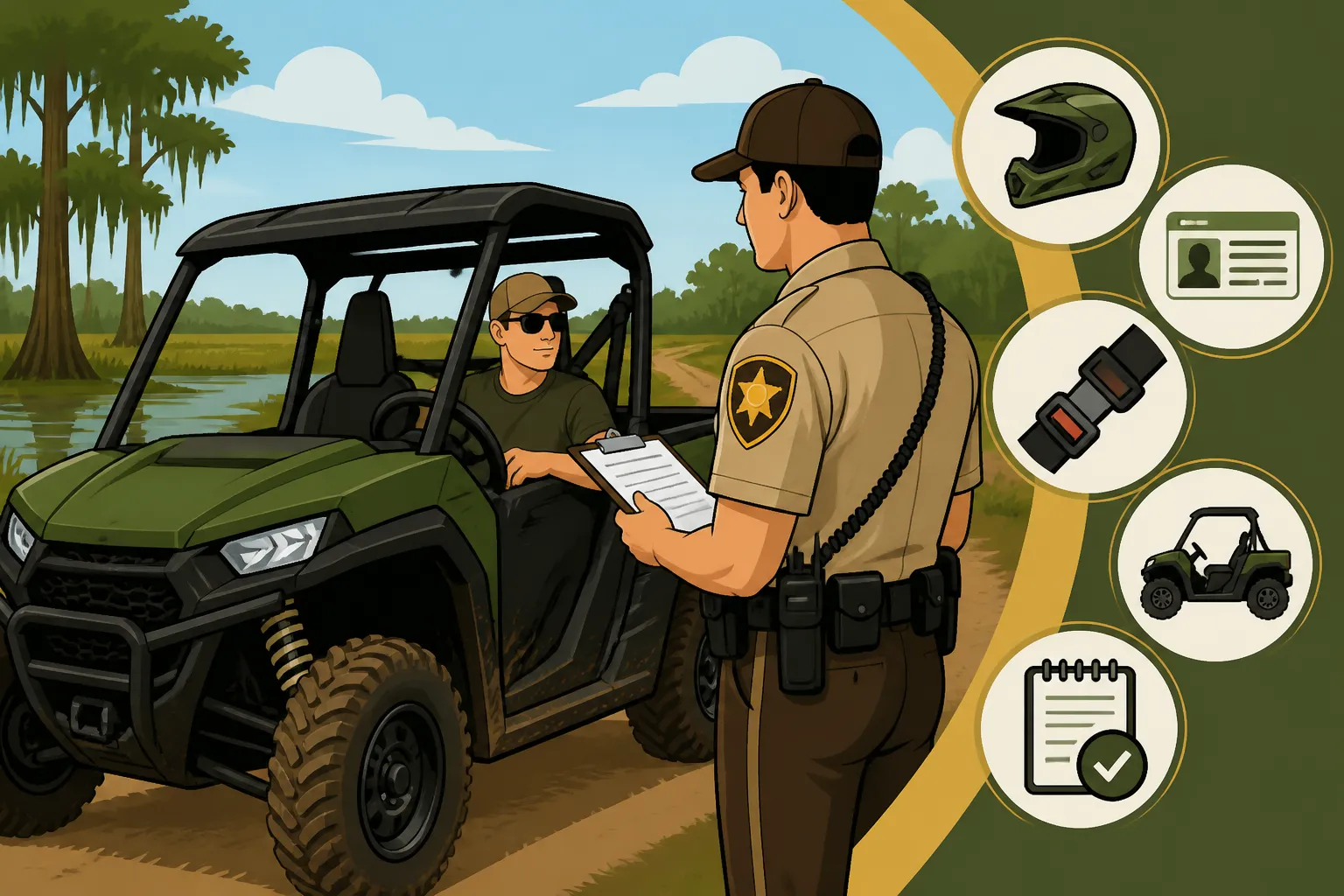
When those lights come on, the first thing to do is remain calm and react safely. Signal, if you have turn signals, and pull over to the safest possible spot. This often means getting completely off the roadway or as far to the shoulder as possible. Turn off your engine and keep your hands visible, perhaps on the handlebars or steering wheel. This helps ease any tension and shows respect for the officer. The deputy will typically approach and ask for your identification, proof of ownership for the machine, and sometimes proof of insurance.
It's your responsibility to produce these documents promptly. While you have the right to remain silent regarding questions that might incriminate you, you are generally required to provide identification and documentation related to the operation of your vehicle. Remember, being polite and cooperative goes a long way. Even if you feel the stop is unwarranted, arguing with the officer at the roadside is rarely productive. Save your challenges for court, if it comes to that. The deputy has the authority to ask for your name, address, and relevant vehicle documents like a title or registration, and they'll definitely want to see your driver's license if you're operating on a public road.
Essential Documents and Proof of Ownership
One of the first things a deputy will ask for is proof that you own the machine and that it's properly authorized for any kind of public use. This isn't just about catching rule-breakers; it's also a critical part of preventing theft and ensuring machines are properly accounted for in the state.
Proof of Ownership: The Title and Bill of Sale
Establishing rightful ownership is paramount. A Louisiana deputy will want to see either a valid title with your name on it or, for a very recent purchase, a properly executed bill of sale combined with the assigned title from the previous owner. The title acts as the official record of ownership, just like with a car or truck. The deputy will cross-reference the Vehicle Identification Number (VIN) on the machine with the VIN on your title to ensure they match. This check helps confirm the machine isn't stolen and belongs to you.
Many riders, especially after a private sale, might be caught in that awkward "I just bought it last week" phase where the title hasn't been officially transferred yet. While understandable, this situation can raise questions. It's crucial to have the previous owner's properly assigned title with you, along with a [Louisiana Notarized Bills of Sale] for a private purchase. Remember, Louisiana requires you to apply for a new title within 30 days of purchase, and the deputy will want to see that you're in the process of doing so if the title isn't yet in your name. This is why [Why an ATV Needs Both a Title and a Decal] is so important – one proves ownership, the other allows legal operation in specific circumstances. For a used machine, the OMV needs to see [Louisiana Requires an Assigned Title for a Used One] when you go to transfer it.
The Louisiana ORV Decal and Its Placement
Beyond ownership, your machine needs to be authorized for certain types of public use through the Louisiana Off-Road Vehicle (ORV) decal. This small sticker is a big deal. The deputy will specifically look for the current [Louisiana's Yearly Off-Road Decal] prominently displayed on your machine. The law states it must be affixed in a clearly visible location, typically on the left rear fender. [Louisiana Decal Placement on a Machine]. This decal indicates that you've paid the annual fee allowing your machine to be ridden on designated public trails, or on the shoulder of roads under the agricultural exemption.
If you're stopped on a public road and you don't have this decal, or if it's expired, it's a clear violation. Even if you're only using the machine on private land, if you venture onto a public road without a decal, you could face consequences. The [Louisiana Penalties for No Decal] can range from fines to impoundment, making it a critical item to check before every ride. It might seem like just a sticker, but it signifies compliance with a key piece of Louisiana’s off-road vehicle law.
Insurance and License Requirements for Road Use
This is where many riders get tripped up, especially those who primarily operate on private land. If you are operating an ATV or UTV on any public road in Louisiana—even the shoulder under the farm exemption, or a parish road that has been officially designated for UTVs—you must have proof of liability insurance. [Louisiana UTV Insurance Minimums] spell out exactly what's needed. A deputy will ask to see this, and if you can't produce it, that's another citation. You’ll need to provide [Louisiana Insurance Proof on Demand].
Furthermore, for operating a UTV on any public road, you are generally required to hold a valid Class E driver’s license. [Louisiana Requires a Class E License]. This means the same license you use to drive your car. While ATVs have slightly different rules regarding licensing for limited road use under specific farm exemptions, UTVs are much more stringent. If you’re driving a UTV on a designated parish road or using the farm exemption, and you don’t have a valid Class E license, you’re looking at a serious violation. Don't assume that just because it's a "back road" or "farm country" that these basic requirements don't apply. They do.
Machine-Specific Equipment and Compliance Checks
Beyond your documents, a deputy will also be looking at the machine itself. Is it equipped properly for where you're riding it? Are there obvious safety concerns? These physical checks are just as important as the paperwork.
Required Equipment for Designated Road Use (UTVs Primarily)
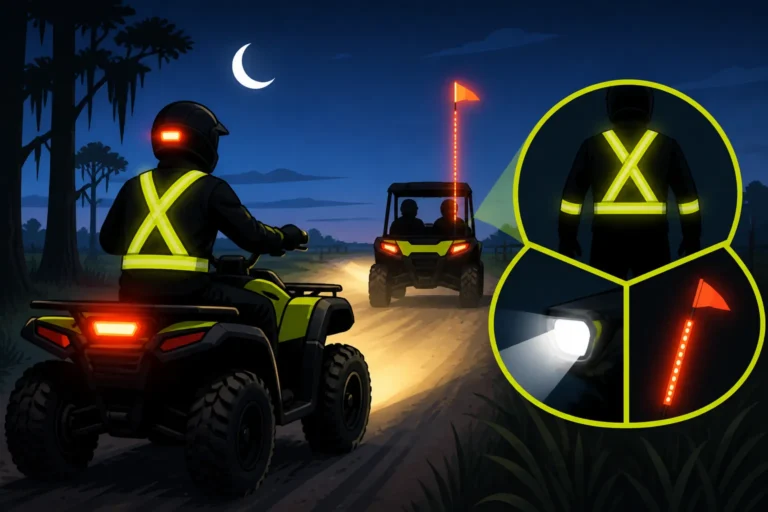
For UTVs that are legally operating on designated public roads, there's a specific list of equipment that must be present and functional. This isn't optional; it's part of what makes a UTV "street legal" on those specific, designated routes. Deputies will check for working headlights, taillights, and brake lights. [Louisiana UTV Road Rules Under 32:299.3] are very clear on this. You'll also need turn signals, a horn, and at least one rearview mirror. Many riders choose to upgrade their machines with aftermarket kits to meet these requirements, and reputable brands like SuperATV offer a range of comprehensive street-legal kits that include all the necessary lighting, mirrors, and horns to get your UTV compliant for designated road use.
In some cases, a windshield and windshield wiper might also be required. The intent behind these rules is simple: to make UTVs as visible and controllable as other motor vehicles when they share the road, even if only on designated segments. If your UTV lacks any of this mandated equipment when operating on a designated road, a deputy will quickly notice, and it could lead to a citation. It's a common mistake for riders to assume "street legal" means they can ride anywhere, but it specifically pertains to [Louisiana Parishes Must Designate and Sign Roads].
General Safety and Compliance: What the Deputy Observes
Even if you're not on a designated road, or if you're using a farm exemption, deputies will still be looking for general safety compliance and observable issues. One key item, especially if you're near or on public trails, is a spark arrestor on your exhaust. [Do Louisiana Forest Trails Require a Spark Arrester?] for many public lands, and a deputy might check if you're close to such areas, as a missing spark arrestor can be a fire hazard. They'll also be listening for excessive noise. While there might not be strict decibel limits for all scenarios, a machine that's clearly modified to be extremely loud can attract attention and complaints, leading to a stop. [Louisiana Noise Complaints About Quads] are real and can lead to enforcement action.
Passenger limits are another area of scrutiny. Most ATVs are designed for a single rider, and [Can You Carry a Passenger on a Louisiana ATV?] generally carries strict rules, especially for children. UTVs are designed for multiple passengers, but everyone must be properly seated and wearing seatbelts if equipped. Helmets are also a factor, particularly for younger riders or in specific circumstances outlined in [Louisiana ATV Helmet Rules]. Finally, the overall condition of your machine matters. Are tires excessively worn or damaged? Is cargo unsecured? While these might not always be direct violations, they can contribute to a deputy’s decision to pull you over for a closer look at your safety practices. Aftermarket accessories, like robust mirrors from SuperATV, can actually enhance visibility and make your machine safer, demonstrating a commitment to responsible riding.
Farm Exemptions and Their Strict Limitations
The agricultural exemption is a lifeline for many Louisiana farmers and landowners, allowing limited road use for their ATVs and UTVs. However, it's arguably the most misunderstood aspect of Louisiana’s off-road vehicle laws. A deputy will carefully evaluate if your use falls within these strict parameters. You should be carrying a [Louisiana Farm Affidavits for Road Use] that has been properly sworn before a notary. This affidavit certifies that your machine is primarily used for agricultural purposes.
But the affidavit alone isn't enough. The deputy will be looking at where you are, and where you're going. The exemption generally applies to riding on the shoulder of a public road, within a [Louisiana's 5-Mile Farm Radius] from your farm. If you're riding down the middle of a travel lane, or you're 10 miles from your property on a joyride, the exemption simply doesn't apply. The [Louisiana Rules for Riding a Shoulder] are explicit: you must stay off the main travel lanes. If you deviate from these rules, even slightly, the deputy will consider you to be operating your machine illegally on a public road, just as if the exemption didn't exist. This often comes as a surprise to riders who believe simply owning a farm exempts them from all road rules.
Common Misconceptions and Penalties
Riding an ATV or UTV in rural Louisiana can be incredibly rewarding, but it’s crucial to separate fact from fiction when it comes to road use. Many common beliefs can lead riders straight into trouble with law enforcement.
The "Rural Road" Fallacy
One of the biggest misconceptions among off-road enthusiasts is that "rural roads" or "back roads" are fair game for ATVs and UTVs. This simply isn't true in Louisiana. Just because a road is unpaved, sparsely traveled, or winds through fields and forests, doesn't automatically mean it's legal to ride your off-road machine on it. Louisiana's statutes apply statewide, meaning unless a parish or municipality has specifically designated a road or street for UTV use, or you are operating under a very specific exemption like the farm use rule, it's off-limits.
Deputies are well aware of this fallacy. They know that many riders assume "out in the sticks" means "no rules apply." This leads to frequent stops for what many riders feel is a harmless trip. The burden is on the parish to [Louisiana Parishes Must Designate and Sign Roads] with appropriate signage if they want to allow UTVs on them. Without that official designation and signage, you're usually in violation if you're on a public thoroughfare. It’s essential to understand that "private land" is distinct from "public road," regardless of how rural or quiet that public road may seem.
Penalties and Consequences
The consequences of being found in violation of Louisiana's ATV and UTV road rules can be significant, extending beyond just a verbal warning. The most immediate outcome is usually a fine. [Louisiana Ticket Costs for Road Riding] can vary widely depending on the specific infraction, but they can quickly add up, especially if you're cited for multiple violations (e.g., no decal, no insurance, no license). Beyond the initial fine, you'll also be responsible for [Louisiana Court Costs for a Citation] if you choose to dispute the ticket or if it requires a court appearance.
In more serious cases, or for repeat offenders, your machine could even face [Louisiana Impoundment for No Decal] or other major infractions. Having your ATV or UTV towed and stored can be an expensive and time-consuming headache to resolve. Furthermore, certain violations, especially those involving operating without a license or insurance, can impact your regular driving record and potentially lead to increased insurance premiums for all your vehicles. It's a tough lesson to learn, but ignorance of the law is rarely accepted as an excuse. While it might feel frustrating to be cited for simply trying to get down the road, deputies are enforcing state statutes designed for safety and order on public thoroughfares.
Proactive Steps for Compliance
The best way to avoid a stressful encounter with a deputy is to be proactive and ensure your machine and your riding habits are fully compliant with Louisiana law. Start by taking the time to [Louisiana Parish Ordinance Lookups] for any parish you plan to ride in, to see if specific roads or streets have been designated for UTV use. Don't rely on word-of-mouth; check official sources.
Always keep your essential documents—title, decal, insurance card, and driver's license—readily accessible and in a waterproof bag on your machine. This makes for a smooth stop if you are pulled over. If you frequently use your UTV on designated public roads, consider investing in a high-quality street-legal kit. Brands like SuperATV specialize in these kits, offering durable and compliant components that can transform your UTV to meet necessary road-use requirements, from turn signals to mirrors, ensuring you're not caught off guard. Even though [Louisiana Has No Mandatory Safety Course] for ATVs, taking one is always a good idea to refresh your knowledge of safe and legal riding practices. Taking these steps can save you time, money, and a lot of headaches in the long run, letting you enjoy your Louisiana ATV and UTV adventures with peace of mind.
| Document/Item | What a Deputy Checks For | Why It's Important |
|---|---|---|
| Driver's License (Class E) | Valid, current, and appropriate class for the vehicle (UTV). | Required for operating any motor vehicle on public roads. |
| Vehicle Title/Proof of Ownership | VIN matches machine, name on title, proper assignment if recently purchased. | Verifies legal ownership and helps prevent theft. |
| Louisiana ORV Decal | Current, properly affixed, visible on the left rear fender. | Authorizes use on designated trails and shoulders under specific conditions. |
| Proof of Insurance | Valid liability policy, meets state minimums for road use. | Mandatory for all vehicles on public roads in Louisiana. |
| Farm Affidavit (if applicable) | Properly notarized, certifies agricultural use. | Necessary to qualify for the farm-use exemption for limited road shoulder riding. |
| Required Equipment (UTV on designated roads) | Headlights, taillights, brake lights, turn signals, horn, rearview mirror(s). | Ensures visibility and signaling capabilities for safer road sharing. |
| Passenger Compliance | Appropriate number of passengers, everyone seated properly, helmet use if required. | Safety of occupants, adherence to machine design and age rules. |
| Machine Condition | Visible safety hazards, excessive noise, spark arrestor (if applicable). | General safety, environmental compliance, and noise regulations. |
Disclaimer
This article is for general informational purposes only and does not constitute professional advice. Laws, prices and regulations vary by location and change over time. Consult a qualified professional for guidance on your specific situation.