Campus Employees Who May Ride University Streets
It's a common dilemma for university employees in Louisiana: you own an ATV or a UTV, and you know how incredibly useful these machines are for hauling gear, covering ground quickly, or maintaining sprawling properties. Naturally, you might wonder if your trusty off-road vehicle could become an essential part of your daily job on campus, saving you time and effort. But the rules around riding off-road machines on university streets are far from straightforward, often feeling like a tangled web of state statutes and campus-specific policies. This guide is here to untangle that web, helping you understand precisely when and how university employees might legally and practically operate ATVs and UTVs on Louisiana university streets.
Understanding Louisiana's General Road Rules for ATVs and UTVs
Before we even get to the specifics of university campuses, it's crucial to grasp the foundational rules that govern ATVs and UTVs on public roads in Louisiana. This context is essential because, even on a university campus, many roads are effectively treated as public thoroughfares.
The Baseline: Off-Road Means Off-Road
Let's be blunt: in Louisiana, ATVs and UTVs are primarily designed and intended for off-road use. The state’s general stance is that these machines simply don't belong on public streets and highways. This isn't just a suggestion; it's enshrined in law. [Louisiana ATV Road Rules Under 32:299] and [Louisiana UTV Road Rules Under 32:299.3] clearly lay out these restrictions. The reasoning is rooted in safety and design: ATVs and UTVs lack many of the safety features required for road-going vehicles, like full crash protection, specific lighting configurations, and often, the stability needed for higher speeds or unpredictable traffic. They are built for dirt, mud, and trails, not asphalt.
Think about it from a common-sense perspective. Your sport quad, with its knobby tires and lack of turn signals, isn't exactly suited for merging onto a busy four-lane street. Even a larger UTV, while more stable, often doesn't meet the stringent federal motor vehicle safety standards for highway use. Many university campuses, while technically private property, contain roads that are open to the public, connect to municipal streets, and see regular vehicle and pedestrian traffic. This blending of public and private access means the general "off-road means off-road" rule applies to a significant portion of a university's road network, making it tricky for employees to simply assume they can ride their personal machines.
Limited Exceptions to the Rule
Now, like almost every rule, there are exceptions. Louisiana law does carve out specific scenarios where ATVs and UTVs can legally operate on public roads. These typically include agricultural purposes, certain utility work, and use by authorized law enforcement or emergency personnel. For example, a farmer might be able to ride an ATV on a public road for a short distance to access another part of their land, provided they adhere to specific rules like maintaining a certain speed and carrying proper identification. Similarly, [Louisiana Law Enforcement Exceptions] and [Louisiana Paramedic Exceptions] allow these professionals to utilize off-road machines in the course of their duties, often for reaching remote areas or during special events where traditional vehicles aren't practical.
However, it's crucial not to misinterpret these exceptions. They are highly specific and narrowly defined. Just because a state trooper can ride a UTV down a city street in a parade doesn't mean a university groundskeeper can do the same to get to the athletic fields. These exceptions are rarely, if ever, designed to cover general commuting or convenience for employees who simply own an ATV or UTV. The critical takeaway here is that if a university employee wants to ride an off-road machine on campus roads, they need a very clear, explicit, and legally recognized exception that directly applies to their situation. Without it, they're operating in violation of state law, regardless of whether the campus roads feel "private."
University Policies and Specific Exemptions for Employees
This is where the rubber meets the road (pun intended!) for university employees. While the general state law restricts off-road vehicles from public roads, there are specific provisions that address university campuses.
The "University Campus Exceptions" in Louisiana Law
The good news for some university employees is that Louisiana law does provide a pathway for using certain off-road machines on campus. Specifically, for utility vehicles (UTVs), Louisiana Revised Statute 32:299.3, which governs UTVs on public roads, includes an explicit exemption for "employees of a university or college acting in the course and scope of their employment." This is a significant detail, as it recognizes the practical need for these vehicles in managing large academic institutions. [Louisiana University Campus Exceptions] are not a blanket allowance, though. The phrase "acting in the course and scope of their employment" is paramount. It means the UTV use must be directly related to the employee's job duties and necessary for them to perform those duties effectively. It's not for personal errands, commuting to and from work, or leisurely rides around campus.
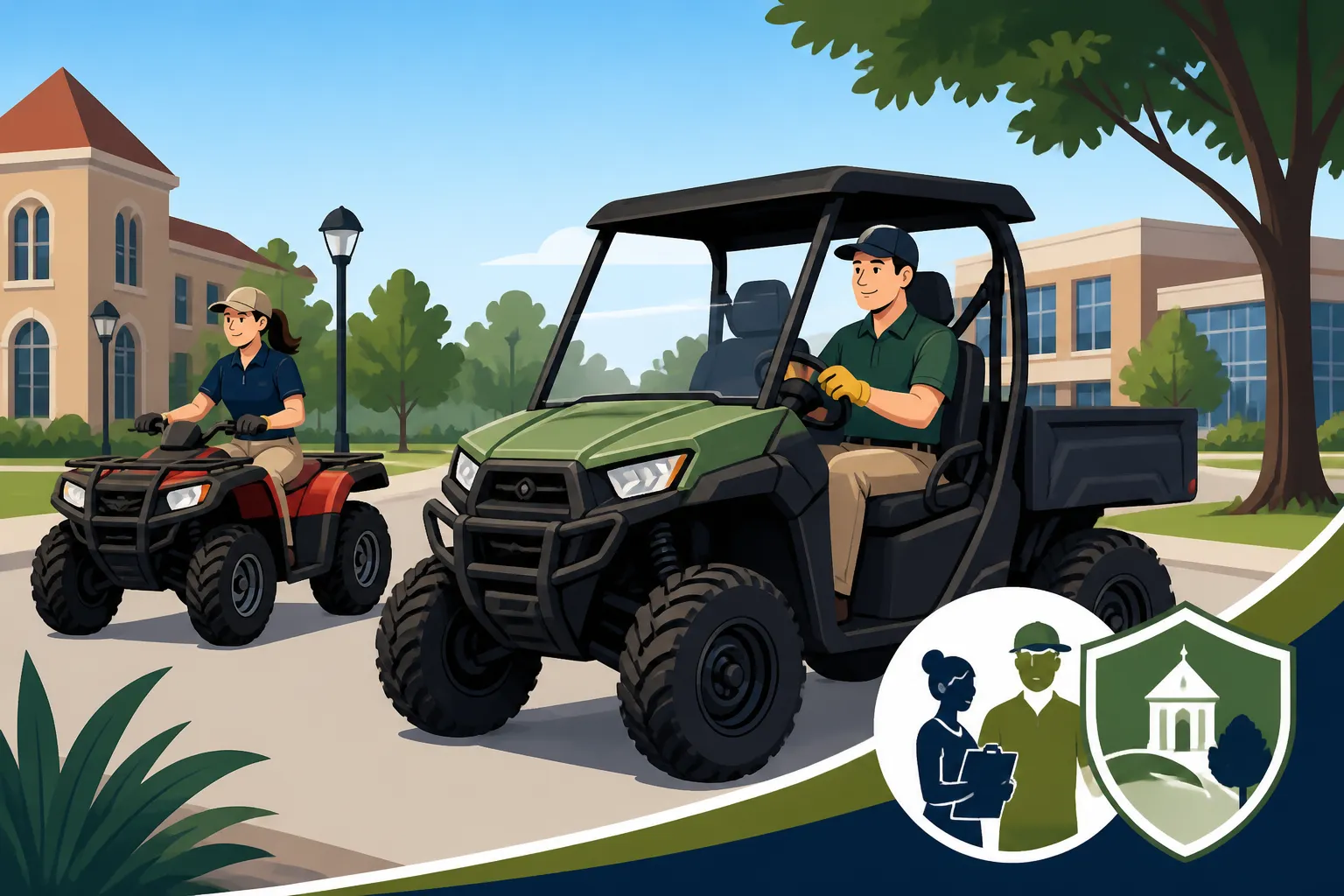
For instance, this exemption could apply to a facilities management crew using a UTV to transport tools and materials across a large campus, or groundskeepers moving lawn care equipment from one section to another. Athletic department staff might use a UTV to set up equipment on practice fields or transport injured athletes. Campus security personnel could use a UTV for patrols in areas not easily accessible by car, or during large campus events. The key is that the vehicle is being used as a piece of work equipment, not as personal transportation. The statute often specifies "utility vehicles" (UTVs) in these exemptions, which typically excludes ATVs due to their differing design and purpose, as we'll explore further.
University-Specific Regulations and Internal Approvals
While state law provides the authorization for these exceptions, it doesn't automatically mean you can just drive your personal UTV to work and start using it on campus. Each individual university in Louisiana has the autonomy—and the responsibility—to establish its own internal policies and procedures for implementing this state-level exemption. This means what's permissible at Louisiana State University might differ slightly from the policies at the University of Louisiana at Lafayette or Tulane University. It's not a "one-size-fits-all" situation across the state.
Therefore, any employee hoping to utilize an off-road machine for work on campus must first consult their specific institution's policies, typically found through their departmental administration, facilities management, or campus police. You'll likely encounter a formal approval process. This might involve:
- Departmental Approval: Your direct supervisor and department head will need to sign off, confirming the use is essential to your job.
- Machine Inspection: The university might require an inspection to ensure the machine is in safe operating condition, with working lights, brakes, and tires suitable for campus roads. They may even have requirements for specific safety modifications.
- Designated Routes and Areas: You might be limited to certain roads or areas, perhaps avoiding high-pedestrian zones or main thoroughfares during peak hours.
- Training Requirements: Some institutions may mandate specific safety training for operating UTVs on campus.
- Insurance: Even if the state doesn't require insurance for off-road use, the university almost certainly will for vehicles operating on its property, especially if there's any public access. This would ensure liability coverage in case of an accident. [Louisiana UTV Insurance Minimums] would be a good benchmark for what your institution might expect.
- Vehicle Identification: The university may require the machine to be marked with university decals, fleet numbers, or other identifiers, making it clear it's an authorized vehicle.
Consider a grounds crew employee at LSU, for example. They might be tasked with maintaining the extensive landscaping around Tiger Stadium. Instead of pushing a heavy cart or making multiple trips in a golf cart, a SuperATV UTV equipped with a cargo bed would be incredibly efficient for hauling tools, mulch, or even small trees. However, to use this UTV, they'd first need their supervisor's approval, undergo any required training, ensure the UTV has university markings, and follow specific routes approved by campus facilities, avoiding game day crowds or busy class-change times. It's about balancing efficiency with safety and compliance.
Practical Considerations and Compliance for Campus UTV Use
Once a university employee receives the green light to operate a UTV on campus, understanding the practical implications and maintaining strict compliance is absolutely critical. This isn't just about following rules; it's about ensuring safety for everyone on campus.
Machine Requirements and Safety Protocols
Even under an authorized campus exemption, the UTV itself must be up to par. It's not enough that the machine simply "runs." Universities will almost invariably impose their own safety standards, which often go beyond what might be acceptable for purely off-road trail riding. You should expect that the university will require the machine to be equipped with and maintain basic safety features, regardless of whether they are strictly mandated by the state for off-road vehicles. This typically includes:
- Headlights and Taillights: Essential for visibility, especially during dawn, dusk, or in inclement weather.
- Brake Lights: To signal deceleration to other vehicles and pedestrians.
- Turn Signals: While not always required for off-road, a university may mandate them for campus road use to improve communication in traffic.
- Mirrors: Side mirrors and a rearview mirror greatly enhance the operator's situational awareness, a must in a busy campus environment.
- Seatbelts: Operators and any authorized passengers should always be buckled up.
- Brakes: The braking system must be in excellent working order.
- Tires: Tires should be appropriate for mixed-surface use (pavement and grass) and in good condition, not overly worn or damaged.
Beyond the machine itself, operator safety training is paramount. Even seasoned off-road riders might not be accustomed to navigating pedestrian traffic, bicycle lanes, or sharing roads with cars in a constrained campus setting. Universities often provide or require specific training modules covering campus traffic laws, pedestrian right-of-way, safe loading and unloading of cargo, and emergency procedures. Remember, [Louisiana Traffic Law Still Applies] on campus roads, even if the machine isn't fully street-legal. This means following speed limits, stopping at stop signs, and yielding to pedestrians are non-negotiable.
Operational Guidelines and Potential Pitfalls
Operating a UTV on campus comes with a strict set of operational guidelines. These aren't arbitrary; they're designed to protect the driver, passengers, pedestrians, and university property. Speed limits on campus roads are usually much lower than public streets, and UTV operators must adhere to them rigorously. Pedestrian safety is paramount; UTVs must yield to pedestrians at all times, especially in crosswalks and high-traffic areas. Universities will likely designate specific paths or roads for UTV use, prohibiting them from open green spaces, sidewalks not designated for vehicles, or areas with dense foot traffic.
Passengers are another critical consideration. Unless the UTV is specifically designed and approved to carry multiple passengers for job-related purposes (like a maintenance crew transporting equipment and two workers), single-occupancy is often the rule. For example, a SuperATV Crew Cab UTV would be appropriate for carrying multiple workers, but a two-seater would not be used to transport four people. Avoiding high-traffic areas during peak class-change times, lunch rushes, or special events is a common restriction, sometimes requiring alternative routes or timing for tasks.
The consequences of non-compliance can be severe, ranging from internal disciplinary action (up to and including termination for repeated or serious infractions), loss of the privilege to operate a UTV, and even potential legal ramifications if state laws are violated or an accident occurs. It's vital to always remember the "course and scope of employment" limitation. A history professor, for instance, cannot simply decide to drive their personal UTV to their office every day unless their specific job duties genuinely require it (e.g., managing a large botanical garden on campus grounds). Using it as a personal vehicle, even if allowed for work tasks, is an instant red flag. Lastly, if the UTV is primarily for campus use and requires road travel, even within campus, checking into [Louisiana UTV Registration Before Road Use] might be a prudent step, depending on how the university categorizes and registers its fleet.
What About ATVs on Campus?
When we talk about off-road machines on university campuses, there's a significant distinction that often gets overlooked: the difference between ATVs and UTVs. While the state statute allows exceptions for "utility vehicles," the same flexibility rarely extends to ATVs.
UTVs vs. ATVs in Campus Operations
This distinction is crucial. Most university campus exceptions in Louisiana law, and consequently in university policy, specifically refer to "utility vehicles" (UTVs), not all-terrain vehicles (ATVs). Why the difference? UTVs, often referred to as side-by-sides, are generally regarded as more stable machines with a wider wheelbase, a roll cage, and often, seating for two or more passengers side-by-side, much like a small car or truck. They also typically come with a cargo bed or attachment points for utility equipment, making them incredibly versatile for work tasks. These design features make UTVs inherently safer and more practical for the varied demands of campus operations, such as hauling tools, transporting personnel, or carrying equipment.
In contrast, ATVs are single-rider machines (with limited exceptions for factory-designed two-up models), often with a narrower track, handlebars for steering, and a different center of gravity. While excellent for navigating challenging off-road trails and recreational riding, their design makes them less suitable and inherently riskier for mixed-use campus roads where they interact with pedestrians, bicycles, and other vehicles. Universities prioritize safety and liability, and the general perception of UTVs as "work vehicles" versus ATVs as "recreational vehicles" heavily influences policy. You're far more likely to see a maintenance crew using a Polaris Ranger, a John Deere Gator, or a SuperATV Defender for campus work than a sport quad. The [Louisiana UTV Drivers to Be 21] age requirement, for instance, highlights how even UTVs are treated with specific rules that don't always apply to younger ATV riders on private land, further differentiating their use context.
The Role of Specific Job Duties
The core principle remains the "course and scope of employment" clause. Even if a particular department somehow possessed an ATV, its use on campus roads would be extremely restricted—far more so than a UTV. An ATV simply doesn't lend itself to the typical utility tasks required for campus work. It's difficult to transport significant tools or materials, and carrying passengers on an ATV is generally discouraged and often illegal for non-designated models.
Consider a hypothetical: A university owns a large agricultural research station with extensive unpaved field roads that are truly off-road. In such a highly specific scenario, an ATV might be authorized for an employee to quickly access remote plots for fieldwork. However, this would still be under strict internal policy, likely requiring an [Louisiana Requires a Class E License] (as campus roads are often considered public in terms of driving rules), special training, and definitely not on the main paved campus roads that see daily traffic. [Louisiana Bans ATVs From Travel Lanes] is a strong indicator that even within a campus context, ATVs are not designed for shared road use with vehicles or pedestrians. It's a rare and highly specialized exception, if one exists at all, for an ATV to be a legitimate work vehicle on university streets, further underscoring that the legal "campus exception" is almost exclusively for UTVs.
| Feature / Aspect | Utility Terrain Vehicle (UTV / Side-by-Side) | All-Terrain Vehicle (ATV / Quad) |
|---|---|---|
| Seating | Side-by-side seating for 2, 3, 4, or 6 passengers | Straddle seating for 1 (sometimes 2 on specific models) |
| Steering | Steering wheel | Handlebars |
| Cargo Capacity | Often includes a cargo bed for hauling tools, materials, equipment | Limited cargo racks, typically for small loads or gear |
| Stability | Generally wider wheelbase, lower center of gravity, perceived as more stable | Narrower, higher center of gravity, more agile, less stable on pavement |
| Safety Features | Roll cage, seatbelts standard, often more robust lighting packages | Helmets required, less inherent crash protection, fewer standard safety features |
| Typical Campus Use | Groundskeeping, maintenance, security patrols, athletic equipment transport | Highly limited, perhaps only for specialized fieldwork on unpaved areas |
| Legal Exemption | Explicitly mentioned in Louisiana R.S. 32:299.3 for campus employees | Generally excluded from campus road exemptions due to design and intent |
| Driver Age (LA) | Generally 21 for road use, 16 for off-road | 10 (supervised), 16 (unsupervised) for off-road |
Disclaimer
This article is for general informational purposes only and does not constitute professional advice. Laws, prices and regulations vary by location and change over time. Consult a qualified professional for guidance on your specific situation.