Every Legal Road Trip Has to Be Farm Related
It's a common sight in rural Louisiana – an ATV or UTV zipping down a public road, often making you wonder, "Is that even legal?" Many riders, new and seasoned, grapple with conflicting information and assumptions about where they can and can't ride their off-road machines. This guide is here to untangle the confusion surrounding Louisiana's complex laws, specifically clarifying the very limited circumstances under which your ATV or UTV can legally touch a public road, focusing on the critical requirement that every legal road trip must be farm-related.
The Strict Reality: When Can Your ATV or UTV Legally Touch a Louisiana Road?
Many folks move to Louisiana or buy their first ATV or UTV with a hopeful vision of cruising down country roads, perhaps to a friend's house or a local store. It feels natural, doesn't it? Especially in areas where the fields stretch for miles and the nearest town is a good drive away. You see others doing it, so it must be okay, right? Unfortunately, this common assumption can lead to a rude awakening in the form of a hefty ticket or even an impounded machine. Louisiana law is incredibly specific, and it generally draws a very clear line: ATVs and UTVs are primarily for off-road use, and their presence on public roadways is heavily restricted. It's not about convenience or local custom; it's about the letter of the law.
Dispelling Common Misconceptions
Let's clear the air on some persistent myths. First, just because a road is unpaved, gravel, or seems "rural" doesn't automatically make it legal for your ATV or UTV. Public roads are public roads, whether they're asphalt highways or dirt tracks leading to a back forty. Second, the idea that "everyone does it" is absolutely no defense if you're stopped by a state trooper or parish sheriff. Enforcement varies, yes, but the law itself does not. Third, simply having a title or even an off-road decal doesn't grant you carte blanche to cruise down the highway. The title proves ownership, and the decal permits off-road operation, but neither is a license for public road travel. The rules are much stricter for these machines than they are for, say, a golf cart in a designated community.
The core principle here is that ATVs and UTVs are not street-legal vehicles in the traditional sense. They lack many of the safety features, like sealed cabins, seatbelts for all occupants (in ATVs), or turn signals, that are standard on cars and trucks. The state, for the most part, wants to keep them off roadways where they can pose a significant safety risk to their operators and other motorists. It's a tough pill to swallow for some, especially those who live in remote areas, but understanding this fundamental restriction is the first step to staying out of trouble.
The "Farm Use" Mandate: What It Truly Means
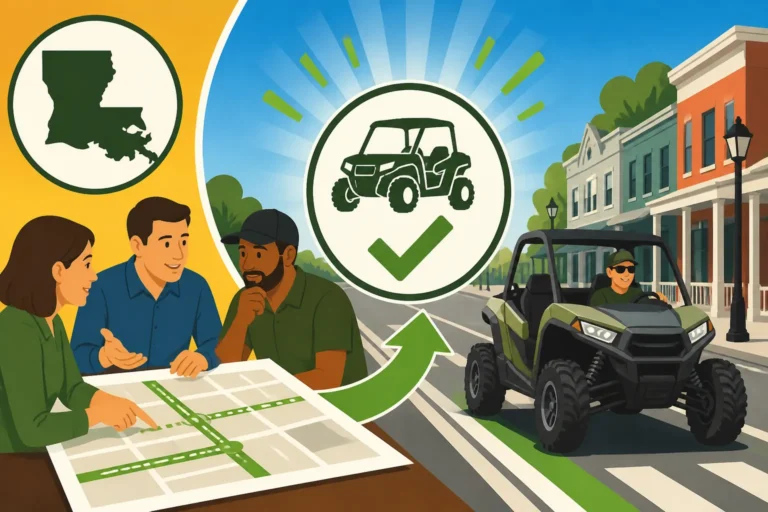
Here's where the title of this guide truly hits home. [Louisiana ATV Road Rules Under 32:299] and [Louisiana UTV Road Rules Under 32:299.3] carve out very narrow exceptions for agricultural purposes. What does this mean in practical terms? It means your reason for being on that public road must be directly tied to farming, ranching, or other bona fide agricultural activities.
Imagine you're a farmer needing to move your UTV from one field to another, perhaps across a two-lane parish road to access a different section of your property. Or maybe you're checking fence lines on a large cattle ranch that straddles a public easement. These are the kinds of scenarios the law is designed to accommodate. It's not for a quick run to the convenience store for a soda, not for visiting your cousin down the street, and certainly not for joyriding. The intent behind your journey is paramount, and it must demonstrably be agricultural. Without this direct farm connection, your machine should simply not be on a public thoroughfare.
Why Non-Farm Rides Are Off-Limits
It bears repeating: if your trip isn't about farm work, it's very likely illegal. The statutes are quite clear in limiting exceptions to "agricultural purposes." This isn't just about avoiding a ticket; it's also about safety and liability. ATVs, in particular, are designed with a high center of gravity and a narrow wheelbase, making them inherently unstable on paved roads, especially at higher speeds or during sharp turns. UTVs, while more stable, still lack the crash protection of an automobile.
If you have an accident on a public road while operating your ATV or UTV for non-farm reasons, you could face severe legal and financial repercussions. Your insurance company might deny coverage, citing illegal operation. You could be held personally liable for damages or injuries. It's a risk simply not worth taking. Think of it this way: your ATV or UTV is a powerful tool for work and recreation off the beaten path. Keep it there, unless its specific purpose on the road directly serves your agricultural needs. Even if you're using aftermarket parts from companies like SuperATV to enhance your machine's utility, those enhancements don't magically grant you street-legal status for non-farm activities. The law focuses on the purpose of the travel, not the machine's capabilities.
Understanding Louisiana's Farm Exemption for Road Use
So, you're a farmer, and you absolutely need to move your machine from one part of your farm to another, or access a field that requires a brief stint on a public road. Great! The law does provide a pathway for this, but it's crucial to understand the very specific parameters. It's not a free pass, but rather a carefully defined exception designed to support the agricultural community while maintaining public safety. This exemption is a lifesaver for many who rely on their machines for their livelihood, but it demands strict adherence to its requirements.
Defining "Agricultural Purposes"
Louisiana law broadly defines "agricultural purposes" to include activities related to farming, ranching, timber operations, and even certain types of aquaculture. This isn't just about plowing fields or herding cattle. It can extend to things like hauling tools to a worksite on a farm, inspecting crops, checking irrigation systems, or transporting supplies needed for your operation. For example, if you're moving fencing materials from your barn to a pasture down the road, that generally falls under agricultural purposes. If you're using your side-by-side to access a rice levee or a crawfish pond, that also fits the bill. The key is that the activity must be directly tied to the production, cultivation, harvesting, or care of agricultural commodities, livestock, or timber.
It's important to differentiate this from mere recreational use on farm property. While you might recreate on your farm, the moment you take that machine onto a public road, the activity must pivot to a legitimate agricultural task. A casual ride around the perimeter of your property that happens to cross a road, without a specific farm-related objective, typically wouldn't qualify. This distinction is vital for avoiding potential penalties.
The Critical 5-Mile Radius Rule
One of the most defining aspects of Louisiana's farm exemption is [Louisiana's 5-Mile Farm Radius]. Your legal road travel is generally limited to within a five-mile radius of the main body of your farm or property. This rule is designed to ensure that the road use is truly incidental and directly connected to operations on your contiguous or closely related agricultural land. You can't, for instance, use this exemption to drive your ATV 20 miles to pick up parts for your tractor from a dealership in another town, even if those parts are for farm equipment. That would exceed the radius and violate the spirit of the law, which is to facilitate short-distance movement essential to farm continuity.
This radius is measured from the nearest boundary of the farm property. It's not from your mailbox or your house, but the actual edge of your land. So, if your property line is right next to a parish road, and you need to access a field half a mile away across that road, you're well within the five-mile limit. But if that field is six miles away, you'll need to trailer your machine, not ride it. This rule underscores that the exemption is for localized, practical farm operations, not extended travel. You also need to keep to the shoulder as much as possible, as stipulated by [Louisiana's Shoulder-Only Farm Exception].
Required Documentation: Your Farm Affidavit
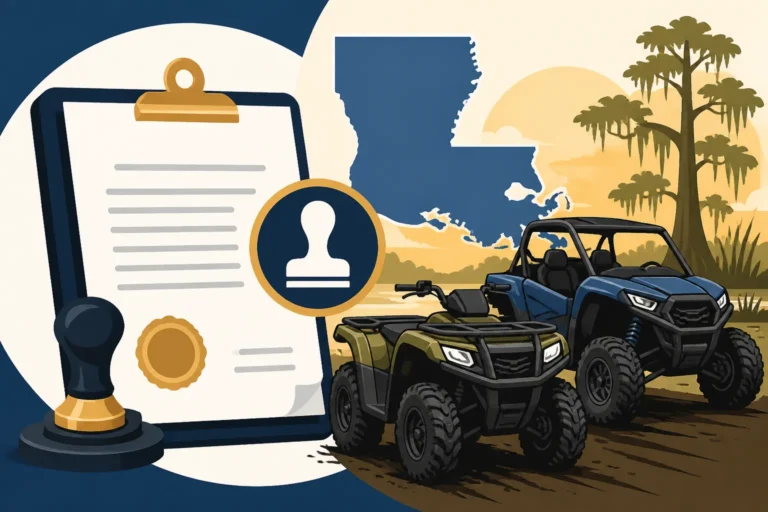
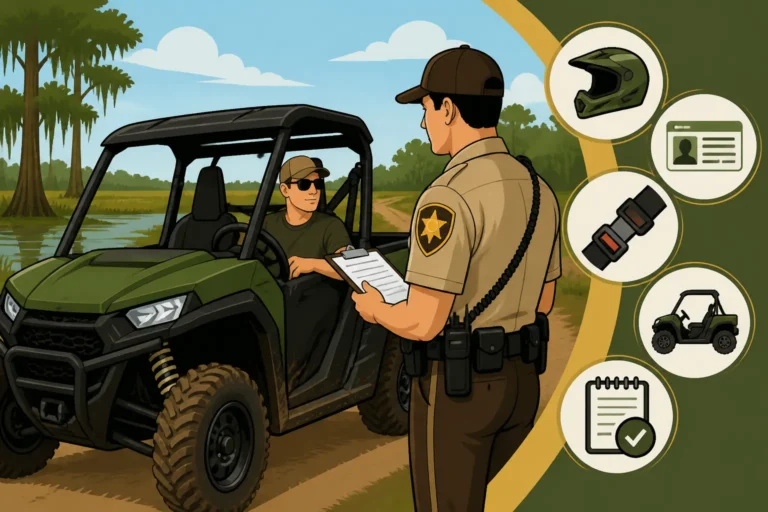
To legally take advantage of this farm exemption, you need to be prepared to prove your machine's farm-only use. This often means carrying [Louisiana Farm Affidavits for Road Use]. This affidavit is a sworn statement, often requiring a notary, declaring that your ATV or UTV is exclusively used for agricultural purposes. It acts as your official documentation to show law enforcement if you're stopped. Without it, even if you are genuinely engaged in farm work within the five-mile radius, you might still face questions or a citation because you lack the required proof.
It's wise to keep this document, along with proof of ownership (title or registration), on your person or securely stored on your machine whenever you plan to use it on a public road for farm purposes. Think of it as your "hall pass" for limited road access. Some riders laminate it or keep it in a waterproof pouch to protect it from the elements. Don't assume that because your property is clearly a farm, you won't be asked for documentation. Law enforcement officers are trained to enforce the statutes, and having your paperwork in order makes their job easier and keeps you out of trouble. Remember, [Carrying an Affidavit Sworn Before a Notary] is often the recommended way to ensure its validity.
Navigating Public Roads: Rules and Restrictions
Even when you meet the strict farm-related criteria and stay within the five-mile radius with your affidavit in hand, simply getting on the road isn't a free-for-all. There are still very specific rules of the road that apply to ATVs and UTVs in Louisiana. These aren't just suggestions; they are legal requirements designed to minimize risk to yourself and others. Ignoring these can quickly negate the farm exemption and land you in hot water. Whether you're making a brief crossing or traversing a short stretch of shoulder, every aspect of your operation matters.
Designated Roads and Parish Ordinances
While [Louisiana's 2015 UTV Statute] provides the overarching framework, local parishes and municipalities have some authority to designate specific roads or streets for UTV use. This is a crucial distinction, as these local ordinances can sometimes expand (or further restrict) where UTVs can operate. However, it's vital to understand that these designations are not universal and often come with their own set of rules, such as speed limits, hours of operation, or even helmet requirements. For ATVs, the rules remain far more stringent, generally limiting them to the farm-related shoulder use. [Louisiana's 2022 UTV Amendment] further clarified some aspects.
It's your responsibility to know the local laws in any parish or municipality where you plan to ride, even for farm-related purposes. [Louisiana Parish Ordinance Lookups] and [Louisiana Municipal Ordinance Lookups] can be your best friends here. A road designated for UTVs in one parish might be entirely off-limits in a neighboring one. Furthermore, [Parishes Have to Post Signs on Designated Roads] to make it clear where UTVs are permitted. If you don't see signage, assume it's not designated. This can be particularly frustrating for riders who cross parish lines as part of their farm operations, as the rules can change literally from one side of the road to the other.
Crossing Public Highways: Incidental Use Only
Even if you're riding your ATV or UTV on a legal shoulder for farm purposes, [Louisiana Crossings of Public Roads] are still heavily regulated. The law generally permits crossing public roads only when it's "incidental" to your farm operation. This means you should cross at a 90-degree angle, as directly and safely as possible, to continue your farm work on the other side. You cannot drive along a major highway for an extended period, even on the shoulder, just to get to a crossing point further down. The crossing must be a minimal, necessary interruption of your off-road or shoulder travel.
Furthermore, when crossing, you must yield to all other traffic. Your off-road machine is not given priority. Treat every crossing as if you are pulling out of a private driveway onto a busy street. This requires extreme caution, good visibility, and often, an additional set of eyes if you're riding with someone else. For example, if you've got a UTV outfitted with a SuperATV lift kit and oversized tires for field navigation, remember that its larger profile might change how other motorists perceive your speed or distance when crossing. Always assume other drivers might not see you, especially on high-speed roads.
Equipment Requirements for Road Travel
While your ATV or UTV isn't a car, Louisiana law does impose certain equipment requirements if you plan to use it on public roads, even under the farm exemption. These are primarily for visibility and safety. You need proper lighting: headlights, taillights, and brake lights are generally a must, especially if there's any chance you'll be operating around dusk or dawn. Many modern UTVs come with these standard, but older ATVs might require upgrades. [Louisiana Lighting Rules on a Machine] dictate what's necessary.
Beyond lighting, you'll need to ensure your machine is in good working order, with functional brakes and steering. While not explicitly stated for farm-use road travel, having some form of reflective material or bright flagging can significantly improve your visibility to other motorists, especially on dusty rural roads or in low-light conditions. And, of course, you must possess a valid driver's license, typically a Class E, to operate any motor vehicle on a public road in Louisiana. [Louisiana Requires a Class E License] for such operations, so ensure your license is current and appropriate for road use. Don't forget that [What a Class E License Lets You Do] includes driving most non-commercial vehicles, and your off-road machine on a public road falls under that umbrella.
Here's a quick summary of key requirements for farm-related road use:
| Requirement | ATV (Farm Use) | UTV (Farm Use) | UTV (Designated Roads) |
|---|---|---|---|
| Purpose | Agricultural only | Agricultural only | Agricultural or designated local use |
| Location | Within 5-mile radius of farm, on shoulder | Within 5-mile radius of farm, on shoulder | Designated parish/municipal roads, shoulder allowed |
| Driver's License | Class E | Class E | Class E |
| Affidavit | Required (for farm exemption) | Required (for farm exemption) | Recommended (if primarily farm use), check local rules |
| Lighting | Headlights, taillights, brake lights | Headlights, taillights, brake lights | Headlights, taillights, brake lights, turn signals |
| Crossing Roads | Incidental only, yield to traffic | Incidental only, yield to traffic | Incidental or as permitted by local ordinance |
| Speed Limit | Reasonable, often lower than posted speed | Reasonable, often lower than posted speed | As posted, or as designated by local ordinance |
| Insurance | Recommended, not legally required for farm use | Recommended, not legally required for farm use | Required by law for designated road use |
| Designated Roads | Generally not permitted | Generally not permitted unless specified by ordinance | Yes, if designated by local parish/municipality |
Consequences of Illegal Road Riding
It's easy to think, "What's the harm? It's just a short hop down the road." But the potential ramifications of illegally riding your ATV or UTV on public roads in Louisiana can be severe and far-reaching, impacting your wallet, your machine, and even your freedom. Law enforcement in Louisiana, from state troopers to local deputies, are well aware of the regulations concerning off-road vehicles and their limitations on public thoroughfares. They are increasingly vigilant, especially in areas where these machines are prevalent.
Fines, Impoundment, and Legal Troubles
The most immediate consequence of being caught riding illegally is a citation. The fines can be substantial, often ranging from hundreds to potentially thousands of dollars, depending on the specific violation and whether it's a first offense or repeat infraction. But a ticket is often just the beginning. Law enforcement has the authority to impound your ATV or UTV if it's being operated illegally. This means your machine could be towed away, and you'd be responsible for towing fees, storage fees, and the original citation before you can even get it back. Imagine having your prized UTV, perhaps one you've invested heavily in with accessories from SuperATV, sitting in an impound lot, racking up daily fees. It's a frustrating and expensive ordeal that can easily exceed the cost of simply trailering your machine.
Beyond the financial penalties, repeated offenses or reckless operation could lead to more serious legal troubles, including charges for reckless driving or even endangering public safety, especially if your actions cause an accident or near-miss. These types of charges can affect your driving record and potentially lead to increased insurance premiums for your other vehicles. [Louisiana Penalties for Illegal Road Riding] are designed to be a deterrent, and they can certainly be effective.
Insurance Implications and Liabilities
This is where things can get particularly sticky. Most standard ATV or UTV insurance policies are designed to cover off-road use, not public road operation. If you have an accident on a public road while operating illegally (i.e., not for bona fide farm purposes within the legal parameters), your insurance company could very well deny your claim. This means you would be personally responsible for all damages to your machine, any injuries to yourself, and potentially massive liability costs for damage to other vehicles or property, or injuries to other people.
Consider a scenario: you decide to ride your ATV to a friend's house a few miles down a parish road, not for farm work. You collide with a car. Your ATV is totaled, you break your leg, and the car suffers significant damage. Your insurance provider might refuse to pay because you were operating the machine outside of its intended and legally permitted use on a public road. Now you're facing thousands, or even tens of thousands, in medical bills, vehicle repair costs, and potential lawsuits, all out of pocket. [Louisiana Insurance Proof on Demand] is generally about ensuring you meet minimum requirements for legal road use, not covering illegal activities. It's a stark reminder that staying within the bounds of the law is not just about avoiding tickets, but about protecting yourself financially.
Protecting Your Riding Privileges
Ultimately, understanding and respecting these laws protects your ability to enjoy your ATV or UTV responsibly. Louisiana offers incredible opportunities for off-road enthusiasts, from vast private lands to designated trail systems like those in Kisatchie National Forest. But these privileges come with the responsibility to know and follow the rules. Choosing to ignore the very clear limitations on public road use not only puts you at risk but also contributes to negative perceptions of all ATV and UTV riders.
If you have a genuine farm need to use the road, do it legally: carry your affidavit, stay within the five-mile radius, adhere to shoulder-only rules, and exercise extreme caution. For any other reason, trailer your machine. It might be less convenient, but it's the only way to ensure you're riding safely, legally, and without risking severe penalties. Staying informed and compliant is the best way to keep enjoying the great outdoors on your machine for years to come.
Disclaimer
This article is for general informational purposes only and does not constitute professional advice. Laws, prices and regulations vary by location and change over time. Consult a qualified professional for guidance on your specific situation.