Louisiana’s Shoulder-Only Farm Exception
It can be incredibly frustrating to own an ATV or UTV, especially in a state like Louisiana, and feel like you can't use it for essential tasks on public roads. Many rural residents, particularly those involved in farming, face the daily dilemma of needing to move their machines short distances for legitimate work but are worried about breaking the law. This guide aims to clear up the confusion surrounding Louisiana's "shoulder-only farm exception," detailing what it entails, its strict limitations, and how you can ensure you're operating your off-road vehicle legally when conducting agricultural business.
Understanding Louisiana's Road Riding Restrictions for ATVs and UTVs
Louisiana has pretty clear-cut rules when it comes to riding ATVs and UTVs on public roads, and for good reason. While these machines are incredibly versatile and powerful, they weren't designed with road safety in mind. This often creates a significant hurdle for those who rely on them for daily chores.
The General Ban on Public Roads
The overarching rule in Louisiana is that ATVs and UTVs are generally prohibited from operating on public streets, roads, and highways. This isn't just some suggestion; it's enshrined in state law. The legislature recognized that off-road vehicles lack many of the safety features found on street-legal vehicles, like turn signals, rearview mirrors, and often, the braking capabilities required for higher speeds or unexpected stops on pavement. Imagine trying to navigate heavy traffic on a machine built for mud and trails – it’s a recipe for disaster. This general ban is designed to protect both the riders and other motorists. It's a common misconception that if a road is rarely used, or if it's just for a short distance, the rules don't apply. Unfortunately, that's simply not the case. The intent is to keep these vehicles primarily off the asphalt unless a specific, narrow exception applies.
For a deeper dive into what is and isn't allowed, you might find [Can You Ride an ATV on the Road in Louisiana?] helpful.
Why the Rules Are So Strict
The strictness of these rules stems from several factors. Public safety is paramount, and the risk of accidents involving ATVs and UTVs on paved roads is significantly higher than for vehicles designed for such environments. These machines are inherently less stable at higher speeds, have different handling characteristics, and are less visible to other drivers. Furthermore, there's the issue of wear and tear on public infrastructure. While it might seem minor, the knobby tires and suspension systems of off-road vehicles can impact road surfaces differently than conventional vehicle tires. Finally, the state aims for consistency and clarity. If there were too many exceptions or ambiguities, enforcement would become a nightmare, and the effectiveness of the law would diminish. The goal is to create a clear boundary, even if it feels restrictive to some riders.
The Core Challenge for Farm Owners
This general ban poses a unique and significant challenge for farm owners and agricultural workers across Louisiana. Think about it: a farmer might need to move a side-by-side from one field to another, perhaps just a quarter-mile down a parish road, to check on livestock, transport tools, or spray a small plot. Driving a full-size pickup truck for such a short, quick task is often inefficient, time-consuming, and sometimes even impractical given the terrain. For generations, farmers have relied on their smaller, more agile equipment to navigate their land and connect different parts of their operations. The fear of getting a ticket or even having their machine impounded for a legitimate farm-related movement is a constant worry, making it essential to understand the specific avenues the law provides.
The Specifics of the Shoulder-Only Farm Exception
Thankfully, Louisiana law acknowledges the practical realities of farming and provides a very specific, limited exception for the operation of ATVs and UTVs on public roads. However, it's absolutely crucial to understand that this isn't a free pass to ride anywhere. It comes with stringent conditions designed to balance agricultural necessity with public safety.
What the Statute Actually Says
Louisiana Revised Statute 32:299 (for ATVs) and 32:299.3 (for UTVs) are the key pieces of legislation here. These statutes permit the operation of off-road vehicles on the shoulder of certain public roads only for bona fide agricultural purposes. The wording is precise, specifying that the machine must be used in connection with farming, ranching, or other legitimate agricultural pursuits. This isn't about joyriding or getting to the fishing hole; it's strictly for work. The law provides a narrow window for farm owners to be efficient, but it expects them to adhere to every detail. Failing to understand the exact text of the statute can lead to serious legal trouble.
The distinction between general road use and this specific exemption is critical. For more information on the general rules, look at [Louisiana ATV Road Rules Under 32:299].
Defining "Farm-Related Purposes"
This is where many riders can go wrong. "Farm-related purposes" is not a vague term; it's quite specific. It means tasks directly associated with the operation of a farm, ranch, or timber operation. Examples include:
- Transporting feed, tools, or small equipment between fields.
- Moving to check on irrigation systems or fence lines.
- Supervising livestock across different pastures.
- Accessing various parts of a large agricultural property that might be bisected by a public road.
- Hauling produce or crops from the field to a nearby processing or storage area.
It does not include riding to a friend's house, heading to the grocery store, going hunting (unless directly related to game management on the farm itself), or commuting to a non-farm job. If your purpose isn't unequivocally agricultural, you likely fall outside this exception. The intent behind the law is to facilitate farm operations, not to provide an alternative mode of transportation for personal errands. The state wants to support its agricultural community, but not at the expense of public safety or the integrity of road regulations.
To really nail down what constitutes this exemption, check out [The Exemption That Only Covers Farm Use].
The "Shoulder-Only" Limitation
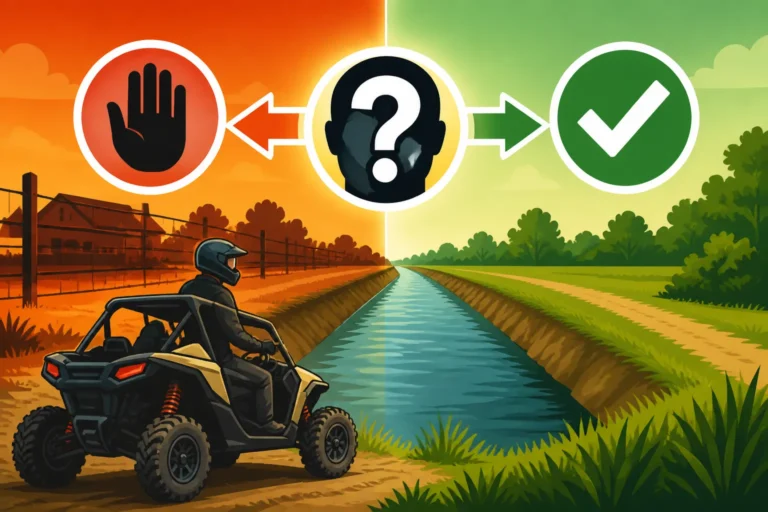
Perhaps the most critical, and often misunderstood, aspect of this exception is the "shoulder-only" rule. When operating an ATV or UTV for agricultural purposes on a public road, the machine must remain on the shoulder of the road. This means you are absolutely not permitted to drive in the travel lanes, even if there's no traffic. The shoulder is the paved or unpaved area adjacent to the main travel lane, typically designed for emergency stops or drainage. It is distinct from the traffic lane.
The reason for this strict adherence to the shoulder is safety. By staying off the main roadway, off-road vehicles minimize interference with faster-moving vehicular traffic. This reduces the risk of rear-end collisions, sideswipes, and other accidents that could occur if an ATV or UTV were to share a lane with cars and trucks. Even if the shoulder is rough, uneven, or narrow, the law requires you to stay on it. If there's no discernible shoulder, or if it's too hazardous to ride on, then that particular section of road might not be suitable for the exception. Riders should exercise extreme caution and prioritize their safety, even if it means finding an alternate route. Thinking about where you can legally ride on the side of the road? Look at [Louisiana Rules for Riding a Shoulder].
Navigating the 5-Mile Farm Radius
Beyond the "shoulder-only" rule, another significant restriction applies to farm-exempt machines: the 5-mile farm radius. This is a critical component of the exception that further defines the geographical limits of where you can legally operate your ATV or UTV on a public road's shoulder for agricultural purposes. It's not a suggestion; it's a hard limit.
Measuring the Radius: Where Does It Start?
The 5-mile radius isn't just a general guideline; it's a measurement that begins at the boundary of the farm property. This means you can only operate your ATV or UTV on the shoulder of a public road within a five-mile straight-line distance from the perimeter of your agricultural land. It's not measured from your house, or from the center of your property, but from the edge of the land you farm. This is important because it dictates the furthest point you can venture for farm-related tasks while still remaining compliant. For larger farms, this might cover a substantial area, but for smaller operations, it means knowing your boundaries precisely.
Understanding this measurement is key to avoiding penalties. It requires a bit of spatial awareness and, for some, perhaps even checking property maps to confirm the exact boundaries of their farm. The intent is to allow for practical movement between contiguous or nearby farm parcels without enabling extensive travel across the parish. It emphasizes that this is an exception for local farm activities, not regional ones. For detailed information, check out [Louisiana's 5-Mile Farm Radius].
Practical Scenarios Within the Radius
Let's imagine some real-world situations. If you have a primary farm property and need to move a small seed spreader on your UTV to a leased field that's three miles away, and both properties fall within your 5-mile radius, you can do so legally, provided you stay on the shoulder and meet all other requirements. Another scenario might involve checking on cattle in a pasture that's two miles down the road from your barn. As long as that pasture is part of your agricultural operation and within the radius, you're likely covered. The key is that the activity must be directly related to the farming operation, within the geographical confines, and you must operate the machine in the prescribed manner.
This also means being prepared to explain your purpose if stopped by law enforcement. Simply saying "I'm farming" might not be enough; you should be able to articulate the specific agricultural task you are performing and how it relates to your property within the radius. Having your relevant paperwork on hand, such as an agricultural affidavit, becomes even more crucial in these situations.
What Happens Beyond 5 Miles
If your agricultural task requires you to travel beyond the 5-mile radius from your farm property, the shoulder-only farm exception no longer applies. At that point, your ATV or UTV is subject to the general ban on public roads, and operating it on the shoulder, or any part of the road, would be illegal. This is a firm cutoff. For example, if you need to transport specialized equipment to a field eight miles away, you would need to load your ATV or UTV onto a trailer and haul it with a street-legal vehicle. You cannot simply ride it the extra three miles on the shoulder.
This limitation means farmers need to plan their movements carefully. For longer distances, a pickup and trailer are the only legal options for transporting an off-road machine on public roads. It reinforces that the exception is truly for localized farm activities and not a loophole for extended travel. Ignoring this radius can result in citations, fines, and potentially even impoundment of your machine, so knowing your limits is paramount.
Essential Paperwork and Compliance for Farm Use
Beyond understanding the physical limitations of where and how you can ride, there's a crucial layer of administrative compliance for Louisiana's farm exception: paperwork. Without the correct documents, even if you're riding within the 5-mile radius on the shoulder for a legitimate farm purpose, you could still find yourself in hot water.
Carrying an Agricultural Affidavit
One of the most vital pieces of documentation for any farmer utilizing this exception is the agricultural affidavit. This is a sworn statement, typically obtained and notarized, confirming that your ATV or UTV is indeed primarily used for agricultural purposes on your farm property. This document serves as official proof of your claim and helps differentiate your machine from one used purely for recreation. It's essentially your legal declaration that you meet the criteria for the farm exemption.
When you're stopped by a state trooper or local deputy, presenting a valid, notarized agricultural affidavit can go a long way in demonstrating your compliance with the law. Without it, your assertion of "farm use" is just your word, which might not be enough to satisfy an officer. It’s a proactive step that protects you and provides clear evidence of your intent and the machine's primary function. Think of it as your passport for legitimate shoulder-only travel. Want to know more about this specific document? Check out [Louisiana Farm Affidavits for Road Use].
Why Your Bill of Sale Needs a Notary
While not directly tied to the farm exception itself, a properly notarized bill of sale is critical for proving ownership and registering your ATV or UTV in Louisiana, which then enables you to obtain the necessary decals for farm use. For any private sale of a used off-road vehicle, the OMV requires the bill of sale to be notarized. This step is designed to prevent fraud and ensure clear transfer of ownership. A notary public verifies the identities of the buyer and seller and confirms that they are signing the document willingly.
Without a notarized bill of sale (for private sales), you won't be able to title the machine, and without a title, you won't be able to get your annual decal. This seemingly small detail can halt the entire process of getting your farm-exempt machine legally ready for shoulder use. It underscores the importance of dotting every 'i' and crossing every 't' when acquiring an off-road vehicle in Louisiana, especially if you plan to use it under any road-riding exception.
The Decal a Farm-Exempt Quad Still Has to Carry
Even if your ATV or UTV qualifies for the agricultural exemption and you're only riding on the shoulder for farm-related purposes, it still needs to display a Louisiana ORV decal. This decal, issued by the Louisiana Department of Public Safety and Corrections, Office of Motor Vehicles (OMV), signifies that your machine is officially registered with the state. It's a small sticker, usually affixed to the front or rear of the machine, but its presence is non-negotiable for any off-road vehicle operating in the state, even under exemptions.
The decal helps law enforcement quickly identify that your machine has been through the state's registration process. While the farm exemption might excuse you from certain aspects of road-legal registration, it does not excuse you from displaying this basic identification. The OMV charges a nominal fee for this decal, and it's typically renewed on a set cycle. Failing to display a current decal, even on a farm machine, can result in penalties. It's just one more layer of compliance that ensures accountability for all off-road vehicle owners in Louisiana. For more on this, see [The Decal a Farm-Exempt Quad Still Has to Carry].
Equipment and Driver Requirements for Farm-Exempt Machines
Just because you're using your ATV or UTV for farm-related purposes on the shoulder doesn't mean you can skip basic safety and operational requirements. Louisiana law still mandates certain standards for both the driver and the machine itself, ensuring a baseline level of safety for everyone on or near public roads.
Driver's License and Age Requirements
One of the most frequently asked questions revolves around who can actually drive these machines under the farm exemption. In Louisiana, if you're operating an ATV or UTV on the shoulder of a public road, even for farm use, you generally need to possess a valid Class E driver's license. This is the standard driver's license for passenger vehicles and light trucks. The rationale is simple: if you're on a public thoroughfare, even the shoulder, you need to demonstrate basic driving competency.
Furthermore, age requirements apply. For UTVs, Louisiana law typically requires the driver to be at least 21 years old to operate on designated public roads. While the farm exception is distinct, it's wise to adhere to these age guidelines whenever operating on public shoulders. For ATVs, general state law often dictates minimum ages for operation, usually around 16 for public land, though private land rules differ. Given the proximity to public traffic, ensuring the driver is a licensed adult is a critical safety measure. This isn't just about avoiding a ticket; it's about mature, responsible operation. [Louisiana Requires a Class E License] provides more detail on this requirement.
Lighting and Visibility Considerations
While off-road vehicles aren't typically equipped with all the lighting of a standard car, for shoulder use, certain visibility measures are crucial. When operating your farm-exempt ATV or UTV on a public road's shoulder, especially during low-light conditions or after sunset and before sunrise, you must ensure it has adequate lighting. This usually means functional headlights and taillights. You want to be seen by other motorists, who might not expect to encounter an off-road machine on the shoulder.
Beyond standard lights, consider adding reflective tape or even a slow-moving vehicle (SMV) triangle if you're traveling at low speeds. The goal is to maximize your visibility to other drivers, particularly those in larger, faster vehicles who might not spot an ATV or UTV until they are very close. Products from companies like SuperATV, known for their aftermarket accessories, can provide excellent lighting upgrades, from LED light bars to enhanced taillights, significantly improving visibility. This isn't just a legal suggestion; it's a fundamental safety practice that can prevent serious accidents.
Insurance for Road-Legal Farm Use
Another critical aspect that many riders overlook when considering the farm exception is insurance. While Louisiana doesn't generally mandate insurance for off-road vehicles used exclusively on private property, the moment your ATV or UTV touches the shoulder of a public road, even under an exemption, the landscape changes. It is highly advisable, and often legally required depending on the specific parish or interpretation, to carry at least liability insurance for your machine if you operate it on public access points.
Imagine a scenario where, despite your best efforts, an accident occurs on the shoulder. Perhaps you swerve to avoid a pothole, and a part of your machine extends into the travel lane, resulting in a collision. Without insurance, you could be held personally liable for damages and injuries, which could be financially devastating. Some parishes may explicitly require proof of insurance for any road-legal operation, even under farm exemptions. Always check with your local OMV or an insurance professional. Having proof of coverage, like [Louisiana Insurance Proof on Demand], can save you a lot of headache and protect your assets.
Common Misconceptions and Penalties
Even with the best intentions, it's easy to misunderstand the nuances of Louisiana's farm exception for ATVs and UTVs. These misconceptions can lead to unintentional violations and, unfortunately, penalties that can range from frustrating fines to the impoundment of your valuable machine.
"Farm Use" Doesn't Mean Any Use
This is perhaps the biggest pitfall. Many riders assume that if they live on or near a farm, any use of their ATV or UTV on the road is automatically "farm use." This is simply not true. As we discussed, "farm-related purposes" is a specific legal term. Taking your quad to pick up groceries from the corner store, even if you’re a farmer, does not qualify. Riding to a hunting lease that isn't part of your core agricultural property also typically falls outside the exemption.
The key is the direct connection to agricultural production or maintenance of the farm itself. A quick run to a neighbor's farm to borrow a tool is likely fine, but a scenic ride down a parish road, even if you are a farmer, is not. Law enforcement officers are trained to distinguish between legitimate agricultural activity and recreational riding disguised as farm work. The burden of proof is on the rider to demonstrate that their activity directly supports their farming operation. Don't assume; know for sure.
What a State Trooper Can Ask to See
If you're operating your ATV or UTV on a public road shoulder, even under the farm exemption, you should be prepared for a potential encounter with law enforcement. A Louisiana State Trooper or local sheriff's deputy has the authority to stop you and ask for certain documentation and information. They will likely ask to see your valid driver's license, proof of insurance (if applicable), and your current Louisiana ORV decal.
Crucially, they will also inquire about the purpose of your travel. This is where your agricultural affidavit comes into play. You should be able to clearly articulate the farm-related task you are performing and how it fits within the 5-mile radius from your farm. If you cannot produce the necessary documents or provide a convincing explanation for your road use, you risk being cited. Being polite, cooperative, and having your paperwork organized can make a significant difference in how the interaction proceeds. Being prepared for [What a State Trooper Can Ask to See] is always a good idea.
Louisiana Penalties for Illegal Road Riding
The consequences of riding an ATV or UTV illegally on Louisiana's public roads or outside the scope of the farm exception can be steep. Penalties can include:
- Fines: These can range from moderate to substantial, especially for repeat offenses.
- Court Costs: Beyond the fine, you'll likely incur additional court fees.
- Impoundment: Law enforcement has the authority to impound your machine, leading to towing and storage fees on top of any other penalties. Retrieving an impounded vehicle can be a costly and time-consuming headache.
- Criminal Charges: In some cases, such as reckless operation or operating under the influence, more severe criminal charges could apply.
- Insurance Implications: An accident while riding illegally could lead to your insurance policy denying coverage, leaving you personally responsible for all damages.
These penalties are designed to deter illegal activity and underscore the seriousness with which Louisiana views the unauthorized use of off-road vehicles on its public roads. It's far better to invest the time in understanding and complying with the farm exception than to face these unpleasant and expensive consequences.
Comparing Farm Use Rules: ATVs vs. UTVs
While the general principles of the farm exception apply to both ATVs (All-Terrain Vehicles) and UTVs (Utility Terrain Vehicles), there are some subtle yet important distinctions in how the law treats these two categories of off-road machines, particularly when it comes to road use. Understanding these differences is crucial for compliance.
Key Differences for ATVs
ATVs, typically designed for a single rider or, in some cases, one passenger, are often smaller and more agile. For farm use on the shoulder, the primary considerations for ATVs generally align with the overall statute: stay on the shoulder, remain within the 5-mile radius, have a valid decal, and be engaged in bona fide agricultural work. The age requirement for driving an ATV on public roads (even the shoulder) is usually 16 with a Class E license, though for designated parish roads it's still often 21.
One notable aspect for ATVs is their inherent lack of many safety features found on conventional vehicles. They often lack seatbelts, roll cages, or comprehensive lighting systems. This design makes them particularly vulnerable on public roads, which is why the "shoulder-only" rule is so strictly enforced. If you’re riding an ATV for farm use, you really need to be extra vigilant about visibility and defensive driving, assuming other motorists might not see you.
Key Differences for UTVs
UTVs, often referred to as side-by-sides, are generally larger, have multiple seats, a steering wheel, and often a cargo bed. They come closer in design to a small car or truck, but they are still off-road vehicles. For UTVs, Louisiana law (specifically [Louisiana UTV Road Rules Under 32:299.3]) has some additional strictures, especially regarding age and designated roads. For a UTV to be operated on a public road (even the shoulder), the driver must be 21 years of age and possess a valid Class E license.
While the general farm exception applies, some parishes might have specific ordinances that designate certain roads for UTV use, and these ordinances often have their own set of rules regarding speed limits, equipment, and hours of operation. However, the core farm exception allowing shoulder use within the 5-mile radius is still foundational. Because UTVs are larger and sometimes faster, they can feel more stable, but they still present significant risks when interacting with highway traffic. The emphasis on driver age reflects a legislative recognition of the added responsibility that comes with operating these more substantial machines near public traffic.
How Aftermarket Parts Can Help With Compliance
Regardless of whether you operate an ATV or a UTV for farm purposes, aftermarket parts can play a significant role in enhancing safety and compliance, especially regarding visibility. While the core law remains unchanged, outfitting your machine with appropriate accessories can mitigate some risks.
For instance, companies like SuperATV offer a wide range of accessories, including enhanced lighting kits (LED headlights, taillights, turn signals), louder horns, and even rearview mirrors. While turn signals and mirrors might not be explicitly mandated for shoulder-only farm use, adding them can dramatically improve your ability to communicate with and perceive other traffic, making your operation much safer. A bright LED light bar can make your UTV visible from a greater distance, especially during dusk or dawn when many farm activities occur. Investing in these types of upgrades isn't just about style; it's about practical safety and making your farm machine as visible and controllable as possible when it briefly shares space with public roads.
Real-World Scenarios and Best Practices
Understanding the letter of the law is one thing, but applying it effectively in real-world farm scenarios requires careful thought and adherence to best practices. Farmers are problem-solvers by nature, and navigating these regulations is just another challenge.
Moving Equipment Between Fields
One of the most common applications for the farm exception is moving small pieces of equipment, like a sprayer, a fence mender, or a post-hole digger, from one field to another. Imagine you have a hayfield on the north side of a parish road and a pasture on the south. Instead of hitching up a full-size tractor or truck for a short hundred-yard jaunt, you can load your tools onto your UTV, drive along the shoulder, and cross directly into the other field. This is precisely what the exception is designed for: efficient, localized movement of farm assets.
Best Practice: Always ensure your cargo is securely fastened and does not obstruct your view or the machine's lights. Drive slowly and deliberately on the shoulder. If crossing the road, yield to all oncoming traffic, signal your intentions clearly (if your machine has signals, or use hand signals), and make the crossing quickly and safely. Before you even leave your property, take a moment to confirm you have your agricultural affidavit, driver's license, and that your ORV decal is current.
Transporting Supplies to a Remote Pasture
Another frequent use case involves transporting supplies – perhaps a bag of feed, a salt lick, or veterinary supplies – to a remote pasture or a section of land that is difficult to access with a larger vehicle. If this pasture is part of your farm property and falls within the 5-mile radius, you can use your ATV or UTV to move these essential items. The agility and off-road capability of these machines make them invaluable for navigating rough farm tracks leading to these areas.
Best Practice: Before heading out, plan your route. Identify the safest points to enter and exit the public road shoulder. Consider the time of day: early mornings or late evenings might have less traffic, but also reduced visibility, necessitating extra caution and good lighting. Always stay focused on the task at hand and avoid distractions. Remember, this is about work, not a leisurely drive. And once again, make sure your machine has proper lighting, perhaps enhanced by aftermarket solutions, if you're out when visibility is low.
Daily Checks to Stay Compliant
Staying compliant isn't a one-time effort; it's an ongoing commitment. For farmers who regularly rely on their ATVs and UTVs for tasks that involve shoulder use, incorporating daily or weekly checks into their routine is a smart move.
Best Practice:
- Decal Check: Is your Louisiana ORV decal current and clearly visible?
- Paperwork Check: Do you have your agricultural affidavit and driver's license on your person or stored securely on the machine?
- Lights & Brakes: Are your headlights, taillights, and brake lights functioning correctly?
- Tires & Condition: Are your tires in good condition and properly inflated? Is there any damage to the machine that could affect its safe operation?
- Cargo Security: If hauling anything, is it secured?
- Route Planning: Are you certain your route stays within the 5-mile radius from your farm boundary? Is the purpose of your trip genuinely agricultural?
By making these quick checks a habit, you significantly reduce the risk of non-compliance and ensure that you're operating your essential farm equipment legally and safely. It's about being responsible and respecting the law that provides this valuable, albeit limited, exception.
Here's a quick reference for common scenarios:
| Scenario | ATV/UTV Use | Compliance Status | Key Requirement |
|---|---|---|---|
| Moving feed between adjacent fields | On public road shoulder for 0.5 miles, 2 miles from farm | Legal (if all criteria met) | Stay on shoulder, valid affidavit, within 5-mile radius |
| Driving to town for non-farm errands | On public road shoulder for 3 miles, 1 mile from farm | Illegal | Not a "farm-related purpose" |
| Checking fence line 4 miles away | On public road shoulder, 4 miles from farm | Legal (if all criteria met) | Stay on shoulder, valid affidavit, within 5-mile radius |
| Transporting tools to a field 7 miles away | On public road shoulder for 7 miles | Illegal | Exceeds the 5-mile farm radius |
| Riding to a friend's house across parish | On public road shoulder | Illegal | Not a "farm-related purpose", likely outside 5-mile radius |
| Hauling harvested crops to nearby silo | On public road shoulder for 1.5 miles, 0.5 miles from farm | Legal (if all criteria met) | Stay on shoulder, valid affidavit, within 5-mile radius |
Disclaimer
This article is for general informational purposes only and does not constitute professional advice. Laws, prices and regulations vary by location and change over time. Consult a qualified professional for guidance on your specific situation.