Minimum Ages a Private Mud Park Sets
A child may be allowed into a Louisiana mud park but still be too young to drive a particular machine, ride as a passenger, or join an event. Parks set their own age and supervision policies, and those rules can differ by vehicle and area. The safest plan is to confirm the park’s current requirements before you pay, load the trailer, or sign a waiver.
Why minimum ages differ from park to park
There is no single age you can assume applies at every private mud park in Louisiana. A park may set separate age limits for drivers, passengers, event areas, or specific machines. Its rules may also depend on whether a young rider is accompanied by an adult, has the right safety equipment, or is using a youth-sized vehicle.
That distinction matters because “children are allowed” does not necessarily mean a child can ride any machine. A park might welcome families while limiting who can operate a full-size ATV or UTV. It might allow a young passenger in one vehicle but not another, or require a parent to stay nearby. Ask about the exact activity your family has in mind rather than relying on a general statement about family access.
Private-property policies also should not be confused with rules for public roads. Louisiana has separate requirements for certain UTV use on designated public roads, including an age rule for drivers in that setting. Those rules do not tell you what a private park allows, and a park’s permission does not make a machine legal to use on a public road. See Louisiana Requires UTV Drivers to Be 21 for the separate road-use topic.
A park can make its own entry and operating rules, then enforce them as a condition of riding there. Policies may change between regular riding days and organized events, too. An event may have a different course, crowd, or supervision setup, so don’t assume the age rule from a previous visit still applies.
| What the age rule covers | Why it matters | What to ask the park |
|---|---|---|
| Driver age | A rider may be old enough to enter but not to operate a machine | What is the minimum age to drive each type of vehicle? |
| Passenger age | Passenger access may have its own limits | Are children allowed as passengers, and on which machines? |
| Supervision | A minor may need an adult present or riding with them | Must a parent or guardian stay with the child, and where? |
| Machine type | Youth quads and full-size machines may be treated differently | Do the rules depend on engine size, vehicle size, or seating? |
| Event access | Special events may have distinct restrictions | Do event-day rules differ from regular park rules? |
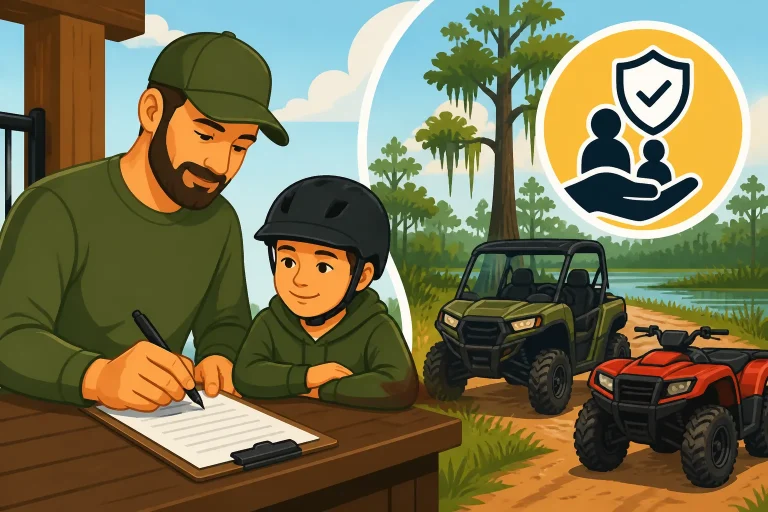
| Waiver and check-in | A minor may need an adult to complete paperwork | Who must sign, and what identification or documents are required? |
The table is a prompt for questions, not a substitute for the park’s written policy. If the answer is unclear, ask staff to explain the rule for the particular child, machine, and area before making plans.
How to check whether a child can ride
Start with the park’s current rules, but get a direct answer if the age policy is vague. A website might say that children are welcome or that youth riders are permitted without explaining whether that means riding as a passenger, operating a youth machine, or driving a larger ATV. A phone call or message to the park can clear up those details.
When you contact the park, describe the situation plainly: the child’s age, whether they would drive or ride as a passenger, and the type of vehicle you plan to bring. If you know the machine’s seating arrangement or size, include that too. A rule for a youth quad may not settle whether a child can ride on a full-size ATV or in a side-by-side.
Ask for the policy in writing if the answer will affect a reservation or a long trip. A current rules page, email, or message can help avoid a disagreement at the gate. If staff give you different answers, ask which rule controls and whether the restriction is specific to a certain part of the park or event.
Useful questions include:
- What is the minimum age to operate the machine we plan to bring?
- Is there a different age limit for passengers?
- Does the rule change for a youth quad, full-size ATV, or UTV?
- Must a parent or guardian ride with the child, follow nearby, or remain on-site?
- Are there separate age rules for trails, mud areas, races, or other activities?
- Does the child need particular safety gear to ride?
- What paperwork must a parent or guardian complete?
- Do the rules differ on event weekends?
- Can staff refuse access if a rider does not meet the park’s requirements?
- Where can we read the current policy before arrival?
Pay attention to the difference between a child being permitted on the property and being permitted to ride. A park may have areas for spectators or families that are separate from riding zones. A child’s access to the campground, parking area, or viewing area does not prove that the child meets the age rule for operating a machine.
Also ask about other rules that affect the child’s ride. Age may be only one part of the decision: the park may have helmet, passenger, speed, or supervision requirements. Review Louisiana Private Park Helmet Rules and Passenger Rules at a Private Mud Park for related questions to ask. For a broader look at park-specific requirements, Louisiana Private Park Waivers and Rules can help you prepare for check-in.
Choose the machine and riding plan around the rule
Once you know the minimum age, match the child to an allowed machine and activity. Don’t treat age eligibility as proof that a particular vehicle is a good fit. A young person may meet a park’s minimum but still need a machine they can control, a less demanding route, and close adult supervision.
For a child who will operate a quad, check that they can reach the controls comfortably and understand how to stop, steer, and respond to changing ground. Mud can hide ruts, holes, and other obstacles. A machine that feels manageable on a flat yard may handle very differently in a crowded or slippery riding area. Keep the first ride conservative, and follow the park’s guidance on where a youth rider may go.
For a child riding as a passenger, confirm that the vehicle is designed to carry a passenger and that the park permits a child of that age in that seat. Do not assume that a second seat, handhold, or adult driver makes a passenger arrangement acceptable. Ask about passenger rules for the exact vehicle. If the machine is a UTV, verify how the park treats its seating and restraint requirements rather than relying on rules for an ATV.
A family may also decide that watching is the better choice for a child who does not meet the park’s riding requirements or is not ready for the terrain. Ask where spectators can safely stand and whether children may stay in the campground or other non-riding areas. It is easier to make that decision at home than after arriving with a child who expected to ride.
A simple planning chart can help keep the discussion specific:
| Rider plan | Questions to settle before leaving |
|---|---|
| Child drives a youth ATV | Is the child old enough under the park rule, and is that machine allowed in the intended riding area? |
| Child drives a full-size ATV | Does the park set a separate age limit, and what supervision does it require? |
| Child rides as a passenger | Is the vehicle passenger-capable, and does the park allow a passenger of that age? |
| Child rides in a UTV | What are the park’s age, seating, restraint, and supervision requirements? |
| Child attends as a spectator | Which areas are open to children who are not riding, and how are they separated from active routes? |
Age-related park policies are not a replacement for basic safety judgment. A child who is allowed to ride still needs to be able to follow instructions, use appropriate protective gear, and stop when conditions feel unsafe. Parents should consider the child’s size, coordination, experience, and comfort—not just the number on a policy page. For general age-related riding considerations, Louisiana ATV Age Requirements and Louisiana Rules for a Ten-Year-Old Rider cover separate contexts and should not be treated as the private park’s own rule.
Prepare for check-in and avoid a wasted trip
Before loading, make a short confirmation call or check the park’s current written rules. Mention the planned riding day, because event weekends may have different procedures or restricted areas. If a child’s eligibility depends on supervision, ask exactly what the accompanying adult must do. “An adult has to be present” can mean different things: nearby in the park, at check-in, or riding with the child.
Confirm who must sign the waiver and whether the park requires a parent or guardian to be present in person. Do not assume another adult can sign for a child unless the park says so. Review Why a Parent Signs the Waiver at the Gate for the paperwork issue, and ask the park what documents or identification it wants for check-in. Having the responsible adult available can prevent delays and misunderstandings.
Make sure everyone in the group knows the boundaries before riding begins. Explain that a child’s permission may apply only to a particular machine or designated area. If the park assigns routes or provides a briefing, listen closely and keep the child within the permitted area. Park rules and staff instructions matter even when a rider has visited before.
A practical pre-trip checklist:
- Confirm the minimum age for driving the exact machine.
- Confirm the minimum age and conditions for riding as a passenger.
- Ask whether rules vary by vehicle, route, event, or riding area.
- Clarify the required level of adult supervision.
- Read the current waiver and park rules.
- Ask who must sign for a minor and who must be present at check-in.
- Check required helmets and other protective equipment.
- Make a backup plan if the child cannot ride.
- Reconfirm the rules if the visit is scheduled for a special event.
If your group will camp at the park, check whether camping access and riding access have separate rules. A child may be able to stay with the family at a campsite without being allowed to operate a machine. The same applies to spectators and event guests: access to one part of the property does not automatically authorize riding elsewhere. Louisiana Private Park Camping Rules may help with planning the non-riding part of the visit.
The clearest answer is always the park’s current policy for the specific rider and machine. Ask before you travel, get uncertain details clarified in writing, and treat age eligibility as only one part of a safe riding decision. That approach helps families avoid gate surprises and choose a ride that fits both the park’s rules and the child.
Disclaimer
This article is for general informational purposes only and does not constitute professional advice. Laws, prices and regulations vary by location and change over time. Consult a qualified professional for guidance on your specific situation.