Louisiana Retrieval Party Limits
Louisiana’s game-retrieval exception is narrow, and bringing several ATVs can turn a recovery trip into a rules problem. The key limit is generally one machine for a retrieval party on an eligible Wildlife Management Area. Here’s what that means, what it does not allow, and what to check before unloading.
What the retrieval party limit means
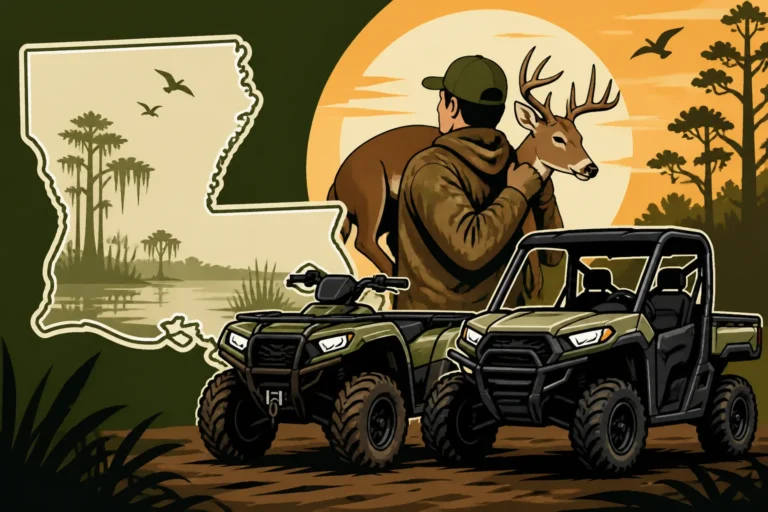
On Louisiana Wildlife Management Areas, a rule allowing an ATV or other machine to retrieve game is not general permission to ride wherever you want. The retrieval exception is limited, and the number of machines is a central part of it: generally, only one machine may be used by a party for the retrieval.
In practical terms, a group of hunters should not assume that each person can take a separate quad to recover the same animal. The limit applies to the party’s machine use, not just to how many machines one person operates. For a concise rule summary, see One Machine and No More.
The machine limit does not automatically mean that only one person may be present. It also does not create permission to carry passengers in a way the machine is not designed for. Keep these questions separate:
| Question | What the limit tells you | What it does not tell you |
|---|---|---|
| How many machines may the party use? | Generally, one machine for the retrieval party | That every hunter may ride a separate machine |
| How many people may ride? | Follow the machine’s seating and applicable WMA rules | That the machine limit is a passenger limit |
| Where may the machine travel? | Only where the specific WMA rules allow it | That a retrieval need permits off-trail riding |
| What activity is allowed? | Recovery of game under the applicable exception | Hunting, searching, or general trail riding |
The party should coordinate before anyone starts the engine. Decide who is operating the machine, where the animal is, and which approved route applies. If several hunters arrive with machines, leave the extra machines parked rather than treating the exception as permission to make multiple trips with different vehicles. The exact application can depend on the WMA’s current rules, so check the area-specific information before your hunt.
This exception also does not override restrictions on the machine itself. A quad or UTV may be prohibited on a particular area, trail, or date even if the group is trying to retrieve harvested game. Review Louisiana WMA Riding Rules for Quads and the area’s posted requirements before relying on the retrieval rule.
Retrieval is not a license to search or hunt from a machine
The retrieval exception is for recovering game that has already been legally harvested. It should not be treated as permission to use a machine to locate an animal, pursue game, or continue a hunt from the trail.
That distinction matters when an animal is hit but not recovered. Riding around to look for a wounded animal is different from traveling to retrieve an animal whose location is known. The machine exception should not be used to search for wounded or lost game; see Never Searching for Wounded Game for more on that boundary.
A useful way to think about the rule is to ask whether the hunt is over and the animal’s location is established. If the answer is no, do not assume the retrieval exception covers the trip. A machine does not make an otherwise prohibited search lawful, and the fact that a hunter is trying to recover an animal does not automatically authorize travel through closed or restricted areas.
The exception also does not turn a trail into a hunting route. It is not permission to scout from a quad, carry hunting equipment while riding in search of game, or use the vehicle to get closer to wildlife. Keep the machine’s purpose limited to recovery, and avoid combining the retrieval trip with another activity.
Firearm rules need separate attention. A retrieval permission should not be read as permission to carry or use a firearm while operating the machine. Check [Louisiana Firearms and Retrieval Rules] and the current WMA regulations for the specific requirements. If the rules call for retrieval without a firearm, leave it secured where permitted before departing. Do not rely on a general understanding of hunting rules to answer a question about a machine trip.
For additional context, Louisiana Game Retrieval Rules explains the broader limits on using a machine to recover game. The practical takeaway is straightforward: retrieve a known, legally harvested animal under the applicable exception; do not use that exception to continue the hunt or search for game.
Check the WMA’s access and permit rules before you go
A retrieval rule is only one part of the requirements for riding on public land. A machine may still need to stay on designated routes, meet equipment restrictions, and comply with seasonal closures. Some areas have different access conditions, so a rule that applies on one WMA may not settle what is allowed on another.
Before the hunt, confirm:
- The area allows the machine and the intended use. Check the WMA’s current regulations and map. Do not assume a route is open because it appears on an older map or because another hunter has used it.
- The route is authorized. Follow posted signs and designated routes. The retrieval exception does not automatically allow travel cross-country or through a closed route. See Louisiana WMA Designated Trails Only.
- The machine meets applicable limits. Verify any restrictions on vehicle type, dimensions, weight, tires, or other equipment. A retrieval purpose does not necessarily waive those requirements.
- The required access paperwork is complete. Review Louisiana WMA Permit Requirements and Louisiana Self-Clearing Permit Steps. Follow the current process for the area and keep any required documentation with you.
- The timing is allowed. Seasonal closures, daily access hours, and hunting-season rules can affect whether a route is open. Confirm the dates and hours for the exact WMA, not just the general statewide rule.
Do not rely only on a sign at the trailhead to establish every detail. Signs may identify an access point or restriction, but they may not explain all of the current rules for retrieval, machine specifications, or permits. Read the WMA’s current regulations and map before the trip, then follow posted instructions on site.
If the animal is not near an approved route, do not assume that a recovery need gives the party permission to leave the route. Consider how the animal can be recovered without violating access restrictions. If the situation is unclear, contact the relevant land manager or wildlife office before using a machine.
A practical plan for a compliant recovery
The easiest way to avoid confusion is to make the retrieval plan before the group is in the field. When hunters decide after dark, in poor weather, or under pressure to recover an animal quickly, it is easier to mistake a narrow exception for broad access.
Use this checklist:
- Identify the WMA and its current rules. Check the exact area, not just Louisiana’s general machine rules.
- Confirm the animal is eligible for retrieval. The exception is not a substitute for searching for wounded or unlocated game.
- Choose one machine for the party. Leave additional machines parked. Do not split the group into multiple machine trips and assume that makes the party limit disappear.
- Keep the route within authorized access. Use approved trails or routes and obey closures and signs.
- Check firearm requirements. Follow the specific rules for traveling to retrieve game, including any restriction on carrying a firearm.
- Carry required permits and identification. Make sure access paperwork is completed as required for that area.
- Bring only what the recovery requires. Avoid turning the trip into a scouting run, a second hunt, or a general ride.
- Ask before proceeding if the facts do not fit the rule. If the animal’s status, location, route, or machine eligibility is uncertain, get clarification rather than improvising.
There can be a difference between a vehicle being allowed on a WMA and that vehicle being allowed for a particular purpose. A machine may be permitted on a designated route but not for unrestricted travel. Likewise, a retrieval exception does not necessarily apply to every species, every season, or every management area. Use the current regulations for the specific location to resolve those questions.
When a group has more than one hunter, clear communication helps keep the rule practical: tell everyone which machine is being used, who is operating it, and where the recovery will take place. That reduces the risk of a second machine following the first or a recovery trip becoming unauthorized travel. If staff or enforcement officers ask about the trip, explain its limited purpose and follow any instructions they give.
The safest interpretation is also the easiest to remember: one machine for the retrieval party, only for recovering eligible game, and only within the access rules for that WMA. Confirm the current requirements before the hunt, because area-specific restrictions and seasonal access rules may change.
Disclaimer
This article is for general informational purposes only and does not constitute professional advice. Laws, prices and regulations vary by location and change over time. Consult a qualified professional for guidance on your specific situation.