One Machine and No More
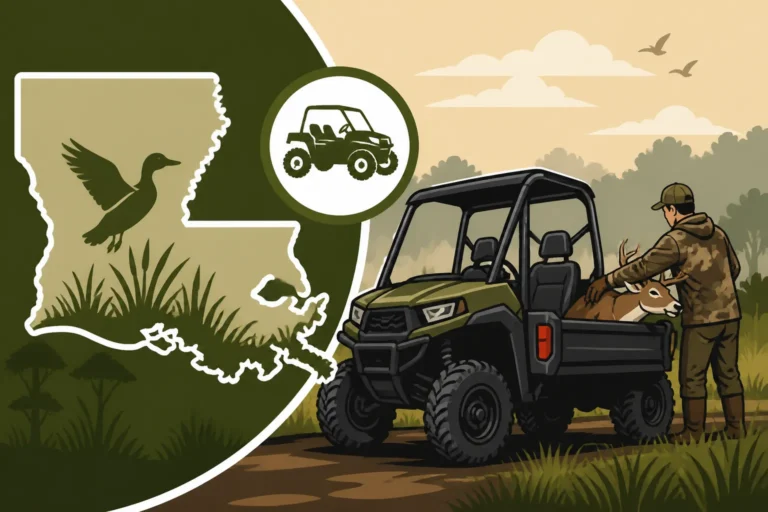
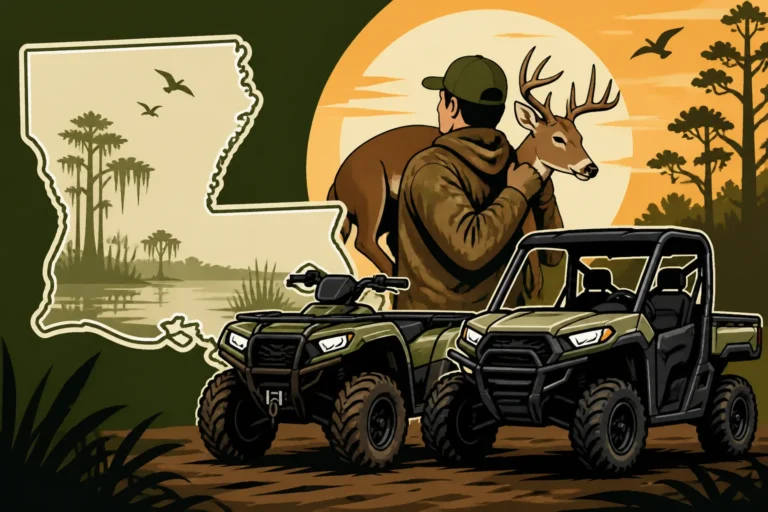
When you harvest game on a Louisiana wildlife management area, an ATV or UTV may seem like the simplest way to bring it out. But a game-retrieval exception is narrow: it does not turn a hunting trip into general off-road access, and it does not authorize a group of machines. Here’s how to understand the one-machine limit and avoid treating retrieval as permission to ride.
What the One-Machine Limit Means
On Louisiana wildlife management areas, motorized access is restricted, and the rules for retrieving legally harvested game are not a general riding pass. The phrase “one machine” is the key limit: a retrieval party should not assume that each hunter, vehicle, or harvested animal gives the group permission to bring another ATV or UTV.
The basic idea is that a single machine may be used for a qualifying retrieval under the applicable WMA rules. The exception is tied to bringing out game that has already been legally taken. It should not be treated as permission to travel around the area for convenience, scout for more game, or look for an animal that may be wounded but has not been recovered.
That distinction matters because ordinary riding and game retrieval are different activities. WMA trails may be limited to marked routes, and some areas have additional restrictions on seasons, machine dimensions, tires, weight, hours, or access. A retrieval exception does not automatically cancel those other rules. Before heading out, check the relevant Louisiana WMA Riding Rules for Quads or Louisiana WMA Riding Rules for UTVs, along with the rules for the particular area and season.
A useful way to think about the limit is this: the machine is there to serve a specific, completed harvest—not to make the WMA generally accessible by vehicle. If your plan involves several machines, repeated trips for unrelated purposes, or riding beyond what is needed for retrieval, stop and verify that the activity is allowed. Do not infer broader access from the fact that one machine may be permitted for a limited task.
| Situation | How to treat it |
|---|---|
| One machine used for a qualifying retrieval | Check the WMA’s current rules and follow the stated conditions |
| Several machines accompanying a retrieval party | Do not assume the exception covers them |
| Riding for scouting, recreation, or convenience | Not the same as retrieving harvested game |
| Searching for a wounded animal | Do not treat this as a completed-game retrieval |
| Traveling on a WMA trail | Follow the area’s posted routes and machine restrictions |
The exact conditions can depend on the WMA and the current hunting or access rules. For the broader framework, see Louisiana Game Retrieval Rules and One Machine in a Retrieval Party. If the wording for a specific area is unclear, ask the managing agency before riding rather than relying on a general understanding of the exception.
Retrieval Is Different From Searching
A key distinction is whether the animal has been recovered. A harvested animal that has been found and can be identified is not the same as an animal that may have been hit and is still missing. The retrieval exception should not be used as a reason to ride a machine through the area to search for wounded game.
This is not just a technical difference. A search can involve repeated travel, changing routes, and covering a much wider area than the direct task of bringing out recovered game. Those actions can conflict with restrictions on motorized use, disturb other hunters, damage land, or lead to riding in places where machines are not allowed. If an animal is wounded but unrecovered, follow the applicable hunting rules and seek guidance from the appropriate WMA authority. For more on the distinction, see Never Searching for Wounded Game.
Nor should carrying a firearm automatically be treated as proof that a trip qualifies for retrieval. The activity is defined by what you are doing, not simply by what you have with you. A machine used to retrieve game is not thereby authorized for a hunting search or general travel. Review Retrieving Without a Firearm for the related issue of what a retrieval trip does—and does not—allow.
Keep the trip focused on the recovered animal. Avoid adding errands such as scouting another location, checking a stand, transporting people who are not part of the retrieval, or making a recreational loop. These may seem minor, but they can make it harder to show that the machine was being used for the narrow purpose allowed.
Practical steps can help keep the purpose clear:
- Confirm that the animal has been recovered and that the retrieval is permitted under the area’s rules.
- Use only the number of machines allowed for the retrieval. Do not assume a larger party gets a larger allowance.
- Follow the authorized route and any posted directions. Do not choose a shorter route across closed ground.
- Keep the trip limited to bringing out the recovered game.
- If a condition is unclear, pause and contact the WMA manager or the relevant Louisiana wildlife authority before proceeding.
A retrieval trip also does not erase ordinary responsibilities. You remain responsible for having the required hunting authorization, following access conditions, respecting closures, and complying with rules for the machine. For general land-access considerations, see Louisiana Hunting License and Land Access. The retrieval exception is only one piece of the rules that apply.
Check WMA Access and Machine Rules Before You Unload
A common mistake is to focus on the retrieval exception and overlook the requirements for entering or using the WMA in the first place. Public-land access may involve a self-clearing permit, designated routes, season limits, and machine-specific restrictions. The correct answer can vary by area, so do not assume that a rule you followed on one WMA applies everywhere.
Start with the WMA map and current access information. Identify the boundary, legal access points, marked trails, and closed areas before unloading. A route that appears convenient on a phone map may cross private land, a closed section, or an area where motorized travel is not allowed. Reading a WMA Map Before You Unload can help you plan around that risk.
Also review permit requirements separately from the retrieval rule. A self-clearing permit or access authorization does not, by itself, grant permission to ride anywhere on the WMA. Likewise, the one-machine retrieval allowance should not be read as a substitute for an access permit. Follow the applicable Louisiana Self-Clearing Permit Steps and check the area’s posted requirements before entering.
Machine specifications can matter, too. Weight, width, tire size, tire type, and other equipment conditions may restrict where or whether an ATV or UTV can be used. A vehicle that is legal on private land is not automatically suitable for a WMA trail. Check the area’s rules for your particular machine instead of relying on its registration, decal, or intended use. If you are bringing a UTV, verify its dimensions and access conditions specifically; do not assume quad rules apply unchanged.
Seasonal restrictions deserve equal attention. A WMA may have a seasonal riding closure even when hunting is open, or a trail may be closed for reasons unrelated to your hunt. Weather, maintenance, fire conditions, and wildlife management can also affect access. Confirm current conditions before traveling and again before riding if there has been a recent change. See Louisiana WMA Season Closures for the broader seasonal issue.
A quick pre-trip check is more dependable than trying to sort out the rules at the trailhead:
- Confirm the WMA is open to the activity and that the relevant trail or access route is open.
- Check whether a self-clearing permit or other authorization is required.
- Verify the retrieval conditions, including the one-machine limit.
- Check that your machine meets the area’s size, weight, tire, and equipment rules.
- Read signs at the entrance and along the route; posted restrictions may identify closures or local conditions.
- Save or carry the area map and access information in case mobile service is unavailable.
If official information does not clearly address your plan, do not treat silence as approval. Ask the WMA manager or relevant agency what applies to that location and activity. It is especially important to confirm before using a machine off a marked route, entering an area during a seasonal closure, or making more than one trip.
Keep the Trip Narrow and Document Your Plan
The safest practical approach is to plan the retrieval as a short, direct task. Decide in advance who is going, which single machine will be used, where it will travel, and how the recovered game will be secured. A simple plan reduces the chance that a permitted retrieval turns into additional riding that falls outside the exception.
Bring what is needed to retrieve and secure the game safely, but avoid loading the machine in a way that interferes with control or visibility. Do not overload racks, block lights, or carry passengers beyond the machine’s design and the area’s rules. If the animal or route makes a safe retrieval impractical, consider another lawful method rather than forcing the machine into unsuitable terrain.
It can also help to keep the relevant information accessible. Carry the WMA map, permit information, and any required hunting documents. If an officer or manager asks why the machine is there, be prepared to explain the specific retrieval purpose and show that you have checked the applicable rules. Documentation does not expand what is allowed, but it can help you follow the rules and answer questions clearly.
Remember that “one machine” is a cap, not a target for every hunting trip. If the game can be carried out without a machine, that may be simpler. If a machine is needed, use only the machine permitted by the applicable rules and only for the qualifying task. Do not bring additional vehicles on the assumption that they can wait nearby or follow part of the route.
If the retrieval becomes a search, the plan changes. Do not continue riding under the assumption that a possible hit makes the search equivalent to retrieving recovered game. Stop and check the correct procedure. This is one of the most important boundaries in the rule: a narrow retrieval allowance is not a broad permission to pursue or locate unrecovered game.
In short, verify the local WMA rules, distinguish recovered game from a search, and keep motorized use limited to the allowed retrieval. The one-machine limit is there to keep a specific task from becoming general riding. Treating it that way helps protect access for hunters and reduces the risk of a preventable violation.
Disclaimer
This article is for general informational purposes only and does not constitute professional advice. Laws, prices and regulations vary by location and change over time. Consult a qualified professional for guidance on your specific situation.