Airing Tires Above 12 PSI on a WMA
A tire gauge that reads above 12 PSI can turn a planned Louisiana WMA ride into a rules problem before you reach the trail. The limit is easy to overlook when tires were set for pavement or hauling. Here’s how to check pressure, understand what the limit means, and avoid assuming a permit or an out-of-state decal makes a machine exempt.
What the 12 PSI Limit Means on a Louisiana WMA
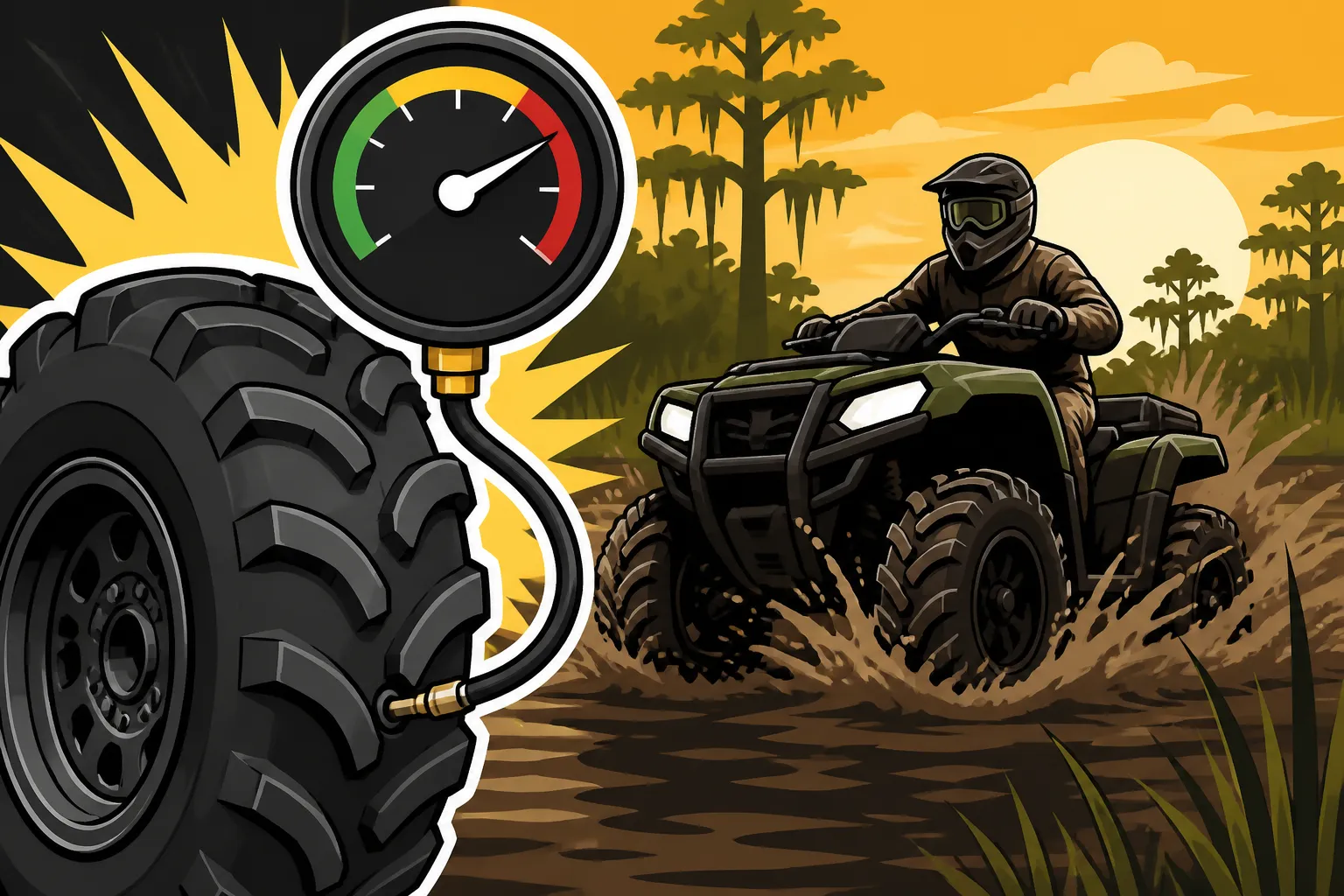
Louisiana WMA riding rules set a maximum tire pressure of 12 pounds per square inch for machines using open riding trails. Treat that as a ceiling, not a target every rider should automatically use. A tire reading above 12 PSI does not meet the stated limit; a reading at or below it does not, by itself, make a machine legal to ride.
The pressure rule is one part of a broader set of restrictions for off-road machines on Wildlife Management Areas. It works alongside rules about where you may ride and what machine you may bring. A machine can comply with the tire-pressure limit and still be barred because it exceeds a weight or size restriction, has prohibited tires, or is being ridden off a designated trail.
For a useful overview of these requirements, see Louisiana WMA Tire Rules Explained and Louisiana WMA Riding Rules for Quads. If you ride a side-by-side, check the applicable UTV rules as well; don’t assume every quad rule applies in the same way to every vehicle.
| Before riding on a WMA | What to check |
|---|---|
| Tire pressure | Keep each tire at or below the 12 PSI maximum |
| Tire size and tread | Confirm the machine and tires meet the applicable WMA restrictions |
| Machine weight and width | Check the limits for the type of machine you plan to ride |
| Trail access | Use designated trails open to your machine |
| Access paperwork | Check whether a self-clearing permit or other access requirement applies |
| Seasonal status | Confirm the WMA and trail are open to riding on your planned date |
The pressure limit is about compliance on the WMA, not a general recommendation for every riding situation. Tire manufacturers specify operating ranges, and a machine’s manual may give pressure guidance for loads and conditions. Those instructions still matter for safe handling and tire care. Don’t lower pressure below a safe level just to meet a land-use rule. If the machine’s safe operating guidance and a WMA requirement seem to conflict, pause and ask the relevant land manager before riding.
The same distinction applies to other restrictions. The fact that a tire is set to 12 PSI or less does not make an oversized machine eligible, and the limit does not grant access to a closed trail or an area without motorized access. See Louisiana WMA Weight Limits Explained for another requirement that can affect whether your machine is allowed.
If you’re riding with a group, check every machine individually. Tire pressures can differ between the front and rear, and one person’s setup does not confirm that everyone else’s tires meet the limit. The rider responsible for loading or preparing the machines should not assume that tires are compliant just because they look soft.
How to Check and Adjust Pressure Before You Ride
Pressure is measured in PSI, and the number on a gauge is only useful if the gauge is working and used correctly. Checking at home, before you unload or approach a WMA trailhead, gives you time to make an adjustment without rushing.
- Check all tires. Use a gauge on each tire, including both front and rear tires. Don’t rely on a single tire as a guide for the whole machine.
- Use a suitable gauge. A reliable low-range tire gauge is easier to read near a 12 PSI limit than a gauge intended mainly for higher-pressure vehicle tires. A compact gauge and a valve-stem deflator from a retailer such as Amazon can be part of a basic trail kit, but confirm that the gauge is appropriate for the range you need.
- Measure consistently. Follow the gauge’s instructions and take the reading before riding. If the machine has been driven or the tires have heated up, the reading may not match the pressure you would see before travel. Make a habit of checking under similar conditions so you can compare readings sensibly.
- Adjust in small steps. If a tire is above 12 PSI, release air gradually and recheck it. Avoid letting out a large amount at once; a small adjustment is easier to control.
- Recheck after adjustment. Take another reading on that tire, then check the remaining tires. A quick final check helps catch a tire that was missed or a gauge that was not seated properly on the valve.
- Carry the gauge. A gauge in the machine or tow vehicle is useful if you need to recheck after transport or a change in conditions. Keep it protected from dirt and damage.
A simple record can help if you regularly use the same machine. Note the pressure you measured, the gauge you used, and whether the machine was cold or had recently been moved. The record is not proof of compliance, and it cannot replace a current measurement, but it can help you notice when a tire is losing air or a gauge gives inconsistent results.
The phrase “at or below 12 PSI” should not be taken as a reason to run tires at an arbitrarily low pressure. Too little pressure can affect steering, stability, tire wear, and the risk of damage or a tire coming off its bead. The safe pressure depends on the machine, tire, load, and operating conditions. If following the WMA maximum would put the tire outside the manufacturer’s safe operating guidance, don’t guess at a compromise. Ask the WMA manager or the Louisiana Department of Wildlife and Fisheries for direction before unloading.
Also check the tire itself, not just the machine’s display or a note from a previous ride. A pressure-monitoring system may not show a current reading for every tire, and a display can be inaccurate or unavailable. A handheld gauge provides a direct way to verify the pressure at the valve. If you suspect a leak, don’t treat repeated deflation as a solution; inspect the tire and valve and get the problem addressed before the trip.
Why Higher Pressure Can Put Your Ride at Risk
A tire reading over 12 PSI is a straightforward compliance concern because it exceeds the stated WMA maximum. If a ranger or other authorized official checks the machine, the reading may raise questions about whether the vehicle meets the requirements. Don’t count on being able to explain that you planned to air down later. Set up the machine before riding and keep it within the rules while it is on the WMA.
Higher pressure can also change how a machine behaves on uneven or soft ground. Tire pressure affects the tire’s shape and how it meets the surface. Depending on the machine and tire, an unsuitable pressure can reduce the contact area or make the ride harsher. That is a practical reason to take the limit seriously, but it is not a reason to adjust blindly. The correct pressure for a particular tire and load is not universal.
Several common situations lead riders to arrive above the limit:
- The machine was prepared for road travel or trailering. Tires may have been inflated to a setting used for a different purpose. Check them again before entering the WMA.
- The tires were adjusted for a private park. Private riding areas can have their own rules and conditions. A pressure that was acceptable there does not automatically meet WMA requirements.
- The rider relies on memory. A setup from a previous trip may not match the current tires, machine, or load.
- Only one tire is checked. Front and rear pressures can differ, and tires can lose air at different rates.
- The gauge is hard to read. A gauge with a broad scale can make it easy to miss a reading above the limit.
- The machine is loaded differently. Added passengers, gear, or cargo can affect how the machine should be operated, even though the WMA pressure maximum remains a separate requirement.
If a tire is above the limit at the trailhead, don’t ride onto the WMA expecting to correct it on the trail. Adjust and verify it before you begin. If the pressure cannot be set within the limit without creating a safety problem, leave the machine off the WMA until you have an answer from the appropriate authority.
Pressure is only one of several possible reasons a machine may not qualify. The WMA restrictions also address tire dimensions and tread characteristics. A rider who sets pressure correctly but overlooks those requirements may still arrive with an ineligible setup. Review Louisiana WMA Tire Rules Explained for the tire-related restrictions as a whole, rather than treating the pressure number as the only test.
And remember that a WMA is not a general-purpose riding park. Use only trails designated for motorized riding and follow closures, access conditions, and any posted instructions. See Louisiana WMA Designated Trails Only and Louisiana WMA Season Closures before planning a route. A trail that is physically accessible is not necessarily open to machines.
Permits, Out-of-State Machines, and a Pre-Ride Check
A permit or proof of ownership does not override the tire-pressure rule. Access paperwork and machine compliance are separate questions: having the required permit does not make a tire above the maximum acceptable, and complying with the pressure limit does not take the place of required access steps.
Before you go, check whether the WMA requires a self-clearing permit and make sure you understand how to complete it. The process is explained in Louisiana WMA Self-Clearing Permit Steps. Keep any required paperwork with you as directed, but don’t treat it as a substitute for checking the machine’s tires, weight, dimensions, or trail eligibility.
Visitors using an out-of-state machine should expect to follow the rules that apply at the Louisiana WMA they visit. A home-state registration, decal, or permit does not give a rider permission to ignore Louisiana land-use requirements. For more on access for nonresident riders, see Riding Louisiana Public Land on an Out-of-State Machine. Check the current rules for the specific WMA rather than assuming that a permit or decal from another jurisdiction settles every requirement.
A practical pre-ride check can prevent most last-minute confusion:
- Confirm that the WMA and the intended trail are open to motorized riding.
- Read the current WMA access rules, including the machine and tire restrictions.
- Check every tire with a working gauge before unloading.
- Adjust any tire above 12 PSI and recheck it.
- Make sure the final pressure is still within safe guidance for the tire and machine.
- Check any other applicable limits, including tire size, tread, machine weight, and vehicle width.
- Complete the required access paperwork and carry it as instructed.
- Follow posted signs and stay on designated trails.
If a WMA’s information is unclear or appears to conflict with the condition of your machine, contact the land manager or Louisiana Department of Wildlife and Fisheries before the trip. It is better to confirm eligibility from the responsible authority than to arrive with a machine that cannot be used legally or safely.
The most reliable approach is simple: treat 12 PSI as a firm maximum for WMA riding, measure each tire with a suitable gauge, and check all the other access and machine rules separately. That keeps a single pressure reading from becoming a preventable problem and helps ensure the machine is ready before you head onto a designated trail.
Disclaimer
This article is for general informational purposes only and does not constitute professional advice. Laws, prices and regulations vary by location and change over time. Consult a qualified professional for guidance on your specific situation.