Why a Title Still Keeps You Off the Road
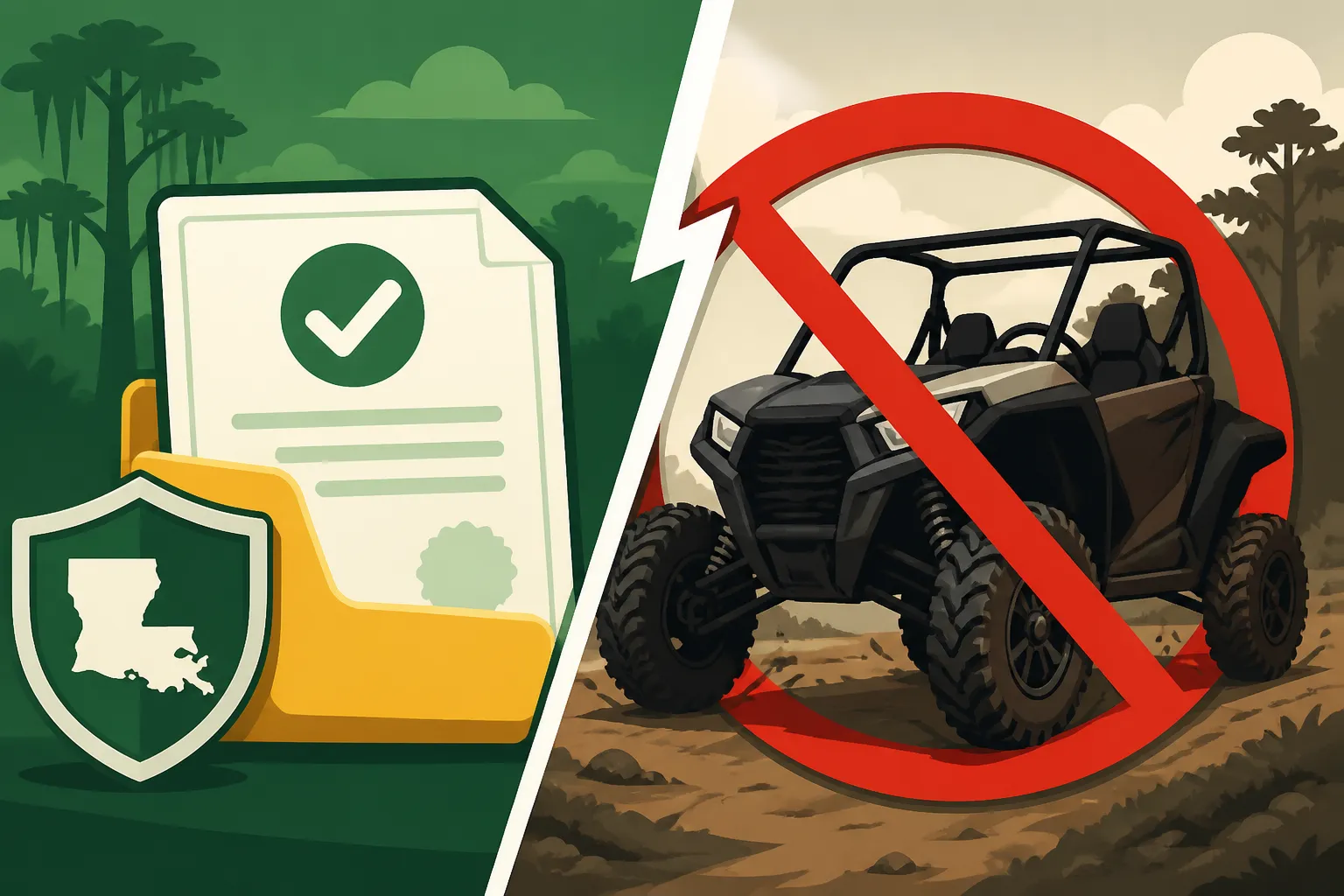
It's a common and totally understandable assumption: you’ve bought your shiny new (or new-to-you) ATV or UTV, you’ve gone through the process of getting it officially titled with the Louisiana Office of Motor Vehicles (OMV), and now you figure you're good to go, right? Maybe a quick jaunt down the street to a friend’s house, or a trip to the corner store? Unfortunately, that official title, while absolutely crucial for ownership, doesn't actually grant you permission to ride your off-road vehicle on public roads in Louisiana. This guide is here to clear up that persistent misunderstanding and help you navigate the nuanced world of Louisiana’s ATV and UTV rules.
What a Louisiana Title Truly Signifies for Your Machine
Let's start by clarifying what that title actually is and what it does for you and your off-road machine. In Louisiana, just like with a car or truck, your ATV or UTV title is first and foremost a document of legal ownership. It proves, without a doubt, that you are the rightful owner of that specific vehicle. When you complete your title application and the OMV processes it, they are essentially recording your name as the legal custodian of that machine, linked to its unique Vehicle Identification Number (VIN).
This is incredibly important for several reasons. For one, it protects you as the owner. If your machine is ever stolen, that title is your primary proof to law enforcement that it belongs to you, aiding in its recovery. It's also absolutely essential for any future sale. Without a clear, properly assigned title, you'll find it extremely difficult, if not impossible, to legally sell your ATV or UTV to another private individual or a dealer. Think of it as the deed to your property. You own a piece of land, but the deed doesn't give you permission to build whatever you want or drive across your neighbor's yard; it just says the land is yours. The same principle applies here. [Louisiana Requires an MSO for a New Machine] or [Louisiana Requires an Assigned Title for a Used One] when you go through the titling process. You’ll need to make sure all your ducks are in a row, including presenting [Louisiana Sales Tax Proof at the Counter].
Proving Ownership and Securing Loans
Beyond simply proving you own the machine, a title also plays a vital role if you've financed your ATV or UTV. When you take out a loan, the lending institution (like a bank or credit union) will typically record a lien on your title. This means they legally have an interest in your machine until the loan is paid off. The OMV handles the recordation of these liens, ensuring that if you were to sell the machine before paying off the loan, the lienholder's interest is protected. This is why you often won't physically receive your title until the loan is satisfied; it stays with the lender. Understanding [Louisiana Title and Lien Records] is key if you're financing your purchase. This ownership document is a cornerstone of responsible vehicle stewardship, but its purpose is distinctly separate from regulating where and how you can operate the machine.
The Role of Your Bill of Sale
While the title is the ultimate proof of ownership once issued by the OMV, the bill of sale is the critical document that bridges the gap between sellers and buyers, especially in private transactions. A well-drafted bill of sale, particularly one that is notarized, provides clear evidence of the transfer of ownership at the time of purchase. This document is essential for the OMV to process your title application. It outlines the purchase price, date, and identities of both parties, and it's a foundational piece of your paperwork. If you're looking for an iron-clad bill of sale, especially for a private transaction, online resources like LawDepot can help you generate a document that includes all the necessary legal language and fields, ensuring you have proper proof when you head to the OMV counter. Remember, [Louisiana Notarized Bills of Sale] are often preferred or required for used machines, adding an extra layer of legal verification.
Title vs. Road Legal Registration: A Crucial Distinction
This is where many riders get tripped up. It’s absolutely vital to understand that having a title for your ATV or UTV is not the same as having it registered or authorized for street-legal use. These are two completely different functions handled by the state, even if both involve the OMV.
Think of it this way: your house has a deed (like your title), proving you own it. But you also need to follow zoning laws, building codes, and maybe even homeowners' association rules to live in it or make changes (like registration and road legality). The deed doesn't automatically mean you can paint your house neon green if the HOA says no.
For off-road vehicles in Louisiana, the "registration" aspect for public road access is extremely limited and comes with specific decals and strict conditions, not just a title. Most ATVs and UTVs, by their very design and equipment, are considered off-road vehicles. They lack standard safety features required for public roads, such as turn signals, brake lights, mirrors, and often have tires not suited for pavement. This distinction is enshrined in Louisiana law. A title merely authenticates your ownership; it does not transform an off-road machine into a street-legal one. This is why [Why a Title Still Keeps You Off the Road] is a recurring question at OMV offices and among riders.
The Off-Road Vehicle Decal
When you hear about "registration" for an ATV or UTV in Louisiana, what people are usually referring to is the mandatory off-road vehicle (ORV) decal issued by the OMV. This decal, which costs a modest amount and is typically renewed on a four-year cycle, is required for most ATVs and UTVs operated off-road on public lands, such as state parks, forests, and designated trails within Wildlife Management Areas (WMAs). It helps the state fund off-road programs and identify legally operating machines on these specific recreational lands. You might also want to understand [Louisiana's Yearly Off-Road Decal].
However, the presence of this decal, or even having paid [Louisiana ORV Decal Cost], absolutely does not authorize you to ride on public streets, highways, or most parish roads. It’s for off-road use on designated public lands. It's a key distinction that frequently leads to confusion and, unfortunately, tickets for those who misunderstand. The decal essentially says, "This machine is authorized for legal off-road use where permitted." It does not say, "This machine is street-legal."
| Document Type | Purpose | Does it allow road use? | Issued by | Key Function |
|---|---|---|---|---|
| ATV/UTV Title | Proves legal ownership and tracks liens | NO | OMV | Ownership verification, asset tracking |
| ORV Decal | Required for off-road operation on public lands | NO (except for very limited legal shoulder use) | OMV | Funds off-road programs, identifies machines |
| Road Legalization | Allows limited use on designated public roads | YES (under strict conditions) | OMV / Parish | Requires specific equipment, driver license, and local ordinances |
What Does Allow Limited Road Use for Off-Road Machines in Louisiana?
While your title itself won't get you on the road, Louisiana law does provide extremely narrow exceptions where ATVs and UTVs might be operated on public roads, but these are highly restricted and come with significant requirements. It's crucial to understand these nuances to avoid penalties, which can include hefty fines and even impoundment of your machine. [Louisiana Penalties for Illegal Road Riding] are not something you want to experience firsthand.
Agricultural Exemptions
The most common exception for ATVs involves agricultural use. Under specific conditions, an ATV can be operated on the shoulder of a public road within a five-mile radius of the owner’s farm or land, only for bona fide agricultural purposes. This means you’re using the ATV as part of your farming operations – perhaps moving between fields, checking irrigation, or transporting tools. This is not for joyriding or commuting. You also need to have proper lighting, a visible flag, and often a bright orange triangle emblem on the rear. Crucially, even under this exemption, you cannot ride in the travel lanes of the road. You must stick to the shoulder. Furthermore, you need to carry proof that your machine is primarily used for agricultural purposes, such as an affidavit. LawDepot can be a valuable tool for creating a formal [Louisiana Agricultural Affidavits for an ATV] to swear to the agricultural use of your machine, providing that necessary documentation should you be stopped by law enforcement. Remember, this specific exemption generally covers ATVs, not necessarily UTVs, and has very strict mileage and use limitations, often referred to as [Louisiana's 5-Mile Farm Radius].
UTV Designated Roads
For UTVs (Utility Terrain Vehicles), the rules are slightly different and offer a bit more flexibility, but still with significant caveats. Louisiana law (specifically [Louisiana UTV Road Rules Under 32:299.3]) allows parishes and municipalities to designate certain roads or streets for UTV use. This is a local decision, not a blanket state rule. If a parish council or city government passes an ordinance designating a particular road as UTV-friendly, then you might be able to ride your UTV on that specific road.
However, even on a designated road, there are strict requirements:
- Driver Age: The operator must be at least 21 years old. [Louisiana Requires UTV Drivers to Be 21].
- Driver's License: The operator must hold a valid Class E driver’s license (the standard car license). [Louisiana Requires a Class E License].
- Insurance: You must carry liability insurance at the state's minimum requirements. [Louisiana UTV Insurance Minimums].
- Equipment: Your UTV must be equipped with standard safety features like headlamps, tail lamps, brake lamps, a horn, a rearview mirror, and often turn signals.
- Signage: The parish or municipality must post signs clearly indicating that the road is designated for UTV use. [Louisiana Parishes Must Designate and Sign Roads].
Without all of these conditions being met, even if a road feels like it should be okay, it isn't. You cannot assume a road is designated; you must verify it with local authorities and look for the specific signage. Orleans Parish, for instance, is explicitly exempt from the UTV statute, meaning UTVs are not permitted on public roads there under this law.
Beyond the Title: Other Essential Paperwork and Permissions for Riding
So, your title confirms you own the machine, and you now understand the very limited circumstances under which you can ride on public roads. But what about all the other places you want to ride? Even off-road, you’ll need more than just a title.
Public Land Use: Decals and Permits
If you plan to ride on public lands, such as national forests or state wildlife management areas (WMAs), your Louisiana ORV decal is essential. This decal proves you’ve paid the required state fee that helps maintain these riding areas. Beyond the decal, specific locations like the Kisatchie National Forest might require additional passes, such as a [Louisiana Forest Pass Cost] or a daily use fee. For WMAs, you'll often need a [Louisiana Self-Clearing Permit Steps] and must adhere to strict rules regarding machine size, tire type, and seasonal closures. These rules are in place to protect natural resources and ensure safety for all users. Never assume you can just show up and ride; always check the specific regulations for your intended riding area before you load up your machine.
Private Land: Landowner Permission
Most off-road riding in Louisiana actually happens on private land, whether it’s your own property, a friend’s farm, or a leased hunting camp. Your title is essential here as proof of ownership, but the permission to ride comes from the landowner. It is absolutely critical to obtain explicit permission from the landowner before riding on private property that isn't yours. This is not just a courtesy; it's a legal requirement to avoid trespassing charges. Written permission is always best, providing a clear record of where and when you're allowed to ride. If you're using a hunting lease, ensure the lease agreement clearly covers ATV/UTV use. For informal arrangements, even a simple, signed note can protect you. LawDepot can assist in creating simple, legally sound [Louisiana Landowner Permission Forms] to cover all your bases, preventing misunderstandings and potential legal headaches.
Insurance Considerations
While Louisiana doesn't generally mandate liability insurance for off-road use on private property, it's a smart decision. Accidents happen, and if you cause damage to property or injure someone, your personal liability could be significant. Some public riding areas or private parks might also require proof of insurance. If you do plan to use your UTV on designated public roads, then, as mentioned, insurance is legally required. It's always a good idea to discuss your off-road machine's use with your insurance agent to ensure you have adequate coverage, whether you're sticking to trails or occasionally venturing onto a parish road. Thinking about [Does Louisiana Require Insurance on an Off-Road Machine?] is an important part of responsible ownership.
Understanding the difference between holding a title and being legally allowed to ride on public roads is paramount for any ATV or UTV owner in Louisiana. Your title is a vital document of ownership and a gateway to buying and selling, but it doesn't grant you street-legal status. Always check local ordinances, carry the correct decals and permits for public lands, and secure explicit landowner permission for private property. Staying informed and compliant will ensure your rides are not only fun but also legal and hassle-free.
Disclaimer
This article is for general informational purposes only and does not constitute professional advice. Laws, prices and regulations vary by location and change over time. Consult a qualified professional for guidance on your specific situation.