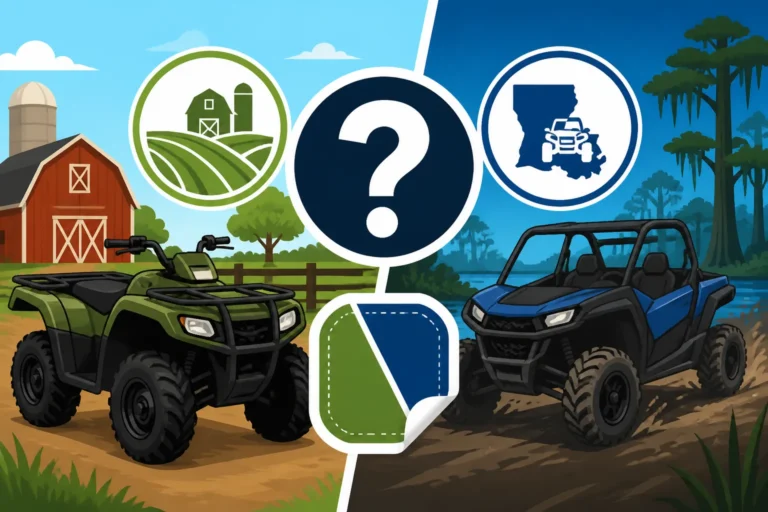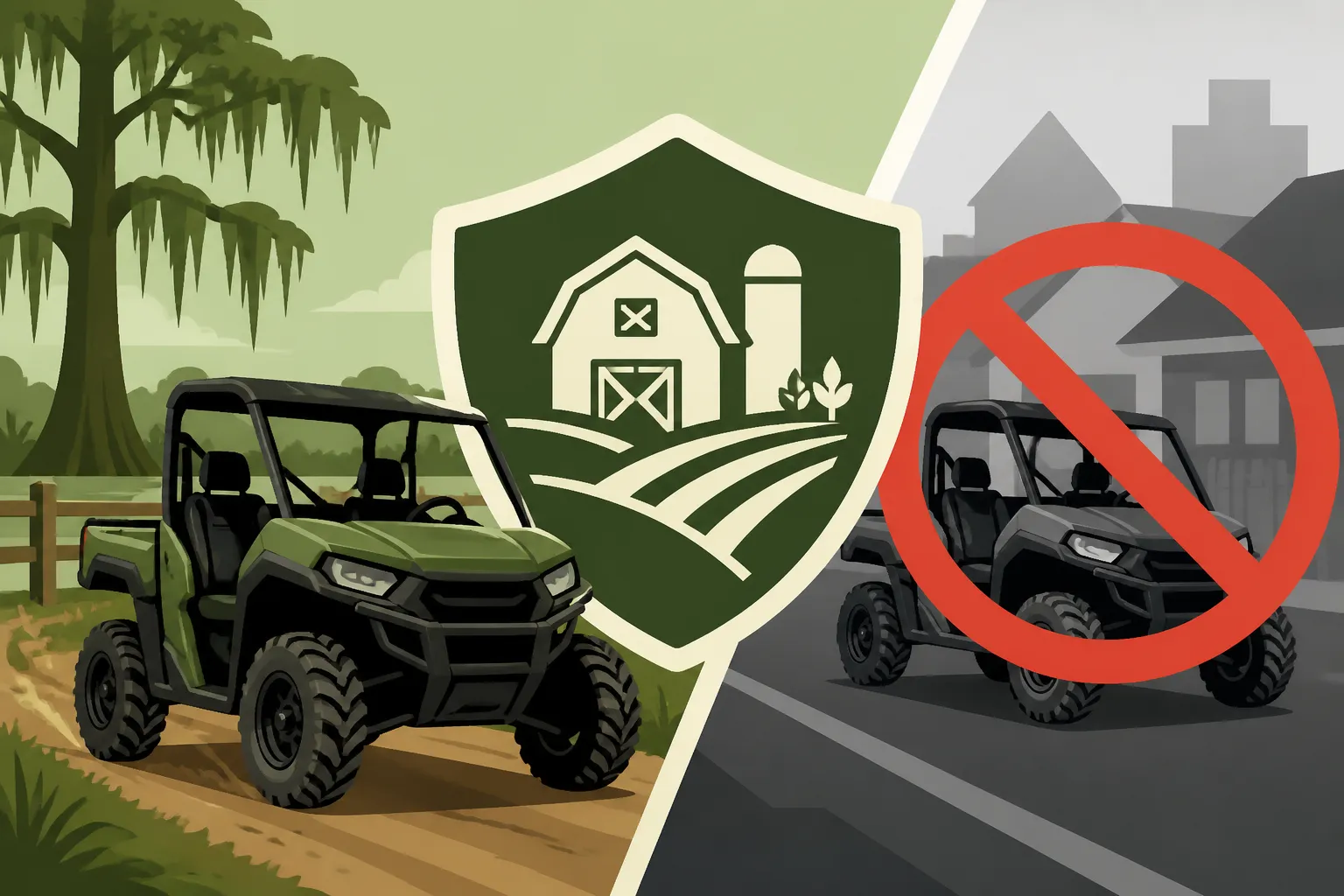
The Exemption That Only Covers Farm Use
One of the trickiest areas for folks who own ATVs and UTVs in Louisiana is understanding when, and if, they qualify for a farm use exemption. It’s a common frustration to think you’re in the clear because your machine is strictly for farm work, only to find out there’s a nuance that could land you in hot water. This guide is going to clear up that confusion, explaining exactly what Louisiana's farm use exemption covers, what it doesn't, and how to make sure you're riding by the book.
Understanding Louisiana's Farm Use Exemption for ATVs and UTVs
It's easy to assume that if you're using your ATV or UTV on a farm, you're automatically exempt from all the usual registration and titling requirements. Unfortunately, it's rarely that simple. Louisiana law, like many states, has very specific definitions and limitations when it comes to "farm use," and misunderstanding these can lead to unexpected headaches. The exemption exists to support our agricultural community, but it's not a free pass for every off-road machine on every rural property. It’s about the purpose and location of the use, not just the ownership.
What "Farm Use" Truly Means in the Eyes of Louisiana Law
When Louisiana law talks about "farm use" for an off-road machine, it's referring to a very specific set of activities directly tied to agricultural production. This isn't just a broad "I live in the country and sometimes ride my quad to check the mail." We're talking about machines being used to cultivate crops, maintain livestock, haul feed and supplies within the farm boundaries, repair fences, or manage agricultural land. Think of it this way: if your machine is integral to the day-to-day operation of a working farm, then it's likely falling under the spirit of the exemption.
However, if you’re using your quad for recreational rides through the pastures after the chores are done, or taking it hunting on a leased tract that isn't actively farmed, those activities typically won't qualify for the "farm use" exemption. The key is that the machine must be exclusively or primarily dedicated to these agricultural tasks. The OMV is looking for genuine farm equipment, not just a personal ATV that happens to be stored on farm property. For more on what qualifies, you can look into [Louisiana Machines Used Only on a Farm].
The Key Distinctions: Title vs. Decal Exemptions
Here's where a lot of the confusion really starts: Louisiana has separate requirements for titling and for displaying an off-road decal. And just because you might be exempt from one doesn't automatically mean you're exempt from the other.
For example, an ATV or UTV used exclusively on private property for agricultural purposes might be exempt from needing an official title from the OMV. However, as soon as that machine even touches a public road, even for a quick hop between fields, it usually needs an off-road decal. This is a critical distinction, and one many riders miss until a state trooper is asking for their papers. [Louisiana Titles ATVs Through the OMV] handles the titling, while the decal is a separate, annual requirement. Always remember that even if your machine never leaves the farm, having a clear title is good for proof of ownership and resale value down the line.
Navigating the Paperwork: Proving Your Farm Exemption
So, you believe your machine qualifies for a farm use exemption. That's a great start, but believing isn't enough in the eyes of the law. You'll need to prove it, and in Louisiana, that usually involves a specific piece of paperwork: the agricultural affidavit. This isn't just a casual conversation; it's a formal declaration.
The Role of the Agricultural Affidavit
If you're claiming a farm use exemption, especially when it comes to riding on public roads under specific, limited circumstances (which we'll cover next), you'll need to complete an agricultural affidavit. This is a sworn statement, often signed in front of a notary, where you declare that your ATV or UTV is used exclusively for bona fide agricultural purposes. It’s a serious document, and providing false information can lead to penalties. The OMV and law enforcement take these declarations seriously because they are the basis for granting an exemption.
You can often find these affidavit forms through the Louisiana Department of Agriculture and Forestry or sometimes the OMV directly. Services like LawDepot can also provide customizable legal forms, including various affidavits, which can be helpful if you need to ensure all the correct legal language is present. Make sure every detail is accurate, and don't hesitate to get it notarized, especially if you intend to use it for road exemptions. This document is essentially your proof that your machine isn't just for fun, but a vital piece of farm equipment. Understanding [Swearing an Affidavit That a Quad Is Farm-Only] is crucial for this step.
When the Exemption Doesn't Apply: Beyond the Farm Gate
The biggest trapdoor with the farm use exemption is assuming it means you can ride anywhere. It absolutely does not. The exemption, even with a properly filled-out affidavit, has very strict boundaries. Once your ATV or UTV leaves your private farm land and enters a public road, even a gravel parish road, you're generally entering a different set of rules.
This means that taking your farm machine to the local co-op, even if it's hauling feed, generally won't be covered by a simple farm use exemption. The exemption is primarily for on-farm activities. If you venture off your property, you'll need to meet standard requirements, including often having a current off-road decal. Think of the affidavit as verifying your machine's primary function for specific purposes, but not as a blanket waiver for public access. The core idea behind [The Exemption That Only Covers Farm Use] is right there in the name: it only covers farm use.
Practical Scenarios and Common Misconceptions
Let's dive into some real-world situations that often trip up Louisiana ATV and UTV owners who believe they're covered by a farm exemption. The road is where most of these issues arise, and it's vital to know the specific rules.
Road Use and the Farm Exemption: A Tricky Line
This is perhaps the most misunderstood aspect of farm exemptions. While Louisiana law does provide a very limited exception for agricultural vehicles, including ATVs and UTVs, to operate on public roads, it comes with a tight leash. Specifically, a farm machine may be ridden on the shoulder of a public highway, but only within a five-mile radius of the farm property and strictly for farm purposes. Even then, an off-road decal is still required. Yes, you read that right: even for this limited road use, you'll need [Louisiana's Yearly Off-Road Decal].
So, if you're taking your quad from one field to another, and those fields are separated by a public road, and the total distance on that road is less than five miles from your farm's main entrance, you might be okay if you're sticking to the shoulder and have your decal. This is [Louisiana's Shoulder-Only Farm Exception]. Crossing a highway where it's incidental to farm operations is also generally permitted. But riding in the travel lanes, going beyond the five-mile radius, or just heading to town for some lunch on your ATV? Absolutely not covered. For more details on the precise geographical limits, see [The 5-Mile Farm Radius on a Shoulder]. The affidavit, possibly drafted with the help of a service like LawDepot, proves your farm intent, but the decal proves your compliance with the general state rules for off-road vehicle road use. [Does a Farm-Only Quad Need a Louisiana ORV Decal?] clarifies this further.
What Happens If You're Caught Without Proper Documentation?
Ignorance of the law is not an excuse, especially when it comes to operating vehicles. If you're riding your ATV or UTV on a public road in Louisiana without the required off-road decal, or attempting to claim a farm exemption without the proper affidavit and adherence to the strict rules, you could face significant penalties. A Louisiana State Trooper or local deputy can pull you over and issue a citation. This can range from fines to, in some cases, impoundment of your machine. It’s not a situation anyone wants to be in.
Law enforcement officers are trained to ask specific questions about your machine’s use and to request documentation. If you can't produce the necessary decal or a valid agricultural affidavit when operating under the narrow farm-use road exception, you're essentially riding illegally. This is why understanding [Louisiana Penalties for No Decal] is so important. They aren't just minor inconveniences; they can hit your wallet and disrupt your farm operations. You can learn more about [What a Louisiana State Trooper Can Ask to See] to be prepared.
Keeping it Legal: Best Practices for Farm Machine Owners
To avoid any issues, here are some practical tips for Louisiana farm machine owners:
- Always Get the Decal if There's Any Doubt: If there's even a slight chance your ATV or UTV will touch a public road, get the annual off-road decal. It's a small fee, typically around $3 a year, and it saves a huge amount of hassle. [The Decal a Farm-Exempt Quad Still Has to Carry] even if it's primarily farm-use.
- Understand the Affidavit: If you're relying on the farm-use road exemption, make sure your agricultural affidavit is correctly filled out, signed, and notarized. Keep a copy with you and a copy on the machine. You can use services like LawDepot to help ensure your affidavit meets all legal requirements.
- Stay Within the Bounds: Strictly adhere to the "shoulder-only" rule and the "five-mile radius" when using a public road for farm purposes. Any deviation puts you at risk. Remember, the statute allows the shoulder and nothing more.
- Educate Yourself and Others: Make sure anyone else operating your farm machine understands these rules as well. Everyone who rides your quad needs to know the limits of the exemption.
- Check Local Ordinances: While state law provides these general guidelines, individual parishes or municipalities might have additional rules or restrictions, especially concerning public road use. Always check with your local parish government.
By being proactive and understanding these nuances, you can continue to use your ATV or UTV as a valuable tool on your Louisiana farm without the added stress of legal uncertainty.
| Feature / Scenario | Covered by Farm Use Exemption (Generally) | NOT Covered by Farm Use Exemption (Generally) |
|---|---|---|
| Primary Use | Cultivating crops, tending livestock, hauling supplies on farm property. | Recreational riding, hunting, casual errands, non-farm business. |
| Titling | Exemption may apply if used exclusively on private property. | If sold, moved off-farm, or used for non-farm purposes. |
| Decal (ORV) | Exemption may apply if never leaves private property. | Required for any public road use (even shoulder, 5-mile farm radius). |
| Road Travel | Shoulder only, within 5-mile farm radius, for farm purposes, with decal. | Travel lanes, beyond 5-mile radius, non-farm errands, without a decal. |
| Proof Required | Agricultural Affidavit (often notarized), proof of farm ownership/activity. | General public road requirements (license, possibly insurance, registration). |
| Consequences of Misuse | Fines, citations, potential impoundment, legal penalties. | Standard traffic violations, fines, possible impoundment. |
Disclaimer
This article is for general informational purposes only and does not constitute professional advice. Laws, prices and regulations vary by location and change over time. Consult a qualified professional for guidance on your specific situation.