Most Drivers Already Hold a Class E License
It can be incredibly confusing, can't it? You've got your ATV or UTV, you've got your driver's license, and you just want to know if that's enough to hop on the shoulder for a quick trip down the road to a friend's camp or a nearby field. The truth is, Louisiana's laws around off-road vehicle use on public roads are a maze, and simply holding a Class E license is often just one piece of a much larger, and far more restrictive, puzzle. This guide will walk you through what your Class E license actually enables you to do, what other critical requirements you'll need to meet, and – perhaps most importantly – what it absolutely doesn't allow when it comes to riding your machine on the state's public thoroughfares.
Understanding the Class E License and Off-Road Machines in Louisiana
Let's start with the basics. Your Louisiana Class E driver's license is the standard license most folks carry, allowing them to operate typical passenger vehicles like cars, SUVs, and light trucks on public roads. It signifies that you've passed the necessary tests to demonstrate basic driving competence and knowledge of traffic laws. For many, it's a simple assumption that if you can drive a car, you can handle an ATV or UTV on a road, right? Well, not so fast when it comes to Louisiana's specific laws concerning off-road vehicles.
The core issue here is that ATVs and UTVs are fundamentally designed and categorized as off-road vehicles, not street-legal ones. This distinction is crucial. While your Class E license permits you to operate a vehicle on the road, it doesn't magically transform an off-road vehicle into one that is legal for general road use. It's like having a pilot's license; you can fly a plane, but that doesn't mean you can taxi it down Main Street. The Class E license is indeed a necessary component for the very limited instances where an ATV or UTV is permitted on public roads, but it's rarely the only one. Think of it as table stakes – you need it to even play the game, but it won't win you the pot on its own. The state's statutes, particularly [Louisiana ATV Road Rules Under 32:299] and [Louisiana UTV Road Rules Under 32:299.3], lay out very specific conditions.
For a long time, the rules were even murkier, and many riders simply took their chances. But as more and more people use ATVs and UTVs for recreation and work, the state has tried to clarify these regulations. Still, confusion persists, leading to frustration and often, unnecessary tickets. The intent of the law isn't to make your life harder, but to ensure safety on roads shared with heavier, faster-moving traffic.
The Specifics: When a Class E License Matters for ATVs/UTVs
So, under what exact circumstances does your Class E license come into play with your off-road machine on a Louisiana road? The law is very particular, and it almost always revolves around agricultural or very specific utility purposes.
Agricultural and Farm Use Exceptions
This is arguably the most common scenario where a Class E license is relevant for ATV/UTV road use. Louisiana law provides a narrow exception for ATVs and UTVs used for agricultural purposes. If you're a farmer, you might be able to operate your machine on the shoulder of a public road, but only for distances up to five miles from the point of origin to your farmland. This is often referred to as the [Louisiana's 5-Mile Farm Radius]. Even then, you absolutely must possess a valid Class E driver's license. The state doesn't want someone operating heavy farm equipment on public roads without having demonstrated basic driving proficiency.
Furthermore, this farm exception isn't just about having your license and driving a few miles. You also need to swear an affidavit, often at an OMV office, stating that your machine is exclusively for farm use. This is called a [Louisiana Farm Affidavits for Road Use]. It’s a formal declaration, and if you're found using the machine for recreational purposes on a public road, you could face penalties. It's critical to understand that "farm use" is strictly defined; it's not a loophole to get your mud machine to the next party. You'll also need to carry this affidavit, along with your license, proof of insurance, and the machine's decal.
Designated Parish and Municipal Roads for UTVs
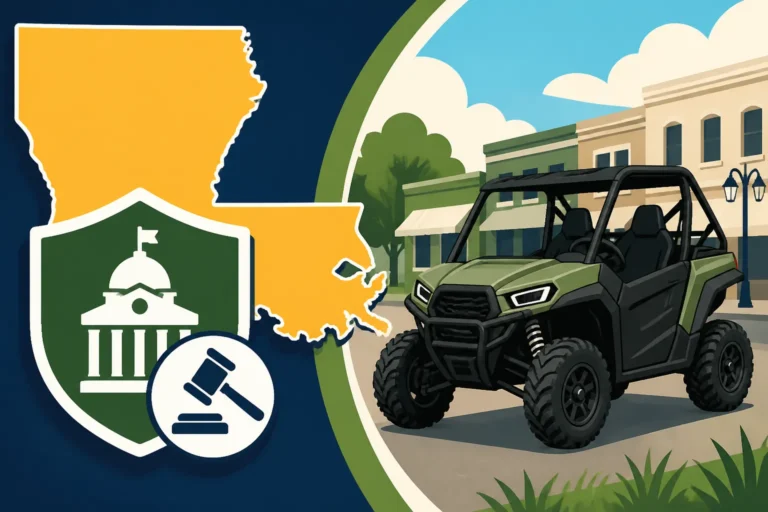
While ATVs have very limited road access even with a Class E license, UTVs (Side-by-Sides) have a slightly different set of rules that can, in some parishes or municipalities, allow for limited road use. Your Class E license is a non-negotiable requirement here. Louisiana's 2015 UTV Statute, and subsequent amendments like [Louisiana's 2022 UTV Amendment], allow local governing bodies (parish police juries or city councils) to designate certain roads or streets for UTV use. If a road is designated and properly signed, and you meet all other requirements, your Class E license allows you to operate your UTV on that specific road.
However, this isn't a free pass. There are typically age restrictions (often 21 for UTV drivers on designated roads), insurance requirements, and specific equipment mandates (like mirrors, headlights, taillights, and sometimes even turn signals). Each parish or municipality can set its own ordinances, so what's legal in one area might be illegal just across the parish line. It's crucial to check local ordinances before you ride. Even on these designated roads, UTVs are often restricted to the shoulder or slow-moving lanes, and prohibited from interstates or high-speed state highways. The idea is to allow residents to use UTVs for local errands or to access nearby properties, not for general transportation.
Your Class E license allows you to operate the vehicle, but the rules governing what vehicle you can operate where are entirely separate. So, while you technically can drive a UTV on a designated parish road with your Class E, you're only allowed to do so if that particular road has been explicitly opened up by local ordinance. It’s a bit of a bureaucratic hoop jump, but it’s there for safety reasons, ensuring you know traffic laws and can safely navigate public roads.
Beyond the License: Other Requirements for Road Use
Just having a [What a Class E License Lets You Do] isn't the finish line for getting your ATV or UTV onto a Louisiana road, even under the limited exceptions. There's a whole checklist of other mandates you absolutely must meet. Missing any one of these can turn a quick trip into a costly ticket or worse.
Decals, Titles, and Proof of Ownership
Every ATV and UTV operated in Louisiana, even if it never touches a public road, needs to be titled and carry a current off-road vehicle (ORV) decal. The OMV (Office of Motor Vehicles) handles this, not the Department of Wildlife and Fisheries. This decal is proof that your machine is registered with the state. While it doesn't make your machine street legal, it's a fundamental requirement. You can find more details in [Louisiana ORV Decals and Titles Explained]. For any road use, even the limited farm exemptions or designated UTV roads, this decal must be current and properly affixed. Law enforcement officers will absolutely be looking for it.
Along with the decal, you need to be able to prove ownership. This means carrying your machine's title or a valid registration card, often in your wallet or a secure spot on the machine itself. If you're stopped and can't produce proof of ownership, or if the decal doesn't match the machine or the owner, you're looking at significant trouble.
Insurance Requirements
This is a big one. For any ATV or UTV that even briefly touches a public road, [Louisiana UTV Insurance Minimums] or ATV insurance is typically required, just like with any other motor vehicle. While many private landowners don't require insurance for riding on their property, the moment your wheels hit public asphalt or gravel, the state's liability laws kick in. This is about protecting yourself and others in case of an accident. Imagine hitting a ditch or, worse, another vehicle while on the shoulder for a farm-related trip. Without insurance, you could be facing substantial financial ruin.
Many insurance companies offer specific ATV/UTV policies that cover liability, collision, and sometimes even comprehensive issues like theft. If you're planning any road use at all, even occasional and highly restricted, you need to ensure your policy specifically covers road operation, not just off-road private land use. Don't assume your homeowner's policy will cover it; most explicitly exclude ATVs and UTVs once they leave private property or a dedicated trail system.
Equipment Requirements
Louisiana law has specific equipment requirements for any ATV or UTV operated on public roads, even under the narrow exemptions. These often include:
- Headlights and Taillights: Essential for visibility, especially during low-light conditions. Even if you're riding during the day, having fully functional lights is a must. If you're riding [Louisiana Rules for Riding After Dark], this becomes absolutely non-negotiable.
- Brake Lights: To signal stops to any traffic behind you.
- Brakes: Fully functional braking system.
- Rearview Mirror: To see traffic behind you.
- Horn: To signal other drivers or pedestrians.
- Reflectors: Additional visibility for other vehicles.
- Tires: Must be suitable for road use and not overly aggressive treads that could damage road surfaces (though this is less frequently enforced than other rules). SuperATV and other aftermarket manufacturers offer a range of road-friendly tires and conversion kits, including things like turn signal kits and DOT-approved windshields, that can help meet these requirements if you're pursuing a very specific road-legal setup, or simply enhancing safety for limited road transitions.
It’s about making your off-road machine as visible and controllable as possible in an environment it wasn't primarily designed for. Skimping on these can lead to fines and put you in a dangerous situation.
Table: Requirements for ATV/UTV Road Use in Louisiana (Limited Exceptions)
| Requirement | Applies to ATV (Farm Use Only) | Applies to UTV (Designated Roads/Farm Use) | Notes |
|---|---|---|---|
| Class E Driver's License | YES | YES | Mandatory for operator. |
| ORV Decal | YES | YES | Required for all ATVs/UTVs in Louisiana. |
| Title/Registration | YES | YES | Proof of ownership must be carried. |
| Insurance | YES (Liability Minimums) | YES (Liability Minimums) | Policy must specifically cover road use. |
| Headlights | YES | YES | Fully functional, on day and night. |
| Taillights/Brake Lights | YES | YES | Fully functional. |
| Brakes | YES | YES | Functional braking system. |
| Rearview Mirror | YES | YES | For visibility of traffic behind. |
| Horn | YES | YES | To alert others. |
| Reflectors | YES | YES | Increased visibility. |
| Age Minimum | 16+ (with Class E) | Often 21+ (for designated roads) | Check local ordinances for UTV age restrictions on designated roads. |
| Agricultural Affidavit | YES (for farm use) | YES (for farm use only) | Must be carried and proven. |
| Local Ordinance Approval | NO (farm use is state-level exception) | YES (for designated roads) | Parishes/municipalities must pass ordinances and post signs for UTV road use. |
| Speed Limit | Generally low (often 25 mph) | Generally low (often 25 mph) | Adhere to posted limits, even if lower. |
| Road Type Restriction | Shoulder of parish roads, secondary highways (farm use only) | Designated parish/municipal roads, shoulder only | [Louisiana Rules for Riding a Shoulder] applies. NO interstates, generally no state highways. |
| Passenger Restrictions | Varies, generally single rider for ATVs | Often limited to manufacturer-designed seating positions for UTVs | Check specific regulations and machine design. |
Common Misconceptions and What a Class E License Doesn't Permit
This is where many riders get into trouble. There are a lot of persistent myths about ATV and UTV legality that simply aren't true, and relying on them can lead to serious consequences, including heavy fines, impoundment, or even accidents. Your Class E license, despite allowing you to drive other vehicles on public roads, does not give you carte blanche with your off-road machine.
Your ATV is Not Street Legal
Let's be unequivocally clear: in Louisiana, an ATV is generally not considered street legal for general road use, even with a Class E license. The only consistent exception is the very specific [Louisiana's Shoulder-Only Farm Exception] for agricultural purposes. This means you cannot use your ATV to run to the store, visit a neighbor a few miles away for a casual chat, or simply take a joyride down a public road. A valid driver's license doesn't change the fundamental classification of the vehicle. [Why a Title Still Keeps You Off the Road] and [Why an Off-Road Decal Is Not Street-Legal Registration] are important to remember.
Riding an ATV on public roads outside of these narrow, farm-related exceptions is illegal. This includes paved parish roads, gravel roads, state highways, and absolutely any interstate. The fact that "everyone else does it" doesn't make it legal, and it's a sure way to incur [Louisiana Penalties for Illegal Road Riding]. Troopers and local deputies are increasingly vigilant about this, especially in rural areas where off-road vehicles are prevalent.
UTVs Have Limited, Not Universal, Road Privileges
While UTVs can have more road access than ATVs, it's a huge mistake to assume that a Class E license makes your UTV universally street legal. As discussed, it only applies to roads that have been explicitly designated by a local ordinance, and you have to meet every single other requirement. This isn't a statewide blanket allowance. So, if you live in one parish where UTVs are permitted on certain streets, but you travel to another that hasn't passed such an ordinance, your UTV immediately becomes illegal on those roads. You need to check [Louisiana UTV Street Legal Rules by Parish] for the specific area you're riding in.
Even on designated roads, there are speed limits, time-of-day restrictions, and often prohibitions against riding in travel lanes, requiring you to stick to the shoulder or far right of the road. Don't assume you can drive your UTV like a car just because you have a driver's license. The rules are much stricter, and the penalties for violation are very real. You could be pulled over for something as simple as failing to have the correct [Louisiana Lighting Rules on a Machine] or for carrying too many passengers.
The "Incidental Crossing" Rule is Often Misinterpreted
Another common point of confusion is the idea of "incidental crossing" of a public road. Some riders believe their Class E license allows them to cross a highway to get from one private property to another. While Louisiana law does allow for incidental crossing of public roads for off-road vehicles, this is usually interpreted very narrowly. It means going directly across a road, not driving down it for any distance. And even then, you must yield to all traffic, come to a complete stop, and cross safely and quickly.
Crucially, this incidental crossing is still typically tied to agricultural use or accessing legal riding areas directly. It is not an excuse to travel down a road. If a state trooper sees you driving a significant distance down a highway, even to cross, they will likely consider it illegal road use, regardless of your Class E license. The rule is about minimizing interaction with public roads, not facilitating travel on them.
In short, your Class E license is a prerequisite for the extremely limited road use cases for ATVs and UTVs in Louisiana. It demonstrates you know how to operate a motor vehicle safely and understand traffic laws. But it does not override the specific legal classifications of ATVs and UTVs as primarily off-road machines. Always assume you cannot ride on public roads unless you have verified every single legal requirement for that specific machine, that specific road, and that specific purpose. When in doubt, err on the side of caution and keep your wheels off the asphalt.
Disclaimer
This article is for general informational purposes only and does not constitute professional advice. Laws, prices and regulations vary by location and change over time. Consult a qualified professional for guidance on your specific situation.