Louisiana Shoulder Riding Still Needs a Decal
It's incredibly frustrating when you try to do the right thing and still feel confused by all the rules and regulations for your ATV or UTV, especially when it comes to something as seemingly simple as riding the shoulder. Many riders assume that if they’re just hugging the side of a parish road, they're somehow exempt from the usual off-road vehicle requirements. But in Louisiana, even if you’re only riding the shoulder, your machine very likely still needs a valid off-road decal. This guide will help you understand why this is the case, what the decal truly signifies, and how to stay compliant while enjoying your machine.
Why "Shoulder Riding" Still Means Public Access
There’s a common misconception out there that if you’re not in the main travel lane of a road, you’re somehow operating in a gray area where the typical rules don’t apply. We often hear from folks who think that because they’re "just on the shoulder," they're essentially operating in an extension of private land or that the regulations are looser. It’s an understandable assumption, especially if you’re using your ATV or UTV for practical purposes like getting to a hunting stand or checking on livestock in a rural area. However, the shoulder of a public road, even a quiet gravel one in the middle of nowhere, is still considered public right-of-way.
This distinction is crucial because it means your machine isn't operating solely on private property. When you pull onto that shoulder, you're entering an area maintained by the parish or state, which is accessible to other vehicles, pedestrians, and certainly, law enforcement. The moment you leave private land and enter that public space, even just a few feet onto the shoulder, your vehicle becomes subject to the state's regulations for off-road vehicles on public property. This is why that little sticker on your machine, the ORV decal, becomes non-negotiable.
The Decal's Purpose Beyond Trails
Think of the off-road decal as your machine’s public access pass. It’s not just for designated trails in Kisatchie National Forest or private mud parks. The state requires this decal for any ATV or UTV that will be operated on public lands, which broadly includes the shoulders of roads. This decal serves several important functions, not least of which is to identify your machine to authorities as one that has met the basic registration requirements set forth by the Louisiana Office of Motor Vehicles (OMV). It helps fund important programs, too, like trail maintenance and enforcement efforts that benefit all riders.
Many riders, particularly those in rural communities, might feel that this rule is an overreach, especially if their shoulder riding is minimal or for utilitarian purposes. "I’m just going from my field to the barn across the road," they might say. And while the spirit of that might feel different from someone joyriding, the letter of the law typically doesn't make that distinction for the decal requirement on public rights-of-way. It's about establishing a clear standard for identification and accountability whenever an ORV touches public ground.
What the Louisiana ORV Decal Actually Covers
The Louisiana ORV decal, often referred to as the "Off-Road Vehicle Decal," is an annual requirement for most ATVs and UTVs operating anywhere other than strictly private property. While the [Louisiana ORV Decals and Titles Explained] article covers the comprehensive requirements, it's important to understand specifically what the decal implies for various use cases, including shoulder riding. This isn't just a revenue-generating sticker; it's a mechanism for tracking, identifying, and ensuring compliance across the state's diverse riding environments.
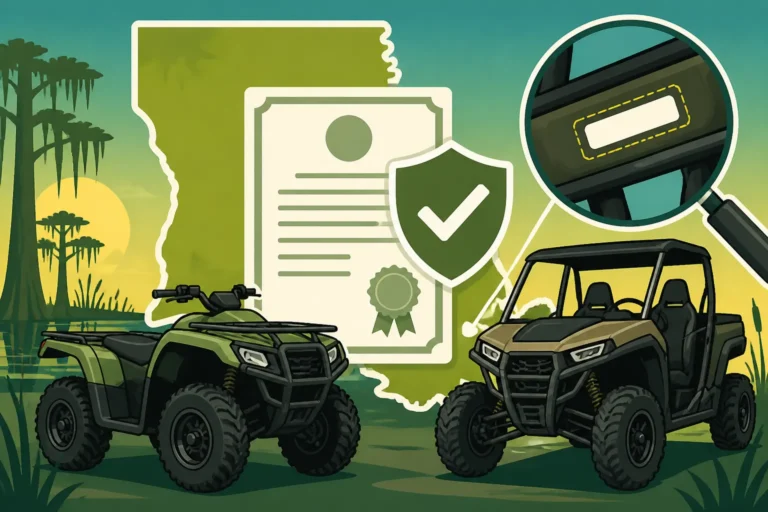
The decal itself is a small, typically brightly colored sticker that must be affixed to a visible part of your machine, usually the front or rear fender. It's a testament that your machine has been properly identified with the OMV and that you've paid the modest annual fee. This fee, while small, contributes to the overall management of off-road vehicle use in Louisiana, including enforcement and, sometimes, development of riding areas.
The Broad Reach of the Decal Requirement
The scope of the decal requirement is broader than many anticipate. It's easy to assume it's only for hardcore trail riders hitting destinations like Muddy Bottoms ATV Park or Sandstone Multiple-Use Trail. However, the legislation aims for wider coverage. Any operation of an ATV or UTV on public property, whether it's a designated trail, a WMA access road (where permitted), or indeed, the shoulder of a parish or state highway, triggers the need for this decal.
This means that if you're using your side-by-side to cruise down a rural road shoulder to your fishing spot, or an ATV to check fence lines that parallel a public thoroughfare, you need that decal. The intent is to ensure that any machine operating in a public domain, regardless of its speed or how far it strays from private land, has been accounted for by the state. This helps in cases of accidents, theft, or even just general compliance with local ordinances. The decal is a basic layer of regulation that ensures a minimum standard for all public interactions involving ORVs.
Decal Versus Title: A Key Distinction
It’s easy to confuse the decal with your machine’s title, but they serve different, albeit related, purposes. Your machine's title, typically issued by the OMV, is proof of ownership. It establishes who legally owns the ATV or UTV, much like a title for a car or truck. The decal, on the other hand, is proof that your machine is registered for use on public lands in Louisiana for a specific period. You can't get a decal without first having a title.
Think of it this way: you can own a car (have its title) but it might not be registered for road use (no plate or sticker). Similarly, you can own an ATV (have its title), but without the decal, it's not approved for public use. So, while you'll need to go through the process of getting your ATV titled (and yes, [Louisiana Titles ATVs Through the OMV]), that's only step one. The decal is the ongoing requirement that lets you actually ride in public spaces, including that shoulder you're eyeing.
The Farm Exemption and Where It Stops
For many Louisiana residents, especially those living and working in agricultural areas, the idea of an "agricultural exemption" often comes up in discussions about ATV and UTV rules. It’s true that Louisiana law provides some specific exemptions for machines used exclusively for farming purposes. This can lead to confusion, as some riders mistakenly believe that if their machine is used for farm work, it’s completely exempt from all state requirements, including the decal, even when riding the shoulder. However, the nuances of this exemption are critical, and unfortunately, it doesn’t usually extend to shoulder riding without the required decal.
The core of the agricultural exemption, as discussed in detail in [Louisiana's Agricultural Registration Exemption], generally pertains to machines used solely on private agricultural land. This means if your ATV never leaves your farm, isn't operated on public roads or their shoulders, and is used strictly for agricultural tasks like hauling feed, checking crops, or managing livestock, it might be exempt from certain title and decal requirements. This is where many riders get tripped up.
Why the Shoulder Isn't "Farm Land" for Exemption Purposes
The key phrase is "solely on private agricultural land." The moment your machine touches a public road or its shoulder, even for a short distance between two fields, it typically falls outside the scope of this strict farm-only exemption when it comes to the decal. The state draws a clear line: public property requires a decal. While there are some very specific allowances for crossing public roads or riding shoulders within a certain radius for farm purposes, these typically come with their own set of requirements, such as a valid farm affidavit and still often necessitate the decal. The article [Why the Farm Exemption Stops at the Shoulder] really drives this point home.
Imagine a scenario: you have two tracts of farmland separated by a parish road. You use your UTV to go from one field to the other. Even if this journey is only a quarter-mile on the shoulder, that shoulder is public property. Law enforcement views this as an ORV operating in a public right-of-way, and thus, the decal is typically required. The intent is to ensure that even agricultural machines are properly identified when they interact with the public infrastructure. Without the decal, you could face penalties, regardless of your good intentions or the machine's primary use.
Documenting Farm Use When Riding the Shoulder
If you absolutely must use your ATV or UTV on a public shoulder for a specific, farm-related purpose, you might be required to carry an agricultural affidavit. This is a formal, notarized document (which you could potentially draft using resources like LawDepot for proper formatting) that attests to your machine's primary use for farming. While this affidavit might help clarify your intentions to law enforcement and is crucial for certain exemptions, it generally does not exempt you from the ORV decal requirement for shoulder use. It's an additional piece of paperwork that validates your claim of farm use, but the decal remains the primary indicator of compliance for public operation.
For instance, if you're taking advantage of the [Louisiana Farm Affidavits for Road Use] provision for very limited road or shoulder travel within a certain radius of your farm, that affidavit proves the purpose of your travel. However, the machine itself still needs to be identified via the ORV decal. It’s a dual layer of compliance: proving why you're on the shoulder, and proving your machine is registered for public operation.
Understanding the Legalities of Road and Shoulder Use
Navigating Louisiana's laws regarding ATVs and UTVs on public roads and shoulders can feel like deciphering a riddle written in legal jargon. The core issue is that off-road vehicles, by their very design and name, are not intended for street use. However, Louisiana, like many agricultural states, recognizes that rural communities have practical needs to move these machines between properties or for specific tasks. This recognition comes with very strict limitations and, crucially, doesn't waive the decal requirement for shoulder use.
The state's primary statute, Louisiana Revised Statute 32:299, lays out the general rules for ATVs, while 32:299.3 addresses UTVs. These statutes explicitly ban ATVs and UTVs from being operated on public streets and highways, with very specific exceptions. The shoulder is, in the eyes of the law, part of that public highway system. So, when people ask, [Can You Ride an ATV on the Road in Louisiana?], the answer is almost always a resounding "no," with very narrow, highly regulated exceptions.
Specific Exceptions to Road and Shoulder Bans
While the general rule is a ban, Louisiana does make limited exceptions for ATVs and UTVs, primarily for agricultural purposes or municipal utility work. For instance, an ATV or UTV may be operated on a public road or shoulder only if:
- It is being used for agricultural purposes within a certain radius of the owner's farm, typically for bona fide farm operations. This usually requires a farm affidavit.
- It is being used by a public utility or municipality for legitimate utility work or law enforcement.
- It is crossing a public road where the crossing is incidental to the operation of the ATV/UTV on private property and is done safely.
Even within these exceptions, the requirements for lighting, safety gear (like helmets, as detailed in [Louisiana ATV Helmet Rules]), and the necessity of a valid ORV decal often remain. The intent of these exceptions is not to create loopholes for general recreational riding on shoulders but to accommodate essential work functions under controlled conditions. This means that if you're not actively engaged in farming or utility work, even that quick trip down the shoulder for convenience is likely outside the legal bounds without explicit local designation.
Local Ordinances and Their Impact
To further complicate matters, while state law sets the baseline, individual parishes and municipalities in Louisiana have the authority to designate specific public roads or sections of roads for ATV and UTV use. These designations are rare and usually come with their own set of rules, including signage requirements ([Louisiana Signage on a Designated Road]) and speed limits. However, even if a parish designates a road, it typically does not exempt the machine from the state's ORV decal requirement. The local designation allows the location of use, but the state decal ensures the machine itself is compliant.
So, before you rely on a local ordinance you heard about, make sure to verify it directly with the parish or municipality. Always assume the state's more restrictive rules apply unless you have clear, documented proof of a local exception and you understand all the conditions that come with it. Even then, your ORV decal is almost certainly still required for any public road or shoulder access.
Getting Your Decal: Steps and Requirements
If you've realized that your shoulder riding habits, or any public land use for your ATV or UTV, means you need that Louisiana ORV decal, don't fret. The process is straightforward, though it requires a bit of preparation and a visit to your local Office of Motor Vehicles (OMV). It's far better to invest a little time and the modest fee now than to face the penalties later. The first step, as mentioned earlier, is ensuring your machine is properly titled. [How to Get a Louisiana ORV Decal] outlines the specific steps in detail.
The OMV is the central authority for issuing these decals. You can't just pick one up at a convenience store or a local hunting supply shop. It requires official verification of your ownership and machine details. This ensures that every decal issued is tied to a specific, identifiable off-road vehicle in the state's database, enhancing accountability and reducing the chances of fraudulent decals being used.
Necessary Documents for Your OMV Visit
When you head to the OMV, you'll need to bring several key documents to successfully obtain your decal. Think of it as putting together a small packet for your machine. This usually includes:
- Proof of Ownership: Your ATV or UTV title is paramount. If you bought a new machine, you'll likely have a Manufacturer's Statement of Origin (MSO) which will be used to get your initial title. If it's used, an [Louisiana Requires an Assigned Title for a Used One] is what you'll need.
- Proof of Sales Tax Payment: Louisiana requires proof that sales tax has been paid on the purchase of the machine. If you bought it from a dealer, your [Louisiana Itemized Dealer Invoices] should show this. For private sales, you might need to show a notarized bill of sale (which [Why Your Bill of Sale Needs a Notary] explains in depth) and potentially pay use tax at the OMV.
- Identification: A valid government-issued photo ID, like your driver's license, is always required for any OMV transaction.
- Application Form: You'll fill out a specific application form for the ORV decal, usually Form DPSMV 1799, which [Louisiana Form DPSMV 1799 Explained] details. This form collects information about you and your machine.
- Payment for Fees: The decal itself has a small annual fee, typically around [Louisiana Charges $3 a Year for a Decal]. There might also be a small handling fee.
Having all these documents organized before you go will make your OMV visit much smoother. It’s always a good idea to call ahead or check the OMV website for specific office hours and any additional requirements, especially if you're dealing with a unique situation like an out-of-state purchase ([Louisiana Titles for an Out-of-State Purchase]) or an inherited machine ([Louisiana Titles for an Inherited Machine]).
When and Where to Affix Your Decal
Once you have your shiny new decal, the job isn't quite done. You need to properly affix it to your machine. The OMV guidelines typically require the decal to be placed in a clearly visible location on the ATV or UTV, usually on the front or rear fender. The goal is easy visibility for law enforcement. Don’t tuck it away under a seat or in a tool kit; it needs to be seen. [Louisiana Decal Placement on a Machine] provides more guidance on this.
It's also important to remember the timing. The decal is valid for a specific period, and it's your responsibility to ensure it's renewed before it expires. [When a Louisiana ORV Decal Comes Up for Renewal] details how these cycles work. Riding with an expired decal is just as problematic as riding with no decal at all. Make a note in your calendar, or set a reminder, so you’re always up-to-date and compliant.
Penalties for Riding Without a Decal
Nobody wants to face fines or other legal trouble, especially when you're just trying to enjoy your ATV or UTV or use it for practical purposes. However, riding your off-road machine on public lands or shoulders in Louisiana without the required ORV decal can lead to real penalties. Law enforcement, from local sheriff's deputies to Louisiana State Troopers, is trained to look for these decals, and a missing one is a clear indicator of non-compliance.
The state doesn't take these regulations lightly, as they are in place for safety, identification, and responsible land use. The penalties are designed to encourage compliance and can be more than just a slap on the wrist. Ignoring the decal requirement can quickly turn a casual ride into a costly headache, proving that an ounce of prevention (or a $3 decal) is worth a pound of cure.
Fines and Citations
The most immediate consequence of riding without a decal is a traffic citation and a fine. While specific fine amounts can vary depending on the parish and the discretion of the issuing officer, they can quickly add up. You'll not only be responsible for the base fine but potentially court costs and other administrative fees. These costs will almost certainly far exceed the modest annual fee for the decal itself.
A common scenario might involve a routine stop by a deputy who notices your UTV on the shoulder of a rural road. If the decal is missing or expired, they have every right to issue a citation. It’s not about whether you’re causing trouble; it’s about compliance with the law. The article [Louisiana Penalties for No Decal] goes deeper into the financial and legal repercussions you might face. It's a stark reminder that even seemingly minor infractions can lead to significant out-of-pocket expenses.
Impoundment and Other Repercussions
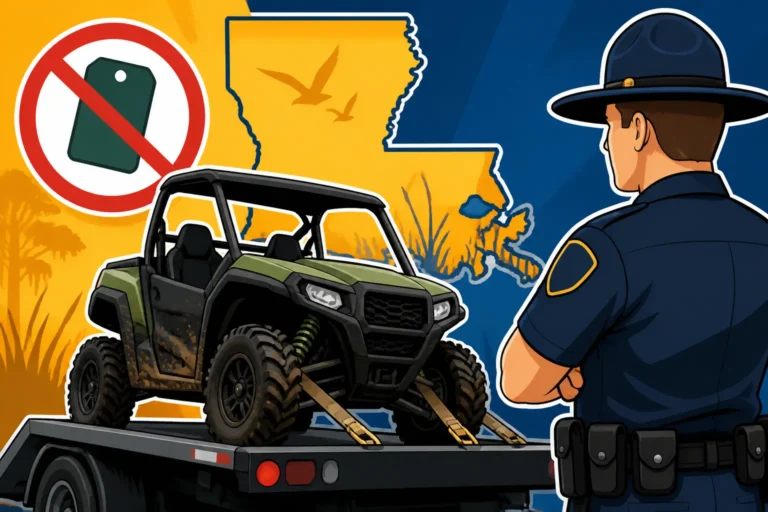
In more severe cases, or if you're a repeat offender, riding without a decal can lead to the impoundment of your ATV or UTV. Imagine your machine being towed away, leaving you stranded and facing a massive headache to retrieve it. Impoundment involves towing fees, daily storage fees, and the hassle of going through the legal process to get your machine back. This can quickly turn an already expensive situation into a financial nightmare. [Louisiana Impoundment for No Decal] explains how this process can unfold and the costs involved.
Beyond financial penalties, repeated violations can also impact your standing with law enforcement, potentially leading to more scrutiny in the future. It’s always best to be an informed and compliant rider. Take the time to understand the rules, get your decal, and avoid the stress and expense that comes with non-compliance.
| Scenario for ATV/UTV Use | Requires Title? | Requires ORV Decal? | Notes |
|---|---|---|---|
| On Private Land Only | Yes (Proof of Ownership) | No | Always good to have proof of ownership for theft/resale. |
| Shoulder of Public Road | Yes | Yes | Even if for short distances or farm use. |
| Designated Public Trails | Yes | Yes | Essential for access to places like Kisatchie. |
| Crossing Public Road (Incidental) | Yes | Yes | Decal usually required; must be safe and incidental. |
| Farm Use (on own land only) | Yes (Exemption possible) | No (Exemption possible) | Specific agricultural exemptions apply only on private land. |
| Farm Use (on shoulder within radius) | Yes | Yes | Often requires both decal and farm affidavit. |
| In a Private Mud Park | Yes | No | Decal not required on private park land, but often needed for transit to park. |
Disclaimer
This article is for general informational purposes only and does not constitute professional advice. Laws, prices and regulations vary by location and change over time. Consult a qualified professional for guidance on your specific situation.