Louisiana Rules Riders Get Wrong
It's incredibly frustrating when you're just trying to enjoy your off-road machine in Louisiana, only to find yourself scratching your head over the maze of rules and regulations. So many folks operate under assumptions that, while well-intentioned, can land them in hot water with local law enforcement or the Office of Motor Vehicles (OMV). This guide is here to untangle some of the most common misconceptions Louisiana ATV and UTV riders have, helping you stay compliant and out of trouble so you can focus on the fun parts of riding.
The "Street Legal" Myth for ATVs: Ownership Versus Operating Privilege
One of the biggest misunderstandings I hear from fellow riders is that once you've titled your ATV, it's somehow "street legal" or can be casually ridden on public roads. I wish it were that simple! The truth is, titling an ATV in Louisiana is a crucial step for proving ownership, but it doesn't automatically grant you the right to drive it down Main Street. There's a world of difference between proving you own a machine and proving you can legally operate it on public roads.
Why an ATV Title Isn't a Street Pass
Think of it this way: you might have the title to a fancy race car, but that doesn't mean you can drive it on city streets without modifications, insurance, and proper registration for road use. The same principle largely applies to ATVs. The Louisiana OMV handles ATV titles, which is often where the confusion begins because the OMV also titles cars and trucks. However, the OMV's role in titling ATVs primarily establishes a legal chain of ownership, helps with sales tax collection, and ensures your machine is on record. It’s about protecting your investment and preventing theft, not about granting road access.
When you go to the OMV, you're confirming who the rightful owner is, especially after a purchase, whether new or used. This is a critical step for your own protection and for the state to collect its dues. Many people assume that because the OMV is involved, their ATV is now treated like a car. Unfortunately, that's not the case. An ATV is still legally designated as an off-road vehicle. [Louisiana Titles ATVs Through the OMV] primarily to track ownership, not to make them street-ready.
The Off-Road Decal's True Purpose
Another piece of paperwork that often leads to misunderstandings is the Louisiana off-road decal. Many riders believe this decal is some form of "limited street registration" or that it somehow allows them more freedom on public roads than it actually does. Let's set the record straight: the off-road decal, while mandatory for certain uses, is specifically not for street use. Its main purpose is to show that you've paid the necessary fee to use designated public off-road riding areas within the state, like those found in national forests or Wildlife Management Areas (WMAs).
When you affix that bright orange decal to your machine, you're signaling compliance for off-pavement adventures, not pavement cruising. This decal helps fund trail maintenance and administration of public riding areas, ensuring that we all have safe and well-kept places to ride. It's truly disheartening when I see someone get a ticket because they thought their decal meant they could just zip down a parish road to the gas station. That decal is your ticket to the trails, not the highway. For a deep dive into this, check out [Why an Off-Road Decal Is Not Street-Legal Registration]. It's a fundamental distinction that every Louisiana rider needs to grasp.
UTVs and Road Use: It's Not a Free-for-All
With the rise in popularity of UTVs, or side-by-sides, a new layer of confusion has emerged regarding their legality on public roads. Unlike ATVs, Louisiana law does provide a pathway for UTVs to be operated on certain public roads. However, this isn't a blanket permission slip for every road in the state, and there are very specific conditions that must be met. Many riders mistakenly believe that because UTVs are larger and sometimes resemble small cars, they inherently have more road privileges than ATVs. This simply isn't true; it's all about local ordinances and specific state requirements.
The Parish-by-Parish Reality
This is where things get really localized and often trip people up. While state law (specifically Louisiana R.S. 32:299.3) allows parishes and municipalities to designate certain public roads for UTV use, it doesn't automatically make all parish or municipal roads legal for UTVs. A parish council or city government must actively pass an ordinance to designate those roads, and crucially, they must post appropriate signage. Without that local ordinance and the visible signs, even if your UTV meets all other state requirements, you're not legally permitted to ride on that road.
Imagine living in a parish that hasn't enacted such an ordinance. Even if the parish next door has designated a dozen roads, you can't just assume the same applies to yours. You absolutely need to check with your local parish government or municipality to understand their specific UTV ordinances. This hyper-local approach means that what's legal in Webster Parish might be strictly prohibited in Acadia Parish. Many riders customize their UTVs with turn signals, mirrors, and windshields, often sourcing quality parts from companies like SuperATV, to meet potential requirements. However, having the right gear is only half the battle; knowing where you can actually use it is the other. It's a patchwork of rules, and ignorance is rarely accepted as an excuse. For more specific details, you'll want to read up on [Louisiana UTV Street Legal Rules by Parish].
Age, License, and Other Misunderstood Rules
Beyond the parish-by-parish designation, state law imposes several other non-negotiable requirements for UTV operation on public roads. One of the most frequently overlooked is the age requirement. While many young people enjoy riding UTVs off-road, Louisiana law clearly states that a driver of a UTV on a designated public road must be at least 21 years old. This isn't a suggestion; it's a hard and fast rule. So, if you're under 21, even if the road is designated and your UTV is properly equipped, you cannot legally drive it on that public road.
Furthermore, any person operating a UTV on a designated public road must possess a valid Class E driver's license, which is the standard license most Louisianans hold for cars. This means even if you're 21 and your UTV is perfectly set up, you still need to be a licensed driver. Beyond age and license, UTVs used on public roads must also have specific equipment, which typically includes headlamps, tail lamps, brake lamps, turn signals, a horn, a rear-view mirror, and a parking brake. You'll also need proof of liability insurance. Many riders look to reputable aftermarket providers like SuperATV for lighting kits, mirrors, and other accessories to ensure their UTVs meet these stringent equipment requirements, but always double-check the exact specifications required by state and local law. These rules are in place for safety, and ignoring them can lead to significant fines and penalties. For further clarity on driver requirements, see [Louisiana Requires UTV Drivers to Be 21] and [Louisiana Requires a Class E License].
Farm Exemptions: They Have Limits
Louisiana, being an agricultural state, has some specific exemptions for ATVs and UTVs used for farming purposes. These exemptions can be incredibly helpful for farmers and those involved in agricultural work, making it easier to move between fields or manage livestock. However, a widespread misconception is that simply owning a property that could be considered a farm, or occasionally using your machine for a farm-related task, automatically grants you a free pass to ignore all other ATV/UTV rules. This simply isn't the case. The farm exemption is quite narrow in its scope and has clear boundaries.
The Limited Scope of Farm Use
The agricultural exemption in Louisiana is not a "get out of jail free" card for all-purpose riding. It's primarily designed to facilitate legitimate farming activities. Specifically, it generally allows for the operation of ATVs and UTVs on the shoulder of certain public roads, within a five-mile radius of the farm's property, and only when engaged in agricultural purposes. This means you can't use the exemption to run to the grocery store or meet up with friends for a recreational ride, even if your machine usually helps with chores. The key phrases are "shoulder of the public road," "within five miles of the farm," and "agricultural purposes." If you're not actively involved in one of those narrow applications, the exemption likely doesn't apply.
For example, riding your ATV down a parish road to your hunting camp, even if the camp is on land you consider agricultural, would typically fall outside the scope of the exemption if hunting isn't directly related to farming as defined by the statute. The state's intent is to support farmers, not to create a loophole for recreational road use. Riders often need to carry an affidavit confirming their agricultural use. Understanding [Louisiana's Shoulder-Only Farm Exception] and [The 5-Mile Farm Radius on a Shoulder] is crucial for anyone relying on this specific exemption.
Still Need a Decal for Farm Use?
Another common point of confusion revolves around whether a farm-exempt machine still needs a decal. Many riders incorrectly assume that if their machine is used exclusively for farming, it's completely exempt from all decal requirements. While some very specific farm machines might have different rules, the general understanding for ATVs and UTVs is that even if you qualify for the farm-use exemption for road shoulder travel, you might still need a decal. This is often a special agricultural decal or you might be required to possess an affidavit of agricultural exemption to be presented upon request.
The exact requirements can sometimes be a bit nuanced, but the takeaway is this: don't assume "farm use" means "no paperwork at all." The state still wants to know that your machine is being used in a compliant manner, even if it's for agricultural work. It’s always best to verify with the OMV or local authorities to ensure you have the correct documentation. Having a discussion with your local OMV office about your specific farm-use scenario is always a good idea. Knowing [Does a Farm-Only Quad Need a Louisiana ORV Decal?] is key to avoiding an unnecessary citation while moving your equipment.
Levee Riding and Other Restricted Zones
Louisiana's unique geography, with its extensive levee systems, batture lands, and canal banks, offers tempting but often illegal riding opportunities. Many riders mistakenly believe these areas are public rights-of-way where off-road machines are always permitted. The reality is far more restrictive, and riding in these sensitive or controlled areas without proper authorization can lead to severe penalties, including fines and even impoundment of your machine. This is one of those areas where local knowledge and official permission are paramount.
Why You Can't Just Ride the Levees
The levee systems across Louisiana are primarily managed by various levee districts, not typically by the parish or state in a recreational sense. These districts have specific responsibilities, mainly flood control and infrastructure protection. As a result, riding ATVs or UTVs on state-maintained levees is generally prohibited without explicit, written permission from the relevant levee district. This isn't just a suggestion; it's a serious regulation aimed at preventing damage to critical flood control structures and ensuring public safety.
I've heard countless stories of riders who thought a levee was fair game, only to find themselves facing a steep fine or having their machine impounded by levee district police or local law enforcement. It's easy to see a wide, open levee and assume it's a great trail, but these areas are under strict control. The same often applies to canal banks, which are typically privately owned or managed by drainage districts. Always assume these areas are off-limits unless you have direct, written permission. For more on this, look into [Louisiana Levee Riding Is Prohibited].
Understanding Private Land and Posted Signs
Beyond state-controlled areas like levees, riders often get into trouble by inadvertently trespassing on private land. Louisiana has vast expanses of timberland, agricultural fields, and other private properties that are frequently used for hunting, logging, or farming. Many riders assume that if a gate isn't locked, or if there's no visible fence, the land is public or open to riding. This is a dangerous assumption. Louisiana trespass law is quite clear: if land is not explicitly designated as public access (like a WMA trail), you must have permission from the landowner to ride there.
Look for signs, even if they seem old or partially obscured. "Posted," "No Trespassing," or "Private Property" signs mean exactly what they say. Even if you're riding a highly customized UTV with accessories from SuperATV that's otherwise compliant for designated roads, it means nothing if you're on someone else's property without permission. Always err on the side of caution. If you're unsure, find out who owns the land and seek explicit permission before you ever unload your machine. Respect for private property is not just a courtesy; it's a legal requirement that can save you a lot of hassle.
Avoiding Common Mistakes and Penalties
Navigating Louisiana's ATV and UTV rules can feel like a full-time job, but understanding these common pitfalls is your first line of defense against citations and other unpleasant surprises. The state isn't trying to make riding impossible; the goal is to ensure safety, protect property, and manage public resources responsibly. Knowing what a law enforcement officer can, and will, ask to see when you're pulled over or stopped on a public road or in a restricted area is critical.
What a Trooper Can Actually Do
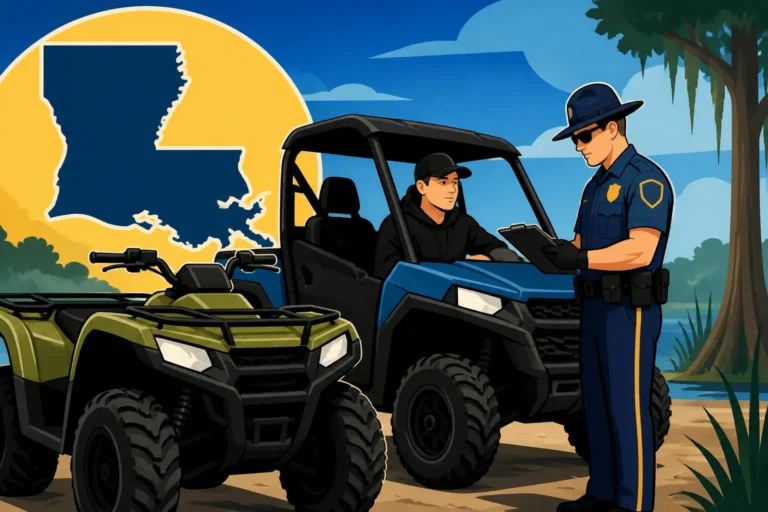
When you're out riding, especially on or near public roads, you can absolutely expect a state trooper or local deputy to stop you if they suspect you're not in compliance. They can, and will, ask for proof of ownership (title), proof of registration (decal, if applicable), and for UTVs on designated roads, proof of driver's license and insurance. If you're on a parish road under the farm exemption, they'll want to see your agricultural affidavit and may question the nature of your trip. The penalties for non-compliance can range from monetary fines to having your machine impounded.
Imagine being pulled over and not having your title, or having a UTV on a road that isn't designated. These situations often escalate quickly. A single citation can easily run into hundreds of dollars, not to mention court costs, and the hassle of retrieving an impounded machine can be an even bigger headache. It's not uncommon for riders to face multiple citations if they're found to be operating without a decal and on a prohibited road and without a license. [Louisiana Penalties for Illegal Road Riding] and [Louisiana Impoundment for No Decal] are serious consequences that can quickly ruin your riding season.
Proactive Steps for Compliant Riding
The best way to avoid these issues is to be proactive and informed. Here are some actionable steps you can take:
- Know Before You Go: Always research the specific rules for your parish or municipality before you ride on any public road. If you plan to ride on public lands, understand the WMA or forest regulations.
- Carry Your Paperwork: Keep your ATV/UTV title, off-road decal information, driver's license, and insurance card (for UTVs on designated roads) easily accessible. A waterproof bag for these documents is a smart investment.
- Equip Your Machine Properly: If you plan to use your UTV on designated roads, ensure it meets all equipment requirements: headlamps, tail lamps, brake lights, turn signals, horn, mirror, etc. Reputable aftermarket brands like SuperATV offer many of these components.
- Understand Exemptions: If you rely on a farm exemption, be crystal clear about its limitations and ensure you have any required affidavits.
- Respect Private Property: When in doubt, assume land is private. Seek and carry written permission if you plan to ride on private property you don't own.
- Stay on Designated Trails: When riding in WMAs or national forests, stick to marked trails. Going off-trail can lead to fines and environmental damage.
By taking these steps, you're not just avoiding penalties; you're also being a responsible rider and helping to preserve access for everyone.
Common Misconceptions vs. Louisiana Reality
Let's summarize some of these common "wrong rules" and their real-world implications in Louisiana.
| Misconception | Louisiana Reality |
|---|---|
| My titled ATV is street legal. | An ATV title proves ownership, not road legality. ATVs are generally not allowed on public roads. The OMV titles ATVs to track ownership and collect taxes, not to grant street access. |
| My UTV can go on any parish road. | UTVs are only permitted on public roads that have been specifically designated and signed by a parish or municipal ordinance. This varies widely by location. You need local permission and a Class E license. |
| My UTV is street legal because it has lights. | While equipment like lights, mirrors, and turn signals (often sourced from companies like SuperATV) are required for UTV road use, they don't override the need for local road designation, a 21+ age for the driver, a valid Class E license, and insurance. |
| My farm ATV/UTV needs no decal or special rules. | Even for farm use, specific rules apply. The farm exemption for road shoulder use is limited to agricultural purposes within a 5-mile radius. Some form of decal or affidavit for agricultural use is often still required. [Does a Farm-Only Quad Need a Louisiana ORV Decal?] for clarity. |
| Levees/canal banks are open for riding. | Riding on state-maintained levees and most canal banks is prohibited without explicit, written permission from the relevant levee district or landowner. These are critical infrastructure or private property. [Louisiana Levee Riding Is Prohibited] to understand why. |
| If land isn't fenced, it's public. | Always assume land is private unless it's clearly marked as public access. Trespassing, even unintentional, can lead to serious legal consequences. Seek and carry written landowner permission. |
| The off-road decal lets me ride anywhere. | The off-road decal is primarily for legal use on designated public off-road trails (like those in Kisatchie National Forest or WMAs) and does not grant permission for street use or access to private land. [Louisiana's Yearly Off-Road Decal] explains its function. |
| I don't need a license for my UTV on the road. | A valid Class E driver's license is mandatory for operating a UTV on any designated public road in Louisiana, in addition to being at least 21 years old. [Louisiana Requires a Class E License] is non-negotiable. |
| I can take my child for a ride on the road in my UTV. | While child passengers have their own rules off-road, Louisiana's UTV road use law applies primarily to drivers aged 21 and over. Passenger rules on public roads would align with general vehicle safety, but the driver still needs to be 21 with a Class E license. Always check specific local ordinances for any passenger restrictions. [Louisiana Rules for Passengers on a UTV] has more. |
Disclaimer
This article is for general informational purposes only and does not constitute professional advice. Laws, prices and regulations vary by location and change over time. Consult a qualified professional for guidance on your specific situation.