Louisiana Parish Ordinance Lookups
Trying to figure out where you can legally ride your ATV or UTV on a public road in Louisiana can feel like navigating a maze blindfolded. State laws set a general framework, but the real power often lies with individual parishes and even municipalities, creating a patchwork of rules that can change from one town line to the next. This guide will help you understand why these local rules are so crucial, how to find them, and what specific details you need to be on the lookout for to avoid a costly misunderstanding or a frustrating conversation with local law enforcement.
Why Local Ordinances Matter More Than State Law
It’s a common misconception that if a state law addresses ATVs or UTVs on public roads, that’s the final word. In Louisiana, however, the state statutes explicitly grant parishes and municipalities the ability to create their own rules regarding the use of these machines on local roads. This means that while the state might say "no," a local ordinance could say "yes, but only here, at these times, and with this equipment." Ignoring these local nuances can land you in hot water, even if you think you're following the general state guidelines.
The State Statute's Limitations and What It Allows
Louisiana's state law, specifically [Louisiana ATV Road Rules Under 32:299] for ATVs and [Louisiana UTV Road Rules Under 32:299.3] for UTVs, sets a baseline. Generally, these statutes are restrictive, prohibiting ATVs and UTVs from most public roads. However, there are some specific exceptions carved out, such as certain agricultural uses or when crossing a highway incidentally. The crucial point is that these state laws aren't just prohibitory; they also contain provisions that allow local governing bodies to take further action. They essentially say, "Unless a local authority steps in, this is the rule." This legislative architecture means that your primary focus for legal road riding should often be on what your parish or city has (or hasn't) decided.
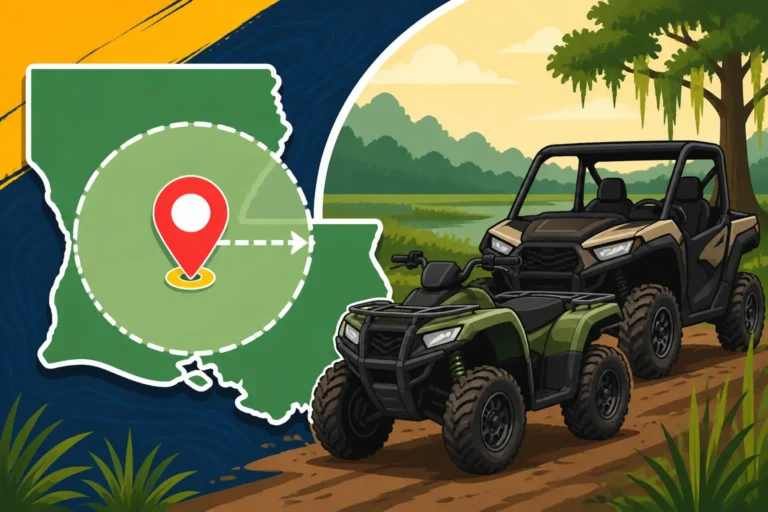
For example, the state law might permit an ATV to operate on the shoulder of a public road for agricultural purposes within a five-mile radius of a farm. This is a general exemption, but a local parish could still introduce additional requirements or even designate specific roads for UTV use that fall outside this narrow agricultural definition. Without checking those local rules, you might mistakenly assume the state-level agricultural exemption covers all your needs, only to find a parish ordinance that requires specific lighting or insurance that you hadn't considered. It’s like having a statewide speed limit, but then certain towns post lower limits on specific streets; the local rule takes precedence in that specific area.
How Parishes Gain Authority to Designate Roads
The state legislature intentionally provided avenues for local governments to regulate off-road vehicles. This power stems from the understanding that a blanket statewide rule simply wouldn't work for Louisiana's diverse geography and communities. What makes sense for a small farming community in rural north Louisiana might be completely impractical or unsafe for a bustling urban parish or a marshy coastal region. Therefore, parishes and municipalities are empowered to pass ordinances that specifically permit or restrict the operation of ATVs and UTVs on local public roads within their jurisdiction. [Louisiana Parishes Must Designate and Sign Roads] to allow UTVs, for instance, highlighting this local power.
This designation process typically involves the parish council or police jury holding public hearings, discussing community needs, and then voting on a specific ordinance. They consider factors like traffic volume, road type, safety concerns, and the local economy. Once an ordinance is passed, it becomes the local law of the land, overriding or adding to the state’s general provisions. This is why you can't just rely on what your buddy in another parish says about their rules; their parish council might have voted entirely differently.
The Critical Role of Posted Signage
Once a parish or municipality has designated certain roads for ATV or UTV use, there's a vital step that must follow: proper signage. Without clear, visible signage, it's virtually impossible for riders, residents, and even law enforcement to know which roads are legal. Imagine driving into a new town and seeing a sign that says "UTVs Permitted on Designated Streets." That sign is your cue to look for other signs that specifically identify those designated streets. This isn't just a suggestion; it’s often a requirement within the state statute and local ordinances themselves that [The Sign a Parish Has to Put Up First] must be installed.
These signs are more than just a courtesy; they are legally binding markers. A road that is designated by ordinance but not properly signed might still lead to a citation because, without the sign, the general state prohibition is still perceived as being in effect. Always be on the lookout for official signage that explicitly permits ATV or UTV use. If you don't see one, even if you think you're on a designated road, it's best to err on the side of caution. If you're using aftermarket parts from a company like SuperATV to make your machine more road-ready, having the correct signage to confirm where you can actually use those upgrades is paramount.
Where to Begin Your Search for Ordinances
Finding these local ordinances can sometimes feel like a treasure hunt, especially since not all parishes have equally modern or accessible online resources. However, knowing where to start looking will save you a lot of time and frustration. The key is to think locally and systematically, utilizing both digital and physical resources.
Parish Council Websites: Your First Stop
In today's digital age, the first place you should always check is the official website for the parish council or police jury. Most parishes maintain a website where they publish their local laws, ordinances, and meeting minutes. Look for sections labeled "Ordinances," "Code of Ordinances," "Public Records," or "Government." You might need to use their internal search function to specifically look for "ATV," "UTV," "off-road vehicle," or "recreational vehicle" regulations. Be prepared to scroll through a lot of legal text. Some parishes, especially more rural ones, might not have their full code digitized, or the search function might be less robust.
Even if you don't find the exact ordinance, the council's website often lists contact information for parish officials, such as the clerk of the council or a specific department that handles public works or transportation. These individuals can often point you in the right direction or tell you if such an ordinance even exists. It's much easier to do this from the comfort of your home than driving around to government buildings.
Clerk of Court Offices: Records and Archives
If the parish council website doesn't yield the results you need, or if you prefer a more direct, in-person approach, the Parish Clerk of Court's office is an invaluable resource. This office is the official custodian of all public records, including all ordinances passed by the parish council. They typically have physical copies of the entire Code of Ordinances for their parish, often indexed and available for public viewing. You might even find historical records there that show when a particular ordinance was passed, amended, or repealed.
While you might not be able to take the books home, you can usually request copies of specific sections for a small fee. This can be especially helpful if you need to show proof of a local ordinance to someone, like a state trooper who might be unfamiliar with a particular parish's unique rules. Think of the Clerk of Court as the definitive library for all local laws. When dealing with something as specific as [Louisiana Rules for Riding a Parish Road], having official documentation can make all the difference.
Reaching Out to Local Law Enforcement
Another direct, though sometimes less consistent, method is to simply ask local law enforcement. This means contacting the Parish Sheriff's Office or the Police Department in a specific municipality. While their primary job is enforcement, many officers are quite knowledgeable about the local laws they are tasked with upholding. They might be able to tell you if any roads are designated, what restrictions apply, or where you can find the relevant ordinances. However, remember that an officer's verbal statement isn't a substitute for an official document.
It's always a good idea to preface your call by stating you're trying to be a responsible rider and ensure you're following all local laws. Ask for clarification on specific roads or areas you plan to ride. If they tell you where to find the written ordinance, follow up and get it in writing. This approach can be hit-or-miss depending on who you talk to, but it's often worth a try, especially for a quick overview. Just be sure to verify any verbal information with a written record whenever possible.
Decoding the Jargon: What to Look For in an Ordinance
Once you get your hands on a local ordinance, the real work begins: understanding what it actually says. Legal language can be dense, and specific details can be buried. You’re not just looking for a simple "yes" or "no" to road riding; you're looking for the specific conditions, limitations, and requirements that come with that permission. Missing a single detail could still lead to a violation.
Designated Roadways and Specific Restrictions
The very first thing to pinpoint in any ordinance is which roads are designated for ATV or UTV use. Many ordinances won't simply say "all parish roads." Instead, they will list specific road names, road numbers, or define geographical areas where riding is permitted. For example, an ordinance might state, "ATVs and UTVs are permitted on all parish roads classified as 'gravel roads' within the unincorporated areas of the parish, excluding State Highways." It's crucial to know exactly where you can and cannot ride. Pay close attention to any exclusions, such as roads near schools, hospitals, or within densely populated subdivisions.
Furthermore, look for any specific restrictions related to these designated roadways. Are there speed limits for ATVs/UTVs that are different from regular vehicles? Are certain times of day restricted? For instance, some ordinances might permit daytime riding but ban all off-road vehicle use after sunset. Others might only allow access during specific seasons, such as during hunting season. These details are paramount, as riding on an undesignated road or outside the permitted hours can still lead to a ticket, regardless of your intent. Always consult the specific wording of the ordinance for your intended riding location.
Equipment Requirements Beyond State Minimums
State law sets a baseline for what kind of equipment your ATV or UTV needs, especially if you're engaging in any activity that might take you on a public road, even for a moment. However, local ordinances often go a step further. While your machine might already have basic headlights, taillights, and brakes, a parish ordinance could mandate additional features like turn signals, rearview mirrors, a horn, or even a brightly colored safety flag. These additional requirements are often driven by local safety concerns, especially if the designated roads are shared with a lot of other traffic. This is where companies like SuperATV come in handy, offering a wide range of accessories to help you meet these varied requirements.
For example, an ordinance might state that any UTV operating on a designated road must have "street-legal conversion kits that include DOT-approved windshields, wipers, and full LED lighting systems." Even if your machine is technically capable of road use, if it lacks one of these specific local requirements, you could still be in violation. It’s not enough to be road-ready; you need to be locally-ordinance-ready. Always make a checklist of required equipment from the ordinance and ensure your machine, perhaps with the help of quality aftermarket parts, meets every single point.
Age, Licensing, and Operational Hour Rules
Beyond the machine itself, local ordinances can also impose restrictions on who can operate an ATV or UTV on designated roads, and when. State law sets some age limits for ATV operation generally, but a parish might mandate a higher age for road use or require a valid driver's license for UTVs, even if the state law for off-road use doesn't explicitly require it for all situations. For example, [Louisiana Requires UTV Drivers to Be 21] for road use under state law, but a parish could impose further conditions on this.
Operational hours are another common area of local regulation. While some areas might allow riding from "dawn to dusk," others might have more specific windows, such as "7 AM to 9 PM," or "only during daylight hours as defined by the National Weather Service." There could also be noise restrictions, especially in areas closer to residential zones. Some ordinances might even specify that minors must be accompanied by an adult, or that a permit must be obtained from the parish annually. These human-factor elements are just as critical as the equipment and road designations, so scrutinize the ordinance for any rules about the rider, passengers, or time of day.
Common Challenges in Finding and Interpreting Ordinances
Even with the right approach, navigating local ordinances can present its own set of challenges. Louisiana's parish system is diverse, and so are its administrative practices. What works smoothly in one parish might be a bureaucratic nightmare in another. Understanding these potential roadblocks can help you prepare and persist in your search for clarity.
The Frustration of Outdated or Unindexed Information
One of the biggest hurdles riders face is finding ordinances that are either not online, poorly indexed, or outdated. Some smaller, more rural parishes might not have the resources to keep their entire Code of Ordinances digitized and easily searchable. You might find a snippet on one page, but the full context is missing. Worse, an online version might not be the most current. An ordinance could have been passed or amended just last month, but the website hasn't been updated yet, leaving you with an incomplete or incorrect picture. This can be incredibly frustrating when you're trying to do your due diligence.
In these situations, a trip to the Clerk of Court's office becomes even more essential. They are legally mandated to maintain current records. If you find conflicting information online, always defer to the physical records at the Clerk's office as the most authoritative source. It's a reminder that sometimes, the old-fashioned way is the most reliable, especially when you're trying to figure out things like [Louisiana Rules for Riding a Parish Road].
When Different Departments Give Different Answers
It's not uncommon to call different parish departments and receive conflicting information. One person in the Public Works department might tell you one thing, while someone in the Sheriff's Office or the Parish Attorney's Office might offer a slightly different interpretation. This usually isn't malicious; it's often due to different departments focusing on different aspects of the law or simply not having the most up-to-date information at their fingertips. It highlights the complexity of local governance and the challenge of a truly unified information system.
When this happens, it's crucial to ask for the written source of the information. "Can you tell me which specific ordinance or resolution you're referring to?" or "Where can I find that in writing?" This pushes them to cite an official document, which is what you ultimately need. Relying on verbal assurances, no matter how well-intentioned, can lead to problems down the road. Always seek out the text of the ordinance itself.
The Nuances of "Farm Use" and Local Interpretations
The state statutes often include exemptions for agricultural use, allowing ATVs and UTVs to operate on shoulders or to cross roads for farm-related activities. However, "farm use" itself can be open to interpretation, and local ordinances might refine or restrict this further. For example, while the state may allow a [Louisiana Farm Affidavit Requirements] for certain road use, a parish might have a specific definition of what constitutes a "farm" or "farm-related activity" that is stricter than what you assumed. Is hauling a deer stand to a hunting lease considered "farm use"? Probably not under most definitions, but some might try to argue it.
You might find an ordinance that says, "Agricultural exemption applies only to actively working farms of five acres or more," or "Farm use vehicles must display a slow-moving vehicle sign." These local clarifications are critical. Never assume the broad state-level farm exemption covers all your needs without checking the local interpretation. The penalties for misinterpreting these rules, as outlined in [Louisiana Penalties for Illegal Road Riding], can be substantial, so getting it right is crucial.
Navigating Parish-Specific Scenarios
Louisiana is a tapestry of parishes, each with its own character, population density, and approach to local governance. What's legal and common in one part of the state might be unheard of, or strictly prohibited, just a few miles away. Understanding these parish-specific scenarios helps to underscore why a uniform approach to ATV/UTV road use simply doesn't work.
The Urban Parish vs. The Rural Parish
The starkest difference you'll encounter is between urban parishes (like Orleans, East Baton Rouge, or Jefferson) and their much more rural counterparts. In a densely populated urban parish, the likelihood of finding designated roads for ATVs or UTVs is significantly lower, and the restrictions will be much tighter, if any access is permitted at all. [Orleans Parish Is Exempt From Louisiana's ATV Statute] entirely, showcasing how some urban areas have been deliberately excluded from general state allowances, let alone local designations. High traffic volume, pedestrian safety, and existing infrastructure simply don't lend themselves to shared use with off-road vehicles.
Conversely, in a rural parish where main industries might include farming, forestry, or hunting, you are much more likely to find ordinances that allow some form of ATV/UTV road access. These communities often rely on these machines for transportation around large tracts of land, and the roads may see less conventional vehicle traffic. Even here, however, don't assume; some rural parishes might still have concerns about noise, dust, or road damage, leading them to restrict access to specific, less-traveled roads. Always check the specific parish, as the rules reflect the local culture and needs.
Riding Near State or Federal Land Boundaries
When you're riding near the boundaries of state parks, national forests like Kisatchie, or wildlife management areas (WMAs), the rules can become even more complicated. While a parish might have an ordinance allowing UTVs on a particular parish road, that road might lead directly into a state or federal property with entirely different regulations. State and federal agencies have their own sets of rules regarding vehicle types, permits, and designated trails. You might legally ride a parish road up to the boundary, only to find you cannot proceed further on your machine.
It's vital to research both the local parish ordinance and the regulations for any adjacent state or federal land you plan to access. You could find yourself having to trailer your machine for the last leg of a journey, even if the parish road itself was legal. For example, while a parish might allow your machine equipped with SuperATV accessories on a gravel road, the WMA next door might have strict rules about tire size or weight that your UTV exceeds. Always check all applicable jurisdictions.
What Happens When No Ordinance Exists
So, what if you've searched diligently, contacted all the relevant offices, and found absolutely no local ordinance regarding ATV/UTV road use in a particular parish? This is a critical point: the absence of a local ordinance does not mean you have permission to ride on public roads. Quite the opposite. If no local ordinance explicitly permits ATV or UTV use on parish roads, then the general, more restrictive state statutes apply.
This means that if a parish hasn't passed an ordinance designating specific roads for your machine, you are generally still bound by the state laws that typically prohibit ATVs and UTVs from public roadways, except for very limited exemptions like agricultural shoulder riding or incidental crossings. You cannot assume that "no rule found" means "anything goes." In fact, it almost certainly means "stick to private property, or face the consequences under state law." This is why understanding [Louisiana Rules for Riding a Parish Road] is so essential; the default is prohibition unless a specific exception, local or state, is clearly documented.
Best Practices for Riding Legally and Safely
Navigating the labyrinth of Louisiana's ATV and UTV laws, especially at the local level, requires diligence and a proactive approach. It's not just about avoiding a ticket; it's about ensuring your safety and the safety of others, and being a responsible member of the off-road community. By following some best practices, you can dramatically improve your experience and reduce your risk.
Always Carry Proof of Your Due Diligence
Imagine this scenario: you're riding your UTV on a designated parish road, fully equipped with your SuperATV lighting kit and rearview mirrors, when a local sheriff's deputy pulls you over. They're new to the area, or simply unfamiliar with the nuances of local ordinances. If you can, respectfully, produce a printed copy of the specific parish ordinance that permits your activity on that exact road, along with your proof of insurance and [What a Louisiana State Trooper Can Ask to See] in terms of identification, you can often resolve the situation quickly and amicably.
Having a physical copy (or a readily accessible digital copy on your phone) of the ordinance is a game-changer. It shows you've done your homework, you're not just guessing, and you're making an effort to comply with the law. This can turn a potentially confrontational situation into an educational one for both parties. It reinforces your credibility as a responsible rider and can prevent a misunderstanding that might otherwise lead to a citation or impoundment.
Outfitting Your Machine for Road Use
Even if an ordinance permits road use, it almost certainly comes with equipment requirements. Beyond the basic safety gear you'd use for off-road riding, such as a helmet and eye protection, you'll need to ensure your machine is equipped for public road travel. This often means adding components like DOT-approved tires, turn signals, brake lights, a horn, mirrors, and sometimes even a windshield and wipers. Many aftermarket companies, including SuperATV, offer comprehensive street-legal kits designed to help convert your off-road machine to meet these varying regulations.
Before you even hit the road, carefully review the ordinance and ensure every single equipment requirement is met. Don't skimp on these upgrades; they're not just about avoiding a ticket. They're about making your machine visible, audible, and controllable in a public road environment where you'll be sharing space with much larger, faster vehicles. Think about visibility after dark, the ability to signal turns clearly, and ensuring you can see traffic behind you. These are crucial safety measures.
Advocating for ATV/UTV Access in Your Community
If you live in a parish where there are no designated roads for ATVs or UTVs, but you believe there's a need and public interest, consider becoming an advocate. Attend parish council or police jury meetings. Gather data on safe riding practices, economic benefits (e.g., tourism, local business support), and how other parishes have successfully implemented similar ordinances. Work with local riding clubs or organizations to present a unified, well-researched proposal. This is how communities often get new ordinances passed, creating opportunities for legal and responsible riding.
Remember, local officials are often responsive to the needs of their constituents, especially when presented with a clear, safe, and well-thought-out plan. It's a long process, but through community engagement and responsible advocacy, you can contribute to shaping the future of ATV and UTV access in your area, making it easier for everyone to enjoy the trails and roads responsibly. This kind of active participation also helps ensure that regulations like [Louisiana UTV Street Legal Rules by Parish] continue to evolve to meet the needs of riders.
Disclaimer
This article is for general informational purposes only and does not constitute professional advice. Laws, prices and regulations vary by location and change over time. Consult a qualified professional for guidance on your specific situation.